Download Free Sample
Kindly complete the form below to receive a free sample of this Report
Bathroom and Toilet Assist Device Market Research Report: Size, Share, Trend Analysis By End Use (Healthcare Establishments, Residential Homes, Long-Term Care Facilities), By Product Type (Grab Bars, Toilet Seat Lifts, Bathtub Assist Devices, Toilet Safety Rails, Patient Lifts), By Material (Metal, Plastic, Non-Slip Coating), By Mechanism (Electric, Manual, Hydraulic), By Design (Fixed, Portable, Adjustable) and By Regional (North America, Europe, South America, Asia Pacific, Middle East and Africa) - Growth Outlook & Industry Forecast 2025 To 2035
As per Market Research Future analysis, the Bathroom and Toilet Assist Device Market was estimated at 3.25 USD Billion in 2024. The Bathroom and Toilet Assist Device industry is projected to grow from 3.436 USD Billion in 2025 to 5.993 USD Billion by 2035, exhibiting a compound annual growth rate (CAGR) of 5.72% during the forecast period 2025 - 2035
The Bathroom and Toilet Assist Device Market is experiencing a transformative shift driven by demographic changes and technological advancements.
| 2024 Market Size | 3.25 (USD Billion) |
| 2035 Market Size | 5.993 (USD Billion) |
| CAGR (2025 - 2035) | 5.72% |
Invacare Corporation (US), Drive DeVilbiss Healthcare (US), Arjo (SE), Hollister Incorporated (US), Medline Industries, Inc. (US), Graham-Field Health Products, Inc. (US), K Care Healthcare Solutions (AU), Etac AB (SE), Seniors' Choice (US)
Our Impact
Enabled $4.3B Revenue Impact for Fortune 500 and Leading Multinationals
Partnering with 2000+ Global Organizations Each Year
30K+ Citations by Top-Tier Firms in the Industry
The Bathroom and Toilet Assist Device Market is currently experiencing a notable evolution, driven by an increasing awareness of accessibility and the growing aging population. As societies become more cognizant of the needs of individuals with mobility challenges, the demand for innovative assistive devices is on the rise. This market encompasses a variety of products designed to enhance safety and independence in bathroom settings, including grab bars, raised toilet seats, and shower chairs. Manufacturers are focusing on creating ergonomic designs that not only provide functionality but also blend seamlessly with modern bathroom aesthetics. Moreover, advancements in technology are influencing the Bathroom and Toilet Assist Device Market. Smart devices that integrate with home automation systems are becoming more prevalent, offering users enhanced control and convenience. The emphasis on user-friendly features and customizable options is likely to attract a broader consumer base, including caregivers and healthcare professionals. As the market continues to evolve, it appears poised for growth, reflecting a societal shift towards inclusivity and improved quality of life for all individuals, regardless of their physical capabilities.
The Bathroom and Toilet Assist Device Market is witnessing a heightened emphasis on products tailored for the aging demographic. As the global population ages, there is a growing recognition of the necessity for devices that facilitate independence and safety in bathroom environments. This trend suggests a shift towards more specialized solutions that cater to the unique needs of older adults.
The incorporation of smart technology into bathroom assist devices is becoming increasingly prevalent. Devices that connect to home automation systems offer enhanced functionality and convenience, allowing users to control features through mobile applications or voice commands. This trend indicates a move towards more sophisticated solutions that improve user experience.
There is a noticeable trend towards the development of aesthetically pleasing and customizable bathroom assist devices. Manufacturers are recognizing the importance of blending functionality with design, creating products that not only serve a practical purpose but also complement modern bathroom decor. This focus on aesthetics may attract a wider audience, including those who prioritize style alongside utility.
The Bathroom and Toilet Assist Device Market is experiencing growth due to the increasing incidence of disabilities among the population. According to recent statistics, approximately 15% of the world's population lives with some form of disability, which necessitates the use of assistive devices. This demographic shift is prompting a greater demand for products that enhance accessibility and safety in bathrooms. As the population ages, the prevalence of mobility impairments is likely to rise, further driving the need for innovative solutions. Manufacturers are responding by developing a range of products, from grab bars to specialized toilet seats, designed to cater to the unique needs of individuals with disabilities. This trend indicates a significant opportunity for growth within the Bathroom and Toilet Assist Device Market.
Government initiatives aimed at improving accessibility for individuals with disabilities are playing a crucial role in the Bathroom and Toilet Assist Device Market. Various countries have implemented policies that promote the use of assistive devices, often providing funding or subsidies to support their acquisition. For instance, programs that offer financial assistance for home modifications, including the installation of bathroom assistive devices, are becoming more prevalent. This support not only encourages consumers to invest in necessary equipment but also raises awareness about the importance of accessibility. As governments continue to prioritize inclusivity, the Bathroom and Toilet Assist Device Market is likely to benefit from increased funding and resources, fostering innovation and expanding product offerings.
Demographic shifts, particularly urbanization, are influencing the Bathroom and Toilet Assist Device Market. As more individuals move to urban areas, the demand for accessible and space-efficient bathroom solutions is increasing. Urban living often presents unique challenges, such as limited space and the need for multifunctional designs. This trend is prompting manufacturers to innovate and create compact assistive devices that can fit into smaller bathrooms without compromising functionality. Additionally, the aging population in urban areas is likely to drive the need for assistive devices that cater to older adults. As urbanization continues to shape living environments, the Bathroom and Toilet Assist Device Market is expected to adapt and grow, providing tailored solutions for diverse consumer needs.
The growing awareness of hygiene and safety standards is driving the Bathroom and Toilet Assist Device Market. Consumers are becoming more conscious of the importance of maintaining cleanliness and preventing accidents in the bathroom environment. This heightened awareness is leading to an increased demand for assistive devices that promote safety, such as non-slip mats, raised toilet seats, and grab bars. Additionally, the emphasis on hygiene has prompted manufacturers to develop products that are easy to clean and maintain, ensuring that they meet the evolving needs of consumers. As the focus on hygiene and safety continues to rise, the Bathroom and Toilet Assist Device Market is likely to expand, offering a wider range of products designed to enhance user experience.
Technological advancements are significantly influencing the Bathroom and Toilet Assist Device Market. The integration of smart technology into assistive devices is enhancing user experience and functionality. For example, devices equipped with sensors can monitor user movements and provide alerts in case of falls or emergencies. This innovation not only improves safety but also offers peace of mind to caregivers and family members. Furthermore, the market is witnessing the emergence of app-controlled devices that allow users to customize settings according to their preferences. As technology continues to evolve, the Bathroom and Toilet Assist Device Market is expected to see a surge in demand for high-tech solutions that cater to the needs of a diverse user base.
The Bathroom and Toilet Assist Device Market is significantly influenced by various end use sectors. Among them, healthcare establishments hold the largest market share, as they require a wide range of assistive devices to support the elderly and disabled populations. This segment encompasses hospitals, clinics, and rehabilitation centers where safety and hygiene are paramount. In contrast, residential homes, with their increasing focus on aging in place, are experiencing rapid growth, driven by demographic shifts and a rising preference for home-based care solutions. As the population ages, the demand for bathroom and toilet assist devices is projected to surge, boosting both healthcare establishments and residential home usage. The latter segment is particularly benefiting from technological advancements in assistive devices, making them more accessible and user-friendly. However, long-term care facilities also contribute to the market by providing specialized services, but they remain overshadowed by the compelling trends in residential care and healthcare settings.

Healthcare Establishments (Dominant) vs. Residential Homes (Emerging)
Healthcare establishments dominate the Bathroom and Toilet Assist Device Market due to stringent compliance requirements and the need for reliable assistive solutions. This segment includes various facilities like hospitals, rehabilitation centers, and outpatient clinics that prioritize patient safety and accessibility. In these environments, devices such as grab bars, raised toilet seats, and bidet seats are extensively utilized. Meanwhile, residential homes represent an emerging market, propelled by trends toward aging in place. Families are increasingly investing in assistive bathroom devices that enhance safety and comfort, promoting independence among elderly residents. Both segments are vital yet cater to different needs, with healthcare establishments emphasizing compliance and safety, while residential homes focus on user empowerment.

In the Bathroom and Toilet Assist Device Market, Grab Bars represent the largest segment, providing essential support for individuals with mobility issues. This segment accounts for a significant share of the market due to its widespread adoption in residential and commercial settings alike. Following closely is the Toilet Seat Lifts segment, gaining traction as an innovative solution to improve comfort and accessibility for individuals with limited mobility. The growth trends in this market are driven by an aging population and increasing prevalence of disabilities, which require supportive devices in bathrooms. Technological advancements and a greater focus on home care solutions also contribute to the rising demand for Bathroom and Toilet Assist Devices, especially the Toilet Seat Lifts that are becoming popular due to their user-friendly designs and functionality.
Grab Bars (Dominant) vs. Bathtub Assist Devices (Emerging)
Grab Bars are recognized as the dominant force in the Bathroom and Toilet Assist Device Market, known for their simplicity and effectiveness in preventing slips and falls. These devices are favored for their straightforward installation and wide range of designs, meeting various aesthetic and functional needs. On the other hand, Bathtub Assist Devices, though categorized as an emerging segment, are gaining attention for their innovative approaches to enhancing safety and convenience during bathing. These include features like adjustable heights and easy-to-grip handles, appealing to users seeking more secure bathing experiences. As the market evolves, both segments are likely to exhibit sustained demand, driven by heightened awareness of safety in bathroom environments.
In the Bathroom and Toilet Assist Device Market, the material segment is primarily dominated by metal, accounting for a significant share due to its durability and strength. Metal devices are widely favored for their robust construction, which provides users with reliability and longevity. Plastic materials are gaining traction as they offer lightweight, cost-effective, and versatile alternatives for various assistive devices, catering to a broader audience.

Material: Metal (Dominant) vs. Plastic (Emerging)
Metal as a dominant material in the Bathroom and Toilet Assist Device Market showcases several advantages, including corrosion resistance, ease of cleaning, and structural integrity. This makes metal devices ideal for long-term use and ensures safety in sometimes wet conditions. In contrast, plastic is emerging rapidly due to its lightweight nature and affordability, enabling manufacturers to create cost-effective solutions for users. Furthermore, the aesthetic appeal of modern plastic designs contributes to increased market demand, while innovations in plastic technology enhance durability and resistance, reinforcing its position in the evolving market.

In the Bathroom and Toilet Assist Device Market, the mechanism segment is primarily divided into Electric, Manual, and Hydraulic devices. The Electric mechanism holds the largest market share, dominating due to its efficiency, ease of use, and suitability for users with varying levels of mobility. Manual devices, while less dominant, are experiencing a surge in popularity, particularly among consumers looking for cost-effective and simple solutions, making it the fastest-growing segment in the market.
Electric (Dominant) vs. Manual (Emerging)
Electric bathroom and toilet assist devices are recognized for their advanced features, including automatic functionalities and user-friendly controls, which cater to a wide range of needs for individuals with disabilities or limited mobility. They are generally preferred for their reliability and technology integration, providing superior user experience. In contrast, manual devices, characterized by their straightforward mechanics and affordability, are increasingly favored by users seeking less complex solutions. This emergence indicates a shift towards value-oriented options for consumers, although they may lack the technological benefits that electric devices offer.
In the Bathroom and Toilet Assist Device Market, the 'Design' segment features three main categories: Fixed, Portable, and Adjustable designs. Fixed designs hold the largest market share, benefitting from their stability and reliability in providing assistance. Portable designs are gaining traction due to their convenience and flexibility, catering to a growing demographic requiring mobility solutions. Adjustable designs, although present, occupy a smaller segment of the market, appealing to specific consumer needs for customization. Growth trends indicate that the portable category is experiencing rapid expansion fueled by increasing adaptability in modern living spaces. The rise in awareness about the importance of bathroom accessibility, particularly among aging populations and individuals with disabilities, is driving consumer interest. Advancements in materials and technology are enhancing the usability of portable units, making them increasingly popular in both residential and commercial settings.

Fixed (Dominant) vs. Portable (Emerging)
The Fixed design segment remains dominant in the Bathroom and Toilet Assist Device Market, characterized by its robust construction and reliability. Fixed devices are often integrated into the bathroom infrastructure, offering a permanent solution that reassures users with physical limitations. On the other hand, the Portable design segment is emerging as a significant market player, appealing to a more mobile consumer base. Portable devices offer unique advantages, such as easy transportation and flexible use in various environments. As more consumers seek adaptable solutions that fit their lifestyles, the demand for portable designs is rising, establishing its position as a crucial segment in the evolving landscape of assist devices.
Get more detailed insights about Bathroom and Toilet Assist Device Market Request Free Sample
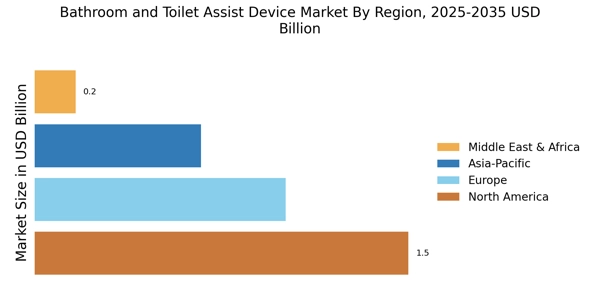
North America is the largest market for bathroom and toilet assist devices, holding approximately 45% of the global market share. The growth is driven by an aging population, increasing awareness of disability rights, and advancements in technology. Regulatory support from agencies like the FDA ensures safety and efficacy, further boosting market demand. The U.S. is the primary contributor, followed by Canada, which holds around 15% of the market share. The competitive landscape is dominated by key players such as Invacare Corporation, Drive DeVilbiss Healthcare, and Medline Industries, all based in the U.S. These companies are focusing on innovation and expanding their product lines to cater to diverse consumer needs. The presence of established healthcare systems and reimbursement policies also enhances market growth, making North America a hub for assistive technology development.
Europe is witnessing significant growth in the bathroom and toilet assist device market, accounting for approximately 30% of the global share. The region benefits from stringent regulations that ensure product safety and quality, driving consumer confidence. Countries like Germany and the UK are leading the market, with increasing investments in healthcare infrastructure and a growing elderly population. The European Union's focus on accessibility and inclusivity further propels market demand. Germany is the largest market in Europe, followed by the UK, which is experiencing a rise in demand for innovative assistive devices. Key players such as Arjo and Etac AB are actively expanding their presence in the region. The competitive landscape is characterized by a mix of local and international companies, all striving to meet the evolving needs of consumers. The emphasis on research and development is also notable, as companies aim to introduce advanced solutions for better user experience.
Asia-Pacific is emerging as a significant player in the bathroom and toilet assist device market, holding around 20% of the global share. The region's growth is driven by a rapidly aging population, increasing disposable incomes, and rising awareness of healthcare needs. Countries like Japan and Australia are at the forefront, with government initiatives promoting accessibility and support for the elderly. The market is expected to expand as urbanization increases and healthcare systems evolve. Japan is the largest market in the region, followed by Australia, which is witnessing a surge in demand for innovative assistive devices. The competitive landscape includes local manufacturers and international players, with companies like K Care Healthcare Solutions gaining traction. The focus on product innovation and customization to meet local needs is crucial for success in this diverse market, as companies strive to enhance user experience and accessibility.
The Middle East and Africa region is currently the smallest market for bathroom and toilet assist devices, holding about 5% of the global share. However, there is significant potential for growth driven by increasing healthcare investments and a rising awareness of disability rights. Countries like South Africa and the UAE are beginning to implement policies that support accessibility and assistive technologies, which could catalyze market expansion in the coming years. South Africa is the leading market in the region, with a growing number of local manufacturers entering the space. The competitive landscape is still developing, with opportunities for international players to establish a foothold. Challenges such as economic disparities and varying levels of healthcare infrastructure remain, but the increasing focus on improving quality of life for individuals with disabilities presents a promising outlook for the market.
The Bathroom and Toilet Assist Device Market is currently characterized by a dynamic competitive landscape, driven by an increasing demand for accessibility solutions among aging populations and individuals with disabilities. Key players such as Invacare Corporation (US), Drive DeVilbiss Healthcare (US), and Arjo (SE) are strategically positioned to leverage innovation and regional expansion to enhance their market presence. Invacare Corporation (US) focuses on product innovation, particularly in developing smart assistive devices that integrate digital health technologies. Meanwhile, Drive DeVilbiss Healthcare (US) emphasizes partnerships with healthcare providers to improve distribution channels, thereby enhancing accessibility to their products. Arjo (SE) is actively pursuing mergers and acquisitions to broaden its product portfolio and strengthen its foothold in emerging markets, collectively shaping a competitive environment that is increasingly focused on technological advancement and customer-centric solutions.The market structure appears moderately fragmented, with numerous players vying for market share. Key business tactics such as localizing manufacturing and optimizing supply chains are becoming increasingly prevalent among these companies. For instance, in August 2025, Drive DeVilbiss Healthcare (US) announced the establishment of a new manufacturing facility in Mexico, aimed at reducing production costs and improving supply chain efficiency. This move not only enhances their operational capabilities but also positions them to respond more swiftly to market demands, thereby reinforcing their competitive edge.In September Invacare Corporation (US) launched a new line of smart toilet assist devices that utilize AI technology to provide personalized user experiences. This strategic initiative underscores the company's commitment to innovation and reflects a broader trend within the industry towards integrating advanced technologies into assistive devices. By enhancing user engagement and satisfaction, Invacare aims to differentiate itself in a crowded market, potentially setting new standards for functionality and user-friendliness.Additionally, in July 2025, Arjo (SE) completed the acquisition of a leading Australian assistive technology firm, which is expected to significantly enhance its product offerings and market reach in the Asia-Pacific region. This acquisition not only diversifies Arjo's portfolio but also aligns with its strategy to penetrate high-growth markets, thereby positioning the company for sustained growth in the coming years. Such strategic moves indicate a trend towards consolidation within the market, as companies seek to bolster their competitive positions through expanded capabilities.As of October the competitive trends within the Bathroom and Toilet Assist Device Market are increasingly defined by digitalization, sustainability, and the integration of AI technologies. Strategic alliances are becoming more common, as companies recognize the value of collaboration in enhancing product offerings and market reach. The competitive differentiation is likely to evolve from traditional price-based competition towards a focus on innovation, technological advancements, and supply chain reliability. This shift suggests that companies that prioritize these aspects will be better positioned to thrive in an increasingly complex and demanding market environment.



The Bathroom and Toilet Assist device market is expected to witness significant growth in the coming years, driven by the rising geriatric population, increasing prevalence of chronic diseases, and growing awareness about accessibility and safety in bathrooms.
The market is witnessing the emergence of innovative technologies such as smart sensors, IoT-enabled devices, and voice-activated controls, offering enhanced convenience and safety for users. Additionally, government regulations and initiatives promoting accessibility are further fueling market growth.
Key players in the market are focusing on product development and strategic partnerships to expand their market presence and cater to the evolving needs of consumers.
The Bathroom and Toilet Assist Device Market is projected to grow at a 5.72% CAGR from 2025 to 2035, driven by aging populations, technological advancements, and increasing health awareness.
New opportunities lie in:
By 2035, the market is expected to achieve substantial growth, reflecting evolving consumer needs and technological innovations.
| MARKET SIZE 2024 | 3.25(USD Billion) |
| MARKET SIZE 2025 | 3.436(USD Billion) |
| MARKET SIZE 2035 | 5.993(USD Billion) |
| COMPOUND ANNUAL GROWTH RATE (CAGR) | 5.72% (2025 - 2035) |
| REPORT COVERAGE | Revenue Forecast, Competitive Landscape, Growth Factors, and Trends |
| BASE YEAR | 2024 |
| Market Forecast Period | 2025 - 2035 |
| Historical Data | 2019 - 2024 |
| Market Forecast Units | USD Billion |
| Key Companies Profiled | Invacare Corporation (US), Drive DeVilbiss Healthcare (US), Arjo (SE), Hollister Incorporated (US), Medline Industries, Inc. (US), Graham-Field Health Products, Inc. (US), K Care Healthcare Solutions (AU), Etac AB (SE), Seniors' Choice (US) |
| Segments Covered | End Use, Product Type, Material, Mechanism, Design, Regional |
| Key Market Opportunities | Integration of smart technology enhances user experience in the Bathroom and Toilet Assist Device Market. |
| Key Market Dynamics | Rising demand for innovative bathroom and toilet assist devices driven by aging populations and enhanced accessibility regulations. |
| Countries Covered | North America, Europe, APAC, South America, MEA |
The projected market valuation for the Bathroom and Toilet Assist Device Market in 2035 is approximately 5.993 USD Billion.
The market valuation for the Bathroom and Toilet Assist Device Market in 2024 was 3.25 USD Billion.
The expected CAGR for the Bathroom and Toilet Assist Device Market during the forecast period 2025 - 2035 is 5.72%.
The Grab Bars segment is projected to grow from 0.975 USD Billion in 2024 to 1.75 USD Billion by 2035.
Key players in the market include Invacare Corporation, Drive DeVilbiss Healthcare, and Arjo, among others.
The Residential Homes segment is projected to reach approximately 2.1 USD Billion by 2035.
The Toilet Seat Lifts segment is expected to grow from 0.65 USD Billion in 2024 to 1.2 USD Billion by 2035, indicating robust demand.
The Plastic material segment is expected to increase from 1.3 USD Billion in 2024 to 2.4 USD Billion by 2035.
The Fixed design type is projected to reach approximately 2.3 USD Billion by 2035.
The Manual mechanism type is anticipated to grow from 1.5 USD Billion in 2024 to 2.5 USD Billion by 2035.


Kindly complete the form below to receive a free sample of this Report

“This is really good guys. Excellent work on a tight deadline. I will continue to use you going forward and recommend you to others. Nice job”


“Thanks. It’s been a pleasure working with you, please use me as reference with any other Intel employees.”


“Thanks for sending the report it gives us a good global view of the Betaïne market.”


“Thank you, this will be very helpful for OQS.”


“We found the report very insightful! we found your research firm very helpful. I'm sending this email to secure our future business.”


“I am very pleased with how market segments have been defined in a relevant way for my purposes (such as "Portable Freezers & refrigerators" and "last-mile"). In general the report is well structured. Thanks very much for your efforts.”


“I have been reading the first document or the study, ,the Global HVAC and FP market report 2021 till 2026. Must say, good info! I have not gone in depth at all parts, but got a good indication of the data inside!”


“We got the report in time, we really thank you for your support in this process. I also thank to all of your team as they did a great job.”


“The Automotive 48V ECU Components Procurement Intelligence Study” was a complex project, but the Market Research Future (MRFR) team handled it with quality, agility, and customer-centricity. They delivered all requested data on time and within the agreed scope. The team, including Shubhendra Anand and Rahul Gotadki, was always readily available to clarify questions and swiftly implement necessary adjustments, driving the project to a successful conclusion within a very demanding timeframe.
I would also like to specifically commend Akshay Agarwal for his responsiveness and support at every stage—from our initial inquiry on May 6th through to final delivery on June 18th. His dedication made the entire process seamless.”



