×
Request Free Sample ×

Kindly complete the form below to receive a free sample of this Report

* Please use a valid business email

Leading companies partner with us for data-driven Insights

clients tt-cursor
Hero Background

Battery Management System Market

ID: MRFR/SEM/7105-CR
200 Pages
Chitranshi Jaiswal
October 2020

Battery Management System Market Research Report Information By Battery Type (Lithium-Ion Based Batteries, Advanced Lead-Acid Batteries, Nickel-Based Batteries and Flow Batteries), By Component (Hardware and Software), By Topology (Centralized, Modular and Distributed), By Application (Automotive, Military & Defense, Medical, Portable Device, Telecommunication, Renewable Energy Systems, Uninterrupted Power Supply and others), And By Region - Industry Forecast Till 2035

Share:
Download PDF ×

We do not share your information with anyone. However, we may send you emails based on your report interest from time to time. You may contact us at any time to opt-out.

Battery Management System Market Infographic
Purchase Options

Battery Management System Market Summary

As per MRFR analysis, the Battery Management System Market Size was estimated at 9592.2 USD Million in 2024. The Battery Management System industry is projected to grow from 11445.44 USD Million in 2025 to 66953.55 USD Million by 2035, exhibiting a compound annual growth rate (CAGR) of 19.32 during the forecast period 2025 - 2035.

Key Market Trends & Highlights

The Battery Management System Market is poised for substantial growth driven by technological advancements and increasing demand across various sectors.

  • The integration of smart technologies is transforming battery management systems, enhancing their efficiency and functionality.
  • Safety and reliability remain paramount, as manufacturers prioritize these aspects in their product offerings.
  • Sustainability considerations are influencing market dynamics, with a growing emphasis on environmentally friendly solutions.
  • The rising demand for electric vehicles and regulatory support for energy efficiency are key drivers propelling market expansion.

Market Size & Forecast

2024 Market Size 9592.2 (USD Million)
2035 Market Size 66953.55 (USD Million)
CAGR (2025 - 2035) 19.32%

Major Players

Texas Instruments (US), NXP Semiconductors (NL), Infineon Technologies (DE), Analog Devices (US), STMicroelectronics (CH), Renesas Electronics (JP), Maxim Integrated (US), LG Chem (KR), Samsung SDI (KR)

Battery Management System Market Trends

The Battery Management System Market is currently experiencing a transformative phase, driven by the increasing demand for efficient energy storage solutions across various sectors. This market encompasses a range of technologies designed to monitor and manage battery performance, ensuring optimal operation and longevity. As electric vehicles gain traction and renewable energy sources become more prevalent, the necessity for advanced battery management systems has become more pronounced. Stakeholders are focusing on enhancing safety, reliability, and efficiency, which are critical for the widespread adoption of battery technologies. Moreover, the integration of smart technologies into battery management systems is reshaping the landscape. Innovations such as artificial intelligence and machine learning are being incorporated to improve predictive maintenance and operational efficiency. This trend suggests a shift towards more intelligent systems that can adapt to varying conditions and user needs. As the Battery Management System Market evolves, it appears poised to play a pivotal role in the broader energy ecosystem, facilitating the transition to sustainable energy solutions and supporting the growth of electric mobility.

Integration of Smart Technologies

The incorporation of smart technologies into battery management systems is becoming increasingly prevalent. This trend indicates a movement towards systems that utilize artificial intelligence and machine learning to enhance performance and predictive maintenance. Such advancements may lead to improved efficiency and adaptability in various applications.

Focus on Safety and Reliability

There is a growing emphasis on safety and reliability within the Battery Management System Market. As the use of batteries expands, particularly in electric vehicles and renewable energy storage, ensuring the safe operation of these systems is paramount. This focus may drive innovations aimed at minimizing risks and enhancing user confidence.

Sustainability and Environmental Considerations

Sustainability is emerging as a key driver in the Battery Management System Market. As environmental concerns gain prominence, there is a noticeable shift towards developing systems that support eco-friendly practices. This trend suggests that future innovations will likely prioritize energy efficiency and reduced environmental impact.

Battery Management System Market Drivers

Growing Renewable Energy Sector

The expansion of the renewable energy sector is significantly influencing the Global Battery Management System Market Industry. As countries invest in solar and wind energy, the need for efficient energy storage solutions becomes paramount. Battery management systems are essential for optimizing the performance of energy storage systems, ensuring reliability and longevity. The increasing deployment of renewable energy sources necessitates advanced battery management solutions to manage energy flow and storage effectively. This trend is expected to drive market growth, as the global energy landscape shifts towards sustainability and resilience, with the market projected to reach 79.7 USD Billion by 2035.

Rising Demand for Electric Vehicles

The increasing adoption of electric vehicles (EVs) is a primary driver for the Global Battery Management System Market Industry. As governments worldwide implement stringent emission regulations and promote sustainable transportation, the demand for EVs is expected to surge. In 2024, the market is projected to reach 9.59 USD Billion, reflecting the growing need for efficient battery management solutions. Battery management systems play a crucial role in optimizing battery performance, enhancing safety, and extending lifespan, which are essential for EV manufacturers. This trend is likely to continue, with the market anticipated to expand significantly as EV sales increase.

Increasing Focus on Energy Efficiency

The global emphasis on energy efficiency is a critical driver for the Global Battery Management System Market Industry. As industries and consumers seek to reduce energy consumption and operational costs, battery management systems are becoming integral to energy management strategies. These systems enable better monitoring and control of battery usage, leading to enhanced efficiency and reduced waste. Governments and organizations are increasingly adopting policies that promote energy efficiency, further fueling the demand for advanced battery management solutions. This growing focus on sustainability and efficiency is likely to contribute to the market's expansion in the coming years.

Emerging Applications in Consumer Electronics

The proliferation of consumer electronics is a notable factor driving the Global Battery Management System Market Industry. With the rise of portable devices, such as smartphones, tablets, and wearables, the demand for efficient battery management solutions is escalating. These devices require advanced battery management systems to ensure optimal performance, safety, and longevity. As consumer preferences shift towards longer-lasting and faster-charging devices, manufacturers are increasingly investing in innovative battery management technologies. This trend is expected to sustain market growth, as the consumer electronics sector continues to evolve and expand.

Technological Advancements in Battery Technologies

Technological innovations in battery technologies, such as lithium-ion and solid-state batteries, are propelling the Global Battery Management System Market Industry forward. These advancements enhance energy density, reduce charging times, and improve overall battery efficiency. As manufacturers strive to develop more efficient and longer-lasting batteries, the demand for sophisticated battery management systems becomes increasingly critical. The integration of smart technologies, such as artificial intelligence and machine learning, into battery management systems further optimizes performance and safety. This trend indicates a robust growth trajectory for the market, with projections suggesting a compound annual growth rate of 21.22% from 2025 to 2035.
Market Segment Insights

By Application: Electric Vehicle (Largest) vs. Energy Storage System (Fastest-Growing)

In the Battery Management System Market, the application segment is primarily dominated by Electric Vehicles (EVs), which command the largest share due to the increasing adoption of sustainable transportation solutions. The rapid shift towards EVs is fueled by government incentives, a growing consumer preference for eco-friendly alternatives, and advancements in battery technology. Following EVs, Energy Storage Systems (ESS) have emerged as a critical application, gaining traction due to the escalating demand for renewable energy integration and grid stability solutions.

Electric Vehicle (Dominant) vs. Energy Storage System (Emerging)

Electric Vehicles represent the dominant application within the Battery Management System Market, driven by the need for efficient energy management in transportation solutions. The surge in EV adoption is underpinned by continuous improvements in battery efficiency, lifespan, and cost reduction. Conversely, Energy Storage Systems are emerging as a significant application, spurred by the necessity for energy storage solutions that support renewable energy utilization. This segment has seen rapid advancements in technology and decreased costs, making it an attractive option for residential and commercial developers looking to enhance energy efficiency and sustainability. As both applications evolve, they are likely to complement each other, paving the way for smarter energy ecosystems.

By End Use: Automotive (Largest) vs. Industrial (Fastest-Growing)

The Battery Management System Market showcases a distinct distribution of market share across various end-use applications. The automotive sector stands as the largest segment, benefiting from the ongoing transition towards electric vehicles and stricter emissions regulations. In contrast, the industrial segment is emerging rapidly, driven by the adoption of advanced energy storage solutions and automation technologies across manufacturing facilities.

Automotive (Dominant) vs. Industrial (Emerging)

The automotive sector in the Battery Management System Market is characterized by its strong demand for sophisticated battery management solutions to enhance the performance and safety of electric vehicles. As automakers increasingly invest in electric and hybrid technologies, the automotive segment maintains a dominant position with innovative battery management features that support longer battery life and efficient energy use. On the other hand, the industrial segment is experiencing fast growth, fueled by the rising need for efficient energy management in sectors such as manufacturing and warehousing. This segment's emerging status is bolstered by advancements in battery technologies and the growing push towards renewable energy integration, leading to a broader adoption of battery management solutions within industrial applications.

By Battery Type: Lithium-ion (Largest) vs. Solid State (Fastest-Growing)

The Battery Management System market exhibits a diverse range of battery types, with Lithium-ion batteries commanding the largest share due to their widespread adoption in various applications, including consumer electronics, electric vehicles, and renewable energy systems. Following close behind are lead-acid and nickel-metal hydride batteries, which continue to have significant usage in automotive and backup power systems, while solid-state and flow batteries are gradually capturing attention as innovative alternatives. Growth trends indicate that while Lithium-ion remains dominant, the solid-state battery segment is emerging rapidly as the technology matures. The increasing demand for energy-efficient solutions, coupled with advancements in battery technology, is driving this transition. Factors such as the rising electrification of transport and the shift towards renewable energy storage are likely to bolster the development and adoption of these advanced battery technologies.

Lithium-ion (Dominant) vs. Solid State (Emerging)

Lithium-ion batteries are the cornerstone of the Battery Management System market, characterized by their high energy density, long cycle life, and relatively low self-discharge rates. This makes them particularly suitable for portable electronics and electric vehicle applications. On the other hand, solid-state batteries, which employ solid electrolytes instead of liquid ones, are gaining traction due to their enhanced safety features and potential for higher energy densities. Although still in the early stages of commercialization, solid-state batteries are considered an emerging alternative that could revolutionize the industry by providing better performance metrics and longevity, ultimately enhancing energy storage solutions.

By Technology: Active Balancing (Largest) vs. Passive Balancing (Fastest-Growing)

In the Battery Management System Market, the technology segment is primarily dominated by Active Balancing which holds the largest share. Passive Balancing, however, is gaining momentum as manufacturers increasingly look for cost-effective solutions. This indicates a significant shift in preferences as companies strive towards innovative battery technologies and efficiency enhancements. Active Balancing optimally distributes energy across cells, thereby improving battery life and performance, which explains its leading position in the market.

Technology: Active Balancing (Dominant) vs. Passive Balancing (Emerging)

Active Balancing technology is currently the dominant player in the Battery Management System market due to its ability to enhance battery longevity and efficiency. It efficiently allocates energy, thus reducing waste and increasing overall performance. In contrast, Passive Balancing is emerging quickly among budget-conscious applications, focusing on simpler design and ease of implementation. The rise of electric vehicles and renewable energy storage systems drives interest in both technologies, with Active Balancing being preferred for high-performance needs, while Passive Balancing caters to entry-level market segments.

By Component: Battery Packs (Largest) vs. Battery Management Software (Fastest-Growing)

The Battery Management System Market demonstrates a diverse distribution among its component categories, with Battery Packs commanding the largest share due to their critical role in overall battery efficiency and performance. Following closely are Battery Modules, which serve as the building blocks of battery systems. Battery Cells, while essential, often fall behind in share due to the less frequent replacement cycle compared to packs and modules. Battery Management Software and Battery Chargers are also notable segments, with the former gaining considerable attention for maximizing battery performance through intelligent analytics.

Battery Packs (Dominant) vs. Battery Management Software (Emerging)

Battery Packs are the dominant component in the Battery Management System Market, reflecting their essential role in ensuring the operational efficiency and reliability of energy storage systems. These packs are crucial for applications ranging from electric vehicles to renewable energy storage solutions. In contrast, Battery Management Software is rapidly emerging as a key player thanks to increasing demand for smart, data-driven management solutions. This software allows users to monitor battery health, optimize performance, and prolong battery life, making it a critical area of innovation and growth. The integration of software solutions with traditional battery components is expected to drive significant advancements in battery technology overall.

Get more detailed insights about Battery Management System Market

Regional Insights

North America : Market Leader in Innovation

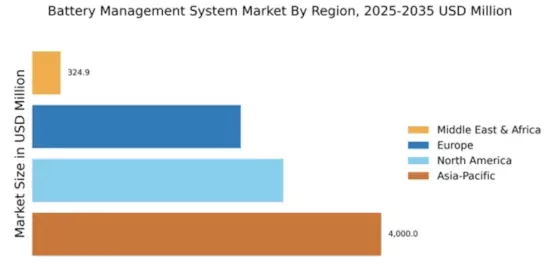
North America is poised to maintain its leadership in the Battery Management System (BMS) market, holding a significant share of 4796.1M in 2025. The region's growth is driven by increasing demand for electric vehicles (EVs) and renewable energy storage solutions. Regulatory support, such as tax incentives for EV adoption, further catalyzes market expansion. The focus on sustainability and energy efficiency is also propelling investments in advanced BMS technologies. The competitive landscape in North America is robust, featuring key players like Texas Instruments, Analog Devices, and Maxim Integrated. These companies are at the forefront of innovation, developing cutting-edge solutions that enhance battery performance and safety. The presence of major automotive manufacturers and tech firms in the region fosters a collaborative environment, driving advancements in BMS technology. As the market evolves, partnerships and mergers are expected to shape the future landscape.

Europe : Emerging Hub for Sustainability

Europe is emerging as a significant player in the Battery Management System market, with a market size of 2875.0M in 2025. The region's growth is largely driven by stringent environmental regulations and a strong push towards electric mobility. Initiatives like the European Green Deal aim to reduce carbon emissions, creating a favorable environment for BMS adoption. The increasing focus on renewable energy sources also contributes to the rising demand for efficient battery management solutions. Leading countries in Europe, such as Germany, France, and the Netherlands, are at the forefront of BMS innovation. The competitive landscape includes major players like Infineon Technologies and STMicroelectronics, who are investing heavily in R&D to enhance battery efficiency and safety. The collaboration between automotive manufacturers and technology firms is fostering a dynamic ecosystem, ensuring that Europe remains a key player in The Battery Management System. "The European Union aims to be climate-neutral by 2050, which will significantly boost the demand for battery technologies."

Asia-Pacific : Rapidly Growing Market Potential

Asia-Pacific is witnessing rapid growth in the Battery Management System market, projected to reach 1580.0M by 2025. The region's expansion is fueled by the increasing adoption of electric vehicles and the rising need for energy storage solutions. Government initiatives promoting clean energy and electric mobility are significant catalysts for market growth. Additionally, the growing consumer electronics sector is driving demand for advanced battery management technologies. Countries like China, Japan, and South Korea are leading the charge in BMS development. The competitive landscape is characterized by the presence of key players such as LG Chem and Samsung SDI, who are investing in innovative solutions to enhance battery performance. The region's focus on technological advancements and strategic partnerships is expected to further accelerate growth in the BMS market, positioning Asia-Pacific as a vital player in the global landscape.

Middle East and Africa : Emerging Market Opportunities

The Middle East and Africa region is gradually emerging in the Battery Management System market, with a projected size of 341.1M by 2025. The growth is driven by increasing investments in renewable energy projects and the rising adoption of electric vehicles. Governments in the region are beginning to recognize the importance of sustainable energy solutions, which is fostering a conducive environment for BMS technologies. The demand for efficient energy storage systems is also on the rise, further propelling market growth. Leading countries in this region, such as South Africa and the UAE, are starting to invest in battery management technologies. The competitive landscape is still developing, with opportunities for both local and international players to enter the market. As the region continues to invest in infrastructure and technology, the BMS market is expected to grow, driven by the need for reliable energy solutions. The potential for growth in this sector is significant as the region seeks to diversify its energy sources.

Key Players and Competitive Insights

The Battery Management System Market is currently characterized by a dynamic competitive landscape, driven by the increasing demand for electric vehicles (EVs) and renewable energy storage solutions. Key players such as Texas Instruments (US), NXP Semiconductors (NL), and Infineon Technologies (DE) are strategically positioning themselves through innovation and partnerships. Texas Instruments (US) focuses on enhancing its product portfolio with advanced battery management solutions, while NXP Semiconductors (NL) emphasizes the integration of security features in its systems. Infineon Technologies (DE) is actively pursuing regional expansion, particularly in Asia, to capitalize on the growing EV market. Collectively, these strategies contribute to a competitive environment that is increasingly focused on technological advancement and market responsiveness.

In terms of business tactics, companies are localizing manufacturing and optimizing supply chains to enhance efficiency and reduce costs. The market structure appears moderately fragmented, with several key players exerting influence over various segments. This fragmentation allows for niche players to emerge, yet the collective strength of major companies like LG Chem (KR) and Samsung SDI (KR) ensures that competition remains robust and innovation-driven.

In November 2025, LG Chem (KR) announced a strategic partnership with a leading EV manufacturer to develop next-generation battery management systems. This collaboration is poised to enhance LG Chem's capabilities in providing tailored solutions that meet the specific needs of the EV sector. The strategic importance of this partnership lies in its potential to accelerate product development cycles and improve market penetration in a rapidly evolving industry.

In October 2025, Analog Devices (US) unveiled a new line of battery management ICs designed for high-performance applications. This launch reflects the company's commitment to innovation and positions it favorably against competitors. The introduction of these ICs is likely to attract attention from manufacturers seeking to enhance the efficiency and reliability of their battery systems, thereby reinforcing Analog Devices' market presence.

In September 2025, Renesas Electronics (JP) expanded its product offerings by acquiring a smaller firm specializing in battery management technology. This acquisition is indicative of Renesas' strategy to bolster its technological capabilities and diversify its product range. By integrating the acquired technology, Renesas aims to enhance its competitive edge and respond more effectively to the growing demand for sophisticated battery management solutions.

As of December 2025, current trends in the Battery Management System Market include a pronounced focus on digitalization, sustainability, and the integration of artificial intelligence (AI) into battery management solutions. Strategic alliances are increasingly shaping the competitive landscape, enabling companies to leverage complementary strengths and accelerate innovation. Looking ahead, competitive differentiation is likely to evolve from traditional price-based competition to a focus on technological innovation, supply chain reliability, and sustainability initiatives. This shift underscores the importance of adaptability and forward-thinking strategies in maintaining a competitive advantage.

Key Companies in the Battery Management System Market market include

Industry Developments

    • In June 2022, Xing Mobility will launch its immersion-cooled battery system at a conference in Germany. The new battery management system is developed to work under rigorous circumstances such as extreme temperatures and poor road conditions.
    • In June 2022, maritime energy solutions company EST - Floattech will be developing a battery management system for the hybrid ship built by the shipping company, Hagland.
    • In May 2022, Endurance Technologies acquired a majority stake in Maxwell Energy Systems, which comes with the key component of its battery management system unit.
.webp

Future Outlook

Battery Management System Market Future Outlook

The Battery Management System Market is projected to grow at a 19.32% CAGR from 2024 to 2035, driven by increasing demand for electric vehicles and renewable energy storage solutions.

New opportunities lie in:

  • Development of advanced algorithms for predictive maintenance in battery systems.
  • Integration of BMS with IoT for real-time monitoring and analytics.
  • Expansion into emerging markets with tailored battery solutions for local industries.

By 2035, the Battery Management System Market is expected to be robust, driven by innovation and strategic expansions.

Market Segmentation

Battery Management System Market End Use Outlook

  • Automotive
  • Industrial
  • Residential
  • Commercial
  • Aerospace

Battery Management System Market Component Outlook

  • Battery Cells
  • Battery Modules
  • Battery Packs
  • Battery Management Software
  • Battery Chargers

Battery Management System Market Technology Outlook

  • Active Balancing
  • Passive Balancing
  • Cell Monitoring
  • State of Charge Estimation
  • Thermal Management

Battery Management System Market Application Outlook

  • Electric Vehicle
  • Energy Storage System
  • Consumer Electronics
  • Telecommunications
  • Medical Devices

Battery Management System Market Battery Type Outlook

  • Lithium-ion
  • Lead-acid
  • Nickel-metal Hydride
  • Solid State
  • Flow Battery

Report Scope

MARKET SIZE 20249592.2(USD Million)
MARKET SIZE 202511445.44(USD Million)
MARKET SIZE 203566953.55(USD Million)
COMPOUND ANNUAL GROWTH RATE (CAGR)19.32% (2024 - 2035)
REPORT COVERAGERevenue Forecast, Competitive Landscape, Growth Factors, and Trends
BASE YEAR2024
Market Forecast Period2025 - 2035
Historical Data2019 - 2024
Market Forecast UnitsUSD Million
Key Companies ProfiledTexas Instruments (US), NXP Semiconductors (NL), Infineon Technologies (DE), Analog Devices (US), STMicroelectronics (CH), Renesas Electronics (JP), Maxim Integrated (US), LG Chem (KR), Samsung SDI (KR)
Segments CoveredApplication, End Use, Battery Type, Technology, Component
Key Market OpportunitiesIntegration of advanced artificial intelligence in Battery Management System Market enhances efficiency and predictive maintenance.
Key Market DynamicsRising demand for electric vehicles drives innovation and competition in the Battery Management System market.
Countries CoveredNorth America, Europe, APAC, South America, MEA

Market Highlights

Author
Chitranshi Jaiswal
Research Analyst Level I

In her 3 years of experience in the market research field, she has handled critical cross-domain projects. She has an in-depth knowledge of market estimation & analysis, problem-solving, primary as well as secondary research, and team management.She holds an engineering degree and is an MBA professional from a well-known university, capable of evaluating the market and competitive conditions. An exceptional strategist with excellent communication skills and a passion for delivering cutting-edge & practical insights for the market. Proficient in multi-tasking, and can successfully deal with competing demands, while maintaining complete confidentiality. Generated business through active client and project development, networking, and high-quality responses. Her knowledge and skills have helped in making solid business decisions, securing funding from investors, and avoiding business failures.

Leave a Comment

FAQs

How much is the Battery Management System market?

The global Battery Management System market size was valued at USD 9592.20 billion in 2024.

What is the growth rate of the Battery Management System market?

The global market is projected to grow at a CAGR of 19.32% during the forecast period, 2025 to 2035.

Which region held the largest market share in the Battery Management System market?

North America had the largest share in the global Battery Management System market

Who are the key players in the Battery Management System market?

Leclanche, Nuvation, Eberspächer, Texas Instruments Inc, Toshiba Corporation, Robert Bosch GmbH, Panasonic Corporation, Midtronics Inc. (US), ST Microelectronics, Deutz AG,

Which Battery Type led the Battery Management System market?

The lithium-ion battery category dominated the market in 2021

Which Topology led the Battery Management System market?

The Modular topology segment is lead the market in 2021

What is the function of BMS?

cell voltage measurement and control.

Which Application led the Battery Management System market?

The automotive segment is dominated the market in 2021.

Download Free Sample

Kindly complete the form below to receive a free sample of this Report

Compare Licence

×
Features License Type
Single User Multiuser License Enterprise User
Price $4,950 $5,950 $7,250
Maximum User Access Limit 1 User Upto 10 Users Unrestricted Access Throughout the Organization
Free Customization
Direct Access to Analyst
Deliverable Format
Platform Access
Discount on Next Purchase 10% 15% 15%
Printable Versions