Beauty Devices Market Summary
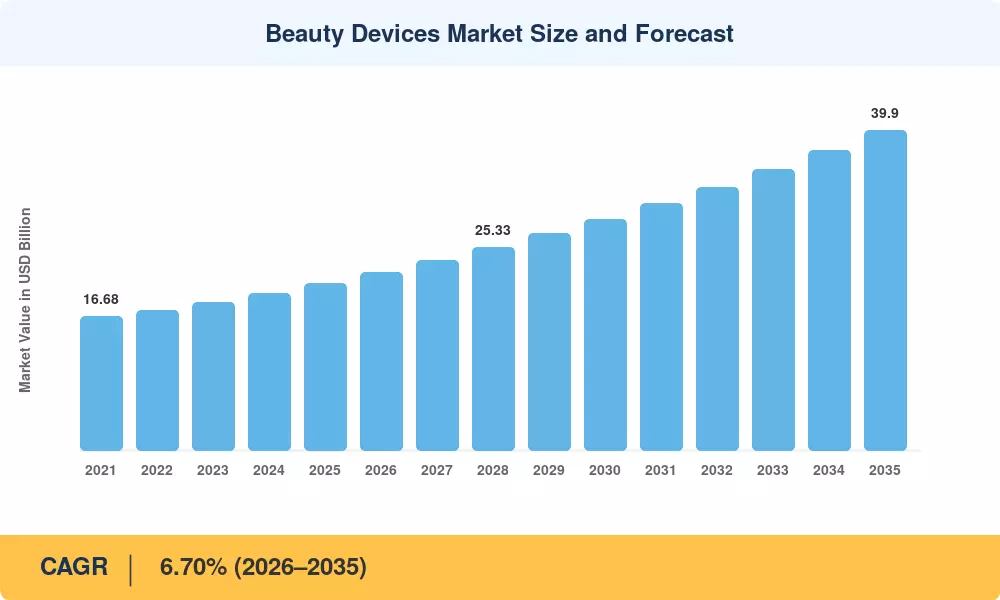
The global Beauty Devices Market was valued at USD 20.85 Billion in 2025 and is projected to grow from USD 22.25 Billion in 2026 to USD 39.90 Billion by 2035, registering a CAGR of 6.70% during the forecast period (2026–2035). Rising consumer demand for salon-grade results outside professional settings has been a central catalyst for this expansion, alongside growing disposable incomes in emerging economies. Government-backed standards for consumer electronics safety, including updated EU Low Voltage Directive requirements and FDA 510(k) clearances for certain light-based devices, have also built consumer confidence and widened addressable demand [1][2].
A significant technology shift is reshaping the Beauty Devices Market. Manual tools such as traditional rollers and basic brushes are steadily giving way to electrically powered, sensor-equipped devices that offer customizable heat, frequency, and intensity settings. Global investment in smart personal care hardware surpassed USD 3.4 Billion in combined R&D spending during 2024, reflecting how seriously major consumer electronics and cosmetics firms are treating this convergence. App-connected styling tools and AI-driven skin analysis devices represent the new frontier.
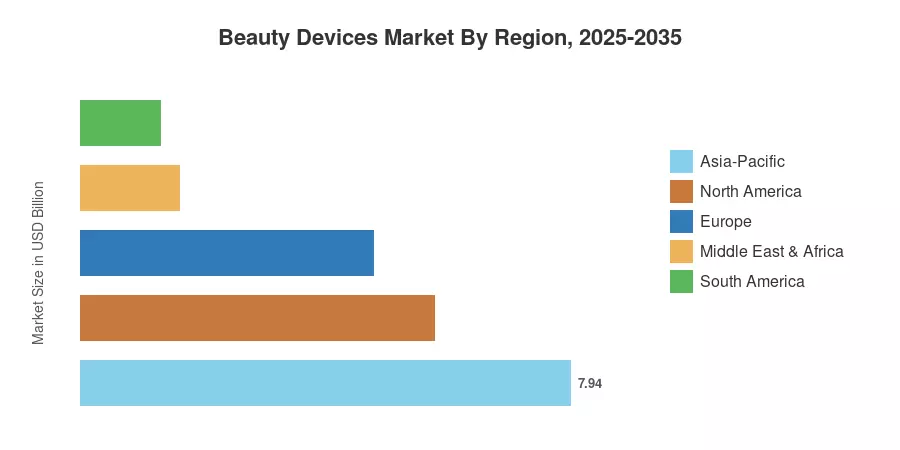
From a regional perspective, Asia-Pacific commands the largest share of the Beauty Devices Market at approximately 38.1% of global revenue, driven by high beauty consciousness across China, Japan, and South Korea. The Middle East & Africa region is the fastest-growing, projected to post a 7.70% CAGR through 2035, as urbanization and retail modernization accelerate demand. North America remains the second-largest region with roughly a 27.5% share, supported by strong direct-to-consumer e-commerce infrastructure. The next decade is set to reward players that can bridge professional performance with intuitive home-use design.
Key Report Takeaways
• By Product Type
- Hair tools held approximately 62.4% of the Beauty Devices Market share in 2025, reflecting the dominance of dryers, straighteners, and curling devices in everyday consumer routines.
- Facial tools are forecast to grow at a CAGR of 8.14% during 2026–2035, driven by rising interest in cleansing brushes, microcurrent devices, and facial steamers.
• By Price Tier
- The mass price tier accounted for roughly 65.2% of the Beauty Devices Market in 2025, underscoring the importance of accessible price points.
- The premium/luxury tier is expected to expand at 8.59% CAGR through 2035 as consumers trade up for advanced features and brand prestige.
• By Distribution Channel
- Offline retail stores represented around 42.3% of the Beauty Devices Market in 2025.
- Online retail channels are advancing at an 8.39% CAGR, fueled by influencer-driven discovery and subscription-based device models.
• By Region
- Asia-Pacific contributed 38.1% of global revenue in 2025.
- The Middle East & Africa region is projected to register the highest CAGR of 7.70% through 2035, with Saudi Arabia and the UAE leading adoption.
Beauty Devices Market Size and Forecast (2021–2035)
Market Research Future's sizing methodology triangulates top-down revenue estimates from public filings of leading manufacturers, bottom-up demand modeling across distribution channels, and primary interviews with industry executives and procurement specialists. Historical values reflect actual trade data and company disclosures, while the forecast applies a calibrated compound growth rate validated against macroeconomic and demographic inputs.





















.webp?v=1787579593)
