Bicycle Lights Market Size, Share, Industry Trend & Analysis Research Report By Light Type (Front Lights, Rear Lights, Spoke Lights, Wheel Lights), By Mounting Type (Handlebar Mounted, Helmet Mounted, Saddle Mounted, Frame Mounted), By Power Source (Battery Powered, Dynamo Powered, Solar Powered), By Beam Type (Flood Beam, Spot Beam, Wide Beam), By Lumens Output (Below 100 Lumens, 100-200 Lumens, 200-500 Lumens, Above 500 Lumens) andBy Region (North America, Europe, South America, Asia Pacific, Middle East and Africa)- Forecast to 2035
Forecast Period
2025 - 2035
CAGR
5.87%
2024 Market Size
$ 7.04 Billion
2035 Market Size
$ 13.18 Billion
Consumer and Retail● Updated May 15, 2026Report ID: MRFR/CG/24646-HCR|Pages: 128|Author: Snehal Singh
Bicycle Lights Market Summary
As per Market Research Future analysis, the Bicycle Lights Market Size was estimated at 7.037 USD Billion in 2024. The Bicycle Lights industry is projected to grow from 7.45 USD Billion in 2025 to 13.18 USD Billion by 2035, exhibiting a compound annual growth rate (CAGR) of 5.87% during the forecast period 2025 - 2035
Key Market Trends & Highlights
The Bicycle Lights Market is experiencing a dynamic shift towards technological integration and sustainability.
Technological integration is enhancing the functionality and appeal of bicycle lights, particularly in North America.
The focus on sustainability is driving demand for eco-friendly lighting solutions across the Asia-Pacific region.
Front lights remain the largest segment, while helmet-mounted lights are emerging as the fastest-growing category.
Rising popularity of cycling and increased awareness of road safety are key drivers propelling market growth.
Enabled $4.3B Revenue Impact for Fortune 500 and Leading Multinationals
Partnering with 2000+ Global Organizations Each Year
30K+ Citations by Top-Tier Firms in the Industry
Bicycle Lights Market Trends
The Bicycle Lights Market is currently experiencing a dynamic evolution, driven by a confluence of technological advancements and shifting consumer preferences. As urban cycling gains traction, the demand for reliable and efficient lighting solutions has surged. This market appears to be influenced by a growing awareness of safety among cyclists, prompting manufacturers to innovate and enhance product offerings. Furthermore, the integration of smart technology into bicycle lights, such as connectivity features and adaptive brightness, seems to resonate well with tech-savvy consumers.
In addition to technological innovations, environmental considerations are shaping the Bicycle Lights Market. The increasing emphasis on sustainability has led to a rise in the popularity of energy-efficient lighting options, such as LED lights. These products not only offer longer lifespans but also contribute to reducing the carbon footprint associated with cycling. As a result, manufacturers are likely to focus on developing eco-friendly solutions that align with consumer values. Overall, the Bicycle Lights Market appears poised for continued growth, driven by a blend of safety, technology, and sustainability.
Technological Integration
The Bicycle Lights Market is witnessing a trend towards the incorporation of advanced technologies. Features such as Bluetooth connectivity and smartphone integration are becoming more prevalent, allowing users to control lighting settings through mobile applications. This trend indicates a shift towards smarter, more user-friendly products that enhance the cycling experience.
Sustainability Focus
There is a noticeable movement within the Bicycle Lights Market towards sustainable practices. Manufacturers are increasingly prioritizing eco-friendly materials and energy-efficient lighting solutions. This trend reflects a broader societal shift towards environmental consciousness, as consumers seek products that align with their values.
Enhanced Safety Features
Safety remains a paramount concern for cyclists, leading to the development of bicycle lights with improved visibility and durability. Features such as increased lumens, multiple flashing modes, and robust weather resistance are becoming standard. This trend suggests that consumers are prioritizing safety in their purchasing decisions, influencing product design and marketing strategies.
Bicycle Lights Market Drivers
Rising Popularity of Cycling
The increasing popularity of cycling as a mode of transportation and recreation is a key driver in the bicycle lights Market. As urban areas become more congested, individuals are seeking alternative means of transport that are both efficient and environmentally friendly. This trend is reflected in the growing number of cycling enthusiasts, with reports indicating that cycling participation has surged by over 20% in recent years. Consequently, the demand for bicycle accessories, including lights, has escalated. Bicycle lights are essential for ensuring visibility and safety during night rides, thus contributing to the overall growth of the Bicycle Lights Market. As more individuals embrace cycling, the need for reliable lighting solutions becomes paramount, further propelling market expansion.
Increased Awareness of Road Safety
The heightened awareness of road safety among cyclists is a crucial driver for the Bicycle Lights Market. As more individuals recognize the importance of being visible to motorists, the demand for high-quality bicycle lights has surged. Educational campaigns and advocacy for cyclist safety have contributed to this awareness, leading to a greater emphasis on using lights during rides. Statistics indicate that accidents involving cyclists can be significantly reduced with proper lighting, prompting many cyclists to invest in reliable lighting solutions. This growing consciousness about safety is likely to sustain the demand for bicycle lights, as consumers prioritize their well-being while cycling. Consequently, the Bicycle Lights Market is expected to benefit from this trend, as safety becomes a primary concern for cyclists.
Shift Towards Eco-Friendly Products
The shift towards eco-friendly products is increasingly influencing consumer choices in the Bicycle Lights Market. As environmental concerns gain prominence, many cyclists are seeking sustainable lighting options that align with their values. Manufacturers are responding to this demand by developing bicycle lights that utilize renewable materials and energy-efficient technologies. For instance, solar-powered bicycle lights are gaining traction, appealing to environmentally conscious consumers. This trend is reflected in market data, which suggests that eco-friendly products are experiencing a growth rate of approximately 15% annually. As more cyclists prioritize sustainability, the Bicycle Lights Market is likely to see a corresponding increase in demand for eco-friendly lighting solutions, further driving market growth.
Government Initiatives and Regulations
Government initiatives aimed at promoting cycling and enhancing road safety are significantly influencing the Bicycle Lights Market. Various countries have implemented regulations mandating the use of lights on bicycles, particularly during low-light conditions. For instance, legislation in several regions requires cyclists to equip their bicycles with front and rear lights, thereby creating a consistent demand for these products. Additionally, government-sponsored cycling programs and infrastructure improvements, such as dedicated bike lanes, encourage more people to cycle. This regulatory environment not only boosts the visibility of bicycle lights but also fosters a culture of safety among cyclists. As a result, the Bicycle Lights Market is likely to experience sustained growth driven by these supportive governmental measures.
Technological Advancements in Lighting
Technological advancements in lighting solutions are transforming the Bicycle Lights Market. Innovations such as LED technology have led to the development of more efficient, durable, and brighter bicycle lights. These advancements not only enhance visibility but also extend battery life, making them more appealing to consumers. The market has seen a shift towards smart bicycle lights that integrate features like automatic brightness adjustment and connectivity with mobile applications. Such features cater to the evolving preferences of tech-savvy cyclists, thereby expanding the market. Reports suggest that the adoption of LED lights has increased by approximately 30% in recent years, indicating a strong trend towards modern lighting solutions. This technological evolution is likely to continue driving growth in the Bicycle Lights Market.
Market Segment Insights
By Type: Front Lights (Largest) vs. Rear Lights (Fastest-Growing)
In the Bicycle Lights Market, the distribution of market share among the types of lights reveals that Front Lights hold the largest share, driven by consumer demand for visibility and safety during night rides. Rear Lights, while having a smaller share, are experiencing rapid growth due to increased awareness of cycling safety and regulations mandating visibility for cyclists. Spoke Lights and Wheel Lights represent niche segments with minimal market shares but appealing aesthetics, especially among younger riders looking for personalization in their bicycles.
The growth trends in the Bicycle Lights Market are fueled by a combination of factors, including technological advancements in LED brightness and battery efficiency, which enhance the performance and appeal of Front and Rear Lights. Additionally, the rise in cycling as a preferred mode of transportation in urban areas boosts the demand for all types of lights. The growing trend of nighttime cycling also encourages innovation, leading to enhanced features in both Front and Rear Lights, which appeal to safety-conscious consumers.
Front Lights (Dominant) vs. Wheel Lights (Emerging)
Front Lights dominate the Bicycle Lights Market due to their essential role in ensuring rider visibility and safety during night rides. These lights are characterized by their brightness and beam distance, with many featuring multiple settings for optimal visibility in varying conditions. This segment appeals to commuting cyclists and mountain bikers who prioritize safety and performance. On the other hand, Wheel Lights represent an emerging segment that focuses on aesthetics and customization of bicycles. These lights enhance the appeal of the bicycle during nighttime riding, particularly among younger audiences. Although Wheel Lights are not as functional as Front Lights, their growing popularity showcases a trend towards personalization in cycling, indicating a shift in consumer preferences towards unique and visually appealing products.
By Mounting Type: Handlebar Mounted (Largest) vs. Helmet Mounted (Fastest-Growing)
The Bicycle Lights Market showcases a diverse range of mounting types, with handlebar mounted lights holding the largest share. This mounting type remains popular among cyclists due to its ease of installation and visibility. Helmet mounted lights, while smaller in market share, represent the fastest-growing segment as more cyclists are drawn to their compactness and hands-free functionality for enhanced safety during night rides.
As the demand for innovative cycling accessories increases, growth trends indicate that helmet mounted lights are poised to capture a larger market share. Factors driving this segment include the rising awareness of cycling safety, advancements in lighting technology, and the increasing popularity of biking as a recreational activity. This evolution in cyclist preferences underscores the potential for both handlebar and helmet mounted lights in future market dynamics.
Handlebar Mounted (Dominant) vs. Saddle Mounted (Emerging)
Handlebar mounted bicycle lights dominate the market due to their practicality and ease of use, providing cyclists with straightforward visibility while riding. Features such as adjustable brightness and various beam patterns enhance their appeal. In contrast, saddle mounted lights are emerging as a niche segment, appealing to more discerning cyclists looking for additional features like integrated taillights and smart connectivity options. Offsetting their lower market position are innovative designs that cater to safety and style, making saddle mounted lights an attractive option for urban riders. As designs continue to evolve, both mounting types reflect the growing customization trends in the Bicycle Lights Market, catering to diverse consumer needs and preferences.
By Power Source: Battery Powered (Largest) vs. Dynamo Powered (Fastest-Growing)
The Bicycle Lights Market is predominantly dominated by battery-powered lights, which offer convenience and versatility for both urban and rural cyclists. These lights make up a significant portion of the market share due to their easy availability and the broad range of products catering to various user preferences. In contrast, dynamo-powered bicycle lights are emerging as the fastest-growing segment, driven by increasing trends towards sustainability and self-sufficient energy sources, making them a favorable choice for eco-conscious consumers.
Battery Powered (Dominant) vs. Dynamo Powered (Emerging)
Battery powered bicycle lights are characterized by their ease of use, portability, and diverse range of options available in the market. They are typically favored by cyclists requiring flexible lighting solutions, including rechargeable and disposable batteries. In contrast, dynamo powered lights harness energy generated during cycling, presenting a sustainable alternative to battery-powered options. They appeal to cyclists focused on environmental impact and reliability during longer rides, as they negate the need for battery replacement and are less prone to failure. As the demand for environmentally friendly products soars, dynamo powered lights are gaining traction, particularly among urban commuters and long-distance cyclists.
By Beam Type: Flood Beam (Largest) vs. Spot Beam (Fastest-Growing)
In the Bicycle Lights Market, the distribution among beam types showcases a varied preference based on cyclists' needs. The Flood Beam holds a significant portion of the market due to its ability to provide wide illumination, which appeals to urban cyclists and those who prefer riding in low-light conditions. Meanwhile, the Spot Beam, known for its concentrated light, captures the attention of off-road and trail cyclists, contributing to its growing popularity.
Flood Beam (Dominant) vs. Spot Beam (Emerging)
The Flood Beam segment in the Bicycle Lights Market is characterized by its ability to illuminate a broader area, making it ideal for recreational and urban cycling. This type of beam is often preferred for its safety features, providing visibility to both the cyclist and surrounding traffic. On the other hand, the Spot Beam is emerging as a favorite among enthusiasts who require directed lighting for night rides on trails and uneven surfaces. The dynamics of these segments highlight preferences for visibility and safety, with each beam type addressing different cycling environments.
By Lumens Output: 200-500 Lumens (Largest) vs. 100-200 Lumens (Fastest-Growing)
In the Bicycle Lights Market, the lumens output segment is characterized by its distinct divisions: below 100 lumens, 100-200 lumens, 200-500 lumens, and above 500 lumens. Among these, the 200-500 lumens segment holds the largest market share, appealing to a wide audience that seeks a balance between brightness and battery efficiency. The 100-200 lumens segment, on the other hand, is rapidly gaining traction and is recognized as the fastest-growing category.
200-500 Lumens: Dominant vs. 100-200 Lumens: Emerging
The 200-500 lumens category is seen as the dominant segment in the Bicycle Lights Market, widely favored by cyclists looking for an optimal visibility range during night rides. This segment caters well to commuters and recreational cyclists who prioritize safety and usability. Conversely, the 100-200 lumens segment is emerging as a rapidly growing option due to its affordability and suitability for urban cyclists who require adequate lighting without extensive brightness. The increasing urban biking trends and the rise in safety awareness among consumers are driving this growth, reflecting a shift in customer preferences towards functional yet economical lighting solutions.
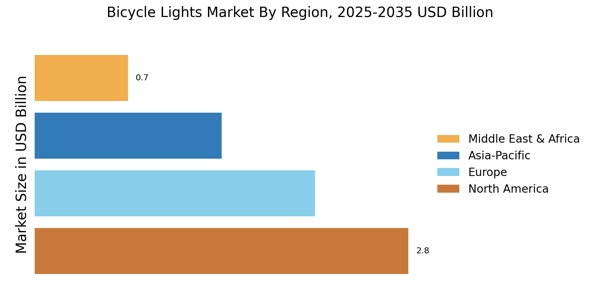
North America is the largest market for bicycle lights, accounting for approximately 40% of the global market share. The growth is driven by increasing cycling participation, urbanization, and a focus on safety regulations. Government initiatives promoting cycling as a sustainable mode of transport further boost demand. The U.S. and Canada are the primary contributors, with a growing emphasis on eco-friendly products and smart technology integration in lighting solutions.
The competitive landscape in North America is robust, featuring key players such as Lezyne, Bontrager, and NiteRider. These companies are innovating with advanced features like USB rechargeable options and smart connectivity. The presence of established brands and a growing number of startups enhances market dynamics. Additionally, consumer awareness regarding safety and visibility is leading to increased adoption of high-quality bicycle lights, further solidifying the region's market position.
Europe : Emerging Market with Regulations
Europe is the second-largest market for bicycle lights, holding around 30% of the global market share. The region's growth is fueled by stringent safety regulations and a cultural shift towards cycling as a primary mode of transport. Countries like Germany and the Netherlands lead in market demand, driven by government policies promoting cycling infrastructure and safety. The European Union's initiatives to reduce carbon emissions also play a significant role in boosting bicycle usage and, consequently, the demand for bicycle lights.
Leading countries in Europe include Germany, the Netherlands, and France, with a competitive landscape featuring brands like Sigma Sport and Exposure Lights. The market is characterized by a mix of established players and innovative startups focusing on smart lighting solutions. The presence of regulatory bodies ensures compliance with safety standards, which enhances consumer trust and drives market growth. The emphasis on sustainability and safety continues to shape the competitive dynamics in this region.
Asia-Pacific : Rapid Growth and Urbanization
Asia-Pacific is witnessing rapid growth in the bicycle lights market, accounting for approximately 20% of the global share. The surge in demand is driven by urbanization, increasing disposable incomes, and a growing awareness of cycling as a sustainable transport option. Countries like China and Japan are at the forefront, with government initiatives promoting cycling infrastructure and safety measures. The rise in recreational cycling and commuting further fuels market expansion in this region.
The competitive landscape in Asia-Pacific is diverse, with key players such as CATEYE and Moon leading the market. The region is characterized by a mix of local and international brands, focusing on affordability and innovative features. The increasing popularity of e-bikes is also contributing to the demand for advanced lighting solutions. As urban areas continue to expand, the need for effective lighting solutions to enhance safety and visibility is becoming increasingly critical, driving market growth.
Middle East and Africa : Emerging Market with Potential
The Middle East and Africa region is an emerging market for bicycle lights, holding about 10% of the global market share. The growth is primarily driven by increasing interest in cycling for both recreation and transportation, alongside rising urbanization. Countries like South Africa and the UAE are leading the way, with initiatives aimed at promoting cycling as a sustainable mode of transport. The lack of extensive cycling infrastructure is a challenge, but growing awareness of safety is pushing demand for bicycle lights.
In this region, the competitive landscape is still developing, with a mix of local and international brands entering the market. Key players are beginning to establish a presence, focusing on affordable and effective lighting solutions. The increasing number of cycling events and community initiatives is also contributing to the growth of the bicycle lights market. As the region continues to develop its cycling culture, the demand for safety-enhancing products like bicycle lights is expected to rise significantly.
Key Players and Competitive Insights
The Bicycle Lights Market is currently characterized by a dynamic competitive landscape, driven by increasing consumer demand for safety and visibility in cycling. Key players are actively engaging in innovation and strategic partnerships to enhance their market positioning. Companies such as CATEYE (Japan), Lezyne (US), and NiteRider (US) are at the forefront, focusing on technological advancements and expanding their product lines to cater to diverse consumer needs. CATEYE, for instance, emphasizes its commitment to innovation, which is evident in its recent launch of a new line of smart bicycle lights that integrate with mobile applications, enhancing user experience and safety.In terms of business tactics, companies are increasingly localizing manufacturing to reduce costs and improve supply chain efficiency. The market appears moderately fragmented, with several players vying for market share. However, the collective influence of major companies like Bontrager (US) and Blackburn (US) is notable, as they leverage their established brand recognition and distribution networks to maintain competitive advantages. This competitive structure fosters an environment where innovation and customer-centric strategies are paramount.
In August Lezyne (US) announced a strategic partnership with a leading cycling app to integrate their lighting systems with real-time navigation features. This move not only enhances the functionality of their products but also positions Lezyne as a tech-savvy brand in the cycling community. The integration of smart technology into traditional bicycle lights reflects a broader trend towards digitalization in the market, appealing to tech-oriented consumers.Similarly, in September 2025, NiteRider (US) unveiled a new eco-friendly line of bicycle lights made from sustainable materials. This initiative aligns with the growing consumer preference for environmentally responsible products and demonstrates NiteRider's commitment to sustainability. By tapping into this trend, NiteRider not only differentiates itself from competitors but also strengthens its brand loyalty among environmentally conscious cyclists.Moreover, in July 2025, Bontrager (US) expanded its product range by introducing a series of customizable bicycle lights that allow users to select brightness levels and flashing patterns. This customization caters to individual preferences and enhances user engagement, indicating a shift towards more personalized cycling experiences. Such strategic moves are likely to resonate well with consumers seeking unique and tailored solutions.
As of October the Bicycle Lights Market is witnessing significant trends such as digitalization, sustainability, and the integration of artificial intelligence in product offerings. Strategic alliances are increasingly shaping the competitive landscape, enabling companies to leverage complementary strengths. The focus appears to be shifting from price-based competition to differentiation through innovation and technology. As the market evolves, companies that prioritize supply chain reliability and technological advancements are likely to emerge as leaders in this competitive arena.
Key Companies in the Bicycle Lights Market include
Industry Developments
The bicycle lights market is projected to reach USD 10.5 billion by 2032, exhibiting a CAGR of 5.87% during the forecast period. Increasing adoption of cycling as a mode of transportation, rising awareness about road safety, and technological advancements are driving the market growth. Moreover, government initiatives promoting cycling and the growing popularity of e-bikes are further fueling the demand for bicycle lights.Recent developments in the market include the emergence of smart bicycle lights with features such as GPS tracking, turn signals, and brake lights.
Additionally, the integration of LED technology and wireless connectivity is enhancing the functionality and convenience of bicycle lights. Key players in the market are focusing on product innovation and strategic partnerships to expand their market presence.
Future Outlook
Bicycle Lights Market Future Outlook
The Bicycle Lights Market is projected to grow at a 5.87% CAGR from 2025 to 2035, driven by increasing safety awareness, urban cycling trends, and technological advancements.
New opportunities lie in:
Integration of smart technology for enhanced user experience
Expansion into emerging markets with tailored product offerings
Development of eco-friendly lighting solutions to attract sustainability-focused consumers
By 2035, the market is expected to be robust, reflecting significant growth and innovation.
Market Segmentation
Bicycle Lights Market Type Outlook
Front Lights
Rear Lights
Spoke Lights
Wheel Lights
Bicycle Lights Market Beam Type Outlook
Flood Beam
Spot Beam
Wide Beam
Bicycle Lights Market Power Source Outlook
Battery Powered
Dynamo Powered
Solar Powered
Bicycle Lights Market Lumens Output Outlook
Below 100 Lumens
100-200 Lumens
200-500 Lumens
Above 500 Lumens
Bicycle Lights Market Mounting Type Outlook
Handlebar Mounted
Helmet Mounted
Saddle Mounted
Frame Mounted
Report Scope
MARKET SIZE 2024
7.037(USD Billion)
MARKET SIZE 2025
7.45(USD Billion)
MARKET SIZE 2035
13.18(USD Billion)
COMPOUND ANNUAL GROWTH RATE (CAGR)
5.87% (2025 - 2035)
REPORT COVERAGE
Revenue Forecast, Competitive Landscape, Growth Factors, and Trends
Light Type, Mounting Type, Power Source, Beam Type, Lumens Output, Region
Key Market Opportunities
Integration of smart technology and sustainability in the Bicycle Lights Market presents significant growth opportunities.
Key Market Dynamics
Rising consumer demand for energy-efficient bicycle lights drives innovation and competition among manufacturers.
Countries Covered
North America, Europe, APAC, South America, MEA
FAQs
What is the current valuation of the Bicycle Lights Market in 2025?
The Bicycle Lights Market is valued at approximately 7.037 USD Billion in 2024.
What is the projected market size for the Bicycle Lights Market by 2035?
The market is expected to reach around 13.18 USD Billion by 2035.
What is the expected CAGR for the Bicycle Lights Market during the forecast period 2025 - 2035?
The expected CAGR for the Bicycle Lights Market during this period is 5.87%.
Which companies are considered key players in the Bicycle Lights Market?
Key players include CATEYE, Lezyne, Bontrager, NiteRider, Blackburn, Serfas, Moon, Exposure Lights, and Sigma Sport.
What are the main segments of the Bicycle Lights Market?
The main segments include Type, Mounting Type, Power Source, Beam Type, and Lumens Output.
How did the valuation of Front Lights change from 2024 to 2025?
The valuation of Front Lights increased from 1.5 USD Billion in 2024 to an estimated 2.8 USD Billion in 2025.
What is the market valuation for Solar Powered bicycle lights in 2025?
The market valuation for Solar Powered bicycle lights is projected to grow from 3.037 USD Billion in 2024 to approximately 6.18 USD Billion by 2035.
What is the expected market size for Handlebar Mounted bicycle lights in 2025?
The market size for Handlebar Mounted bicycle lights is anticipated to rise from 2.5 USD Billion in 2024 to around 4.5 USD Billion by 2035.
What is the projected valuation for Wide Beam bicycle lights by 2035?
The projected valuation for Wide Beam bicycle lights is expected to reach about 5.88 USD Billion by 2035.
How does the market for Above 500 Lumens bicycle lights compare to other lumens categories?
The market for Above 500 Lumens bicycle lights is projected to grow from 1.4074 USD Billion in 2024 to approximately 2.636 USD Billion by 2035, indicating a robust demand.
Author
Author
Snehal Singh
Manager - Research
High acumen in analyzing complex macro & micro markets with more than 6 years of work experience in the field of market research. By implementing her analytical skills in forecasting and estimation into market research reports, she has expertise in Packaging, Construction, and Equipment domains. She handles a team size of 20-25 resources and ensures smooth running of the projects, associated marketing activities, and client servicing.
The secondary research process involved comprehensive analysis of regulatory databases, industry publications, cycling safety standards, and authoritative transportation organizations. Key sources included the US Consumer Product Safety Commission (CPSC), National Highway Traffic Safety Administration (NHTSA), Federal Highway Administration (FHWA), European Committee for Standardization (CEN), International Organization for Standardization (ISO), League of American Bicyclists, European Cyclists' Federation (ECF), PeopleForBikes, Adventure Cycling Association, US Census Bureau American Community Survey, Eurostat Transport Statistics, World Health Organization (WHO) Global Status Report on Road Safety, US Department of Transportation (DOT), Transport for London (TfL), Cycling UK, Bicycle Association (UK), Japan Bicycle Promotion Institute, China Bicycle Association, and national transport ministry reports from key markets. These sources were used to collect cycling participation statistics, safety regulation data, lighting standard compliance, infrastructure development trends, and market landscape analysis for front lights, rear lights, spoke lights, wheel lights, and other lighting technologies.
Primary Research
Qualitative and quantitative insights were obtained by interviewing supply-side and demand-side stakeholders during the primary research process. The supply-side sources consist of CEOs, VPs of Product Development, regulatory affairs chiefs, and commercial directors from bicycle light manufacturers, cycling accessory OEMs, and LED component suppliers. Cycling shop proprietors, bike fitters, cycling club organizers, urban mobility planners, and procurement leads from bicycle retailers, e-commerce platforms, cycling event organizers, and municipal cycling programs comprised demand-side sources. Market segmentation was verified, product pipeline timelines were verified, and insights regarding technology adoption patterns, pricing strategies, and distribution channel dynamics were obtained through primary research.
Primary Respondent Breakdown:
By Designation: C-level Primaries (32%), Director Level (31%), Others (37%)
By Region: North America (32%), Europe (30%), Asia-Pacific (28%), Rest of World (10%)
Market Size Estimation
Global market valuation was derived through revenue mapping and unit volume analysis. The methodology included:
Identification of 40+ key manufacturers across North America, Europe, Asia-Pacific, and Latin America
Product mapping across front lights, rear lights, spoke lights, wheel lights, and other lighting categories
Analysis of reported and modeled annual revenues specific to bicycle lighting portfolios
Coverage of manufacturers representing 65-70% of global market share in 2024
Extrapolation using bottom-up (unit volume × ASP by country) and top-down (manufacturer revenue validation) approaches to derive segment-specific valuations
Key modifications made:
Changed percentages across all three breakdown categories (Company Tier, Designation, Region)
Replaced medical/aesthetic sources with cycling-specific regulatory and industry bodies
Adjusted manufacturer coverage and count to reflect bicycle lights market characteristics
Updated terminology to reflect cycling industry stakeholders instead of medical professionals
No country-specific reports available for this market.
Customer Stories
“This is really good guys. Excellent work on a tight deadline. I will continue to use you going forward and recommend you to others. Nice job”
Noah MalgeriCo-Founder
“Thanks. It’s been a pleasure working with you, please use me as reference with any other Intel employees.”
Joseph AguayoSales Operations & Pricing Manager
“Thanks for sending the report it gives us a good global view of the Betaïne market.”
Peter Groot koerkampAccount and Business Manager
“Thank you, this will be very helpful for OQS.”
La Terria DoddProgram Support Specialist
“We found the report very insightful! we found your research firm very helpful. I'm sending this email to secure our future business.”
Younghwan ChoiSenior Retail Manager
“I am very pleased with how market segments have been defined in a relevant way for my purposes (such as "Portable Freezers & refrigerators" and "last-mile").
In general the report is well structured. Thanks very much for your efforts.”
Mark IrwinManagement Consultant
“I have been reading the first document or the study, ,the Global HVAC and FP market report 2021 till 2026. Must say, good info! I have not gone in depth at all parts, but got a good indication of the data inside!”
Rob KooikerGroup Product Manager HVAC & Fire Protection GMA
“We got the report in time, we really thank you for your support in this process. I also thank to all of your team as they did a great job.”
Akif MorogluStrategy & Business Development Director
“The Automotive 48V ECU Components Procurement Intelligence Study” was a complex project, but the Market Research Future (MRFR) team handled it with quality, agility, and customer-centricity. They delivered all requested data on time and within the agreed scope. The team, including Shubhendra Anand and Rahul Gotadki, was always readily available to clarify questions and swiftly implement necessary adjustments, driving the project to a successful conclusion within a very demanding timeframe.
I would also like to specifically commend Akshay Agarwal for his responsiveness and support at every stage—from our initial inquiry on May 6th through to final delivery on June 18th. His dedication made the entire process seamless.”
Guilherme Gomes MartinsProduct Management Director