Surgical Lights Market (2026 - 2035)

Surgical Lights Market Research Report: Size, Share, Trend Analysis By Technology (Light Emitting Diode, Halogen Lights), By Applications (Surgical Suites, Endoscopy Procedures, Dental Procedures, Others) and By End-User (Hospital Operating Rooms, Ambulatory Surgical Centers, Procedure Rooms) And By Region (North America, Europe, Asia-Pacific, And Rest Of The World) - Growth Outlook & Industry Forecast 2025 To 2035
ID: MRFR/MED/4347-CR
174 Pages
Rahul Gotadki, Kinjoll Dey
Last Updated: June 26, 2026
Surgical Lights Market
Market Size
Forecast Period2026-2035
CAGR (2026-2035)5.90%
2025 Market SizeUSD 2.03 Billion
2035 Market SizeUSD 3.60 Billion
Key Players
Stryker Corporation
STERIS plc
Getinge AB
Drรคgerwerk AG
TRUMPF Medical
Merivaara Group
Opportunities
  • AI-Adaptive Lighting and Smart OR Integration
  • Emerging Market Hospital Construction Pipelines
  • Refurbishment and Retrofit Market for Aging Surgical Suites

Surgical Lights Market Summary

The Global Surgical Lights Market size was valued at USD 2.03 Billion in 2025, and the market is projected to grow from USD 2.15 Billion in 2026 to USD 3.60 Billion by 2035, registering a CAGR of 5.90% during the forecast period 2026โ€“2035.ย Government capital programs targeting hospital infrastructure modernization โ€” including the U.S. HRSA Community Health Center expansions and the EU4Health Programme allocating over EUR 5.3 billion for healthcare facility upgrades โ€” have created sustained procurement demand that anchors this growth trajectory [1][2].

A generational technology shift defines this decade for the Surgical Lights Market. Legacy halogen luminaires, once standard in over 70% of installed surgical suites globally, are giving way to LED-based systems that deliver superior color rendering indices above 95 Ra, consume up to 60% less electricity, and generate minimal radiant heat in the sterile field. The World Health Organization's 2023 guidance on mercury-containing medical devices has accelerated phase-out timelines across 48 member states, driving a replacement cycle worth an estimated USD 420 million annually through 2030 [3][4].

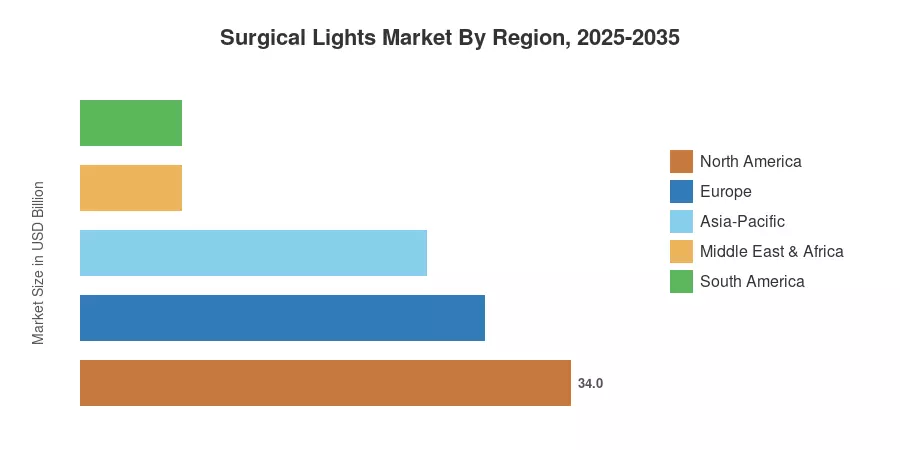
North America commands roughly 34% of revenue in the Surgical Lights Market, anchored by the concentration of hybrid operating suites across the United States. Asia-Pacific is the fastest-growing region with a projected CAGR of 8.66% through 2035, driven by large-scale hospital construction in India and China. Europe holds the second-largest share at approximately 28%, where sustainability mandates under the EU Medical Device Regulation continue to push the adoption of energy-efficient luminaires. The next decade will hinge on how quickly AI-enabled lighting calibration and 4K-integrated surgical visualization reshape procurement priorities worldwide.

ย 

Key Report Takeaways

โ€ข By Type

  • LED lights captured approximately 57% of the Surgical Lights Market in 2025, supported by superior longevity, low thermal emission, and regulatory mandates phasing out mercury-based alternatives.
  • Halogen lights continue to serve cost-sensitive facilities in developing economies, though their share is contracting as LED price premiums narrow below 15%.

โ€ข By Application

  • Cardiac surgery procedures accounted for roughly 20% of the market share in 2025, reflecting the complexity and volume of cardiovascular interventions globally.
  • Gynecological surgery is the fastest-growing application segment.

ย 

โ€ข By End User

  • Ambulatory surgical centers represent the fastest-growing end-user segment, posting a CAGR of 8.28% through 2035 as outpatient procedure volumes climb.
  • ASCs represent the most dynamic growth vector, with U.S. facility counts alone projected to exceed 7,000 by 2030 as payers and health systems shift eligible procedures to lower-cost outpatient settings.

โ€ข By Region

  • North America generated an estimated USD 0.69 billion in Surgical Lights Market revenue during 2025, led by U.S. hospital system capital expenditures.
  • Asia-Pacific is projected to expand at an 8.66% CAGR through 2035, fueled by government-backed healthcare infrastructure programs across India, China, and Southeast Asia.

ย 

Market Size and Forecast (2021โ€“2035)

Market Research Future's proprietary sizing framework triangulates bottom-up equipment shipment tracking, top-down healthcare capital expenditure analysis, and validated distributor channel data across 32 countries. Historical figures reflect audited data through 2024; the 2025 base year combines preliminary shipment records with facility commissioning databases.
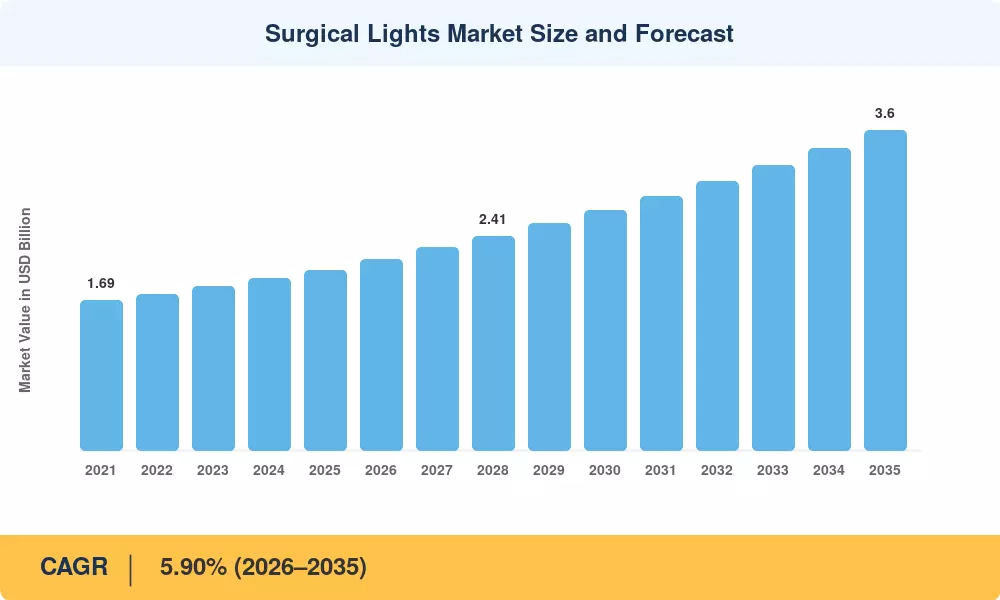
Surgical Lights Market Size and Forecast
Our Impact
Enabled $4.3B Revenue Impact for Fortune 500 and Leading Multinationals
Partnering with 2000+ Global Organizations Each Year
30K+ Citations by Top-Tier Firms in the Industry

Driver Impact Analysis

Driver ~% Impact on CAGR Geographic Relevance Impact Timeline
LED technology transition and halogen phase-out mandates ~22% Global Short-term (โ‰ค2 yr)
Rising surgical volumes and hybrid OR construction ~20% North America, Europe Medium-term (2โ€“4 yr)
Government healthcare infrastructure investments ~18% Asia-Pacific, South America Long-term (โ‰ฅ4 yr)
ASC facility expansion and outpatient surgery growth ~15% North America Medium-term (2โ€“4 yr)
AI and 4K visualization integration in surgical lighting ~12% North America, Europe Long-term (โ‰ฅ4 yr)
Infection control and sterile environment regulations ~8% Global Short-term (โ‰ค2 yr)
Energy efficiency mandates and hospital sustainability programs ~5% Europe, Asia-Pacific Medium-term (2โ€“4 yr)

ย 

LED Technology Transition and Halogen Phase-Out

The most significant factor influencing the surgical lights market between 2026 and 2035 is the worldwide transition from halogen to LED surgical luminaires. Surgeons can more accurately distinguish between tissue layers thanks to LED systems' color rendering indices exceeding 95 Ra and color temperatures that can be adjusted between 3,500 K and 5,000 K. Halogen surgical lights are directly impacted by the production and import limitations on mercury-containing lamps established by the Minamata Convention on Mercury, which has been ratified by more than 140 nations [3]. Energy savings of 55โ€“65% per luminaire are being realized by hospitals replacing outdated systems, which translates into yearly operational cost savings of USD 1,200โ€“1,800 per surgical suite [4].

ย 

Hybrid Operating Room Construction and Surgical Volume Growth

By 2024, there were more than 340 million surgical procedures performed worldwide; by 2030, the number is predicted to rise to 380 million due to aging populations in OECD countries [5]. Advanced imaging, robotic systems, and multi-head ceiling-mounted lighting are all integrated into hybrid operating rooms, which are expanding at almost twice the rate of traditional OR construction. According to the American College of Surgeons, between 2022 and 2024, 38% of teaching hospitals in the United States commissioned at least one new hybrid OR, each of which required USD 1.5โ€“3.0 million in lighting and environmental control technology [7].

ย 

Government Healthcare Infrastructure Programs

India's Pradhan Mantri Swasthya Suraksha Yojana has sanctioned 22 new AIIMS-equivalent institutions, each specifying LED surgical illumination systems as a baseline procurement requirement [10]. China's 14th Five-Year Plan for healthcare allocated CNY 1.3 trillion toward county-level hospital upgrades through 2025, with surgical suite modernization comprising approximately 12% of total capital budgets. These large-scale public investment cycles create durable, multi-year procurement pipelines for the Surgical Lights Market across emerging economies.

ASC Expansion and Outpatient Surgery Growth

The U.S. ambulatory surgical center count surpassed 6,100 facilities in 2024, and CMS reimbursement policy updates continue to shift eligible procedures โ€” including total joint replacements and spinal fusions โ€” from inpatient to outpatient settings [14]. Each new ASC typically installs two to four surgical lighting systems, creating a recurring capital equipment demand stream. The Advisory Board estimates that ASC case volumes will grow 6โ€“8% annually through 2030, directly lifting procurement volumes for compact, high-intensity luminaires [7].

ย 

Restraints Impact Analysis

Restraint ~% Drag on CAGR Geographic Relevance Impact Timeline
High capital cost of advanced LED systems ~โ€“8% Emerging markets Short-term (โ‰ค2 yr)
Rare-earth element supply chain volatility ~โ€“6% Global Medium-term (2โ€“4 yr)
Cybersecurity risks in connected surgical equipment ~โ€“5% North America, Europe Long-term (โ‰ฅ4 yr)
Lengthy regulatory approval timelines for new devices ~โ€“4% Global Medium-term (2โ€“4 yr)
Budget constraints in public healthcare systems ~โ€“3% South America, MEA Long-term (โ‰ฅ4 yr)

ย 

Capital Cost Barriers in Emerging Markets

Depending on features like camera integration, touchless controls, and intensity zoning, a fully functional ceiling-mounted LED surgical light system can cost anywhere between USD 25,000 and USD 90,000. Without grant funding or concessional finance, these price points remain unaffordable for district-level hospitals in South Asia and Sub-Saharan Africa that operate on capital budgets of USD 8,000โ€“15,000 per bed [16]. Within four to five years, the total cost of ownership favors LED over halogen; however, adoption is slowed in the areas with the worst gaps in surgical infrastructure because of the upfront purchase hurdle.

ย 

Rare-Earth Element Price Volatility

Rare-earth metals, including yttrium, cerium, and europium, are necessary for LED phosphor compounds, and China accounts for around 60% of the world's refined production. Manufacturing costs for surgical luminaires are directly impacted by price fluctuations of 30โ€“50% within a single quarter, as was the case in late 2023 when cerium oxide prices surged after export quota modifications [17]. In response, manufacturers have expanded their sourcing to Australia and Brazil and qualified alternate phosphor chemistries, but most companies are still two to three years away from achieving complete supply chain resilience.

ย 

ย 

Surgical Lights Market Opportunities

AI-Adaptive Lighting and Smart OR Integration

The surgical lights market has a lot of room to develop because of machine learning algorithms that automatically modify light intensity, color temperature, and shadow control based on current surgical field conditions. Surgeon-reported visual tiredness during procedures longer than four hours has been reduced by 18โ€“22% in early-stage deployments at Johns Hopkins and Charitรฉ Berlin [11]. Vendors who directly integrate AI processors into luminaire control units stand to gain premium pricing that is 25โ€“40% higher than that of traditional LED systems.

ย 

Emerging Market Hospital Construction Pipelines

Between 2025 and 2032, India, Indonesia, Vietnam, and Nigeria will add more than 850,000 hospital beds, all of which will need surgery suites equipped with contemporary lighting systems [10]. These high-growth corridors will attract suppliers of modular, field-serviceable luminaires made for fluctuating power grid situations.

ย 

Refurbishment and Retrofit Market for Aging Surgical Suites

Approximately 45% of operating rooms in OECD countries were built before 2005, and their lighting systems are approaching or past recommended service life. Retrofit kits that allow hospitals to upgrade existing ceiling mounts with new LED heads โ€” at 40โ€“50% of full replacement cost โ€” open a mid-market segment worth an estimated USD 180 million annually by 2030.

Lighting-as-a-Service and Managed Equipment Models

Hospital systems facing capital budget constraints are increasingly receptive to operational expenditure models. Managed equipment agreements โ€” where manufacturers retain ownership and charge per-procedure or monthly fees covering maintenance, upgrades, and consumables โ€” reduce procurement friction. This model mirrors successful adoption patterns seen in surgical robotics and diagnostic imaging leasing.

4K Camera-Integrated Surgical Lighting Platforms

Convergence between surgical visualization and illumination creates a platform opportunity for integrated lighting-camera systems that stream high-definition surgical feeds for telesurgery, training, and documentation. Early adoption in academic medical centers suggests willingness to pay 30โ€“35% premiums for integrated units over standalone configurations [12].

ย 

Surgical Lights Market Future Outlook

AI-Enabled Autonomous Lighting Calibration

Surgical lighting systems are evolving from passive illumination tools into intelligent surgical environment components. By 2030, leading manufacturers are expected to deploy luminaires with embedded neural processors that analyze surgical field depth, tissue reflectivity, and instrument position in real time โ€” adjusting light intensity, beam diameter, and color temperature without surgeon intervention. The IEEE Medical Devices Working Group projects that autonomous lighting calibration will become a baseline specification in 65% of new OR builds by 2033 [11].

Sustainability and Circular Economy Models

Hospital systems account for roughly 4.4% of global carbon emissions, and surgical suites are among the most energy-intensive hospital zones. The Surgical Lights Market will increasingly respond to procurement frameworks that weigh energy efficiency, recyclability, and lifecycle carbon footprint alongside clinical performance. Manufacturers offering take-back programs, modular component replacement, and verified environmental product declarations will gain preferential access to public tenders in the EU, UK, and Australasia [9].

Convergence with Surgical Visualization Platforms

The boundary between surgical lighting and surgical visualization is dissolving. Integrated platforms combining high-intensity LED illumination with 4K/8K camera systems, augmented-reality overlays, and real-time data feeds from patient monitors are entering clinical trials at leading academic centers. By 2035, the addressable market for converged lighting-visualization platforms could represent 20โ€“25% of total Surgical Lights Market revenue, up from less than 3% in 2025 [12].

Emerging Market Capacity Surge

The World Bank estimates that low- and middle-income countries need to add 4.4 million surgical procedures per 100,000 population by 2030 to meet the Lancet Commission's target for universal surgical access. This capacity gap translates directly into surgical suite construction demand โ€” and by extension, lighting equipment procurement โ€” across Sub-Saharan Africa, South Asia, and Central America. Multilateral financing from the IFC, AfDB, and ADB will channel an estimated USD 12 billion toward surgical infrastructure in these regions through 2035 [19][20].

ย 

Surgical Lights Market Segmentation

By Type

Segment Key Metric Primary Demand Driver
LED Lights ~57% market share (2025) Regulatory phase-out of mercury-based lamps; superior CRI and lifespan
Halogen Lights CAGR of 2.1% (2026โ€“2035) Installed base maintenance in cost-sensitive facilities
Other (Xenon, Fiber Optic) USD 0.08 Billion (2025) Niche specialty applications in dental and minor procedure settings

ย 

LED lights dominate the Surgical Lights Market by type, having crossed the majority-share threshold as manufacturing scale drove average selling prices down 35% between 2019 and 2024. Modern LED surgical luminaires deliver adjustable color temperatures between 3,500 K and 5,500 K, color rendering indices exceeding 95 Ra, and operational lifespans of 30,000 to 50,000 hours โ€” roughly five to eight times longer than halogen equivalents. Halogen systems retain a presence in budget-constrained procurement environments, particularly across South Asia and Sub-Saharan Africa, but their share of contracts annually declines as LED price premiums narrow and regulatory mandates tighten.

By Mounting Configuration

Segment Key Metric Primary Demand Driver
Ceiling-Mounted ~60% market share (2025) Standard in new OR construction; multi-head configurations
Mobile/Floor-Standing USD 0.35 Billion (2025) Flexibility for minor procedures and field hospitals
Surgical Headlights CAGR of 7.36% (2026โ€“2035) Growing demand for focused illumination in minimally invasive surgery

ย 

Ceiling-mounted systems remain the backbone of the Surgical Lights Market by configuration, installed in the vast majority of purpose-built operating rooms globally. Their multi-arm, multi-head designs allow surgical teams to position light precisely across large operative fields. Surgical headlights, meanwhile, are gaining traction among surgeons performing minimally invasive, laparoscopic, and robotic-assisted procedures where targeted beam control supplements overhead illumination.

By Light Intensity Range

Segment Key Metric Primary Demand Driver
โ‰ค100,000 Lux USD 0.22 Billion (2025) Minor procedures, examination rooms, ambulatory settings
100,001โ€“160,000 Lux ~52% market share (2025) General surgery, orthopedic, and cardiac applications
>160,000 Lux CAGR of 8.39% (2026โ€“2035) Deep-cavity surgery, neurosurgery, and complex microsurgical procedures

ย 

The 100,001โ€“160,000 lux range captures the broadest slice of demand because it covers the intensity requirements of most general, orthopedic, and cardiovascular surgical procedures. The greater-than-160,000 lux category is expanding rapidly as surgeons performing deep-cavity, neurosurgical, and reconstructive microsurgical procedures require extreme illumination to maintain tissue differentiation at depth.

By Application

Segment Key Metric Primary Demand Driver
Cardiac Surgery ~20% market share (2025) High procedural complexity; multi-luminaire suite configurations
Gynecological Surgery CAGR of 9.24% (2026โ€“2035) Rising minimally invasive gynecological procedure volumes
Orthopedic Surgery USD 0.34 Billion (2025) Joint replacement volume growth in aging populations
Neurosurgery CAGR of 7.8% (2026โ€“2035) Demand for ultra-high-intensity, focused beam profiles
Other Applications ~22% market share (2025) General surgery, ENT, ophthalmic, and dental procedures

ย 

Cardiac surgery leads the Surgical Lights Market by application due to the inherently complex, lengthy nature of cardiovascular procedures that demand continuous, shadow-free illumination across deep operative fields. Gynecological surgery is the fastest-growing application segment, propelled by the rapid adoption of minimally invasive techniques, including robotic-assisted hysterectomy and laparoscopic endometriosis excision.

By End User

Segment Key Metric Primary Demand Driver
Hospitals ~56% market share (2025) Large installed base; multi-OR facilities driving volume procurement
Ambulatory Surgical Centers CAGR of 8.28% (2026โ€“2035) Outpatient procedure migration; new facility openings
Specialty Clinics & Others USD 0.12 Billion (2025) Dental surgery centers, military field hospitals, and academic labs

ย 

Hospitals control the majority of the Surgical Lights Market by end user, reflecting both their dominant share of surgical procedure volumes and their multi-suite procurement patterns. ASCs represent the most dynamic growth vector, with U.S. facility counts alone projected to exceed 7,000 by 2030 as payers and health systems shift eligible procedures to lower-cost outpatient settings.

ย 

Regional Market Share Analysis

Region Share of Global Revenue (2025) Primary Investment Themes
North America 34% Hybrid OR buildouts; ASC expansion; AI integration
Europe 28% EU MDR compliance; sustainability mandates; retrofit programs
Asia-Pacific 24% Government hospital construction; LED first-adoption
South America 7% Public health system modernization; PPP-funded facilities
Middle East & Africa 7% Medical tourism infrastructure; specialty hospital development
Total 100% โ€”

The Surgical Lights Market exhibits a concentrated geographic footprint, with three regions โ€” North America, Europe, and Asia-Pacific โ€” accounting for approximately 86% of global revenue. Growth trajectories diverge sharply: mature markets focus on technology upgrades and replacement cycles, while emerging regions prioritize new-build surgical capacity.

ย 

North America

Country Key Metric Key Driver
United States ~78% of regional share Hospital system CAPEX; ASC reimbursement expansion
Canada CAGR of 5.4% (2026โ€“2035) Provincial healthcare infrastructure renewal programs
Mexico USD 0.03 Billion (2025) Medical tourism corridor development along the northern border

ย 

The United States remains the anchor of the North American Surgical Lights Market, propelled by a hospital construction pipeline exceeding USD 48 billion through 2028, according to Revista's medical construction database [7]. Medicare's expanded ASC-covered procedure list โ€” which added 11 musculoskeletal and cardiac catheterization codes in 2024 โ€” continues to stimulate facility openings that generate reliable lighting equipment demand. Canada's surgical suite renewal programs across Ontario and British Columbia are funded through provincial infrastructure bonds, while Mexico benefits from cross-border medical tourism facilities in Monterrey and Tijuana, investing in internationally accredited surgical environments.

Europe

Country Key Metric Key Driver
Germany ~24% of regional share Medtech innovation cluster; Universitรคtskliniken modernization
United Kingdom CAGR of 5.7% (2026โ€“2035) NHS New Hospital Programme capital disbursements
France USD 0.05 Billion (2025) Plan France 2030 healthcare digitization investments
Italy CAGR of 5.3% (2026โ€“2035) PNRR-funded hospital infrastructure upgrades
Spain ~8% of regional share Public hospital network renewal in autonomous communities
Nordic Countries CAGR of 5.1% (2026โ€“2035) Lean hospital design and sustainability-first procurement
Russia ~5% of regional share Federal healthcare modernization program
Rest of Europe USD 0.04 Billion (2025) Varied national upgrade timelines

ย 

Europe's Surgical Lights Market is shaped by the EU Medical Device Regulation, which imposed compliance deadlines that forced thousands of facilities to evaluate and upgrade legacy surgical equipment. The UK's NHS New Hospital Programme โ€” targeting 40 new hospital builds by 2030 โ€” represents one of the continent's largest individual procurement opportunities, with surgical lighting specifications increasingly mandating integrated camera capabilities and energy ratings meeting NHS Net Zero targets [9][15].

Asia-Pacific

Country Key Metric Key Driver
China ~38% of regional share 14th Five-Year Plan county hospital upgrades
India CAGR of 9.8% (2026โ€“2035) Ayushman Bharat and AIIMS expansion programs
Japan USD 0.06 Billion (2025) An aging population, surgical volume increases
South Korea CAGR of 7.2% (2026โ€“2035) Medical device export manufacturing and domestic upgrades
ASEAN ~12% of regional share Hospital PPP projects in Thailand, Vietnam, and Indonesia
Rest of Asia-Pacific CAGR of 6.5% (2026โ€“2035) Incremental healthcare capacity additions

ย 

Asia-Pacific leads global growth in the Surgical Lights Market, driven by government-backed construction programs of unprecedented scale. India alone plans to operationalize 157 new medical colleges with attached teaching hospitals by 2027, each requiring multiple advanced surgical suites. China's county-level hospital upgrade mandate covers over 1,600 facilities, with standardized procurement specifications increasingly favoring domestic LED luminaire manufacturers such as Mindray and WEGO [10][13].

South America

Country Key Metric Key Driver
Brazil ~58% of regional share SUS public health system equipment renewal
Argentina CAGR of 5.6% (2026โ€“2035) Provincial hospital modernization grants
Rest of South America USD 0.02 Billion (2025) Gradual facility upgrades across smaller markets

ย 

Brazil's Unified Health System serves over 150 million citizens and operates a vast network of public surgical facilities, many equipped with aging lighting systems due for replacement. Federal procurement tenders for surgical equipment reached BRL 2.1 billion in 2024, with lighting systems comprising an increasing share as facilities transition from halogen to LED configurations [13].

Middle East & Africa

Country Key Metric Key Driver
Saudi Arabia ~32% of regional share Vision 2030 healthcare city developments
UAE CAGR of 7.8% (2026โ€“2035) Medical tourism hub investments in Abu Dhabi and Dubai
South Africa USD 0.02 Billion (2025) National Health Insurance pilot facility upgrades
Egypt CAGR of 6.9% (2026โ€“2035) New Administrative Capital medical district construction
Rest of MEA ~18% of regional share Incremental public hospital improvements

ย 

Saudi Arabia's Vision 2030 healthcare investment portfolio, exceeding USD 65 billion, includes multiple specialty hospital campuses in Riyadh, Jeddah, and NEOM that specify state-of-the-art surgical lighting [19]. The UAE's positioning as a regional medical tourism destination sustains premium equipment demand, while South Africa's NHI pilot program channels funding toward district hospital surgical suite upgrades that favor cost-effective yet modern lighting solutions.

ย 

Surgical Lights Market By Region, 2025-2035

Competitive Benchmarking

The Surgical Lights Market exhibits medium concentration, with the top five players collectively holding an estimated 45โ€“52% of global revenue. The Herfindahl-Hirschman Index sits in the 800โ€“1,200 range, indicating a moderately competitive structure where established medtech conglomerates compete alongside specialized surgical environment companies. Differentiation increasingly hinges on integrated digital capabilities โ€” camera systems, AI calibration, connectivity โ€” rather than illumination performance alone.

Company Est. Revenue Share Range Key Offerings for the Surgical Lights Market Strategic Positioning
Stryker Corporation ~10โ€“14% Visum LED surgical lights; integrated OR solutions Full-suite OR integration with navigation and visualization
STERIS plc ~8โ€“12% HarmonyAIR surgical lighting; ceiling infrastructure Infection prevention and a sterile environment ecosystem
Getinge AB ~7โ€“10% Maquet PowerLED surgical lights Hybrid OR solutions with advanced workflow integration
Drรคgerwerk AG ~5โ€“8% Polaris surgical luminaires Gas management and OR environment convergence
TRUMPF Medical ~5โ€“8% TruLight LED series Precision optics and German engineering heritage
Merivaara Group ~3โ€“5% Q-Flow surgical lights Modular, Nordic design-driven OR equipment
Skytron LLC ~3โ€“5% Aurora surgical lighting systems Value-positioned ceiling-mounted solutions for community hospitals
Mindray Medical ~3โ€“5% HyLED surgical light series Cost-competitive LED systems for emerging market expansion
Hill-Rom (Baxter) ~2โ€“4% TruDef surgical lights Patient care ecosystem integration across surgical and post-op
Integra LifeSciences ~2โ€“3% Luxtec headlight systems; surgical illumination Specialist in surgical headlights and portable illumination

ย 

ย 

Recent News & Developments

ย 

ย 

ย 

ย 

ย 

ย 

ย 

  • January 2025: Syensqo and MezLight introduced a surgical lighting system molded in Radel PPSU that lowers weight and improves sterilization cycles.
  • January 2024: Activ Surgical completed the first international procedure using ActivSight Intelligent Light at Abdali Hospital in Jordan

ย 

ย 

Surgical Lights Market Report Scope

Parameter Detail
Market Scope Global Surgical Lights Market across five regions and 18+ countries
Study Period 2021โ€“2035
CAGR 5.90% (2026โ€“2035)
Market Size (2025) USD 2.03 Billion
Market Size (2035) USD 3.60 Billion
Fastest Growing Segment Ambulatory Surgical Centers (by end user); Asia-Pacific (by region)
Companies Profiled 10 major players, including Stryker, STERIS, Getinge, Drรคger, TRUMPF Medical, and others
Valuation Currency USD Billion

ย 

ย 

FAQs

What procurement model delivers the best total cost of ownership for surgical lighting?
Managed equipment agreements that bundle maintenance, software updates, and component replacement into a fixed monthly fee typically reduce the ten-year total cost of ownership by 18โ€“25% compared to outright capital purchase [16]. Hospitals performing fewer than 3,000 annual procedures benefit most from this model.
How do cybersecurity regulations affect connected surgical light procurement?
The FDA's 2024 premarket guidance requires network-connected surgical devices to include a software bill of materials and documented vulnerability management plans [18]. Procurement teams should verify vendor compliance before committing to integrated lighting-camera platforms.
Which color rendering index threshold should buyers prioritize for tissue differentiation?
A CRI of 95 Ra or above is the clinical benchmark for distinguishing vascular, adipose, and connective tissue under surgical illumination [6]. Systems below 90 Ra risk compromising visual accuracy in deep-cavity procedures.
How do modular retrofit kits compare to full luminaire replacement in aging ORs?
Retrofit kits reuse existing ceiling mounts and wiring infrastructure, cutting installation costs by 40โ€“50% and downtime by 60% versus full replacement [4]. Clinical light output typically reaches 85โ€“90% of new-build equivalents.
What role does light-source heat emission play in surgical site infection risk?
Halogen luminaires generate infrared radiation that can raise tissue-surface temperatures by 2โ€“4ยฐC, potentially affecting wound healing and bacterial proliferation rates [15]. LED systems virtually eliminate this thermal load.
Are there trade-offs when integrating 4K cameras directly into surgical light heads?
Integrated units reduce ceiling clutter and simplify sterile draping, but they constrain camera angle independently of light positioning [12]. Facilities performing diverse surgical specialties may prefer separate articulated camera arms.
How should procurement teams evaluate surgical lighting vendors for emerging-market hospital projects?
Prioritize vendors offering voltage-tolerant power supplies (180โ€“260V), field-serviceable modular components, and regional spare-parts inventories [16]. Local regulatory registration and after-sales service networks are essential for sustained uptime. ย  ย 
Author
Author
Author Profile
Rahul Gotadki LinkedIn
Research Manager
He holds an experience of about 9+ years in Market Research and Business Consulting, working under the spectrum of Life Sciences and Healthcare domains. Rahul conceptualizes and implements a scalable business strategy and provides strategic leadership to the clients. His expertise lies in market estimation, competitive intelligence, pipeline analysis, customer assessment, etc.
Co-Author
Co-Author Profile
Kinjoll Dey LinkedIn
Senior Research Analyst
He is an extremely curious individual currently working in Healthcare and Medical Devices Domain. Kinjoll is comfortably versed in data centric research backed by healthcare educational background. He leverages extensive data mining and analytics tools such as Primary and Secondary Research, Statistical Analysis, Machine Learning, Data Modelling. His key role also involves Technical Sales Support, Client Interaction and Project management within the Healthcare team. Lastly, he showcases extensive affinity towards learning new skills and remain fascinated in implementing them.

Research Approach

ย 

Secondary Research

The secondary research process involved comprehensive analysis of medical device regulatory databases, healthcare infrastructure publications, surgical technology journals, and authoritative healthcare organizations. Key sources included the US Food & Drug Administration (FDA) Center for Devices and Radiological Health, European Medicines Agency (EMA) Medical Device Coordination Group, International Electrotechnical Commission (IEC) 60601-2-41 standards for surgical luminaires, International Organization for Standardization (ISO) 9680 technical specifications, Association for the Advancement of Medical Instrumentation (AAMI), Association of periOperative Registered Nurses (AORN), American Society of Heating, Refrigerating and Air-Conditioning Engineers (ASHRAE) healthcare facility guidelines, ECRI Institute health technology assessments, National Institutes of Health (NIH) surgical outcomes research, National Center for Biotechnology Information (NCBI/PubMed) surgical technology reviews, Centers for Disease Control and Prevention (CDC) National Center for Health Statistics hospital capacity data, World Health Organization (WHO) Global Health Observatory surgical care indicators, OECD Health Statistics hospital infrastructure metrics, Eurostat Healthcare Resource Statistics, and national health ministry reports from key markets (US CMS Hospital Cost Reports, NHS England Digital Estates Returns, Japan Ministry of Health Labour and Welfare medical device registrations).

These sources were employed to gather data on the volumes of surgical procedures, operating room infrastructure, regulatory clearance databases (510(k), PMA), energy efficiency standards compliance, LED adoption rates, ambulatory surgical center growth statistics, and market landscape analysis for LED surgical light systems, halogen surgical lights, and hybrid illumination technologies.

ย 

Primary Research

Qualitative and quantitative insights were obtained by interviewing supply-side and demand-side stakeholders during the primary research process. The supply-side sources consisted of CEOs, VPs of Product Development, regulatory affairs chiefs, and commercial directors from surgical lighting manufacturers, operating room equipment OEMs, and medical illumination technology providers. Procurement leads from hospital systems, ambulatory surgical center administrators, facilities managers from healthcare institutions, perioperative directors, operating room managers, biomedical equipment technicians, and chief surgeons constituted demand-side sources. The primary research validated technology segmentation (the dynamics of the LED vs. halogen transition), confirmed product development pipelines (smart/adjustable color temperature systems), and gathered insights on the dynamics of capital equipment budgeting, energy efficiency procurement criteria, infection control lighting requirements, and OR infrastructure upgrade cycles.

Primary Respondent Breakdown:

By Designation: C-level Primaries (40%), Director Level (30%), Others (30%)

By Region: North America (40%), Europe (25%), Asia-Pacific (25%), Rest of World (10%)

ย 

Market Size Estimation

Revenue mapping installed base analysis, and correlations between surgical procedure volumes were implemented to determine global market valuation. The methodology comprised the following:

Identification of 35+ key manufacturers in North America, Europe, Asia-Pacific, and Latin America who specialize in surgical illumination systems

LED surgical lights (including cold light LED and shadowless LED), halogen surgical lights, and fiber optic light sources are all represented in the technology mapping.

An analysis of end-user segmentation in hospital operating rooms (inpatient), ambulatory surgical centers (outpatient), and procedure rooms (minor surgery/diagnostic)

Analysis of annual revenues that are specific to surgical illumination portfolios and OR equipment divisions, as reported and modeled

Manufacturers that account for 75-80% of the global market share in 2024 are included in the coverage.

Segment-specific valuations for LED (dominant) and halogen (declining/emerging markets) technologies are derived through extrapolation using bottom-up (OR construction/renovation activity ร— illumination units per OR ร— ASP by country) and top-down (manufacturer revenue validation) approaches.

Validation against healthcare infrastructure investment databases and hospital capital expenditure surveys

Download Free Sample

Kindly complete the form below to receive a free sample of this Report

Download PDF ×

We do not share your information with anyone. However, we may send you emails based on your report interest from time to time. You may contact us at any time to opt-out.
















