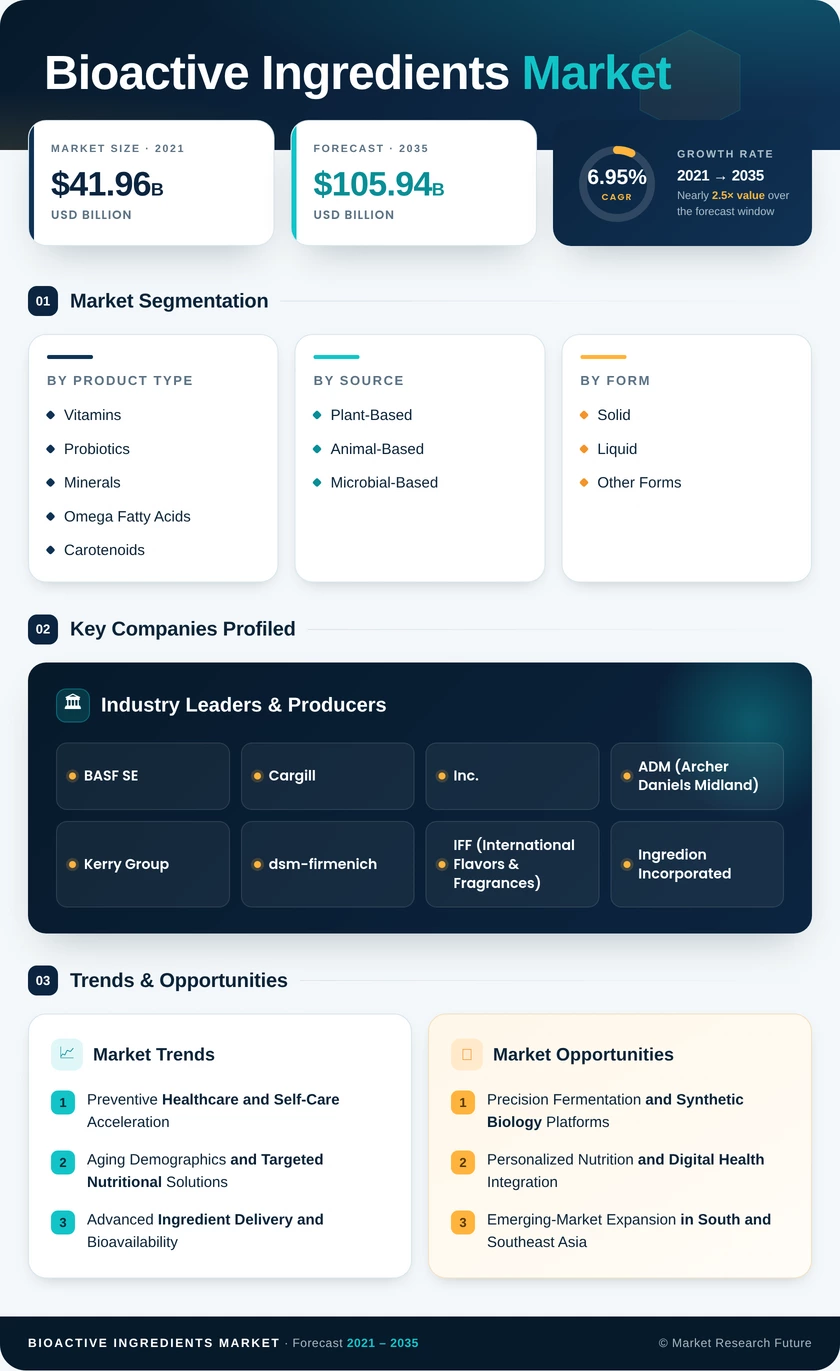
Bioactive Ingredients Market (2026 - 2035)

ID: MRFR/FnB/3928-HCR
90 Pages
Snehal Singh
Last Updated: July 06, 2026
Bioactive Ingredients Market Size, Share, Industry Trend & Analysis Research Report Information By Product Type (Vitamins, Probiotics, Minerals, Omega Fatty Acids, Carotenoids, Plant Extracts, Others), By Source (Plant-Based, Animal-Based, Microbial-Based), By Form (Solid, Liquid, Other Forms), By Application (Dietary Supplements, Food & Beverages, Pharmaceuticals, Personal Care & Cosmetics, Animal Nutrition), By Geography (North America, Europe, Asia-Pacific, South America, Middle East & Africa) - Forecast 2035
Bioactive Ingredients Market
Market Size
Forecast Period2026-2035
CAGR (2026-2035)6.95%
2025 Market SizeUSD 54.12 Billion
2035 Market SizeUSD 105.94 Billion
Key Players
BASF SE
Cargill, Inc.
ADM
Kerry Group
dsm-firmenich
IFF
Opportunities
  • Precision Fermentation and Synthetic Biology Platforms
  • Personalized Nutrition and Digital Health Integration
  • Emerging-Market Expansion in South and Southeast Asia
  1. 1 Market Overview |
    1. 1.1 Study Assumptions & Market Definition |
    2. 1.2 Scope of the Study |
    3. 1.3 Research Methodology
  2. 2 Market Summary & Key Takeaways
  3. 3 Market Dynamics |
    1. 3.1 Market Drivers Analysis | |
      1. 3.1.1 Preventive Healthcare and Self-Care Acceleration | |
      2. 3.1.2 Aging Demographics and Targeted Nutritional Solutions | |
      3. 3.1.3 Advanced Ingredient Delivery and Bioavailability | |
      4. 3.1.4 Regulatory Harmonization Across Trade Blocs | |
      5. 3.1.5 E-Commerce and Direct-to-Consumer Channels | |
      6. 3.1.6 Clean-Label and Organic Ingredient Demand |
    2. 3.2 Market Restraints Analysis | |
      1. 3.2.1 Fragmented Regulatory Standards | |
      2. 3.2.2 Raw-Material Price Volatility | |
      3. 3.2.3 Consumer Skepticism and Misinformation | |
      4. 3.2.4 IP and Patent Disputes on Novel Compounds | |
      5. 3.2.5 Limited Clinical Validation for Emerging Ingredients |
    3. 3.3 Market Opportunity Analysis | |
      1. 3.3.1 Precision Fermentation and Synthetic Biology Platforms | |
      2. 3.3.2 Personalized Nutrition and Digital Health Integration | |
      3. 3.3.3 Emerging-Market Expansion in South and Southeast Asia | |
      4. 3.3.4 Data-Driven Ingredient Optimization and B2B SaaS Models | |
      5. 3.3.5 Clean-Label and Transparency-Driven Product Reformulation |
    4. 3.4 Industry Value Chain Analysis |
    5. 3.5 Porter's Five Forces Analysis
  4. 4 Global Bioactive Ingredients Market Size & Forecast (2021–2035) |
    1. 4.1 Historical Market Size (2021–2025) |
    2. 4.2 Current & Forecast Market Size (2026–2035) |
    3. 4.3 Market Size by Revenue (USD Billion) |
    4. 4.4 Year-over-Year Growth Analysis
  5. 5 Segmentation Analysis |
    1. 5.1 By Product Type | |
      1. 5.1.1 Vitamins | |
      2. 5.1.2 Probiotics | |
      3. 5.1.3 Minerals | |
      4. 5.1.4 Omega Fatty Acids | |
      5. 5.1.5 Carotenoids | |
      6. 5.1.6 Plant Extracts & Others |
    2. 5.2 By Source | |
      1. 5.2.1 Plant-Based | |
      2. 5.2.2 Animal-Based | |
      3. 5.2.3 Microbial-Based |
    3. 5.3 By Form | |
      1. 5.3.1 Solid | |
      2. 5.3.2 Liquid | |
      3. 5.3.3 Other Forms |
    4. 5.4 By Application | |
      1. 5.4.1 Dietary Supplements | |
      2. 5.4.2 Food & Beverages | |
      3. 5.4.3 Pharmaceuticals | |
      4. 5.4.4 Personal Care & Cosmetics | |
      5. 5.4.5 Animal Nutrition
  6. 6 Regional Analysis |
    1. 6.1 North America | |
      1. 6.1.1 United States | |
      2. 6.1.2 Canada | |
      3. 6.1.3 Mexico |
    2. 6.2 Europe | |
      1. 6.2.1 Germany | |
      2. 6.2.2 United Kingdom | |
      3. 6.2.3 France | |
      4. 6.2.4 Italy | |
      5. 6.2.5 Spain | |
      6. 6.2.6 Nordic Countries | |
      7. 6.2.7 Russia | |
      8. 6.2.8 Rest of Europe |
    3. 6.3 Asia-Pacific | |
      1. 6.3.1 China | |
      2. 6.3.2 India | |
      3. 6.3.3 Japan | |
      4. 6.3.4 South Korea | |
      5. 6.3.5 ASEAN | |
      6. 6.3.6 Rest of Asia-Pacific |
    4. 6.4 South America | |
      1. 6.4.1 Brazil | |
      2. 6.4.2 Argentina | |
      3. 6.4.3 Rest of South America |
    5. 6.5 Middle East & Africa | |
      1. 6.5.1 Saudi Arabia | |
      2. 6.5.2 UAE | |
      3. 6.5.3 South Africa | |
      4. 6.5.4 Egypt | |
      5. 6.5.5 Rest of MEA
  7. 7 Competitive Landscape |
    1. 7.1 Market Share Analysis (2025) |
    2. 7.2 Competitive Benchmarking Matrix |
    3. 7.3 Company Profiles | |
      1. 7.3.1 BASF SE | |
      2. 7.3.2 Cargill, Inc. | |
      3. 7.3.3 ADM (Archer Daniels Midland) | |
      4. 7.3.4 Kerry Group | |
      5. 7.3.5 dsm-firmenich | |
      6. 7.3.6 IFF (International Flavors & Fragrances) | |
      7. 7.3.7 Ingredion Incorporated | |
      8. 7.3.8 Kemin Industries | |
      9. 7.3.9 Sabinsa Corporation | |
      10. 7.3.10 Novonesis (formerly Chr. Hansen)
  8. 8 Future Outlook & Strategic Recommendations (2026–2035) |
    1. 8.1 AI-Driven Formulation and Smart Manufacturing |
    2. 8.2 Sustainability and Circular Bioeconomy Integration |
    3. 8.3 Regulatory Convergence and Global Trade Facilitation |
    4. 8.4 Longevity Science and Next-Generation Bioactives
  9. 9 Recent Developments & News
  10. 10 Frequently Asked Questions (FAQs)
  11. 11 Report Scope & Methodology |
    1. 11.1 Study Period & Base Year |
    2. 11.2 Data Sources & Citations |
    3. 11.3 Abbreviations
  12. 12 LIST OF TABLES |
  13. TABLE 1 Global Bioactive Ingredients Market Size & Forecast, by Revenue (USD Billion), 2021–2035 |
  14. TABLE 2 Global Bioactive Ingredients Market — Year-over-Year Growth Analysis, 2021–2035 |
  15. TABLE 3 Driver Impact Analysis — Global Bioactive Ingredients Market |
  16. TABLE 4 Restraint Impact Analysis — Global Bioactive Ingredients Market |
  17. TABLE 5 Global Bioactive Ingredients Market Size, by Product Type, 2021–2035 (USD Billion) |
  18. TABLE 6 Global Bioactive Ingredients Market Size, by Source, 2021–2035 (USD Billion) |
  19. TABLE 7 Global Bioactive Ingredients Market Size, by Form, 2021–2035 (USD Billion) |
  20. TABLE 8 Global Bioactive Ingredients Market Size, by Application, 2021–2035 (USD Billion) |
  21. TABLE 9 Global Bioactive Ingredients Market Size, by Region, 2021–2035 (USD Billion) |
  22. TABLE 10 North America Bioactive Ingredients Market Size, by Country, 2021–2035 (USD Billion) |
  23. TABLE 11 Europe Bioactive Ingredients Market Size, by Country, 2021–2035 (USD Billion) |
  24. TABLE 12 Asia-Pacific Bioactive Ingredients Market Size, by Country, 2021–2035 (USD Billion) |
  25. TABLE 13 South America Bioactive Ingredients Market Size, by Country, 2021–2035 (USD Billion) |
  26. TABLE 14 Middle East & Africa Bioactive Ingredients Market Size, by Country, 2021–2035 (USD Billion) |
  27. TABLE 15 Competitive Benchmarking Matrix — Global Bioactive Ingredients Market, 2025 |
  28. TABLE 16 Company Profiles — Key Players, Global Bioactive Ingredients Market |
  29. TABLE 17 Recent Developments & Strategic Announcements, 2023–2025 |
  30. TABLE 18 Report Scope & Methodology Summary |
  31. TABLE 19 Detailed Sources and Citations
  32. 13 LIST OF FIGURES |
  33. FIGURE 1 Global Bioactive Ingredients Market Dynamics (Drivers, Restraints, Opportunities) |
  34. FIGURE 2 Industry Value Chain Analysis — Bioactive Ingredients Market |
  35. FIGURE 3 Porter's Five Forces Analysis — Bioactive Ingredients Market |
  36. FIGURE 4 Global Bioactive Ingredients Market Size Trend (USD Billion), 2021–2035 |
  37. FIGURE 5 Bioactive Ingredients Market Share, by Product Type (%), 2025 |
  38. FIGURE 6 Bioactive Ingredients Market Share, by Source (%), 2025 |
  39. FIGURE 7 Bioactive Ingredients Market Share, by Form (%), 2025 |
  40. FIGURE 8 Bioactive Ingredients Market Share, by Application (%), 2025 |
  41. FIGURE 9 Bioactive Ingredients Market Share, by Region (%), 2025 |
  42. FIGURE 10 Competitive Landscape — Market Share Distribution, 2025

Segmentation Quick Reference

DimensionSub-SegmentsDominant SegmentFastest Growing Segment
Product TypeVitamins, Probiotics, Minerals, Omega Fatty Acids, Carotenoids, Plant Extracts & OthersVitaminsProbiotics
SourcePlant-Based, Animal-Based, Microbial-BasedPlant-BasedMicrobial-Based
FormSolid, Liquid, Other FormsSolidLiquid
ApplicationDietary Supplements, Food & Beverages, Bioactive Ingredients Markets, Personal Care & Cosmetics, Animal NutritionDietary SupplementsFood & Beverages
GeographyNorth America, Europe, Asia-Pacific, South America, Middle East & AfricaEuropeAsia-Pacific


Market Segmentation Overview

By Product Type

Sub-SegmentKey Trend
VitaminsImmune-support positioning sustains premium demand post-pandemic
ProbioticsStrain-specific clinical validation accelerating commercial adoption
MineralsMicronutrient deficiency awareness driving fortification programs
Omega Fatty AcidsAlgae-derived omega-3 alternatives are gaining market traction
CarotenoidsDual-use as a bioactive and natural colorant expands addressable applications
Plant Extracts & OthersClean-label reformulation creating new demand from mainstream food brands


Vitamins and probiotics together represent the core growth engine of the product-type segmentation, while minerals maintain steady volume-driven demand through government-led fortification initiatives worldwide.

By Source

Sub-SegmentKey Trend
Plant-BasedDominant share driven by consumer preference for naturally derived ingredients
Animal-BasedMarine-sourced omega-3 and collagen peptides sustain demand despite vegan competition
Microbial-BasedPrecision fermentation scalability positioning microbial sources as a strategic growth vector


Plant-based sourcing retains its majority position, but microbial-based ingredients are capturing increasing R&D investment as fermentation economics improve and supply-chain resilience becomes a strategic priority.

By Form

Sub-SegmentKey Trend
SolidTablets, capsules, and powders dominate through established manufacturing and consumer familiarity
LiquidReady-to-drink functional beverages are driving rapid format adoption
Other FormsGummies and gel formats are expanding through improved taste and convenience profiles


Solid formats continue to lead on volume, while liquid delivery is reshaping the competitive landscape through functional beverage innovation and enhanced bioavailability profiles.

By Application

Sub-SegmentKey Trend
Dietary SupplementsPreventive health spending and e-commerce distribution sustaining category leadership
Food & BeveragesFortification mandates and functional food innovation are driving the fastest application growth
Bioactive Ingredients MarketsClinical-grade bioactives bridging the supplement-pharma boundary
Personal Care & CosmeticsNutricosmetics and ingestible beauty are creating cross-category demand
Animal NutritionPet wellness premiumization and livestock productivity optimization are expanding use cases


Dietary supplements anchor the application segmentation, while food and beverage applications are converging with supplement functionality as consumers seek bioactive benefits integrated into everyday consumption patterns.


Download PDF ×

We do not share your information with anyone. However, we may send you emails based on your report interest from time to time. You may contact us at any time to opt-out.