×
Request Free Sample ×

Kindly complete the form below to receive a free sample of this Report

* Please use a valid business email

Leading companies partner with us for data-driven Insights

clients tt-cursor
Hero Background

Biometric Authentication Identification Market

ID: MRFR/SEM/0368-HCR
115 Pages
Aarti Dhapte
October 2025

Biometric Authentication & Identification Market Research Report Information By Modality (Market statistics, Multimodal biometric), By Motility (Fixed, Mobile), By Application (Government, Consumer Electronics, Commerce), And By Region (North America, Europe, Asia-Pacific, And Rest Of The World) –Market Forecast Till 2035.

Share:
Download PDF ×

We do not share your information with anyone. However, we may send you emails based on your report interest from time to time. You may contact us at any time to opt-out.

Biometric Authentication Identification Market Infographic
Purchase Options

Biometric Authentication Identification Market Summary

As per MRFR analysis, the Biometric Authentication Identification Market Size was estimated at 36.71 USD Billion in 2024. The biometric authentication industry is projected to grow from 41.2 USD Billion in 2025 to 130.64 USD Billion by 2035, exhibiting a compound annual growth rate (CAGR) of 12.23 during the forecast period 2025 - 2035.

Key Market Trends & Highlights

The Biometric Authentication Identification Market is experiencing robust growth driven by technological advancements and increasing security concerns.

  • The market is witnessing increased adoption in financial services, particularly in North America, which remains the largest market.
  • Integration with mobile devices is becoming a prevalent trend, enhancing user convenience and accessibility across various sectors.
  • Regulatory support and compliance are fostering a conducive environment for biometric solutions, especially in the Asia-Pacific region.
  • Rising security concerns and growing demand in e-commerce are major drivers propelling the market forward, particularly in the access control and fingerprint recognition segments.

Market Size & Forecast

2024 Market Size 36.71 (USD Billion)
2035 Market Size 130.64 (USD Billion)
CAGR (2025 - 2035) 12.23%

Major Players

Thales (FR), NEC Corporation (JP), Gemalto (FR), IDEMIA (FR), HID Global (US), Fujitsu (JP), Safran (FR), MorphoTrust (US), Aware (US)

Biometric Authentication Identification Market Trends

The Biometric Authentication Identification Market is currently experiencing a transformative phase, driven by advancements in technology and increasing demand for secure identification methods. Organizations across various sectors are adopting biometric solutions to enhance security protocols and streamline user experiences. This market encompasses a wide range of biometric modalities, including fingerprint recognition, facial recognition, iris scanning, and voice recognition, each offering unique advantages and applications. As concerns regarding data privacy and security continue to rise, the integration of biometric systems appears to be a strategic response to mitigate risks associated with traditional authentication methods. Moreover, the Biometric Authentication Identification Market is likely to witness significant growth as regulatory frameworks evolve to support the implementation of biometric technologies. Governments and enterprises are increasingly recognizing the potential of biometrics in improving identity verification processes, thereby fostering trust and efficiency. The convergence of artificial intelligence and machine learning with biometric systems may further enhance their accuracy and reliability. As the landscape of digital security continues to evolve, the market is poised for expansion, with innovations that could redefine how individuals and organizations approach authentication and identification.

Increased Adoption in Financial Services

The financial sector is increasingly integrating biometric authentication to enhance security measures. This trend is driven by the need to protect sensitive financial data and prevent fraud. Biometric solutions, such as fingerprint and facial recognition, are being utilized to streamline customer verification processes, thereby improving user experience while ensuring robust security.

Integration with Mobile Devices

The proliferation of mobile devices has led to a surge in biometric authentication solutions embedded within smartphones and tablets. This trend reflects a growing consumer preference for convenient and secure access to applications and services. As mobile technology continues to advance, the integration of biometric systems is expected to become more prevalent, offering users seamless authentication experiences.

Regulatory Support and Compliance

Governments worldwide are increasingly establishing regulations that support the use of biometric technologies for identification purposes. This trend indicates a shift towards formalizing biometric authentication within legal frameworks, which may enhance public trust and encourage wider adoption across various industries. Compliance with these regulations is likely to drive innovation and investment in biometric solutions.

Biometric Authentication Identification Market Drivers

Rising Security Concerns

The Global Biometric Authentication and Identification Market Industry is propelled by escalating security concerns across various sectors. Organizations are increasingly adopting biometric solutions to mitigate risks associated with unauthorized access and identity theft. For instance, financial institutions are implementing biometric authentication to secure transactions and protect sensitive customer data. The global market is projected to reach 36.7 USD Billion in 2024, reflecting a growing recognition of the efficacy of biometric systems in enhancing security protocols. This trend is likely to continue as businesses prioritize safeguarding their assets and customer information.

Market Segment Insights

By Application: Access Control (Largest) vs. Time and Attendance (Fastest-Growing)

In the Biometric Authentication Identification Market, the application segment showcases diverse functionalities, with Access Control leading in market share. This segment capitalizes on heightened security demands across various sectors, including corporate, government, and healthcare. Time and Attendance follows closely, witnessing rapid adoption as organizations increasingly recognize its efficiency in workforce management and compliance with labor regulations. The identity verification, mobile payments, and border control applications also contribute significantly, but they occupy a smaller share compared to the dominant Access Control and emergent Time and Attendance segments. The ongoing trend towards digital transformation and heightened focus on security is driving growth in the biometric authentication sector. The growing reliance on improved identification methods boosts the demand for Time and Attendance systems, especially in remote working conditions. Meanwhile, Access Control systems emphasize integration with existing security protocols and technologies such as AI and IoT, positioning themselves as essential components in safeguarding sensitive environments. As biometric solutions continue to evolve, a balanced growth across these applications is expected, catering to the increased global demand for secure identification methods.

Access Control (Dominant) vs. Time and Attendance (Emerging)

The Access Control segment stands as a dominant force within the Biometric Authentication Identification Market, primarily geared towards enhancing security measures across various industries. It encompasses a range of technologies, including fingerprint scanning and facial recognition, tailored for protecting physical and digital assets. Enterprises prioritize Access Control investments to mitigate risks associated with unauthorized access. In contrast, the Time and Attendance segment is emerging rapidly, driven by its ability to streamline employee monitoring and attendance tracking. Organizations are increasingly leveraging biometric solutions for time management, resulting in higher accuracy and efficiency in payroll processes. As remote work expands, these systems are gaining traction, offering flexibility and innovative features, thus positioning themselves as a vital tool in modern workforce management.

By Technology: Fingerprint Recognition (Largest) vs. Facial Recognition (Fastest-Growing)

Within the Biometric Authentication Identification Market, Fingerprint Recognition continues to hold the largest market share due to its widespread adoption across various sectors such as banking, law enforcement, and personal devices. Its reliability and cost-effectiveness have made it a go-to solution for many organizations seeking to enhance security protocols. Conversely, Facial Recognition is rapidly emerging as a formidable contender, spurred by technological advancements, increased investment in surveillance systems, and a growing number of applications in airports, retail, and smart devices. The growth trajectory of the biometric technologies is driven by increasing concerns over security and fraud prevention, as well as the need for easier and faster authentication methods. The expanding range of creative applications for Facial Recognition, including social media tagging and personalized marketing, highlights its potential for substantial market penetration. Additionally, innovations in AI and machine learning are enhancing the accuracy and reliability of these technologies, further propelling market growth as more industries recognize the benefits of biometric authentication systems.

Biometric Technology: Fingerprint Recognition (Dominant) vs. Behavioral Biometrics (Emerging)

Fingerprint Recognition remains the dominant force in the Biometric Authentication Identification Market, attributed to its longstanding presence and extensive market adoption. Its characteristic reliability and quick authentication processes make it favored across many sectors like finance and personal devices. Meanwhile, Behavioral Biometrics is emerging as a unique segment that analyzes patterns in user behavior to enhance security measures. This technology assesses metrics such as keystroke dynamics and mouse movements, offering an innovative layer of security that adapts to user habits. The fusion of these two technologies demonstrates a growing trend towards multi-factor authentication solutions, where both established and emerging technologies coexist to meet diverse security needs in a rapidly evolving digital landscape.

By End Use: Government (Largest) vs. Healthcare (Fastest-Growing)

In the Biometric Authentication Identification Market, the Government sector is the largest contributor, leveraging biometric solutions for identity verification in various public services and security applications. Following closely, the Healthcare sector is emerging with significant growth potential, as hospitals and clinics seek to enhance patient data security and streamline access to medical records through biometric identification technologies. The growth in the Biometric Authentication Identification Market is driven by increasing demands for security across various sectors, particularly in Government and Healthcare. Governments are adopting these technologies for national security and efficient citizen services, while the growing focus on safeguarding patient data within healthcare institutions accelerates the adoption of biometric solutions. This aligns with the wider trend towards digitization and improved identity management systems in critical sectors.

Government (Dominant) vs. Healthcare (Emerging)

The Government sector remains dominant in the Biometric Authentication Identification Market due to stringent regulations and the need for secure identification processes in various applications such as immigration, law enforcement, and national security. Government agencies invest heavily in biometric systems to enhance security and operational efficiency. On the other hand, the Healthcare sector is an emerging player, characterized by a swift adoption of biometric technologies to ensure secure access to patient information and streamline administrative processes. This segment benefits from recent technological advancements and a growing emphasis on patient privacy and data protection, paving the way for biometric solutions to become integral in healthcare operations.

Get more detailed insights about Biometric Authentication Identification Market

Regional Insights

North America : Market Leader in Biometric Solutions

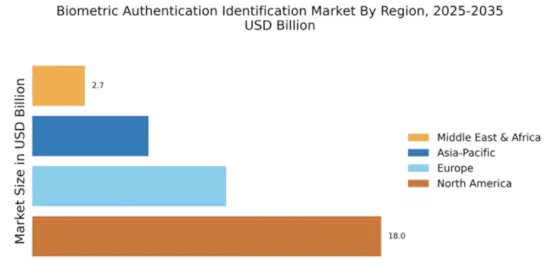
North America is poised to maintain its leadership in the biometric authentication identification market, holding a significant market share of 18.0 in 2025. The region's growth is driven by increasing security concerns, technological advancements, and regulatory support for biometric systems. Government initiatives aimed at enhancing security protocols further catalyze demand, making it a fertile ground for innovation and investment in biometric technologies. The competitive landscape in North America is robust, featuring key players such as Thales, HID Global, and IDEMIA. The U.S. stands out as a major contributor, with a strong focus on integrating biometric solutions across various sectors, including finance, healthcare, and government. The presence of established companies and continuous R&D efforts ensure that North America remains at the forefront of biometric authentication advancements.

Europe : Growing Adoption Across Sectors

Europe is witnessing a significant rise in the biometric authentication identification market, with a market size of 10.0 in 2025. The growth is fueled by increasing regulatory requirements for security and privacy, alongside a growing demand for seamless user experiences. The European Union's General Data Protection Regulation (GDPR) has also played a pivotal role in shaping the market, encouraging organizations to adopt biometric solutions for compliance and enhanced security measures. Leading countries such as Germany, France, and the UK are at the forefront of this expansion, with a competitive landscape featuring companies like Gemalto and Safran. The region's focus on innovation and collaboration among tech firms and government bodies fosters a conducive environment for the growth of biometric technologies. As organizations increasingly recognize the value of biometric authentication, Europe is set to become a key player in the global market.

Asia-Pacific : Emerging Market with High Potential

The Asia-Pacific region is emerging as a significant player in the biometric authentication identification market, with a market size of 6.0 in 2025. The growth is driven by rapid urbanization, increasing smartphone penetration, and a rising demand for secure identification solutions. Governments in countries like China and India are investing heavily in biometric systems for national security and citizen services, further propelling market growth. Key players such as NEC Corporation and Fujitsu are actively expanding their presence in the region, capitalizing on the growing demand. The competitive landscape is characterized by a mix of established firms and innovative startups, all vying for market share. As the region continues to embrace digital transformation, the biometric authentication market is expected to flourish, driven by both public and private sector initiatives.

Middle East and Africa : Untapped Market Opportunities

The Middle East and Africa (MEA) region is gradually recognizing the potential of biometric authentication identification, with a market size of 2.71 in 2025. The growth is primarily driven by increasing security concerns, particularly in sectors like banking and government. Regulatory frameworks are beginning to support the adoption of biometric technologies, creating a conducive environment for market expansion. Countries like the UAE and South Africa are leading the charge in implementing biometric solutions for enhanced security measures. The competitive landscape in MEA is still developing, with a mix of local and international players entering the market. Companies are focusing on tailored solutions to meet regional needs, and partnerships with government entities are becoming increasingly common. As awareness of biometric technologies grows, the MEA region is poised for significant growth in the coming years.

Key Players and Competitive Insights

The Biometric Authentication Identification Market is currently characterized by a dynamic competitive landscape, driven by technological advancements and increasing demand for secure identification solutions. Key players such as Thales (France), NEC Corporation (Japan), and IDEMIA (France) are strategically positioned to leverage innovation and partnerships to enhance their market presence. Thales (France) focuses on integrating advanced biometric technologies into its security solutions, while NEC Corporation (Japan) emphasizes the development of AI-driven biometric systems to improve accuracy and efficiency. IDEMIA (France) is actively pursuing collaborations with governmental and private sectors to expand its biometric offerings, thereby shaping a competitive environment that prioritizes technological sophistication and user-centric solutions.

In terms of business tactics, companies are increasingly localizing manufacturing and optimizing supply chains to enhance operational efficiency. The market structure appears moderately fragmented, with several key players exerting influence over various segments. This fragmentation allows for a diverse range of solutions, catering to different customer needs while fostering competition among established and emerging players.

In November 2025, Thales (France) announced a strategic partnership with a leading tech firm to develop next-generation biometric authentication systems. This collaboration aims to integrate cutting-edge AI technologies, potentially enhancing the accuracy and speed of biometric identification processes. Such a move underscores Thales's commitment to innovation and positions it favorably in a market that increasingly values technological advancements.

In October 2025, NEC Corporation (Japan) launched a new biometric identification platform that utilizes deep learning algorithms to improve facial recognition accuracy. This platform is expected to cater to various sectors, including security and finance, indicating NEC's strategic focus on expanding its product portfolio to meet evolving market demands. The introduction of this platform may significantly enhance NEC's competitive edge by addressing the growing need for reliable biometric solutions.

In September 2025, IDEMIA (France) secured a multi-million € contract with a European government to implement a nationwide biometric identification system. This contract not only reinforces IDEMIA's position as a leader in the public sector but also highlights the increasing reliance on biometric technologies for national security and identity management. Such strategic moves are likely to bolster IDEMIA's market share and influence in the biometric authentication landscape.

As of December 2025, current trends in the Biometric Authentication Identification Market include a pronounced shift towards digitalization, sustainability, and the integration of AI technologies. Strategic alliances among key players are shaping the competitive landscape, fostering innovation and enhancing product offerings. Looking ahead, it appears that competitive differentiation will increasingly hinge on technological innovation and supply chain reliability, rather than solely on price. This evolution suggests a market poised for growth, driven by the demand for sophisticated and secure biometric solutions.

Key Companies in the Biometric Authentication Identification Market market include

Industry Developments

  • Q2 2024: Thales launches new biometric payment card in Europe Thales announced the commercial launch of its new biometric payment card, featuring fingerprint authentication, across several European markets. The card aims to enhance security and convenience for contactless payments.
  • Q2 2024: iProov raises $70M to expand biometric authentication platform Biometric authentication company iProov secured $70 million in a new funding round to accelerate the development and global rollout of its facial verification and liveness detection technologies.
  • Q2 2024: Apple introduces Passkey support for biometric authentication in iOS 18 Apple announced the integration of Passkey, a biometric-based authentication method, into iOS 18, enabling users to log in to apps and websites using Face ID or Touch ID without passwords.
  • Q3 2024: IDEMIA and Microsoft partner to deliver biometric authentication for Azure Active Directory IDEMIA and Microsoft announced a strategic partnership to integrate IDEMIA’s biometric authentication solutions with Microsoft’s Azure Active Directory, aiming to enhance secure access for enterprise customers.
  • Q3 2024: Fingerprint Cards appoints new CEO to drive biometric expansion Fingerprint Cards AB announced the appointment of a new Chief Executive Officer, citing a renewed focus on expanding its biometric authentication business in mobile and payment sectors.
  • Q3 2024: NEC opens new biometric R&D center in Singapore NEC Corporation inaugurated a new research and development center in Singapore dedicated to advancing biometric authentication technologies, including facial and iris recognition.
  • Q4 2024: Mastercard launches Biometric Checkout Program in the US Mastercard announced the US launch of its Biometric Checkout Program, allowing consumers to pay at retail stores using facial or fingerprint recognition instead of physical cards or devices.
  • Q4 2024: Veriff raises $45M Series C to scale biometric identity verification Veriff, a provider of AI-powered biometric identity verification, closed a $45 million Series C funding round to expand its global operations and enhance its product offerings.
  • Q1 2025: BIO-key secures $10M contract for biometric authentication with US government agency BIO-key International announced it has been awarded a $10 million contract to provide biometric authentication solutions to a major US government agency, supporting secure access to sensitive systems.
  • Q1 2025: Clearview AI receives regulatory approval for biometric identification platform in UK Clearview AI obtained regulatory approval from UK authorities to deploy its biometric identification platform for law enforcement use, following a comprehensive data privacy review.
  • Q2 2025: Samsung unveils next-generation Galaxy device with in-display biometric authentication Samsung launched its latest Galaxy smartphone featuring advanced in-display fingerprint and facial recognition technology, aiming to set new standards for mobile biometric security.
  • Q2 2025: IDEMIA launches MorphoWave SP, a new biometric access control device IDEMIA introduced MorphoWave SP, a new biometric access control device that enables touchless fingerprint scanning for secure entry in commercial and government facilities.

Future Outlook

Biometric Authentication Identification Market Future Outlook

The Biometric Authentication Identification Market is projected to grow at a 12.23% CAGR from 2024 to 2035, driven by technological advancements, increasing security concerns, and regulatory mandates.

New opportunities lie in:

  • Integration of biometric systems in smart home devices
  • Development of mobile biometric payment solutions
  • Expansion of biometric identification in healthcare systems

By 2035, the market is expected to be robust, driven by innovation and widespread adoption.

Market Segmentation

Biometric Authentication Identification Market End Use Outlook

  • Government
  • Healthcare
  • Banking and Financial Services
  • Retail
  • Telecommunications

Biometric Authentication Identification Market Technology Outlook

  • Fingerprint Recognition
  • Facial Recognition
  • Iris Recognition
  • Voice Recognition
  • Behavioral Biometrics

Biometric Authentication Identification Market Application Outlook

  • Access Control
  • Time and Attendance
  • Identity Verification
  • Mobile Payments
  • Border Control

Report Scope

MARKET SIZE 202436.71(USD Billion)
MARKET SIZE 202541.2(USD Billion)
MARKET SIZE 2035130.64(USD Billion)
COMPOUND ANNUAL GROWTH RATE (CAGR)12.23% (2024 - 2035)
REPORT COVERAGERevenue Forecast, Competitive Landscape, Growth Factors, and Trends
BASE YEAR2024
Market Forecast Period2025 - 2035
Historical Data2019 - 2024
Market Forecast UnitsUSD Billion
Key Companies ProfiledThales (FR), NEC Corporation (JP), Gemalto (FR), IDEMIA (FR), HID Global (US), Fujitsu (JP), Safran (FR), MorphoTrust (US), Aware (US)
Segments CoveredApplication, Technology, End Use
Key Market OpportunitiesIntegration of artificial intelligence enhances security and user experience in the Biometric Authentication Identification Market.
Key Market DynamicsRising demand for secure access solutions drives innovation and competition in the biometric authentication identification market.
Countries CoveredNorth America, Europe, APAC, South America, MEA

Market Highlights

Author
Aarti Dhapte
Team Lead - Research

She holds an experience of about 6+ years in Market Research and Business Consulting, working under the spectrum of Information Communication Technology, Telecommunications and Semiconductor domains. Aarti conceptualizes and implements a scalable business strategy and provides strategic leadership to the clients. Her expertise lies in market estimation, competitive intelligence, pipeline analysis, customer assessment, etc.

Leave a Comment

FAQs

How much is the Biometric Authentication & Identification market?

The Biometric Authentication & Identification Market size was valued at USD 36.71 billion in 2024.

What is the growth rate of the Biometric Authentication & Identification market?

The global market is projected to grow at a CAGR of 12.23% during the forecast period, 2025 to 2035.

Which region held the largest market share in the Biometric Authentication & Identification market?

Asia Pacific had the largest share in the global market

Who are the key players in the Biometric Authentication & Identification market?

The key players in the market are BuiEngagable Technologies Pvt. Ltd., SIC Biometrics, Leidos Holdings Inc., NEC Corporation.

Which modality the Biometric Authentication & Identification market?

The multimodal category dominated the market in 2022.

Which application had the largest market share in the Biometric Authentication & Identification market?

The government segment had the largest share in the global market.

Download Free Sample

Kindly complete the form below to receive a free sample of this Report

Compare Licence

×
Features License Type
Single User Multiuser License Enterprise User
Price $4,950 $5,950 $7,250
Maximum User Access Limit 1 User Upto 10 Users Unrestricted Access Throughout the Organization
Free Customization
Direct Access to Analyst
Deliverable Format
Platform Access
Discount on Next Purchase 10% 15% 15%
Printable Versions