Biosimilar Contract Manufacturing Market Summary
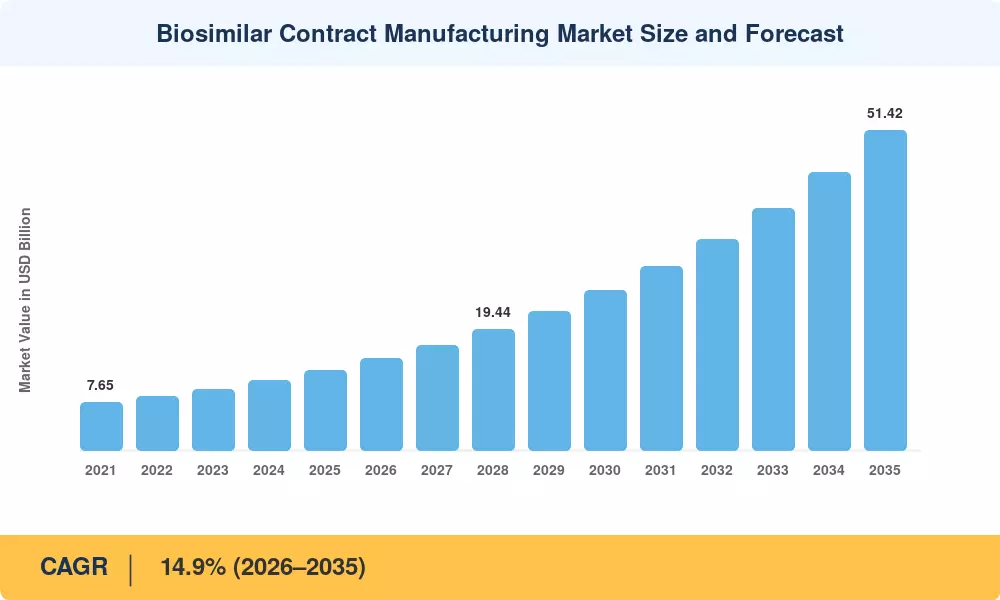
The Biosimilar Contract Manufacturing Market reached USD 12.82 billion in 2025 and opens the forecast window at USD 14.73 billion in 2026, climbing to USD 51.42 billion by 2035 at a 14.9% CAGR. Two catalysts anchor that trajectory. The first is the patent cliff: roughly USD 180 billion in annual biologic sales lose exclusivity between 2026 and 2032, and most sponsors chasing those molecules do not own commercial-scale bioreactor capacity [1][3]. The second is payer pressure — the US Inflation Reduction Act's negotiation list and Europe's tender-driven procurement have compressed reference-product pricing to the point where in-house plants rarely clear their cost of capital [2].
Manufacturing is remaking itself. Stainless-steel fed-batch lines of 12,000 to 20,000 liters are being replaced by single-use, intensified perfusion lines with 2,000-liter bioreactors that operate at four to six times the volumetric productivity, reducing capital intensity per gram by almost 40%. Samsung Biologics, Lonza and WuXi Biologics have together committed more than USD 12 billion to new capacity since 2023, much of it intended for biosimilar medication manufacture rather than innovative biologics [4][5][6].
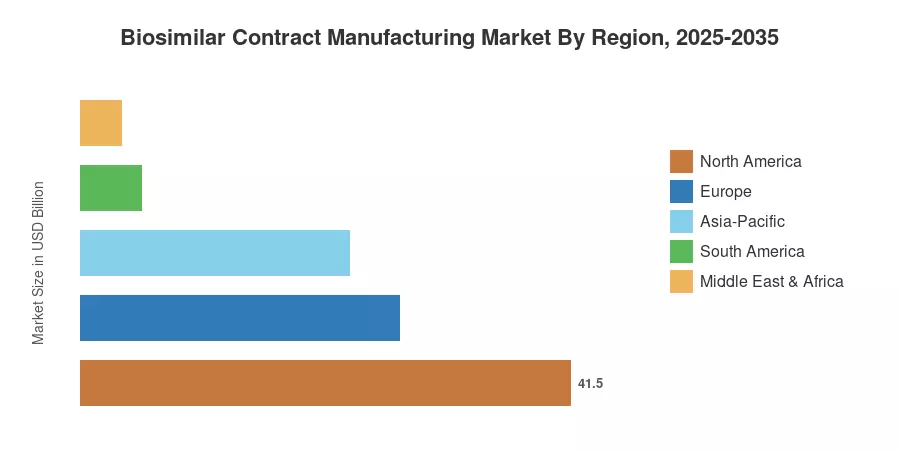
North America accounts for 41.5% of global revenue, spurred by FDA interchangeability channels and a solid contract-development basis. Asia-Pacific will lead the growth at 17.6% CAGR through 2035, driven by capacity build-outs in Korea and China. Europe follows with a 27.0% share, where EMA’s 2024 tailored-comparability guidance is compressing development schedules. The next ten years are going to reward manufacturers who can show analytical comparability faster than they can pour concrete.
Key Report Takeaways
• By Technology
- Mammalian expression systems command 74.5% of the Biosimilar Contract Manufacturing Market, reflecting antibody dominance in the off-patent pipeline.
- Microbial platforms generate USD 3.27 billion, concentrated in insulins, filgrastim and teriparatide programs.
• By Sector
- Oncology applications hold 42.8% revenue share, led by trastuzumab, bevacizumab and rituximab follow-ons.
- Infectious disease indications post the strongest application CAGR at 16.4%
- Upstream processing services account for 35.2% of outsourced spend
• By Geography
- North America contributes USD 5.32 billion to the Biosimilar Contract Manufacturing Market in 2025
- Asia-Pacific advances at a 17.6% CAGR, the fastest of any region
- South America represents 5.2% of global revenue, anchored by Brazilian public procurement
Market Size and Forecast (2021–2035)
Below estimates triangulate audited CDMO segment revenues, published capacity utilization rates, regulatory file volumes at FDA and EMA, and interview input from 42 sponsor-side procurement leads. Historical numbers are reconciled to firm annual reports. For projection years, a capacity-constrained demand model is used for the Biosimilar Contract Manufacturing Market.