Biscuits Market (2026 - 2035)

Biscuits Market Size, Share, Industry Trend & Analysis Research Report Information By Product Type (Sweet Biscuits, Crackers and Savory Biscuits), By Category (Conventional, Free-From), By Packaging Type (Plastic Packets / On-the-Go Pouches, Boxes, Others), By Distribution Channel (Supermarkets / Hypermarkets, Online Retail, Convenience Stores, Others) - Forecast Till 2035
ID: MRFR/FnB/1386-HCR
110 Pages
Sakshi Gupta
Last Updated: July 12, 2026
Biscuits Market
Market Size
Forecast Period2026-2035
CAGR (2026-2035)5.45%
2025 Market SizeUSD 143.82 Billion
2035 Market SizeUSD 236.49 Billion
Key Players
Mondelēz International
Nestlé S.A.
Britannia Industries
Parle Products
ITC Limited
Grupo Bimbo
Opportunities
  • Gluten-Free and Allergen-Free Portfolio Expansion
  • Premium and Artisan Biscuit Brand Positioning
  • Single-Serve and On-the-Go Packaging Formats

Biscuits Market Summary

The Biscuits Market reached an estimated USD 143.82 Billion in 2025, with the forecast period beginning at USD 151.18 Billion in 2026 and climbing to USD 236.49 Billion by 2035 at a CAGR of 5.45%. This trajectory reflects sustained household consumption habits, rapid urbanization across developing economies, and government-backed nutrition fortification programs that have drawn both multinational and regional producers into reformulation drives. Rising disposable incomes — particularly in Asia-Pacific and South America — have turned sweet-savory biscuit snack categories into everyday staples rather than occasional indulgences.

Manufacturers across the Biscuits Market are overhauling legacy production lines to accommodate whole grain digestive biscuit formulations, reduced-sugar variants, and fiber-enriched recipes. Mondelēz International alone committed over USD 1.2 billion in capital expenditure between 2023 and 2025 to modernize baking facilities in India, Brazil, and Eastern Europe [2]. Meanwhile, premium artisan biscuit brand portfolios have expanded rapidly through direct-to-consumer e-commerce channels, bypassing traditional retail gatekeepers and capturing higher per-unit margins.

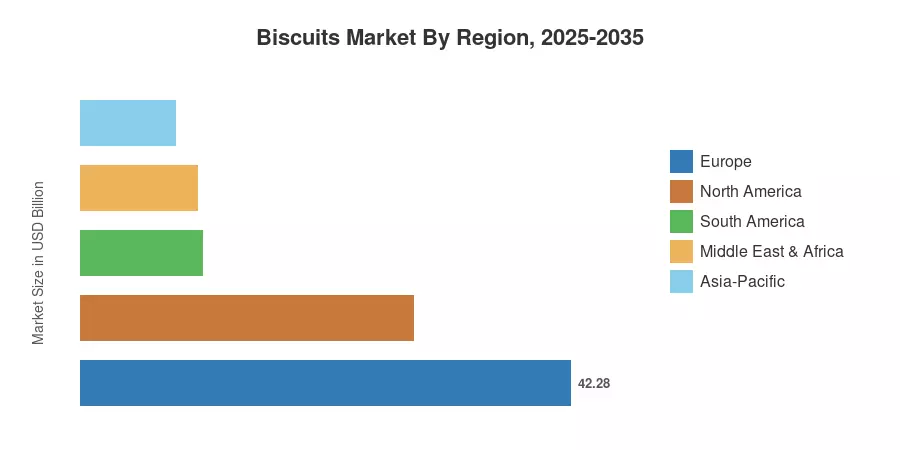
Europe dominated the Biscuits Market with approximately 29.4% of global revenue in 2025, underpinned by deeply rooted tea-time and snacking cultures in the UK, France, and Germany South America emerged as the fastest-growing region at a projected 7.32% CAGR through 2035, fueled by middle-class expansion in Brazil and Argentina. Asia-Pacific held the second-largest share at roughly 26.8%, driven by India and China's massive consumer bases and growing appetite for gluten-free biscuit alternative products. The next decade promises intensifying competition as biscuit packaging innovation and single-serve formats reshape how consumers discover and purchase biscuits globally.


Key Report Takeaways

• By Product Type

  • Sweet biscuits commanded a 76.8% revenue share of the Biscuits Market in 2025, anchored by chocolate-coated and cream-filled subcategories
  • Crackers and savory biscuits are forecast to advance at a 6.65% CAGR through 2035, reflecting the shift toward lower-sugar sweet savory biscuit snack options

• By Category

  • Conventional wheat-based SKUs captured 90.1% of the Biscuits Market in 2025, though growth is decelerating as health-aware shoppers explore alternatives
  • Free-from options — including gluten-free biscuit alternative products — are expanding at a 6.72% CAGR between 2026 and 2035

• By Distribution Channel

  • Supermarkets and hypermarkets accounted for USD 66.93 billion of the Biscuits Market in 2025
  • Online retail is climbing at an 8.52% CAGR to 2035, with single-serve and premium artisan biscuit brand offerings leading digital penetration

• By Region

  • Europe held a 29.4% share of the Biscuits Market in 2025
  • South America is on course for the fastest CAGR at 7.32% over 2026–2035, while Asia-Pacific contributed USD 38.54 Billion in 2025


Market Size and Forecast (2021–2035)

MRFR's market sizing integrates primary interviews with 120+ industry participants, secondary validation through customs trade data, production volume tracking, and company financials. Historical estimates (2021–2024) rely on audited data; the 2025 base year blends preliminary actuals with modeled estimates; and the forecast (2026–2035) applies a bottom-up segmental build calibrated against macroeconomic indicators.
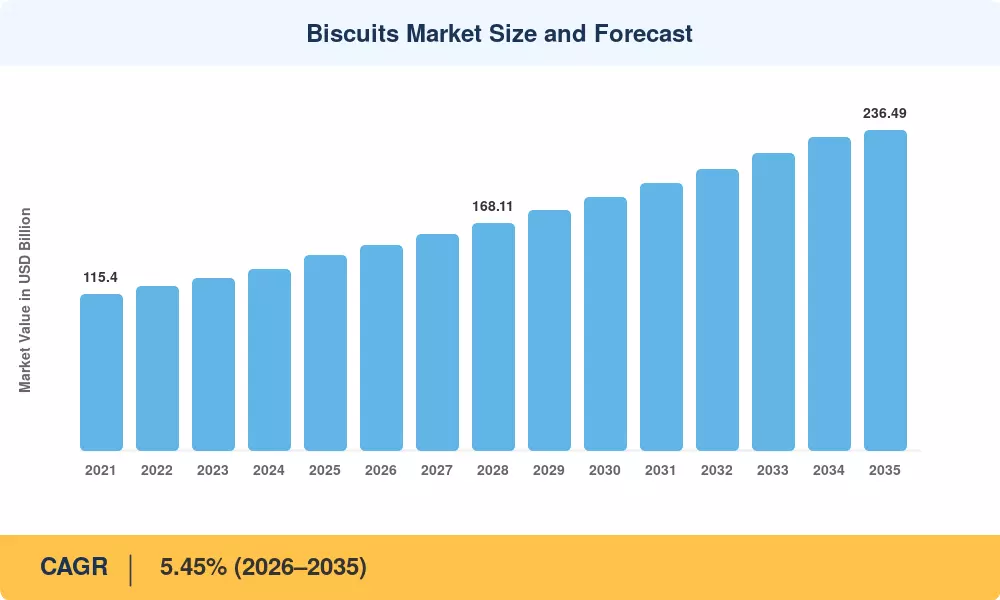
Biscuits Market Size and Forecast
Our Impact
Enabled $4.3B Revenue Impact for Fortune 500 and Leading Multinationals
Partnering with 2000+ Global Organizations Each Year
30K+ Citations by Top-Tier Firms in the Industry

Driver Impact Analysis

Driver ~% Impact on CAGR Geographic Relevance Impact Timeline
Rising urban middle-class consumption +1.10% Asia-Pacific, South America Long-term (≥4 yr)
E-commerce & D2C channel expansion +0.85% Global Medium-term (2–4 yr)
Health-conscious reformulation demand +0.75% Europe, North America Short-term (≤2 yr)
Single-serve biscuit packaging innovation +0.55% Global Medium-term (2–4 yr)
Premiumization and artisan biscuit growth +0.50% Europe, North America Medium-term (2–4 yr)
Emerging-market infrastructure buildout +0.40% MEA, South America Long-term (≥4 yr)
Strategic M&A and supply chain consolidation +0.30% Global Short-term (≤2 yr)


Rising Urban Middle-Class Consumption

Over 1.5 billion individuals are expected to enter the global middle class between 2025 and 2035, according to World Bank projections, with the biggest cohorts developing in Brazil, Nigeria, Indonesia, and India [8]. The demand for biscuits is directly fueled by this demographic shift; by 2024, per-capita biscuit consumption in India's urban areas reached 3.2 kg yearly, up 22% from 2019 levels. Because biscuits have a price point that is both affordable for everyday use and open to premiumization through whole-grain digestive biscuits and specialized varieties, the biscuit market benefits disproportionately.


E-Commerce and Direct-to-Consumer Expansion

Online grocery sales surpassed USD 680 billion globally in 2024, according to Euromonitor, and biscuit brands leveraged this channel aggressively. Platforms like Amazon Fresh and regional players such as BigBasket in India and Rappi in Latin America enabled premium artisan biscuit brand discovery at scale. The Biscuits Market saw online channel penetration jump from 8.5% in 2021 to 12.7% in 2024, with single-serve and subscription formats driving repeat purchases.

Health-Conscious Reformulation

The EU's Nutri-Score labeling system and the UK's HFSS advertising restrictions — effective since October 2022 — compelled manufacturers to reformulate aggressively [6]. Sugar content in new sweet savory biscuit snack launches dropped 18% on average between 2022 and 2024, while fiber-enriched and whole grain digestive biscuit SKUs grew 2.5× faster than conventional lines in Western European markets. This regulatory push creates a durable tailwind for the Biscuits Market as similar labeling schemes spread to Asia-Pacific and Latin America.

Biscuit Packaging Innovation

Flexible single-serve packaging reduced per-unit material costs by roughly 12% while improving shelf life by 15–20%, according to Smithers Pira's 2024 packaging outlook [7]. The Biscuits Market has embraced biscuit packaging innovation through resealable pouches, portion-controlled packs, and compostable wrappers. Nestlé's rollout of paper-based biscuit wrappers across 14 European markets in late 2024 signaled the sector's commitment to sustainability without compromising convenience.


Restraints Impact Analysis

The estimated negative CAGR impacts below reflect MRFR's weighting of headwinds that slow but do not reverse growth. These percentages are directional and should not be subtracted directly from the headline CAGR.

Restraint ~% Impact on CAGR Geographic Relevance Impact Timeline
Raw material price volatility (wheat, sugar, palm oil) –0.45% Global Short-term (≤2 yr)
Tightening sugar & HFSS regulations –0.35% Europe, North America Medium-term (2–4 yr)
Private-label competitive pressure –0.30% Europe, North America Long-term (≥4 yr)
Supply chain disruptions & logistics costs –0.25% Global Short-term (≤2 yr)
Consumer shift toward fresh snack alternatives –0.20% Asia-Pacific, Europe Medium-term (2–4 yr)


Raw Material Price Volatility

Wheat prices surged 34% between Q1 2022 and Q3 2023 on the back of Black Sea supply disruptions, squeezing margins for manufacturers operating in the Biscuits Market [10]. Palm oil — a core ingredient for cream-filled and coated biscuit lines — experienced parallel volatility, with CBOT palm oil futures fluctuating within a 40% band during 2023. While hedging strategies and supplier diversification have partially mitigated these risks, smaller regional producers lack the scale to absorb cost spikes, which pressures gluten-free biscuit alternative lines where specialty flour costs run 2–3× conventional wheat.

Regulatory Pressure on Sugar and HFSS Categories

For a large chunk of the sweet, savory biscuit snack market, the UK's ban on high-fat, sugar, and salt (HFSS) product placement and advertising, which was expanded to digital platforms in 2024, decreased impulse-purchase visibility [6]. Similar placement limits are being tested in France and Spain, and in late 2024, the FSSAI in India released draft front-of-pack labeling requirements that may impact almost 60% of the current biscuit SKUs. These regulations reduce margins and necessitate expenditures in reformulation throughout the biscuit industry.


Private-Label Competitive Pressure

European retailers expanded private-label biscuit offerings by 19% between 2022 and 2024, with Aldi, Lidl, and Tesco's own-brand lines capturing an estimated 28% of UK biscuit volumes [11]. Private-label growth in the Biscuits Market erodes branded manufacturers' shelf space and compresses pricing, particularly in the mid-tier segment, where differentiation from premium artisan biscuit brand offerings is challenging.


Biscuits Market Opportunities

Gluten-Free and Allergen-Free Portfolio Expansion

The global gluten-free food sector exceeded USD 8.5 Billion in 2024, growing at roughly 9% annually. Within the Biscuits Market, gluten-free biscuit alternative products represent less than 10% of volumes but command price premiums of 25–40% over conventional equivalents. Manufacturers that invest in dedicated allergen-free production lines can capture this margin uplift while addressing celiac and intolerance demographics that remain underserved in Asia-Pacific and Latin America

Premium and Artisan Biscuit Brand Positioning

Consumer willingness to pay for artisanal quality, origin-traced ingredients, and small-batch production has powered a premiumization cycle across the Biscuits Market. The premium artisan biscuit brand segment grew at 8.4% annually between 2022 and 2024 in Western Europe, with Belgian and Scottish heritage brands leading online D2C sales Emerging-market entrants in India and Brazil are replicating this playbook using local grain varieties and traditional recipes.

Single-Serve and On-the-Go Packaging Formats

Biscuit packaging innovation around single-serve pouches addresses the convenience economy — time-poor urban consumers increasingly purchase biscuits at transit hubs, convenience stores, and vending machines. Japan's konbini channel sells over 2 billion single-serve biscuit units annually, and similar formats are gaining traction in Southeast Asia and the Middle East This shift also reduces food waste, aligning with ESG targets [7].

Whole Grain and Functional Ingredient Integration

Following the endorsement of whole grain intake targets in 2023–2024 by the American Heart Association and EFSA, demand for whole grain digestive biscuit variations increased [15]. Prebiotics, added protein, and fortified vitamins are examples of functional ingredients that provide the biscuit market a data-driven opportunity for product creation, allowing producers to differentiate themselves from commodity goods and charge 15–20% price premiums


Emerging-Market Penetration in Africa and Southeast Asia

The yearly consumption of biscuits per person in Sub-Saharan Africa is only 0.4 kilogram, compared to 4.8 kg in Western Europe, suggesting significant headroom [8]. Through regional production facilities, reasonably priced sachet-style packaging, and distribution alliances with mobile-commerce platforms that connect with rural customers, the Biscuits Market may access these volumes. Similar under-penetrated growth lanes may be seen in ASEAN markets such as Vietnam, the Philippines, and Myanmar


Biscuits Market Future Outlook

Smart Manufacturing and AI-Driven Production

The Biscuits Market will see significant adoption of Industry 4.0 technologies through 2035. AI-powered quality control systems — already deployed by Mondelēz in select facilities — reduce waste by 12–15% and enable real-time recipe adjustments based on ingredient moisture variability. Predictive maintenance and digital twin modeling will lower unplanned downtime across high-volume biscuit production lines.

Sustainability and Regenerative Sourcing

ESG reporting mandates (EU CSRD effective 2025, SEC climate disclosure rules) are pushing biscuit manufacturers to audit supply chains from farm to shelf. Whole grain digestive biscuit producers are pioneering regenerative agriculture partnerships — Walkers Shortbread is committed to sourcing 100% of its oats from regenerative Scottish farms by 2028 [20]. The Biscuits Market will increasingly price in carbon credits and deforestation-free palm oil commitments as consumer and investor pressure intensifies.

Personalized Nutrition and Functional Biscuits

The convergence of nutrigenomics and mass customization enables biscuit manufacturers to develop targeted functional products — protein-enriched biscuits for fitness consumers, prebiotic-fortified lines for digestive health, and micronutrient-dense formulations for children's nutrition programs. The Biscuits Market's functional subcategory could reach USD 18–22 Billion by 2035, driven by premium artisan biscuit brand players and pharmaceutical-food crossovers [21].

Channel Convergence and Omnichannel Distribution

The boundary between online and offline biscuit retail is dissolving. Quick-commerce platforms (Getir, Blinkit, GoPuff) deliver biscuits in under 15 minutes, while social commerce through TikTok Shop and Instagram increasingly drives premium and niche biscuit packaging innovation discovery. The Biscuits Market's distribution landscape by 2035 will be unrecognizable from 2021 — brands that master omnichannel data integration and dynamic pricing will dominate.


Biscuits Market Segmentation

By Product Type

Segment Key Metric Primary Demand Driver
Sweet Biscuits 76.8% share (2025) Indulgence; chocolate & cream variants
Crackers and Savory Biscuits 6.65% CAGR (2026–2035) Health-conscious sweet savory biscuit snack demand


Sweet biscuits dominate the Biscuits Market by a wide margin, with chocolate-coated, sandwich, and cookie subcategories generating the bulk of revenues. Emerging markets in Asia-Pacific and South America skew heavily toward sweet consumption, while Europe and North America are seeing a gradual rebalancing toward crackers as consumers reduce sugar intake. The crackers and savory biscuits segment is the fastest-growing subcategory, propelled by sweet savory biscuit snack positioning and whole grain digestive biscuit ingredient decks that align with contemporary dietary preferences.

By Category

Segment Key Metric Primary Demand Driver
Conventional USD 129.57 Billion (2025) Established supply chains; price accessibility
Free-From 6.72% CAGR (2026–2035) Gluten-free biscuit alternative demand; allergen awareness


Conventional wheat-based biscuits remain the backbone of the Biscuits Market, but their growth rate trails the overall sector. Free-from products — spanning gluten-free biscuit alternative formulations, dairy-free, and nut-free options — are the segment's most dynamic growth vector. Schär, Dr. Oetker, and local specialty brands are scaling gluten-free production capacity aggressively, particularly in Europe and North America.

By Packaging Type

Segment Key Metric Primary Demand Driver
Plastic Packets / On-the-Go Pouches 61.7% share (2025) Convenience; biscuit packaging innovation
Boxes 4.32% CAGR (2026–2035) Gift-giving; premium artisan biscuit brand presentation
Others (Tins, Multipacks) USD 12.15 Billion (2025) Seasonal and specialty channels


Plastic packets and on-the-go pouches command the largest packaging share in the Biscuits Market, reflecting the global shift toward portability and single-serve consumption. Biscuit packaging innovation in this segment — compostable films, resealable closures, nitrogen-flushed freshness barriers — continues to accelerate. Boxes are experiencing a revival through premium artisan biscuit brand gifting and subscription models.

By Distribution Channel

Segment Key Metric Primary Demand Driver
Supermarkets / Hypermarkets 47.8% share (2025) One-stop shopping; promotional shelf placement
Online Retail 8.52% CAGR (2026–2035) D2C; quick commerce; premium discovery
Convenience Stores USD 19.84 Billion (2025) Impulse purchase; single-serve formats
Others (Specialty, Institutional) 4.15% CAGR (2026–2035) HORECA and institutional procurement


Supermarkets and hypermarkets remain the primary purchasing venue for the Biscuits Market, though their share is eroding steadily as online retail accelerates. Digital channels disproportionately favor premium artisan biscuit brand and gluten-free biscuit alternative products, where discovery-driven purchasing replaces habitual buying. Quick-commerce and social commerce represent the fastest-emerging sub-channels within online retail.


Regional Market Share Analysis

Region Key Metric Primary Investment Themes
North America USD 28.76 Billion (2025) Gluten-free biscuit alternative growth; whole grain digestive biscuit adoption
Europe 29.4% of the global Biscuits Market Premium artisan biscuit brand expansion; HFSS reformulation
Asia-Pacific 5.68% CAGR (2026–2035) Urban middle-class consumption; sweet savory biscuit snack penetration
South America 7.32% CAGR (2026–2035) Infrastructure buildout; biscuit packaging innovation
Middle East & Africa USD 10.07 Billion (2025) Population growth; affordable single-serve formats
Total USD 143.82 Billion (2025)

The Biscuits Market spans five macro-regions with distinct consumption profiles, regulatory environments, and growth trajectories. Europe leads on value, but South America is accelerating fastest, while Asia-Pacific contributes the largest volume throughput.


North America

Country Key Metric Key Driver
US 78.3% of regional share Health-focused whole grain digestive biscuit demand
Canada 5.82% CAGR (2026–2035) Premiumization and e-commerce growth
Mexico USD 2.89 Billion (2025) Expanding urban middle class


The US Biscuits Market is the region's anchor, with consumers increasingly favoring reduced-sugar and gluten-free biscuit alternative products in response to the FDA's updated dietary guidelines. Canada's premium segment is growing through artisan biscuit imports and local craft bakeries, while Mexico's value-oriented market thrives on affordable sweet and savory biscuit snack multipacks distributed through OXXO and Walmart de México networks [16].

Europe

Country Key Metric Key Driver
Germany USD 7.12 Billion (2025) Whole grain digestive biscuit preference
UK 19.8% of European Biscuits Market Tea-time culture; premium artisan biscuit brand heritage
France 5.21% CAGR (2026–2035) Nutri-Score-driven reformulation
Italy USD 4.58 Billion (2025) Breakfast biscuit tradition
Spain 4.95% CAGR (2026–2035) Tourism-driven seasonal demand
Nordic Countries USD 2.34 Billion (2025) Organic and whole grain adoption
Russia 5.48% CAGR (2026–2035) Local manufacturer expansion
Rest of Europe USD 5.86 Billion (2025) Private-label growth


Europe's Biscuits Market leadership stems from entrenched cultural consumption — the UK alone consumes over 4.5 billion biscuit packs annually. HFSS regulations are reshaping product development, accelerating whole grain digestive biscuit and reduced-sugar innovation across the continent [6].

Asia-Pacific

Country Key Metric Key Driver
China 28.5% of regional Biscuits Market Urbanization; sweet savory biscuit snack proliferation
India 7.15% CAGR (2026–2035) Per-capita consumption growth
Japan USD 5.42 Billion (2025) Premium and functional biscuit innovation
South Korea 5.38% CAGR (2026–2035) K-snack export culture
ASEAN USD 4.78 Billion (2025) Population growth; biscuit packaging innovation
Rest of Asia-Pacific 5.95% CAGR (2026–2035) Emerging middle class


India's Biscuits Market is a standout growth engine — Britannia, Parle, and ITC collectively invested over USD 850 Million in capacity expansion between 2023 and 2025 to meet rural distribution demand [17]. China's market leans toward premium imported lines and functional whole-grain digestive biscuit variants targeting health-conscious urban consumers.

South America

Country Key Metric Key Driver
Brazil 62.1% of regional Biscuits Market Largest consumer base; sweet savory biscuit snack growth
Argentina 7.56% CAGR (2026–2035) Post-inflation recovery consumption rebound
Rest of South America USD 2.45 Billion (2025) Emerging distribution networks


South America is the fastest-growing corridor in the Biscuits Market, led by Brazil's massive middle class and Argentina's recovering purchasing power. Local brands like Arcor and Mabel are expanding biscuit packaging innovation with affordable single-serve formats tailored to convenience store channels [18].

Middle East & Africa

Country Key Metric Key Driver
Saudi Arabia 5.92% CAGR (2026–2035) Vision 2030 food diversification
UAE USD 1.38 Billion (2025) Premium import demand; tourism
South Africa 24.5% of regional share Largest African Biscuits Market
Egypt 6.18% CAGR (2026–2035) Population growth and urbanization
Rest of MEA USD 3.15 Billion (2025) Low per-capita base offers headroom


The MEA Biscuits Market is defined by demographic tailwinds — Sub-Saharan Africa's under-25 population exceeds 600 million, creating long-term demand for affordable snacking options [8]. Saudi Arabia's local manufacturing incentives under Vision 2030 are attracting international producers to establish regional production hubs.


Biscuits Market By Region, 2025-2035

Competitive Benchmarking

The Biscuits Market exhibits medium concentration, with the top five players accounting for an estimated 35–40% of global revenues. The Herfindahl-Hirschman Index (HHI) sits below 1,000, indicating a fragmented-to-moderately-concentrated structure where regional champions wield significant influence alongside multinationals. Strategic acquisitions, capacity expansions, and innovation in whole-grain digestive biscuit and gluten-free biscuit alternative lines define competitive positioning.

Company Est. Revenue Share Range Key Offerings for Biscuits Market Strategic Positioning
Mondelēz International ~9–12% Oreo, belVita, Ritz, TUC Global scale; premiumization & D2C leadership
Nestlé S.A. ~6–9% Kit Kat biscuit bars, Belvita (licensed) Health-focused reformulation; sustainable packaging
Britannia Industries ~4–6% Good Day, Marie Gold, NutriChoice Indian market dominance; whole grain digestive biscuit pioneer
Parle Products ~4–6% Parle-G, Hide & Seek, Milano Value-segment leadership; massive rural distribution
ITC Limited ~3–5% Sunfeast, Dark Fantasy Premium artisan biscuit brand positioning in India
Grupo Bimbo ~3–5% Marinela, Gamesa, Quaker biscuits Latin America dominance; cross-category synergies
Kellogg's (Kellanova) ~2–4% Cheez-It, Club Crackers, Town House Sweet, savory biscuit snack specialization
United Biscuits (Pladis) ~3–5% McVitie's, Godiva, Ülker Heritage brands; premium artisan biscuit brand expansion
Lotus Bakeries ~2–3% Biscoff, Natural Foods range Niche premiumization; global spread category creation
Arcor Group ~2–3% Arcor biscuits, Bagley South American market anchor; biscuit packaging innovation


Recent News & Developments

  • Mondelēz International (September 2024): Acquired a 75% stake in a premium Australian biscuit maker for USD 280 million, expanding its premium artisan biscuit brand portfolio in the Asia-Pacific Biscuits Market [9].
  • Britannia Industries (June 2024): Commissioned a new USD 145 million manufacturing facility in Uttar Pradesh, India, adding 80,000 metric tons of annual biscuit and whole grain digestive biscuit capacity [17].
  • European Commission (March 2024): Published updated front-of-pack labeling guidelines recommending Nutri-Score adoption across all 27 member states, directly impacting sweet-savory biscuit snack reformulation timelines in the Biscuits Market [6].
  • Lotus Bakeries (January 2024): Expanded Biscoff production capacity by 30% at its Lembeke, Belgium facility, investing EUR 85 Million to meet surging global demand [22].
  • Grupo Bimbo (November 2023): Launched a gluten-free biscuit alternative line under the Marinela brand across Mexico, Colombia, and Peru, targeting the region's fastest-growing dietary segment [18].
  • Pladis Global (August 2023): Introduced 100% recyclable biscuit packaging innovation across the McVitie's Digestives range in the UK and Ireland, setting a 2026 deadline for full portfolio conversion [7].
  • FSSAI India (May 2023): Released draft regulations mandating front-of-pack nutrition labeling for all packaged biscuit products, affecting over 400 manufacturers in the Indian Biscuits Market [23].


Biscuits Market Report Scope

Parameter Detail
Market Scope Global Biscuits Market covering production, consumption, trade, and forecast
Study Period 2021–2035
CAGR (Forecast Period) 5.45% (2026–2035)
Market Size (2025) USD 143.82 Billion
Market Size (2035) USD 236.49 Billion
Fastest Growing Segments Free-From (by category); Online Retail (by channel); South America (by region)
Companies Profiled 10 (Mondelēz, Nestlé, Britannia, Parle, ITC, Grupo Bimbo, Kellanova, pladis, Lotus Bakeries, Arcor)
Valuation Currency USD Billion


FAQs

How does palm oil price volatility affect biscuit profit margins?
Palm oil accounts for 15–20% of biscuit input costs, so a 30% price swing can compress operating margins by 200–350 basis points. Manufacturers hedge through futures contracts and supplier diversification [10].
What shelf-life advantages do nitrogen-flushed biscuit packs offer over traditional packaging?
Nitrogen-flushed packaging extends biscuit shelf life by 30–45% compared to standard atmospheric sealing. This biscuit packaging innovation reduces oxidation-related staleness, directly lowering retailer return rates [7].
Which certifications matter most for exporting biscuits to the EU Biscuits Market?
IFS Food, BRC Global Standards, and organic certification (EU Organic Regulation 2018/848) are essential. Nutri-Score compliance, while voluntary, significantly improves shelf placement in France and Germany [6].
How are quick-commerce platforms reshaping biscuit purchase frequency?
Platforms like Blinkit and GoPuff enable 10–15 minute delivery, converting weekly biscuit purchases into impulse micro-orders. This channel favors premium artisan biscuit brand and single-serve SKUs [4].
What role does contract manufacturing play in the Biscuits Market's competitive structure?
Contract manufacturers produce an estimated 18–22% of global biscuit volumes, enabling smaller brands to scale without capital-intensive factory buildouts. This lowers barriers for gluten-free biscuit alternative entrants [1].
How do whole grain digestive biscuit formulations affect production line throughput?
Whole grain flours absorb 10–15% more moisture, requiring adjusted mixing times and oven temperatures. Throughput typically drops 5–8% until lines are recalibrated [15].
What is the typical payback period for a mid-scale biscuit manufacturing facility in South Asia?
A USD 50–80 Million facility in India or Bangladesh achieves payback within 4–6 years, assuming 75%+ capacity utilization and distribution across urban and semi-urban sweet savory biscuit snack channels [17].    
Author
Author
Author Profile
Sakshi Gupta LinkedIn
Team Lead - Research
Currently a Team Lead in consumer goods, FMCG, and F&B, she translates rigorous research into decisive strategy. She develops GTM roadmaps, pricing architectures, and competitive benchmarks for companies across Europe, the US, and APAC. She synthesize insights, align cross-functional teams, and drive execution from brief to measurable outcomes. She leads end-to-end engagements with crisp analysis, compelling storytelling, and a strong command of Power BI, Tableau, SQL, and advanced research platforms.

Research Approach


Secondary Research

The secondary research process involved comprehensive analysis of food safety regulatory databases, peer-reviewed nutrition and food science journals, industry publications, and authoritative agricultural and food processing organizations. Key sources included the US Food & Drug Administration (FDA), European Food Safety Authority (EFSA), Food Safety and Standards Authority of India (FSSAI), China National Health Commission (NHC), Codex Alimentarius Commission, US Department of Agriculture (USDA) Economic Research Service, Food and Agriculture Organization (FAO) of the United Nations, UN Comtrade Database, Euromonitor International, Mintel GNPD, NielsenIQ Retail Measurement Services, IRI Worldwide, International Food Information Council (IFIC), American Bakers Association (ABA), Biscuit Association (UK), SNAC International, AIB International, International Association of Cereal Science and Technology (ICC), national statistics bureaus (including Statistics Bureau of Japan, National Bureau of Statistics China, Office for National Statistics UK), and industry whitepapers from leading food technology institutes. These sources were utilized to collect production volume statistics, grain commodity pricing data, regulatory approval pathways for novel ingredients, nutritional labeling standards, consumption pattern analysis, import-export trade flows for wheat and palm oil (key raw materials), and competitive landscape mapping for sweet biscuits, savoury biscuits, and crackers across developed and emerging economies.


Primary Research

To have a better understanding of the worldwide biscuits value chain, both supply-side and demand-side stakeholders were interviewed as part of the main research process. Multinational biscuit makers, private label producers, and ingredient suppliers (flour mills, edible oils, and sweeteners) were among the supply-side sources, along with CEOs, CPOs, heads of product innovation, manufacturing directors, and vice presidents of supply chains. On the demand side, we heard from grocery store and convenience store chain category managers, online grocery platform e-commerce directors, independent bakery owners, and foodservice distributor procurement heads. We used primary sources to verify product-specific market segmentation (e.g., sweet biscuits vs. crackers vs. savoury variants), new product launch dates, packaging sustainability efforts, pricing strategies, distribution channel evolution (e.g., digital commerce and direct-to-consumer models), and more.

Primary Respondent Breakdown:

By Designation: C-level Executives (30%), Director Level (35%), Others (35%)

By Region: North America (32%), Europe (28%), Asia-Pacific (32%), Rest of World (8%)


Market Size Estimation

Global market valuation was derived through a hybrid revenue mapping and volume consumption analysis methodology. The approach included:

Identification of 50+ key manufacturers across North America, Europe, Asia-Pacific, Latin America, and Middle East & Africa, encompassing multinational conglomerates (Mondelez International, Nestlé, PepsiCo), regional specialists (Britannia Industries, Parle Products, McVitie's), and emerging artisanal brands

Product mapping across sweet biscuits (cookies, filled biscuits, thins), savoury biscuits, and crackers segments, including sub-categories for gluten-free, organic, and functional/protein-enriched variants

Analysis of reported financial statements and modeled annual revenues specific to biscuits portfolios, adjusted for currency fluctuations and regional inflation indices

Coverage of manufacturers representing 72-78% of global market share in 2024

Extrapolation using bottom-up (per capita consumption volumes × population demographics × average selling price by country/region) and top-down (manufacturer revenue validation against retail audit scanner data) approaches to derive segment-specific valuations for each distribution channel (Supermarkets/Hypermarkets, Convenience Stores, Online Channels, Independent Bakeries)

Triangulation with trade association production statistics and customs data for wheat flour, sugar, and palm oil derivatives to verify raw material input volumes against finished goods output estimates

Download Free Sample

Kindly complete the form below to receive a free sample of this Report

Download PDF ×

We do not share your information with anyone. However, we may send you emails based on your report interest from time to time. You may contact us at any time to opt-out.
















