×
Request Free Sample ×

Kindly complete the form below to receive a free sample of this Report

* Please use a valid business email

Leading companies partner with us for data-driven Insights

clients tt-cursor
Hero Background

Black Masterbatch Market

ID: MRFR/CnM/9517-CR
499 Pages
Chitranshi Jaiswal
June 2025

Black Masterbatch Market Research Report Information By Type (Standard Black Masterbatch, Specialty Black Masterbatch, Conductive Black Masterbatch), By Carrier Resin (Power Rating Plastic, Elastomer/Rubber), By Phase (Single phase ,Three phase) By Application (Packaging, Consumer Goods , Building & Construction , Electrical & Electronics, Automotive, Chemical/Compounding, Others ,And Three-Phase) , And By Region (North America, Europe, Asia-Pacific, Southeast Asia, And Latin America) –Market Forecast Till 2035

Share:
Download PDF ×

We do not share your information with anyone. However, we may send you emails based on your report interest from time to time. You may contact us at any time to opt-out.

Black Masterbatch Market Infographic
Purchase Options

Black Masterbatch Market Summary

As per MRFR analysis, the Black Masterbatch Market Size was estimated at 2710.0 USD Million in 2024. The Black Masterbatch industry is projected to grow from 2849.35 in 2025 to 4704.45 by 2035, exhibiting a compound annual growth rate (CAGR) of 5.14 during the forecast period 2025 - 2035.

Key Market Trends & Highlights

The Black Masterbatch Market is experiencing robust growth driven by sustainability and technological advancements.

  • North America remains the largest market for black masterbatch, driven by its extensive plastics and packaging industries.
  • Asia-Pacific is the fastest-growing region, reflecting increasing demand for customized solutions in the automotive sector.
  • The plastics segment continues to dominate, while the rubber segment is witnessing rapid growth due to innovative applications.
  • Key market drivers include rising demand in the packaging industry and a focus on eco-friendly products, which are shaping market dynamics.

Market Size & Forecast

2024 Market Size 2710.0 (USD Million)
2035 Market Size 4704.45 (USD Million)
CAGR (2025 - 2035) 5.14%

Major Players

Cabot Corporation (US), Continental Carbon (US), Kraton Corporation (US), SABIC (SA), BASF SE (DE), A. Schulman (US), PolyOne Corporation (US), M. Holland Company (US)
Black Masterbatch Market Trends

The Black Masterbatch Market is currently experiencing a dynamic evolution, driven by various factors that influence its growth trajectory. The increasing demand for high-quality plastic products across multiple industries, including packaging, automotive, and consumer goods, appears to be a primary catalyst. As manufacturers seek to enhance the performance and aesthetic appeal of their products, the incorporation of black masterbatch becomes essential. This trend is further supported by the rising awareness of sustainability, prompting companies to explore eco-friendly alternatives in their production processes. Consequently, the market is likely to witness a shift towards innovative formulations that align with environmental standards. Moreover, advancements in technology and production techniques are reshaping the landscape of the Black Masterbatch Market. The emergence of new additives and processing methods seems to enhance the efficiency and effectiveness of black masterbatch applications. This evolution not only improves the quality of end products but also reduces production costs, making it an attractive option for manufacturers. As the market continues to expand, collaboration between suppliers and end-users may foster the development of tailored solutions that meet specific industry requirements, thereby driving further growth in the sector.

Sustainability Initiatives

The Black Masterbatch Market is increasingly influenced by sustainability initiatives, as manufacturers strive to reduce their environmental footprint. This trend involves the development of eco-friendly black masterbatch formulations that utilize recycled materials and biodegradable components. Such innovations not only cater to consumer preferences for sustainable products but also align with regulatory pressures aimed at minimizing plastic waste.

Technological Advancements

Technological advancements play a crucial role in shaping the Black Masterbatch Market. Innovations in production processes and the introduction of new additives enhance the performance characteristics of black masterbatch. These developments enable manufacturers to achieve superior color consistency, improved dispersion, and enhanced durability, thereby expanding the range of applications across various industries.

Customization and Tailored Solutions

Customization is becoming a prominent trend within the Black Masterbatch Market, as companies seek to meet the specific needs of diverse applications. This trend involves the formulation of specialized black masterbatch products that cater to unique requirements, such as varying processing conditions or specific end-use properties. Such tailored solutions are likely to enhance customer satisfaction and foster long-term partnerships between suppliers and manufacturers.

Black Masterbatch Market Drivers

Market Growth Projections

The Global Black Masterbatch Market Industry is poised for substantial growth, with projections indicating a market value of 1.95 USD Billion in 2024 and an anticipated increase to 2.59 USD Billion by 2035. This growth trajectory suggests a compound annual growth rate of 2.61% from 2025 to 2035, reflecting the ongoing demand across various sectors. The market's expansion is driven by factors such as rising applications in packaging, automotive, and construction, alongside technological advancements in production processes. These projections underscore the potential for continued investment and innovation within the black masterbatch sector.

Growth in Automotive Applications

The automotive sector plays a crucial role in the expansion of the Global Black Masterbatch Market Industry. Black masterbatch is extensively used in automotive components due to its properties such as UV resistance and thermal stability. As the automotive industry increasingly focuses on lightweight materials and aesthetic enhancements, the demand for black masterbatch is likely to rise. This growth is projected to contribute to the market's value, potentially reaching 2.59 USD Billion by 2035. The integration of black masterbatch in various automotive applications underscores its significance in meeting both performance and design requirements, thereby driving market growth.

Rising Demand from Packaging Industry

The Global Black Masterbatch Market Industry experiences a notable surge in demand, particularly from the packaging sector. As consumer preferences shift towards sustainable and visually appealing packaging solutions, manufacturers increasingly utilize black masterbatch for its excellent color consistency and opacity. This trend is expected to drive the market's growth, with projections indicating a market value of 1.95 USD Billion in 2024. The packaging industry, which accounts for a significant portion of the black masterbatch consumption, is anticipated to expand further, contributing to the overall market dynamics and reinforcing the importance of black masterbatch in achieving desired aesthetic and functional properties.

Increasing Use in Construction Materials

The construction industry is increasingly adopting black masterbatch for its applications in various building materials, thereby impacting the Global Black Masterbatch Market Industry. Black masterbatch is utilized in products such as roofing membranes, pipes, and insulation materials due to its durability and resistance to environmental factors. As urbanization continues to rise globally, the demand for construction materials is expected to grow, further driving the consumption of black masterbatch. This trend highlights the material's versatility and essential role in enhancing the performance and longevity of construction products, contributing to the overall market growth.

Technological Advancements in Production

Technological innovations in the production of black masterbatch are significantly influencing the Global Black Masterbatch Market Industry. Advances in manufacturing processes, such as improved dispersion techniques and the development of high-performance additives, enhance the quality and efficiency of black masterbatch. These innovations not only reduce production costs but also improve the environmental footprint of manufacturing processes. As a result, manufacturers are better positioned to meet the evolving demands of various industries, including packaging and automotive. This trend is expected to support a compound annual growth rate of 2.61% from 2025 to 2035, reflecting the positive impact of technology on market dynamics.

Environmental Regulations and Sustainability Initiatives

The Global Black Masterbatch Market Industry is influenced by the growing emphasis on environmental regulations and sustainability initiatives. Manufacturers are increasingly required to adopt eco-friendly practices, leading to the development of bio-based and recyclable black masterbatch formulations. This shift not only aligns with regulatory requirements but also meets consumer demand for sustainable products. As industries strive to reduce their carbon footprint, the adoption of sustainable black masterbatch solutions is likely to increase. This trend reflects a broader commitment to environmental stewardship, which could further enhance the market's growth trajectory.

Market Segment Insights

By Application: Plastics (Largest) vs. Rubber (Fastest-Growing)

The Black Masterbatch Market displays a diverse application landscape, with plastics being the largest segment, commanding a significant portion of the market. It serves various industries, including packaging and automotive, where color and performance enhancement are crucial. Rubber, while smaller in market share, is rapidly growing due to increased demand in tire manufacturing and automotive applications, pushing its market presence upwards.

Plastics (Dominant) vs. Rubber (Emerging)

The plastics segment in the Black Masterbatch Market is characterized by its extensive use in consumer goods, packaging, and automotive parts, as it enhances aesthetic appeal and product performance. The segment's dominance stems from its established infrastructure and robust demand across multiple industries. Conversely, the rubber segment, though emerging, is fueled by growing automotive production and the rising demand for durable and high-performance tires. This segment is positioned to experience significant growth, driven by advancements in rubber formulations and the need for environmentally friendly solutions.

By End Use Industry: Packaging (Largest) vs. Automotive (Fastest-Growing)

In the Black Masterbatch Market, Packaging emerges as the largest end-use industry, driven by the increasing demand for aesthetically appealing and functional packaging solutions across various sectors. Automotive, while currently smaller in share, is rapidly growing as manufacturers focus on lightweight materials to enhance fuel efficiency and reduce emissions, integrating black masterbatches into their production processes. This dynamic landscape indicates a diverse distribution of applications within the market. Growth in the Black Masterbatch Market is propelled by the expanding Packaging sector, which benefits from innovations in design and functionality that enhance brand appeal and product protection. The Automotive industry is identified as the fastest-growing segment where stringent regulations on emissions and the drive towards electric vehicles spur adoption of lightweight and high-performance materials. As sustainability efforts continue to reshape industries, black masterbatches are increasingly utilized for their versatility and performance in various applications.

Packaging: Dominant vs. Automotive: Emerging

Packaging represents a dominant force in the Black Masterbatch Market, catering to a wide range of product requirements from food and beverage to consumer goods. It is characterized by its emphasis on visual appeal, with manufacturers leveraging black masterbatches for both functional and aesthetic benefits such as UV protection and color consistency. Meanwhile, the Automotive sector, while currently emerging, is rapidly gaining traction. The trend towards electric vehicles and lightweight materials for better fuel economy positions automotive applications for significant growth. Companies are focusing on integrating black masterbatches into components like dashboards and exterior finishes not only for their coloration capabilities but also for added performance attributes. This shift represents a notable evolution in material usage in the automotive industry.

By Formulation Type: Polyethylene (Largest) vs. Polypropylene (Fastest-Growing)

In the Black Masterbatch Market, Polyethylene holds the largest share among formulation types, primarily due to its extensive use in packaging and consumer goods. Its suitability for a range of applications, along with cost-effectiveness, makes it a preferred choice for manufacturers. Polypropylene, on the other hand, is witnessing rapid growth as industries increasingly adopt it in automotive and electronics for its lightweight and high durability features, allowing it to capture a significant portion of the market share.

Polyethylene (Dominant) vs. Polypropylene (Emerging)

Polyethylene is characterized by its versatility and reliability in various applications, making it a dominant formulation type in the Black Masterbatch Market. Its resilience against chemicals and moisture, coupled with low production costs, positions it as the go-to choice for numerous manufacturers. Conversely, Polypropylene is emerging as a strong contender due to its superior mechanical properties and recyclability. It serves as an attractive alternative for businesses striving to enhance sustainability while maintaining performance, leading to a significant uptick in adoption across various sectors. This trend positions Polypropylene as an essential player poised for continual growth.

By Color Concentration: High Concentration (Largest) vs. Medium Concentration (Fastest-Growing)

In the Black Masterbatch Market, the color concentration segment is dominated by high concentration black masterbatches, which hold a significant share due to their ability to deliver deep black tones with excellent dispersion. Medium concentration is emerging rapidly, appealing to sectors that require a balance between cost and performance, thus capturing a notable portion of the market. Both segments benefit from rising demands in industries such as plastic and polymers.

Medium Concentration: Emerging vs. Low Concentration: Underperforming

The medium concentration black masterbatch represents an emerging trend in the market, as it balances performance and cost, making it ideal for applications that do not require the intense coloration of high concentration products. This segment is experiencing growth driven by manufacturers seeking cost-effective solutions without compromising quality. In contrast, low concentration black masterbatch is currently underperforming in the market. Its limited application scope and lack of efficiency compared to higher concentration alternatives have resulted in declining interest and demand. As industries evolve towards more sophisticated color requirements, low concentration may continue to struggle unless innovations occur.

By Production Method: Extrusion (Largest) vs. Injection Molding (Fastest-Growing)

In the Black Masterbatch Market, the production methods are diverse, with extrusion leading in market share, attributed to its efficiency and widespread application across various industries. Following extrusion, injection molding holds a significant market position due to its precision and ability to produce complex shapes, making it particularly popular among manufacturers seeking customization in their products. Other methods like blow molding and calendering, while valuable, hold smaller shares in comparison. The recent trends indicate a robust growth trajectory for injection molding, driven by the increasing demand for lightweight yet durable materials in sectors such as automotive and consumer goods. Meanwhile, extrusion remains strong, propelled by the booming plastic processing industry and the rising adoption of advanced production technologies that enhance production rates and quality, thereby supporting overall market expansion.

Extrusion (Dominant) vs. Blow Molding (Emerging)

Extrusion stands as the dominant production method in the Black Masterbatch Market, cherished for its continuous production capabilities and cost-effectiveness. This method facilitates the creation of a wide array of plastic products, which have become integral in packaging, construction, and automotive industries. On the other hand, blow molding is an emerging production technique that is gaining traction, particularly in the manufacture of hollow plastic products such as bottles and tanks. Its competitive edge lies in the flexibility and efficiency of producing varied shapes and sizes, responding to the growing demand for customized solutions in packaging and storage applications. With technological advancements, blow molding's market share is expected to expand, complementing the established dominance of extrusion.

Get more detailed insights about Black Masterbatch Market

Regional Insights

North America : Established Market with Growth Potential

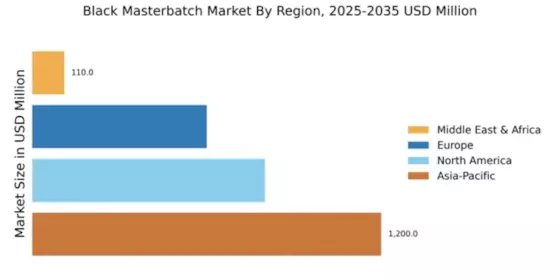
The North American black masterbatch market is projected to reach $800.0 million by 2025, driven by increasing demand in the packaging and automotive sectors. Regulatory support for sustainable materials is also a key growth driver, as companies seek to enhance product performance while adhering to environmental standards. The region's focus on innovation and technology further fuels market expansion, with a growing emphasis on high-quality, durable materials. Leading countries in this region include the US and Canada, where major players like Cabot Corporation and BASF SE are actively competing. The competitive landscape is characterized by a mix of established firms and emerging players, all striving to capture market share. The presence of significant manufacturing capabilities and R&D facilities enhances the region's attractiveness for investment in black masterbatch production.

Europe : Diverse Market with Regulatory Focus

Europe's black masterbatch market is expected to reach $600.0 million by 2025, influenced by stringent regulations promoting sustainable practices. The demand for eco-friendly materials is rising, particularly in the packaging and consumer goods sectors. Regulatory frameworks, such as the EU Plastics Strategy, are pivotal in shaping market dynamics, encouraging innovation in sustainable black masterbatch solutions. Germany, France, and the UK are leading countries in this market, with key players like BASF SE and A. Schulman driving competition. The presence of advanced manufacturing technologies and a strong emphasis on R&D contribute to the region's competitive edge. As companies adapt to regulatory changes, the market is witnessing a shift towards high-performance, environmentally friendly products.

Asia-Pacific : Emerging Powerhouse in Masterbatch

The Asia-Pacific region dominates the black masterbatch market, projected to reach $1,200.0 million by 2025. Rapid industrialization, urbanization, and a growing middle class are driving demand across various sectors, including packaging, automotive, and consumer goods. The region's favorable regulatory environment supports the adoption of advanced materials, further propelling market growth. China, India, and Japan are the leading countries in this market, with significant contributions from local and international players. Companies like SABIC and Kraton Corporation are expanding their presence, enhancing competition. The region's robust manufacturing capabilities and increasing investments in R&D are key factors that solidify its position as a global leader in black masterbatch production.

Middle East and Africa : Emerging Market with Growth Opportunities

The Middle East and Africa black masterbatch market is projected to reach $110.0 million by 2025, driven by increasing industrial activities and a growing demand for plastic products. The region's diverse economic landscape presents opportunities for growth, particularly in sectors like construction and packaging. Regulatory initiatives aimed at promoting local manufacturing are also contributing to market expansion. Countries such as South Africa and the UAE are at the forefront of this market, with a mix of local and international players vying for market share. The competitive landscape is evolving, with companies focusing on innovation and quality to meet the rising demand. As the region continues to develop, the black masterbatch market is expected to gain momentum, supported by investments in infrastructure and manufacturing capabilities.

Key Players and Competitive Insights

The Black Masterbatch Market is currently characterized by a competitive landscape that is both dynamic and multifaceted. Key growth drivers include the increasing demand for high-performance plastics across various industries, such as automotive, packaging, and consumer goods. Major players like Cabot Corporation (US), BASF SE (DE), and SABIC (SA) are strategically positioned to leverage their extensive product portfolios and technological advancements. For instance, Cabot Corporation (US) focuses on innovation in carbon black production, enhancing the performance characteristics of its masterbatches, while BASF SE (DE) emphasizes sustainability in its operations, aiming to reduce carbon footprints through eco-friendly formulations. These strategies collectively shape a competitive environment that is increasingly focused on innovation and sustainability.

In terms of business tactics, companies are localizing manufacturing to better serve regional markets and optimize supply chains for efficiency. The market structure appears moderately fragmented, with several key players exerting influence while also facing competition from smaller, specialized firms. This fragmentation allows for a diverse range of products and innovations, although larger companies tend to dominate in terms of market share and technological capabilities.

In November 2025, SABIC (SA) announced a partnership with a leading automotive manufacturer to develop advanced black masterbatches tailored for electric vehicle applications. This strategic move is significant as it aligns with the growing trend towards electrification in the automotive sector, positioning SABIC as a key player in a rapidly evolving market segment. The collaboration is expected to enhance product performance while meeting stringent regulatory requirements.

In October 2025, BASF SE (DE) launched a new line of sustainable black masterbatches derived from renewable resources. This initiative reflects the company's commitment to sustainability and addresses the increasing consumer demand for environmentally friendly products. By integrating renewable materials, BASF not only enhances its product offerings but also strengthens its market position amidst rising environmental concerns.

In September 2025, Cabot Corporation (US) expanded its production capacity for black masterbatches in response to growing global demand. This expansion is crucial as it enables Cabot to meet the needs of various industries while maintaining competitive pricing. The increased capacity is likely to enhance supply chain reliability and support the company's long-term growth objectives.

As of December 2025, current competitive trends in the Black Masterbatch Market are heavily influenced by digitalization, sustainability, and the integration of AI technologies. Strategic alliances are becoming increasingly important, as companies seek to enhance their capabilities and market reach. The competitive differentiation is expected to evolve from traditional price-based competition towards a focus on innovation, technological advancements, and supply chain reliability. This shift indicates a future where companies that prioritize sustainable practices and cutting-edge technology will likely emerge as leaders in the market.

Key Companies in the Black Masterbatch Market market include

Future Outlook

Black Masterbatch Market Future Outlook

The Black Masterbatch Market is projected to grow at a 5.14% CAGR from 2024 to 2035, driven by increasing demand in packaging, automotive, and consumer goods sectors.

New opportunities lie in:

  • Expansion into biodegradable masterbatch formulations
  • Development of customized black masterbatch solutions for specific industries
  • Investment in advanced manufacturing technologies to enhance production efficiency

By 2035, the Black Masterbatch Market is expected to achieve robust growth and diversification.

Market Segmentation

Black Masterbatch Market Application Outlook

  • Plastics
  • Rubber
  • Coatings
  • Masterbatch
  • Textiles

Black Masterbatch Market End Use Industry Outlook

  • Automotive
  • Packaging
  • Construction
  • Consumer Goods
  • Electronics

Black Masterbatch Market Formulation Type Outlook

  • Polyethylene
  • Polypropylene
  • Polyvinyl Chloride
  • Polystyrene
  • Polyurethane

Black Masterbatch Market Production Method Outlook

  • Extrusion
  • Injection Molding
  • Blow Molding
  • Calendering

Black Masterbatch Market Color Concentration Outlook

  • High Concentration
  • Medium Concentration
  • Low Concentration

Report Scope

MARKET SIZE 20242710.0(USD Million)
MARKET SIZE 20252849.35(USD Million)
MARKET SIZE 20354704.45(USD Million)
COMPOUND ANNUAL GROWTH RATE (CAGR)5.14% (2024 - 2035)
REPORT COVERAGERevenue Forecast, Competitive Landscape, Growth Factors, and Trends
BASE YEAR2024
Market Forecast Period2025 - 2035
Historical Data2019 - 2024
Market Forecast UnitsUSD Million
Key Companies ProfiledCabot Corporation (US), Continental Carbon (US), Kraton Corporation (US), SABIC (SA), BASF SE (DE), A. Schulman (US), PolyOne Corporation (US), M. Holland Company (US)
Segments CoveredApplication, End Use Industry, Formulation Type, Color Concentration, Production Method
Key Market OpportunitiesGrowing demand for sustainable packaging solutions drives innovation in the Black Masterbatch Market.
Key Market DynamicsRising demand for sustainable materials drives innovation and competition in the Black Masterbatch Market.
Countries CoveredNorth America, Europe, APAC, South America, MEA

Market Highlights

Author
Chitranshi Jaiswal
Research Analyst Level I

In her 3 years of experience in the market research field, she has handled critical cross-domain projects. She has an in-depth knowledge of market estimation & analysis, problem-solving, primary as well as secondary research, and team management.She holds an engineering degree and is an MBA professional from a well-known university, capable of evaluating the market and competitive conditions. An exceptional strategist with excellent communication skills and a passion for delivering cutting-edge & practical insights for the market. Proficient in multi-tasking, and can successfully deal with competing demands, while maintaining complete confidentiality. Generated business through active client and project development, networking, and high-quality responses. Her knowledge and skills have helped in making solid business decisions, securing funding from investors, and avoiding business failures.

Leave a Comment

FAQs

How much is the Black Masterbatch Market?

The Black Masterbatch Market size is expected to be valued at USD 2.59 Billion in 2035.

What is the growth rate of the Black Masterbatch Market?

Black Masterbatch Market is projected to register a CAGR of 5.14% from 2025-2035

Which region held the largest market share in the Black Masterbatch Market?

Asia Pacific had the largest share of the global market.

Who are the key players in the Black Masterbatch Market?

The key players in the market are Astec Industries CABOT CORPORATION, LYONDELLBASELL, AVIENT CORPORATION, PLASTIKA KRITIS S.A., PLASTIBLENDS INDIA LTD., DOW, POLYPLAST MULLER GMBH, RTP COMPANY, AMPACET CORPORATION, TOSAF, CAPITAL COLOURS, UNIVERSAL MASTERBATCH LLP, JJ PLASTALLOY, BASF SE, REPIN MASTERBATCH, LTD, And among others.

Which Type led the Black Masterbatch Market?

Standard Black Masterbatch dominated the market in 2024.

Which Application had the largest market share in the Black Masterbatch Market?

The packaging segment had the largest revenue share of the global market.

Download Free Sample

Kindly complete the form below to receive a free sample of this Report

Compare Licence

×
Features License Type
Single User Multiuser License Enterprise User
Price $4,950 $5,950 $7,250
Maximum User Access Limit 1 User Upto 10 Users Unrestricted Access Throughout the Organization
Free Customization
Direct Access to Analyst
Deliverable Format
Platform Access
Discount on Next Purchase 10% 15% 15%
Printable Versions