Segmentation Quick Reference
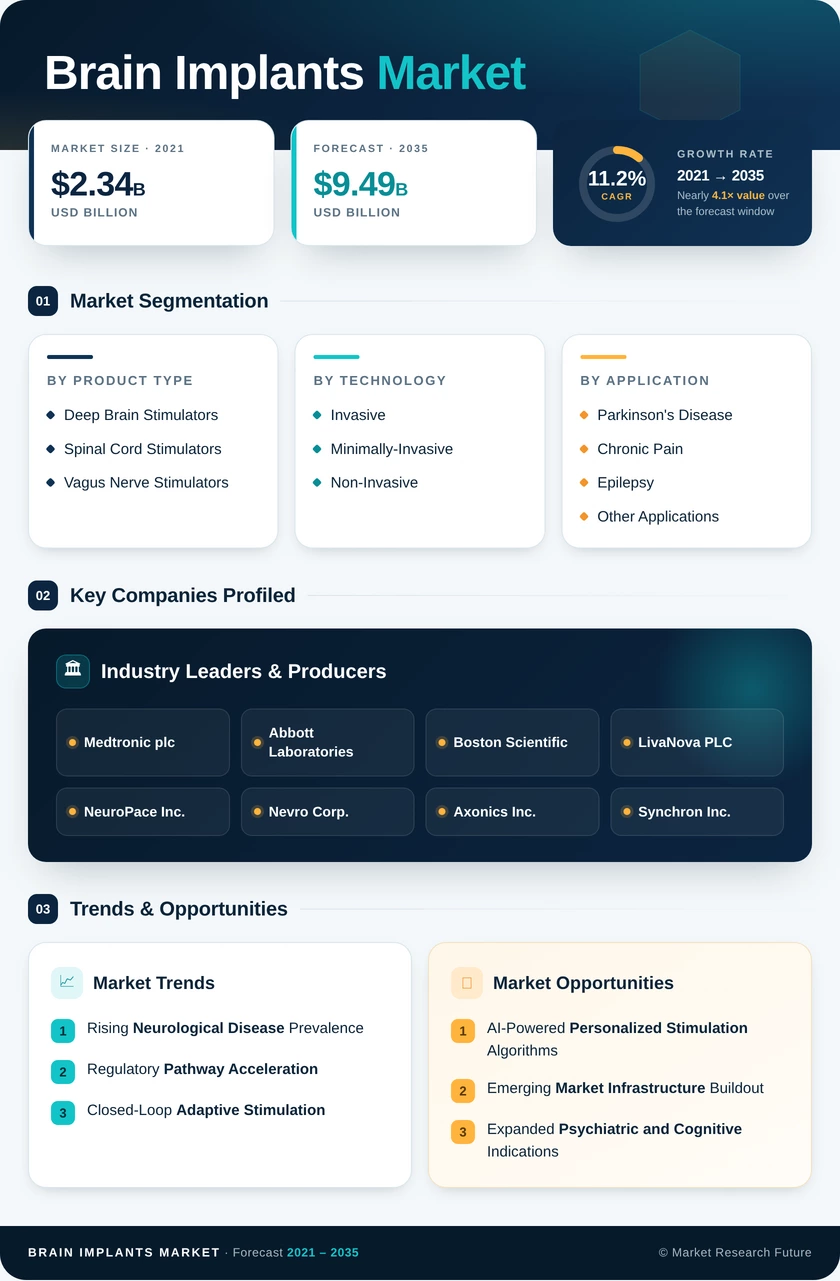
| Dimension | Sub-Segments | Dominant Segment | Fastest Growing Segment |
| Product Type | Deep Brain Stimulators, Spinal Cord Stimulators, Vagus Nerve Stimulators | Deep Brain Stimulators | Vagus Nerve Stimulators |
| Technology | Invasive, Minimally-Invasive, Non-Invasive | Minimally-Invasive | Non-Invasive |
| Application | Parkinson's Disease, Chronic Pain, Epilepsy, Other Applications | Parkinson's Disease | Epilepsy |
| End User | Hospitals & Neurosurgical Centers, Specialty Clinics, Other End Users | Hospitals & Neurosurgical Centers | Specialty Clinics |
Market Segmentation Overview
By Product Type
| Sub-Segment | Key Trend |
| Deep Brain Stimulators | Transition to directional leads and sensing-enabled platforms |
| Spinal Cord Stimulators | High-frequency and burst stimulation paradigms expanding clinical evidence |
| Vagus Nerve Stimulators | Indication expansion into depression, anxiety, and cluster headache |
Deep brain stimulators anchor the largest product segment, driven by entrenched clinical use in movement disorders and an expanding body of evidence for psychiatric applications. Vagus nerve stimulators represent the fastest growth trajectory as new therapeutic indications receive regulatory and reimbursement support.
By Technology
| Sub-Segment | Key Trend |
| Invasive | Precision targeting through robotic-assisted stereotactic surgery |
| Minimally-Invasive | Reduced hospital stays and lower infection rates driving surgeon preference |
| Non-Invasive | Transcranial and focused ultrasound approaches eliminating surgical barriers |
Minimally-invasive technologies hold the largest share, reflecting a systemic clinical preference for reduced operative risk. Non-invasive approaches are experiencing the fastest growth as transcranial platforms mature from research tools to clinically validated treatment modalities.
By Application
| Sub-Segment | Key Trend |
| Parkinson's Disease | Aging demographics expanding the global patient pool |
| Chronic Pain | Opioid alternative mandates driving non-pharmacological referrals |
| Epilepsy | Responsive neurostimulation closing the treatment gap in drug-resistant cases |
| Other Applications | Active clinical trials in depression, OCD, Alzheimer's disease |
Parkinson's disease remains the dominant application, while epilepsy represents the fastest-growing indication driven by closed-loop neurostimulation outcomes. Emerging psychiatric indications hold significant long-term upside potential.
By End User
| Sub-Segment | Key Trend |
| Hospitals & Neurosurgical Centers | Multidisciplinary team infrastructure requirements sustaining dominance |
| Specialty Clinics | Outpatient neuromodulation programs reducing per-procedure costs |
| Other End Users | Ambulatory surgical centers and academic research institutions |
Hospitals and neurosurgical centers command the majority of end-user share due to the capital-intensive nature of implant procedures. Specialty clinics are the fastest-growing channel as healthcare systems shift eligible procedures to lower-cost outpatient settings.