×
Request Free Sample ×

Kindly complete the form below to receive a free sample of this Report

* Please use a valid business email

Leading companies partner with us for data-driven Insights

clients tt-cursor
Hero Background

Brazil Metal Casting Market

ID: MRFR/CnM/47825-HCR
111 Pages
Chitranshi Jaiswal
October 2025

Brazil Metal Casting Market Research Report: By Metal (Cast Iron, Aluminum, Stainless Steel, Zinc, Magnesium), By Material Type (Cast Iron, Aluminum, Stainless Steel, Zinc, Magnesium), By Process (Sand Casting, Die Casting, Shell Mold Casting, Gravity Casting, Vacuum Casting), and By End-Use Industry (Automotive & Transportation, Building & Construction, Mining, Equipment & Machine, Consumer Goods) - Forecast to 2035.

Share:
Download PDF ×

We do not share your information with anyone. However, we may send you emails based on your report interest from time to time. You may contact us at any time to opt-out.

Brazil Metal Casting Market Infographic
Purchase Options

Brazil Metal Casting Market Summary

As per analysis, the Brazil metal casting market is projected to grow from USD 5.99 Billion in 2024 to USD 6.26 Billion in 2025, exhibiting a compound annual growth rate (CAGR) of 4.4% during the forecast period (2025 - 2035).

Key Market Trends & Highlights

The Brazil metal casting market is poised for growth driven by technological advancements and sustainability initiatives.

  • The automotive sector remains the largest segment, reflecting robust demand for cast components.
  • The aerospace segment is the fastest-growing, indicating increasing investments in advanced materials and technologies.
  • Ferrous casting continues to dominate the market, while non-ferrous casting is experiencing rapid growth due to its lightweight properties.
  • Key market drivers include infrastructure development and the growth of the automotive industry, which are likely to propel market expansion.

Market Size & Forecast

2024 Market Size 5.99 (USD Billion)
2035 Market Size 9.62 (USD Billion)
CAGR (2025 - 2035) 4.4%

Major Players

Metalurgica Gerdau (BR), Fundicao Tupy (BR), Metalcasty (BR), Fundicao de Ferro Tupy (BR), Fundicao de Metais (BR), Fundicao de Aluminio (BR), Fundicao de Aco (BR), Fundicao de Precisao (BR)

Brazil Metal Casting Market Trends

The Brazil metal casting market is currently experiencing a dynamic evolution, driven by various factors including industrial growth and technological advancements. The country has a robust manufacturing sector, which relies heavily on metal casting processes for producing components used in automotive, aerospace, and machinery industries. This reliance indicates a strong demand for high-quality cast products, which are essential for enhancing the performance and durability of end products. Furthermore, Brazil's strategic position in South America allows it to serve as a key supplier to neighboring countries, potentially expanding its market reach. In addition to industrial demand, environmental considerations are becoming increasingly relevant in the Brazil metal casting market. The industry is gradually adopting more sustainable practices, such as recycling scrap metal and utilizing eco-friendly materials. This shift not only aligns with global trends towards sustainability but also meets the expectations of consumers and regulatory bodies. As the market continues to adapt to these changes, it appears poised for growth, with opportunities for innovation and improved efficiency in casting processes.

Sustainability Initiatives

The Brazil metal casting market is witnessing a notable shift towards sustainability. Companies are increasingly adopting practices that minimize environmental impact, such as recycling materials and reducing waste. This trend reflects a growing awareness of ecological responsibilities and aligns with regulatory pressures for greener manufacturing processes.

Technological Advancements

Innovations in technology are significantly influencing the Brazil metal casting market. The integration of automation and advanced manufacturing techniques is enhancing production efficiency and product quality. These advancements enable manufacturers to meet the rising demand for precision-engineered components across various sectors.

Growing Automotive Sector

The automotive industry in Brazil is a major driver of the metal casting market. As vehicle production ramps up, the need for high-quality cast components is increasing. This trend suggests a robust future for manufacturers who can supply the necessary parts to support this expanding sector.

Market Segment Insights

By Application: Automotive (Largest) vs. Aerospace (Fastest-Growing)

In the Brazil metal casting market, the application segment is primarily dominated by the automotive industry, which encompasses a significant share due to the extensive production of vehicles in the region. Following closely are segments like industrial machinery and construction, which also contribute substantially to the market landscape. Aerospace is emerging with a growing stake, reflecting a shift towards advanced technologies and lightweight materials in aircraft manufacturing. The growth trends in the Brazil metal casting market are significantly impacted by the surge in automotive production, propelled by increasing consumer demand. However, the aerospace industry is rising rapidly, driven by investments in innovation and the need for more energy-efficient aircraft solutions. This shift indicates a broader trend of modernization across all sectors, which is vital for sustaining long-term growth in the metal casting market.

Automotive: Dominant vs. Aerospace: Emerging

The automotive sector remains the dominant force in the Brazil metal casting market, characterized by high volume production and a robust supply chain that supports various vehicle manufacturing operations. This segment benefits from continuous advancements in technology, enabling manufacturers to produce complex castings that meet stringent safety and performance standards. On the other hand, the aerospace sector is emerging as a significant player, focusing on high-value production with less volume compared to automotive. This segment prioritizes precision and quality, driven by regulatory compliance and the demand for lightweight materials in aircraft design. As both industries continue to evolve, they create a dynamic interplay of competition and collaboration that shapes the metal casting landscape in Brazil.

By Material Type: Ferrous (Largest) vs. Non-Ferrous (Fastest-Growing)

In the Brazil metal casting market, the material type segment is primarily dominated by Ferrous materials, which cover a significant share due to their applications in construction, automotive, and machinery. Non-Ferrous metals, while holding a smaller share, are rapidly gaining traction due to their lightweight and corrosion-resistant properties, becoming increasingly popular in high-tech applications and lightweight construction. The growth trends indicate a promising rise in Non-Ferrous materials as industries shift towards performance-oriented and environmentally-friendly options. The push for innovation and performance in sectors such as automotive and aerospace is fueling this demand. Additionally, the government initiatives toward sustainability are likely to further accelerate the shift from Ferrous to Non-Ferrous casting materials, making them a vital part of future market forecasts.

Ductile Iron (Dominant) vs. Gray Iron (Emerging)

Ductile Iron, recognized for its high strength and flexibility, dominates the Brazil metal casting market. This material is widely used in applications such as automotive components, pipes, and heavy machinery due to its excellent mechanical properties. Its market position is fortified by a growing demand for durable materials in infrastructure projects. In contrast, Gray Iron, known for its excellent casting characteristics and thermal conductivity, is emerging as a popular choice for manufacturing engine blocks and machine bases. The increase in automotive production in Brazil, combined with the need for cost-effective solutions, positions Gray Iron as a competitor in niche applications, suggesting a potential for growth as manufacturers seek balance between cost and performance.

By Process Type: Die Casting (Largest) vs. Sand Casting (Fastest-Growing)

In the Brazilian metal casting market, the distribution among process types indicates that Die Casting holds a significant share, largely due to its efficiency and capacity for mass production. Sand Casting and Investment Casting also contribute notably, but they fall behind in market presence. Permanent Mold and Centrifugal Castings play more niche roles, catering to specific applications where their advantages are distinctly beneficial, but they do not dominate the overall market landscape.

Casting Method: Die Casting (Dominant) vs. Sand Casting (Emerging)

Die Casting serves as the dominant method in the Brazil metal casting market, providing superior precision and expedited production processes, especially for high-volume component manufacturing. Its ability to create complex geometries with minimal finishing also elevates its appeal. Conversely, Sand Casting is emerging rapidly, driven by its lower costs and versatility for producing both small and large components. While traditionally considered more labor-intensive, advancements in technology are enhancing its efficiencies, broadening its application in various industries including automotive and aerospace.

Get more detailed insights about Brazil Metal Casting Market

Key Players and Competitive Insights

The metal casting market in Brazil is characterized by a competitive landscape that is both dynamic and multifaceted. Key growth drivers include the increasing demand for automotive components, infrastructure development, and advancements in manufacturing technologies. Major players such as Metalurgica Gerdau (BR), Fundicao Tupy (BR), and Metalcasty (BR) are strategically positioned to leverage these trends. Metalurgica Gerdau (BR) focuses on innovation and sustainability, investing in eco-friendly production processes, while Fundicao Tupy (BR) emphasizes regional expansion and partnerships to enhance its market reach. Metalcasty (BR) appears to be concentrating on digital transformation, integrating advanced technologies into its operations, which collectively shapes a competitive environment that is increasingly reliant on technological advancements and sustainable practices.

In terms of business tactics, companies are localizing manufacturing to reduce costs and optimize supply chains, which is particularly crucial in a market that is moderately fragmented. The competitive structure allows for both established players and new entrants to coexist, with key players exerting considerable influence over market dynamics. This fragmentation encourages innovation and responsiveness to market demands, as companies strive to differentiate themselves through unique offerings and operational efficiencies.

In November 2025, Metalurgica Gerdau (BR) announced a strategic partnership with a leading technology firm to develop AI-driven solutions for optimizing production processes. This move is significant as it not only enhances operational efficiency but also positions the company as a frontrunner in adopting cutting-edge technologies within the metal casting sector. The integration of AI is likely to streamline operations and reduce waste, aligning with the growing emphasis on sustainability.

In October 2025, Fundicao Tupy (BR) expanded its manufacturing capabilities by acquiring a local competitor, which is expected to bolster its production capacity and market share. This acquisition reflects a strategic approach to consolidate resources and enhance competitiveness in a rapidly evolving market. By increasing its footprint, Fundicao Tupy (BR) aims to better serve its clients and respond to the rising demand for high-quality castings in various industries.

In September 2025, Metalcasty (BR) launched a new line of eco-friendly aluminum castings, which underscores its commitment to sustainability and innovation. This product line is designed to meet the growing consumer demand for environmentally responsible manufacturing practices. By prioritizing sustainable materials and processes, Metalcasty (BR) is likely to attract a broader customer base and strengthen its market position.

As of December 2025, current competitive trends in the metal casting market are heavily influenced by digitalization, sustainability, and the integration of AI technologies. Strategic alliances are becoming increasingly important, as companies seek to enhance their capabilities and market presence through collaboration. The competitive differentiation is expected to evolve from traditional price-based competition to a focus on innovation, technology adoption, and supply chain reliability. This shift indicates a transformative phase in the market, where companies that prioritize these aspects are likely to emerge as leaders.


Key Companies in the Brazil Metal Casting Market market include

Industry Developments

In recent months, the Brazil Metal Casting Market has witnessed significant developments, particularly in the realm of mergers and acquisitions. In July 2023, Gerdau announced the acquisition of a majority stake in a local metal casting firm, aiming to enhance its production capabilities and expand its market share within the region.

Additionally, Usiminas has been focused on increasing its investments in production technology to meet the rising demand for automotive components, which is projected to boost its market valuation. The overall market has experienced solid growth due to the surge in sectors like automotive and construction, prompting companies like Weg and ArcelorMittal Brasil to ramp up their production capacities.

Furthermore, the Brazilian government is implementing initiatives to enhance the competitiveness of domestic metal casting, which is reshaping the landscape for companies such as Metalsa and Tupy. In the last few years, particularly in 2022, there was a noticeable increase in environmental standards affecting production processes, driving modernization efforts across the industry.

Market participants are now focusing on sustainable practices to align with national policies and consumer expectations.

Future Outlook

Brazil Metal Casting Market Future Outlook

The Brazil metal casting market is projected to grow at a 4.4% CAGR from 2024 to 2035, driven by industrial demand, technological advancements, and sustainable practices.

New opportunities lie in:

  • Investment in advanced automation technologies for increased efficiency.
  • Development of eco-friendly casting materials to meet regulatory standards.
  • Expansion into emerging sectors like renewable energy components.

By 2035, the Brazil metal casting market is expected to be robust, driven by innovation and sustainability.

Market Segmentation

Brazil Metal Casting Market Application Outlook

  • Automotive
  • Aerospace
  • Industrial Machinery
  • Consumer Goods
  • Construction

Brazil Metal Casting Market Process Type Outlook

  • Sand Casting
  • Die Casting
  • Investment Casting
  • Permanent Mold Casting
  • Centrifugal Casting

Brazil Metal Casting Market Material Type Outlook

  • Ferrous
  • Non-Ferrous
  • Alloy
  • Ductile Iron
  • Gray Iron

Report Scope

MARKET SIZE 20245.99(USD Billion)
MARKET SIZE 20256.26(USD Billion)
MARKET SIZE 20359.62(USD Billion)
COMPOUND ANNUAL GROWTH RATE (CAGR)4.4% (2024 - 2035)
REPORT COVERAGERevenue Forecast, Competitive Landscape, Growth Factors, and Trends
BASE YEAR2024
Market Forecast Period2025 - 2035
Historical Data2019 - 2024
Market Forecast UnitsUSD Billion
Key Companies ProfiledMetalurgica Gerdau (BR), Fundicao Tupy (BR), Metalcasty (BR), Fundicao de Ferro Tupy (BR), Fundicao de Metais (BR), Fundicao de Aluminio (BR), Fundicao de Aco (BR), Fundicao de Precisao (BR)
Segments CoveredApplication, Material Type, Process Type
Key Market OpportunitiesAdoption of advanced manufacturing technologies enhances efficiency in the Brazil metal casting market.
Key Market DynamicsBrazil's metal casting market experiences growth driven by technological advancements and increasing demand from automotive and aerospace sectors.
Countries CoveredBrazil

Leave a Comment

FAQs

What was the market size of the Brazil Metal Casting Market in 2024?

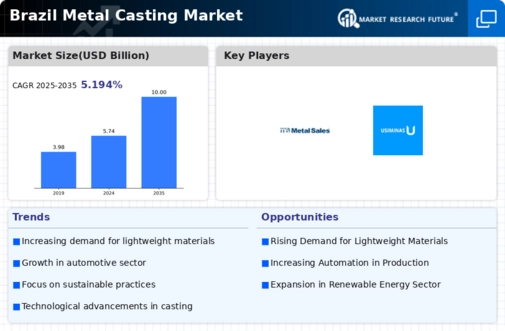
The Brazil Metal Casting Market was valued at 5.74 USD Billion in the year 2024.

What is the expected market value of the Brazil Metal Casting Market by 2035?

By the year 2035, the market is anticipated to reach a value of 10.02 USD Billion.

What is the compound annual growth rate (CAGR) for the Brazil Metal Casting Market from 2025 to 2035?

The expected CAGR for the Brazil Metal Casting Market during the forecast period from 2025 to 2035 is 5.194%.

Which segment of the Brazil Metal Casting Market held the largest value in 2024?

In 2024, the Aluminum segment of the Brazil Metal Casting Market was valued at 1.5 USD Billion, making it the largest segment.

What is the projected value of the Cast Iron segment in the Brazil Metal Casting Market by 2035?

The Cast Iron segment is expected to grow to a value of 2.22 USD Billion by the year 2035.

Who are the key players in the Brazil Metal Casting Market?

Major players in the Brazil Metal Casting Market include Weg, Votorantim Metais, Metalsa, Gerdau, and Usiminas.

What was the market value of the Stainless-Steel segment in 2024?

The Stainless-Steel segment was valued at 1.0 USD Billion in the year 2024.

How much is the Magnesium segment expected to be valued in 2035?

By 2035, the Magnesium segment is projected to be valued at 0.18 USD Billion.

What challenges are affecting the growth of the Brazil Metal Casting Market?

Challenges affecting growth include fluctuating raw material prices and environmental regulations impacting production.

What are the emerging trends in the Brazil Metal Casting Market?

Emerging trends include increased automation in manufacturing and a growing emphasis on sustainable casting practices.

Download Free Sample

Kindly complete the form below to receive a free sample of this Report

Compare Licence

×
Features License Type
Single User Multiuser License Enterprise User
Price $4,950 $ $7,250
Maximum User Access Limit 1 User Upto 10 Users Unrestricted Access Throughout the Organization
Free Customization
Direct Access to Analyst
Deliverable Format
Platform Access
Discount on Next Purchase 10% 15% 15%
Printable Versions