×
Request Free Sample ×

Kindly complete the form below to receive a free sample of this Report

* Please use a valid business email

Leading companies partner with us for data-driven Insights

clients tt-cursor
Hero Background

Business Analytics Market

ID: MRFR/ICT/5235-HCR
100 Pages
Aarti Dhapte
October 2025

Business Analytics Market Research Report: Information By Deployment Mode (On-Cloud, and On-Premises), Industry (Retail, Telecom & IT, Healthcare, Manufacturing, Media & Entertainment, Energy & Power, Government, BFSI, Education), Services (Managed, Professional Services), Software (Advanced & Predictive Analytics, Data Discovery & Visualization Software, Content Analytics), Application (Finance Analytics, Marketing Analytics, Supply Chain Analytics, Data Mining), End-User (SMEs & Large-Scale Enterprises) Regions-Fore... read more

Share:
Download PDF ×

We do not share your information with anyone. However, we may send you emails based on your report interest from time to time. You may contact us at any time to opt-out.

Business Analytics Market Infographic
Purchase Options

Business Analytics Market Summary

As per MRFR analysis, the Business Analytics Market was estimated at 55.25 USD Billion in 2024. The Business Analytics industry is projected to grow from 59.94 USD Billion in 2025 to 135.56 USD Billion by 2035, exhibiting a compound annual growth rate (CAGR) of 8.5 during the forecast period 2025 - 2035.

Key Market Trends & Highlights

The Business Analytics Market is experiencing robust growth driven by technological advancements and increasing demand for data insights.

  • The integration of AI and Machine Learning is transforming data analysis capabilities across industries.
  • North America remains the largest market, while Asia-Pacific is recognized as the fastest-growing region in business analytics.
  • Predictive Analytics continues to dominate the market, whereas Prescriptive Analytics is emerging as the fastest-growing segment.
  • Rising demand for data-driven decision making and increased adoption of cloud-based solutions are key drivers propelling market expansion.

Market Size & Forecast

2024 Market Size 55.25 (USD Billion)
2035 Market Size 135.56 (USD Billion)
CAGR (2025 - 2035) 8.5%

Major Players

IBM (US), Microsoft (US), SAP (DE), Oracle (US), SAS (US), Tableau (US), Qlik (US), Domo (US), MicroStrategy (US)

Business Analytics Market Trends

The Business Analytics Market is currently experiencing a transformative phase, characterized by the increasing integration of advanced technologies such as artificial intelligence and machine learning. Organizations across various sectors are recognizing the value of data-driven decision-making, which enhances operational efficiency and drives strategic initiatives. As businesses strive to remain competitive, the demand for sophisticated analytics tools is on the rise. This trend is further fueled by the growing emphasis on real-time data analysis, enabling companies to respond swiftly to market changes and consumer preferences. Moreover, the proliferation of cloud computing solutions is facilitating easier access to analytics platforms, thereby democratizing data insights for organizations of all sizes. In addition to technological advancements, the Business Analytics Market is witnessing a shift towards a more collaborative approach to data utilization. Stakeholders are increasingly prioritizing cross-departmental collaboration, which fosters a culture of shared insights and collective problem-solving. This collaborative environment not only enhances the quality of analytics but also promotes innovation within organizations. Furthermore, the focus on data privacy and security is becoming paramount, as businesses seek to protect sensitive information while leveraging analytics for growth. Overall, the Business Analytics Market appears poised for continued expansion, driven by these evolving trends and the relentless pursuit of data excellence.

Integration of AI and Machine Learning

The incorporation of artificial intelligence and machine learning technologies is reshaping the Business Analytics Market. These innovations enable organizations to analyze vast datasets more efficiently, uncovering patterns and insights that were previously unattainable.

Real-Time Data Analysis

The demand for real-time data analysis is surging within the Business Analytics Market. Companies are increasingly seeking tools that allow them to make informed decisions quickly, adapting to dynamic market conditions and consumer behaviors.

Collaborative Data Utilization

A notable trend in the Business Analytics Market is the shift towards collaborative data utilization. Organizations are fostering environments where cross-departmental teams work together, sharing insights to enhance decision-making and drive innovation.

Business Analytics Market Drivers

Market Growth Projections

The Global Business Analytics Market Industry is poised for substantial growth in the coming years. Projections indicate that the market will reach 35.8 USD Billion in 2024 and is expected to expand to 135.5 USD Billion by 2035. This growth trajectory reflects a compound annual growth rate of 12.85% from 2025 to 2035. The increasing reliance on data analytics across various industries, coupled with technological advancements, suggests a robust future for the market. As organizations continue to prioritize data-driven strategies, the Global Business Analytics Market is likely to evolve, presenting new opportunities and challenges for stakeholders.

Regulatory Compliance and Risk Management

Regulatory compliance and risk management are becoming pivotal drivers in the Global Business Analytics Market Industry. As businesses face increasing scrutiny from regulatory bodies, the need for robust analytics solutions to ensure compliance with various regulations is paramount. Analytics tools help organizations monitor and analyze data to identify potential risks and ensure adherence to legal standards. This necessity is particularly pronounced in sectors such as finance and healthcare, where compliance failures can lead to severe penalties. Consequently, the demand for analytics solutions that facilitate risk assessment and compliance monitoring is expected to grow, further propelling market expansion.

Increasing Adoption of Cloud-Based Solutions

The shift towards cloud-based solutions significantly influences the Global Business Analytics Market Industry. Organizations are increasingly migrating their analytics operations to the cloud, attracted by the scalability, flexibility, and cost-effectiveness that cloud platforms offer. This transition allows businesses to access advanced analytics tools without the need for substantial upfront investments in infrastructure. As a result, the market is expected to witness a compound annual growth rate of 12.85% from 2025 to 2035. The ability to analyze data in real-time and collaborate across geographies enhances decision-making processes, further driving the adoption of cloud-based analytics solutions.

Rising Demand for Data-Driven Decision Making

The Global Business Analytics Market Industry experiences a surge in demand for data-driven decision making as organizations recognize the value of leveraging data insights. In 2024, the market is projected to reach 35.8 USD Billion, driven by the need for improved operational efficiency and competitive advantage. Companies across various sectors, including finance and healthcare, are increasingly adopting analytics tools to enhance their strategic planning. This trend indicates a broader shift towards data-centric cultures, where decisions are informed by empirical evidence rather than intuition. As organizations continue to invest in analytics capabilities, the market is expected to expand significantly.

Technological Advancements in Analytics Tools

Technological advancements play a crucial role in propelling the Global Business Analytics Market Industry forward. Innovations in artificial intelligence, machine learning, and cloud computing are transforming how businesses analyze data. These technologies enable organizations to process vast amounts of information quickly and derive actionable insights. For instance, AI-driven analytics platforms can identify patterns and trends that human analysts might overlook. As these tools become more sophisticated and accessible, businesses are likely to invest more heavily in analytics solutions, contributing to the projected growth of the market, which is anticipated to reach 135.5 USD Billion by 2035.

Growing Importance of Customer Experience Management

The emphasis on customer experience management is reshaping the Global Business Analytics Market Industry. Organizations are increasingly utilizing analytics to understand customer behavior, preferences, and feedback. By leveraging data insights, businesses can tailor their offerings and improve customer satisfaction, leading to increased loyalty and retention. This trend is particularly evident in retail and e-commerce sectors, where companies analyze purchasing patterns to optimize marketing strategies. As customer-centric approaches gain traction, the demand for analytics solutions that provide actionable insights into customer interactions is likely to rise, contributing to the overall growth of the market.
Market Segment Insights

By Application: Predictive Analytics (Largest) vs. Prescriptive Analytics (Fastest-Growing)

In the Business Analytics Market, the application segment is primarily dominated by predictive analytics, which captures a substantial share due to its widespread adoption across various industries. Predictive analytics empowers organizations to forecast future trends and behaviors by analyzing historical data, making it a vital tool for strategic decision-making. Following closely is prescriptive analytics, which is gaining traction as businesses seek to not only predict outcomes but also to recommend actions to optimize results. This shift toward actionable insights is driving growth in prescriptive analytics, establishing it as a key area of investment.

Analytics: Predictive (Dominant) vs. Prescriptive (Emerging)

Predictive analytics stands as the dominant application within the Business Analytics Market, leveraging machine learning algorithms to identify patterns and predict future scenarios based on historical data. It is widely used in industries like retail, finance, and healthcare to enhance decision-making processes. On the other hand, prescriptive analytics is emerging rapidly, focusing on advising on possible outcomes and optimal courses of action. By combining both historical insights and predictive models, prescriptive analytics enables organizations to navigate complex decision landscapes with confidence. This harmonious blend of both analytics types equips decision-makers with comprehensive insights, fostering data-driven strategies.

By Deployment Model: Cloud-Based (Largest) vs. On-Premises (Fastest-Growing)

In the Business Analytics Market, the deployment model segment shows a diverse landscape with Cloud-Based solutions holding the largest market share. Organizations increasingly prefer the scalability, flexibility, and cost-effectiveness offered by cloud environments. In comparison, On-Premises solutions have a significant yet smaller share, recognized for their enhanced security and data control, appealing to industries with strict compliance mandates. As the market continues to evolve, the demand for different deployment models reflects varied business needs.

Cloud-Based (Dominant) vs. On-Premises (Emerging)

Cloud-Based deployment models are increasingly dominant in the Business Analytics Market due to their ability to provide instant access to analytics tools and real-time data processing. This model supports rapid scaling, thus accommodating a growing number of users and applications seamlessly. On-Premises deployment, while still relevant, is emerging as businesses seek greater control over their data and compliance with regulatory standards. Hybrid models, combining both cloud and on-premises solutions, are also gaining traction, offering organizations the best of both worlds—flexibility and stringent security. Each model addresses unique operational needs, shaping the diverse landscape of business analytics.

By End User: BFSI (Largest) vs. Healthcare (Fastest-Growing)

The Business Analytics Market demonstrates a diverse distribution of market share among its end users. The Banking, Financial Services, and Insurance (BFSI) sector emerges as the largest end user, benefitting from increasingly complex data requirements and regulatory pressures. Meanwhile, the healthcare sector is rapidly gaining traction, driven by the need for improved patient outcomes and efficiency in healthcare delivery through data-driven insights. As we look at market dynamics, BFSI's stability is contrasted by healthcare's growing adoption of analytics solutions, positioning it as a key player for future growth.

BFSI: Dominant vs. Healthcare: Emerging

The BFSI sector is characterized by its extensive reliance on data analytics to manage risks, improve customer service, and comply with regulatory standards. This dominance is fueled by the sector's robust infrastructure and established processes that integrate analytics seamlessly. In contrast, the healthcare sector is emerging as a significant player, spurred by advancements in medical technology and the increasing importance of personalized healthcare solutions. While BFSI dominates the analytics landscape, healthcare’s rapid adaptation points towards its transformative potential, with analytics enabling healthcare providers to leverage patient data for enhanced decision-making and operational efficiency.

By Component: Software (Largest) vs. Services (Fastest-Growing)

In the Business Analytics Market, the component segment consists of software, services, and hardware. Among these, software holds the largest market share, driven by its foundational role in business intelligence and analytics. Organizations are increasingly leveraging advanced analytical software to gain insights from data. Services, while currently smaller in share, are the fastest-growing segment, fueled by the rising demand for consulting and implementation services associated with complex analytics solutions. Hardware, although necessary, plays a supporting role compared to the above two.

Software (Dominant) vs. Services (Emerging)

Software services in the Business Analytics Market are characterized by their comprehensive capabilities, enabling organizations to process vast amounts of data and extract actionable insights. These solutions range from basic analytics tools to sophisticated machine learning platforms, providing users with a wide array of functionalities. The dominant position of software is largely attributed to the ongoing digital transformation across industries, where data-driven decision-making is paramount. Conversely, service offerings, including analytics consulting and support, are emerging rapidly as businesses seek expertise in optimizing their analytics processes. As organizations prioritize data strategy, the service segment is witnessing robust growth, establishing itself as a critical component of effective business analytics implementations.

By Organization Size: Small Enterprises (Largest) vs. Large Enterprises (Fastest-Growing)

In the Business Analytics Market, the distribution of market share among organization sizes reveals that small enterprises occupy the largest segment. This can be attributed to their increasing adoption of data-driven decision-making, enabling them to leverage insights for competitive advantage. Medium enterprises also hold a significant portion, while large enterprises are witnessing rapid growth due to their expansive resources and capabilities to invest in advanced analytics tools. As the market evolves, smaller businesses are ramping up their analytics capabilities, driven by affordability and accessibility of technology. Meanwhile, large enterprises are focusing on sophisticated analytics solutions to streamline operations and enhance strategic initiatives. This dual dynamic signifies the disruptive potential of evolving analytics applications across organization sizes.

Small Enterprises (Dominant) vs. Large Enterprises (Emerging)

Small enterprises remain the dominant force in the Business Analytics Market, primarily due to their agility and responsiveness to market changes. They tend to adopt user-friendly analytics solutions that require less investment, allowing for quicker implementation and immediate returns. In contrast, large enterprises, while currently emerging in terms of market growth, harness significant capital to invest in cutting-edge analytics capabilities. They focus on complex data analysis, aiming for deeper insights into customer behavior and operational efficiency. The drive towards big data analytics, cloud computing, and AI integration positions large enterprises to outpace smaller competitors over time, even as the latter enjoy a broader presence within the market.

Get more detailed insights about Business Analytics Market

Regional Insights

North America : Innovation Hub for Analytics

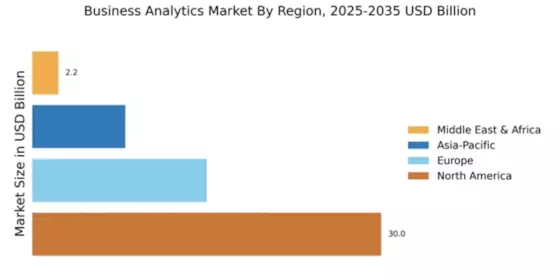
North America dominates the Business Analytics Market, holding a significant 30.0% share as of December 2025. The region's growth is driven by rapid technological advancements, increasing demand for data-driven decision-making, and supportive regulatory frameworks. Companies are investing heavily in analytics to enhance operational efficiency and customer engagement, further propelling market expansion. The competitive landscape is robust, with key players like IBM, Microsoft, and Oracle leading the charge. The U.S. remains the primary market, characterized by a high concentration of technology firms and startups. This environment fosters innovation and collaboration, ensuring that North America continues to set trends in business analytics.

Europe : Emerging Analytics Powerhouse

Europe's Business Analytics Market is poised for growth, currently valued at 15.0%. The region benefits from increasing digital transformation initiatives and a strong emphasis on data privacy regulations, such as GDPR, which drive demand for compliant analytics solutions. The focus on sustainability and efficiency in business operations also fuels market expansion, as organizations seek to leverage data for strategic insights. Leading countries like Germany, the UK, and France are at the forefront of this growth, with a competitive landscape featuring major players like SAP and Oracle. The presence of numerous SMEs also contributes to a diverse market, fostering innovation and tailored solutions. As businesses increasingly recognize the value of analytics, Europe is set to enhance its market position significantly.

Asia-Pacific : Rapidly Growing Market Potential

The Asia-Pacific region, with a market size of 8.0%, is rapidly emerging as a key player in the Business Analytics Market. The growth is fueled by increasing internet penetration, mobile device usage, and a burgeoning middle class that demands data-driven insights. Governments are also investing in digital infrastructure, creating a conducive environment for analytics adoption across various sectors. Countries like China, India, and Japan are leading the charge, with a mix of established firms and startups driving innovation. The competitive landscape is diverse, featuring both global giants and local players. As organizations in this region recognize the importance of analytics for competitive advantage, the market is expected to witness substantial growth in the coming years.

Middle East and Africa : Resource-Rich Frontier for Analytics

The Middle East and Africa (MEA) region, valued at 2.25%, is gradually emerging in the Business Analytics Market. The growth is driven by increasing investments in technology and a shift towards data-driven decision-making across various industries. Governments are recognizing the importance of analytics in enhancing operational efficiency and are implementing supportive policies to encourage adoption. Countries like South Africa, UAE, and Kenya are leading the way, with a growing number of startups and established firms entering the analytics space. The competitive landscape is evolving, with both local and international players vying for market share. As the region continues to develop its digital infrastructure, the potential for analytics growth is significant.

Key Players and Competitive Insights

The Business Analytics Market is currently characterized by a dynamic competitive landscape, driven by rapid technological advancements and an increasing demand for data-driven decision-making. Key players such as IBM (US), Microsoft (US), and SAP (DE) are strategically positioned to leverage their extensive portfolios and innovative capabilities. IBM (US) focuses on integrating AI and machine learning into its analytics solutions, enhancing predictive capabilities and operational efficiency. Meanwhile, Microsoft (US) emphasizes cloud-based analytics, promoting its Azure platform to facilitate seamless data integration and real-time insights. SAP (DE) is concentrating on expanding its analytics offerings through strategic partnerships, thereby enhancing its market reach and customer engagement. Collectively, these strategies contribute to a competitive environment that is increasingly centered around innovation and technological integration.

In terms of business tactics, companies are increasingly localizing their operations and optimizing supply chains to enhance responsiveness to market demands. The Business Analytics Market appears moderately fragmented, with a mix of established players and emerging startups. The collective influence of key players shapes market dynamics, as they engage in strategic collaborations and acquisitions to bolster their market positions and expand their service offerings.

In November 2025, IBM (US) announced a significant partnership with a leading cloud service provider to enhance its AI-driven analytics capabilities. This collaboration is poised to enable IBM to offer more robust solutions that integrate seamlessly with cloud infrastructures, thereby attracting a broader customer base. The strategic importance of this partnership lies in its potential to enhance IBM's competitive edge in the rapidly evolving analytics landscape, particularly as businesses increasingly migrate to cloud-based solutions.

In October 2025, Microsoft (US) launched a new suite of analytics tools designed specifically for small and medium-sized enterprises (SMEs). This initiative reflects Microsoft's commitment to democratizing access to advanced analytics capabilities, allowing SMEs to harness data insights for strategic decision-making. The launch is strategically significant as it positions Microsoft to capture a growing segment of the market that has historically been underserved, thereby expanding its customer base and reinforcing its market leadership.

In September 2025, SAP (DE) unveiled a new analytics platform that integrates sustainability metrics into business intelligence tools. This move aligns with the increasing emphasis on sustainability in corporate strategies and reflects SAP's commitment to providing comprehensive solutions that address both operational efficiency and environmental responsibility. The strategic importance of this platform lies in its ability to attract environmentally conscious businesses, thereby enhancing SAP's competitive positioning in a market that is increasingly prioritizing sustainability.

As of December 2025, current competitive trends in the Business Analytics Market are heavily influenced by digitalization, sustainability, and AI integration. Strategic alliances are becoming increasingly pivotal, as companies seek to enhance their technological capabilities and market reach. The competitive differentiation is likely to evolve from traditional price-based competition to a focus on innovation, technology, and supply chain reliability. This shift suggests that companies that prioritize advanced analytics capabilities and sustainable practices will be better positioned to thrive in the future.

Key Companies in the Business Analytics Market market include

Industry Developments

November 2022: IBM has unveiled a business intelligence (BI) and analytics package, branded Business Analytics Market Enterprise, that it says is aimed to assist firms in breaking down data silos and limitations to cooperation generated by using disparate sets of analytics tools in different divisions. By doing this, businesses may address emerging issues like supply chain interruptions, labor shortages, and changing legislation more effectively.

Future Outlook

Business Analytics Market Future Outlook

The Business Analytics Market is projected to grow at an 8.5% CAGR from 2024 to 2035, driven by advancements in AI, data integration, and demand for real-time insights.

New opportunities lie in:

  • Development of AI-driven predictive analytics tools for retail optimization.
  • Integration of IoT data analytics for enhanced supply chain management.
  • Creation of customized analytics solutions for small and medium enterprises.

By 2035, the Business Analytics Market is expected to be robust, driven by innovation and diverse applications.

Market Segmentation

Business Analytics Market End User Outlook

  • BFSI
  • Retail
  • Healthcare
  • Manufacturing
  • Telecommunications

Business Analytics Market Component Outlook

  • Software
  • Services
  • Hardware

Business Analytics Market Application Outlook

  • Predictive Analytics
  • Descriptive Analytics
  • Prescriptive Analytics
  • Diagnostic Analytics

Business Analytics Market Deployment Model Outlook

  • On-Premises
  • Cloud-Based
  • Hybrid

Business Analytics Market Organization Size Outlook

  • Small Enterprises
  • Medium Enterprises
  • Large Enterprises

Report Scope

MARKET SIZE 202455.25(USD Billion)
MARKET SIZE 202559.94(USD Billion)
MARKET SIZE 2035135.56(USD Billion)
COMPOUND ANNUAL GROWTH RATE (CAGR)8.5% (2024 - 2035)
REPORT COVERAGERevenue Forecast, Competitive Landscape, Growth Factors, and Trends
BASE YEAR2024
Market Forecast Period2025 - 2035
Historical Data2019 - 2024
Market Forecast UnitsUSD Billion
Key Companies ProfiledIBM (US), Microsoft (US), SAP (DE), Oracle (US), SAS (US), Tableau (US), Qlik (US), Domo (US), MicroStrategy (US)
Segments CoveredApplication, Deployment Model, End User, Component, Organization Size
Key Market OpportunitiesIntegration of artificial intelligence and machine learning enhances predictive analytics capabilities in the Business Analytics Market.
Key Market DynamicsRising demand for data-driven decision-making fuels competition and innovation in the Business Analytics Market.
Countries CoveredNorth America, Europe, APAC, South America, MEA

Market Highlights

Author
Aarti Dhapte
Team Lead - Research

She holds an experience of about 6+ years in Market Research and Business Consulting, working under the spectrum of Information Communication Technology, Telecommunications and Semiconductor domains. Aarti conceptualizes and implements a scalable business strategy and provides strategic leadership to the clients. Her expertise lies in market estimation, competitive intelligence, pipeline analysis, customer assessment, etc.

Leave a Comment

FAQs

How much is the business analytics market?

The global business analytics market size was valued at USD 55.24 Billion in 2024.

What is the growth rate of the business analytics market?

The global market is projected to grow at a CAGR of 8.50% during the forecast period, 2025-2034.

Which region held the most extensive market share in the business analytics market?

North America had the largest share of the global market

Who are the key players in the business analytics market?

The key players in the market are SAS Institute, Inc., SAP SE, Tableau Software, Inc., Microstrategy Incorporated, Teradata Corporation, Oracle Corporation, Adobe Systems Incorporated, and Qlik Technologies, Inc.

Which deployment mode led the business analytics market?

The cloud-based category dominated the market in 2023.

Which industry had the largest market share in the business analytics market?

The BFSI had the largest share of the global market.

Which services led the business analytics market?

The managed services category dominated the market in 2023.

Which software had the largest market share in the business analytics market?

Content analytics had the largest share of the global market.

Which application led the business analytics market?

The marketing analytics category dominated the market in 2023.

Which end-users had the largest market share in the business analytics market?

Large-scale enterprises had the largest share of the global market.

Download Free Sample

Kindly complete the form below to receive a free sample of this Report

Compare Licence

×
Features License Type
Single User Multiuser License Enterprise User
Price $4,950 $5,950 $7,250
Maximum User Access Limit 1 User Upto 10 Users Unrestricted Access Throughout the Organization
Free Customization
Direct Access to Analyst
Deliverable Format
Platform Access
Discount on Next Purchase 10% 15% 15%
Printable Versions