Business Jet MRO Market
Business Jet MRO Market Summary
As per Market Research Future analysis, The Global Business Jet MRO Market was estimated at 10.65 USD Billion in 2024. The business jet MRO industry is projected to grow from 11.14 USD Billion in 2025 to 17.5 USD Billion by 2035, exhibiting a compound annual growth rate (CAGR) of 4.62% during the forecast period 2025 - 2035
Key Market Trends & Highlights
The Global Business Jet MRO Market is poised for growth driven by technological advancements and increasing demand for business aviation.
- North America remains the largest market for business jet MRO services, reflecting a mature aviation sector.
- Asia-Pacific is emerging as the fastest-growing region, driven by rising economic development and increasing business travel.
- Airframe maintenance continues to dominate the market, while engine maintenance is experiencing the fastest growth due to technological innovations.
- The increasing demand for business aviation and a focus on sustainability are key drivers propelling the market forward.
Market Size & Forecast
| 2024 Market Size | 10.65 (USD Billion) |
| 2035 Market Size | 17.5 (USD Billion) |
| CAGR (2025 - 2035) | 4.62% |
Major Players
Bombardier (CA), Gulfstream Aerospace (US), Textron Aviation (US), Dassault Aviation (FR), Embraer (BR), Honeywell Aerospace (US), Rockwell Collins (US), Pratt & Whitney Canada (CA), Airbus Corporate Jets (FR)
Business Jet MRO Market Trends
The Global Business Jet MRO is currently experiencing a dynamic evolution, driven by various factors that influence maintenance, repair, and overhaul services. As the demand for business jets continues to rise, operators are increasingly seeking reliable MRO providers to ensure the safety and efficiency of their aircraft. This trend is further supported by advancements in technology, which enhance the capabilities of MRO services, allowing for more efficient operations and reduced turnaround times. Additionally, the growing emphasis on sustainability within the aviation sector is prompting MRO providers to adopt eco-friendly practices, thereby aligning with global environmental goals. Moreover, the competitive landscape of The Global Business Jet MRO is becoming more intricate, with new entrants and established players vying for market share. This competition fosters innovation, as companies strive to differentiate their offerings through enhanced service quality and customer experience. The integration of digital solutions, such as predictive maintenance and data analytics, is also gaining traction, enabling MRO providers to anticipate issues before they arise and optimize maintenance schedules. Overall, The Global Business Jet MRO appears poised for continued growth, driven by technological advancements and a commitment to operational excellence.
Technological Advancements
The integration of cutting-edge technologies is reshaping The Global Business Jet MRO. Innovations such as predictive maintenance and data analytics are becoming increasingly prevalent, allowing MRO providers to enhance operational efficiency and reduce downtime. These advancements enable more proactive maintenance strategies, which can lead to improved aircraft reliability and safety.
Sustainability Initiatives
There is a noticeable shift towards sustainability within The Global Business Jet MRO. MRO providers are increasingly adopting eco-friendly practices, such as waste reduction and energy-efficient operations. This trend reflects a broader commitment to environmental stewardship, aligning with global efforts to minimize the aviation industry's carbon footprint.
Competitive Landscape
The competitive dynamics of The Global Business Jet MRO are intensifying, with both established companies and new entrants striving for market presence. This competition encourages innovation and service differentiation, as firms seek to enhance customer satisfaction and loyalty. As a result, the market is witnessing a variety of service offerings tailored to meet diverse client needs.
Business Jet MRO Market Drivers
Growth of Emerging Markets
The growth of emerging markets is a significant driver for The Global business jet mro Industry. Regions such as Asia-Pacific and Latin America are witnessing a surge in business jet acquisitions, driven by economic development and an expanding affluent class. This trend is expected to result in a substantial increase in the number of business jets requiring MRO services. For example, the Asia-Pacific region is anticipated to see a compound annual growth rate (CAGR) of over 5% in business jet operations. MRO providers that strategically position themselves in these emerging markets may capitalize on the increasing demand for maintenance services, thereby enhancing their global footprint and revenue potential.
Increasing Demand for Business Aviation
The rising demand for business aviation is a pivotal driver for The Global Business Jet MRO Industry. As corporations and high-net-worth individuals seek efficient travel solutions, the number of business jets in operation continues to grow. According to industry estimates, the fleet of business jets is projected to increase by approximately 3.5% annually over the next decade. This growth necessitates a corresponding rise in maintenance, repair, and overhaul services to ensure safety and compliance with regulatory standards. Consequently, MRO providers are likely to expand their service offerings to accommodate the diverse needs of an expanding customer base, thereby enhancing their market presence and operational capabilities.
Technological Innovations in MRO Services
Technological innovations are reshaping the landscape of The Global Business Jet MRO Industry. Advancements in predictive maintenance, data analytics, and digital tools are enhancing the efficiency and effectiveness of MRO operations. For instance, the integration of Internet of Things (IoT) technology allows for real-time monitoring of aircraft systems, enabling proactive maintenance strategies that can reduce downtime and operational costs. Furthermore, the adoption of advanced materials and repair techniques is likely to improve the longevity and performance of business jets. As these technologies become more prevalent, MRO providers that invest in innovation may gain a competitive edge, attracting a broader clientele and increasing their market share.
Regulatory Compliance and Safety Standards
Regulatory compliance remains a critical driver for The Global Business Jet MRO Industry. Aviation authorities worldwide impose stringent safety and maintenance regulations to ensure the airworthiness of business jets. As these regulations evolve, operators are compelled to adhere to updated standards, which often require more frequent and comprehensive MRO services. The International civil aviation Organization (ICAO) and other regulatory bodies continuously update their guidelines, which can lead to increased demand for specialized MRO services. This dynamic creates opportunities for MRO providers to offer tailored solutions that meet compliance requirements, thereby positioning themselves as essential partners in the aviation ecosystem.
Focus on Sustainability and Environmental Responsibility
The focus on sustainability and environmental responsibility is increasingly influencing The Global Business Jet MRO Industry. As environmental concerns gain prominence, operators are seeking MRO services that align with sustainable practices. This includes the adoption of eco-friendly materials, waste reduction strategies, and energy-efficient processes. MRO providers that prioritize sustainability may not only comply with regulatory requirements but also attract environmentally conscious clients. Furthermore, the aviation industry is under pressure to reduce its carbon footprint, which could lead to innovations in MRO practices aimed at enhancing fuel efficiency and reducing emissions. This shift towards sustainability may redefine competitive dynamics within the market.
Market Segment Insights
By Service Type: Airframe Maintenance (Largest) vs. Engine Maintenance (Fastest-Growing)
In The Global Business Jet MRO Market, 'Airframe Maintenance' holds the largest share among service types due to its essential role in ensuring the overall structural integrity and safety of business jets. This segment encompasses inspections, repairs, and modifications, making it a critical component of aircraft operations. Following behind, 'Engine Maintenance' is rapidly gaining traction, driven by technological advancements and an increasing emphasis on performance optimization. The growth trends of these segments are influenced by several factors, including the rising fleet of business jets and the growing demand for specialized maintenance services. 'Airframe Maintenance' benefits from the necessity of regular inspections mandated by aviation authorities, while 'Engine Maintenance' is experiencing a surge due to the increasing complexity of modern engines and the focus on efficiency and reliability enhancements.
Airframe Maintenance (Dominant) vs. Component Maintenance (Emerging)
Airframe Maintenance is recognized as the dominant service type in The Global Business Jet MRO Market, serving as a cornerstone for aircraft safety and compliance. This segment provides comprehensive services such as structural repairs, modifications, and routine inspections, which are essential for maintaining airworthiness. As the fleet of business jets grows, the demand for airframe-related services continues to expand. In contrast, Component Maintenance is emerging as a significant player, focusing on the upkeep of specific aircraft parts and systems. This segment is propelled by advancements in technology that allow for more efficient diagnosis and repair of components. As operators seek to enhance overall operational efficiency, Component Maintenance is poised for substantial growth, driven by a shift toward targeted maintenance strategies.
By Aircraft Type: Light Jets (Largest) vs. Heavy Jets (Fastest-Growing)
In The Global Business Jet MRO Market, the distribution of market share among aircraft types reveals that Light Jets hold the largest share, catering to a significant segment of cost-conscious consumers looking for efficiency and accessibility. Heavy Jets, on the other hand, are witnessing rapid growth, driven by increasing demand for long-distance travel and luxury services. Their ability to provide spacious interiors and advanced technology appeals to high-net-worth individuals and corporations alike. As the market evolves, trends indicate a shift towards more sophisticated maintenance solutions for both Light and Heavy Jets. Factors such as enhanced safety regulations and the growing complexity of aircraft systems are driving MRO providers to adopt innovative technologies, ultimately improving service efficiency and customer satisfaction. this will lead to increased investment in maintenance for Heavy Jets, while Light Jets will continue to benefit from their operational cost advantages.
Light Jets (Dominant) vs. Heavy Jets (Emerging)
Light Jets are characterized by their compact size and versatility, making them immensely popular among small businesses and private owners for short to mid-range travel. Their operational efficiency and lower maintenance requirements contribute to their dominant position within the Business Jet MRO Market. In contrast, Heavy Jets are emerging as more favorable options for ultralong-range travel, appealing to affluent clients who prioritize comfort, advanced technology, and enhanced services. With a growing interest in corporate travel and luxury experiences, Heavy Jets are set to capture a larger share of the market, prompting MRO providers to focus on specialized maintenance and support services tailored to this segment.
By MRO Type: Maintenance (Largest) vs. Overhaul (Fastest-Growing)
In The Global Business Jet MRO Market, the maintenance segment holds the largest market share, driven by a steady need for regular upkeep and compliance with safety regulations. The repair segment follows closely, as it addresses unforeseen issues that arise during operation. In contrast, the overhaul segment, while smaller, is gaining traction due to its comprehensive nature and the increasing desire for enhanced performance and longevity of business jets.
Maintenance (Dominant) vs. Repair (Emerging)
The maintenance segment is the dominant player in The Global Business Jet MRO Market, characterized by routine activities such as inspections, servicing, and preventive measures. This segment appeals to operators seeking to maintain aircraft airworthiness and operational efficiency. On the other hand, the repair segment is emerging as a critical focus area, facilitated by advancements in technology and materials. This has led to quicker turnaround times and innovative solutions for aircraft issues, allowing operators to reduce downtime and keep their jets operational, thus driving growth in this segment.
By End Use: Private (Largest) vs. Charter (Fastest-Growing)
In The Global Business Jet MRO Market, the end-use segment is prominently dominated by private jets, making up the largest share of the market. These jets are preferred by high-net-worth individuals and families seeking comfort, luxury, and personalized travel experiences. The charter segment is also emerging rapidly, driven by the increasing demand for on-demand travel solutions among businesses and affluent travelers who prefer the flexibility that charters offer. The growth trends in this segment are significantly influenced by the rising disposable incomes of individuals and corporations, combined with the evolution of air travel preferences post-pandemic. Charter services have gained traction as they provide more accessible options for business travel alongside enhanced safety protocols. Furthermore, technological advancements in aircraft maintenance are fostering increased operational efficiency in both private and charter segments.
Private (Dominant) vs. Charter (Emerging)
The private segment represents a dominant force in The Global Business Jet MRO Market due to its appeal to affluent individuals who appreciate the exclusivity and luxury associated with private travel. These aircraft are often equipped with sophisticated technology and high-quality interiors, leading to specific maintenance needs that cater to their unique functionalities. In contrast, the charter segment is emerging rapidly as a cost-effective alternative to full ownership, typically appealing to corporate clients looking for flexibility without the burdens of ownership. While charter services are often characterized by a varied fleet, including smaller jets and turboprops, they are becoming increasingly popular among businesses and affluent travelers who prioritize convenience and efficiency in their travel plans.
Regional Insights
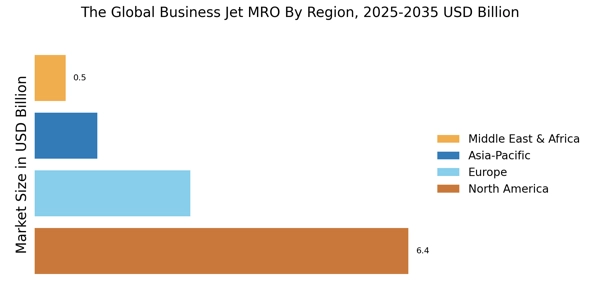
The Global Business Jet MRO Market revenue showcased significant regional dynamics, with North America leading with a valuation of 5.25 USD Billion in 2024 and rising to 8.4 USD Billion by 2035, representing a majority holding in the market. This region was vital due to the high concentration of business jet operators.

Europe followed with valuations of 3.0 USD Billion in 2024 and 4.8 USD Billion in 2035, making it a substantial player as regulatory frameworks foster MRO growth. The APAC region, valued at 1.75 USD Billion in 2024 and 2.8 USD Billion by 2035, emerged as an important market as increasing wealth and travel demand boost business jet usage.
South America and MEA were smaller markets; with South America at 0.4 USD Billion in 2024 and 0.65 USD Billion by 2035, and MEA at 0.25 USD Billion in 2024 and 0.45 USD Billion by 2035, they presented unique growth opportunities due to developing economies.
Overall, the Global Business Jet MRO Market data indicated that the sector is driven by rising travel frequency, technological advancements, and regulatory changes across regions, with opportunities for growth in underrepresented areas. Market challenges included skilled labor shortages and fluctuating fuel prices, which could impact operational costs for MRO providers.
Key Players and Competitive Insights
Key Companies in the Business Jet MRO Market include
Industry Developments
Recent developments in the Global Business Jet MRO Market have highlighted significant growth trends and strategic moves among key players. StandardAero has expanded its network of service locations to enhance customer accessibility, while Flexjet continues investing in its fleet management capabilities, focusing on sustainability and efficiency.
Duncan Aviation reported a surge in demand for its refurbishment and modification services, supporting increased aircraft utilization. Gulfstream Aerospace and General Dynamics have been actively enhancing their service offerings to cater to an evolving market landscape influenced by the increasing demand for maintenance precision.
MRO Holdings has completed upgrades in its facilities, driving capacity expansion. Bombardier and Rockwell Collins have also made strides in avionics upgrades to boost aircraft performance. On the mergers and acquisitions front, notable transactions have occurred, signaling consolidation in the market.

Honeywell and SR Technics remain focused on collaborative partnerships to streamline operations, while Textron Aviation and Signature Flight Support are expanding their service portfolios to meet customer demands.
The overarching growth in market valuation for these companies is poised to reshape service delivery models, enhance operational efficiencies, and drive innovation in the Global Business Jet MRO Market, significantly impacting overall industry dynamics and competitive landscape.
Future Outlook
Business Jet MRO Market Future Outlook
The Global Business Jet MRO Market is projected to grow at a 4.62% CAGR from 2025 to 2035, driven by increasing demand for maintenance services and technological advancements.
New opportunities lie in:
- Expansion of digital maintenance tracking systems for enhanced efficiency. Development of specialized MRO services for electric and hybrid business jets. Strategic partnerships with OEMs for exclusive service agreements.
By 2035, the market is expected to be robust, reflecting sustained growth and innovation.
Market Segmentation
Business Jet MRO Market End Use Outlook
- Private
- Corporate
- Charter
Business Jet MRO Market MRO Type Outlook
- Maintenance
- Repair
- Overhaul
Business Jet MRO Market Service Type Outlook
- Airframe Maintenance
- Engine Maintenance
- Component Maintenance
- Line Maintenance
Business Jet MRO Market Aircraft Type Outlook
- Light Jets
- Mid-Size Jets
- Heavy Jets
- Large Jets
Report Scope
| MARKET SIZE 2024 | 10.65(USD Billion) |
| MARKET SIZE 2025 | 11.14(USD Billion) |
| MARKET SIZE 2035 | 17.5(USD Billion) |
| COMPOUND ANNUAL GROWTH RATE (CAGR) | 4.62% (2025 - 2035) |
| REPORT COVERAGE | Revenue Forecast, Competitive Landscape, Growth Factors, and Trends |
| BASE YEAR | 2024 |
| Market Forecast Period | 2025 - 2035 |
| Historical Data | 2019 - 2024 |
| Market Forecast Units | USD Billion |
| Key Companies Profiled | Bombardier (CA), Gulfstream Aerospace (US), Textron Aviation (US), Dassault Aviation (FR), Embraer (BR), Honeywell Aerospace (US), Rockwell Collins (US), Pratt & Whitney Canada (CA), Airbus Corporate Jets (FR) |
| Segments Covered | Service Type, Aircraft Type, MRO Type, End Use, Regional |
| Key Market Opportunities | Integration of advanced predictive maintenance technologies enhances efficiency in The Global Business Jet MRO. |
| Key Market Dynamics | Technological advancements and regulatory changes drive competitive dynamics in the business jet Maintenance, Repair, and Overhaul market. |
| Countries Covered | North America, Europe, APAC, South America, MEA |
FAQs
What is the projected market valuation of The Global Business Jet MRO by 2035?
The projected market valuation for The Global Business Jet MRO is 17.5 USD Billion by 2035.
What was the overall market valuation of The Global Business Jet MRO in 2024?
The overall market valuation of The Global Business Jet MRO was 10.65 USD Billion in 2024.
What is the expected CAGR for The Global Business Jet MRO during the forecast period 2025 - 2035?
The expected CAGR for The Global Business Jet MRO during the forecast period 2025 - 2035 is 4.62%.
Which companies are considered key players in The Global Business Jet MRO?
Key players in The Global Business Jet MRO include Bombardier, Gulfstream Aerospace, Textron Aviation, Dassault Aviation, Embraer, Honeywell Aerospace, Rockwell Collins, Pratt & Whitney Canada, and Airbus Corporate Jets.
What are the projected valuations for airframe maintenance in The Global Business Jet MRO by 2035?
The projected valuation for airframe maintenance in The Global Business Jet MRO is expected to reach between 4.0 and 5.0 USD Billion by 2035.
How does the valuation for engine maintenance compare to other service types in The Global Business Jet MRO?
Engine maintenance is projected to have a valuation between 5.0 and 6.5 USD Billion by 2035, indicating its prominence compared to other service types.
What is the expected valuation for line maintenance in The Global Business Jet MRO by 2035?
The expected valuation for line maintenance in The Global Business Jet MRO is anticipated to be between 5.5 and 6.5 USD Billion by 2035.
What are the projected valuations for different aircraft types in The Global Business Jet MRO by 2035?
By 2035, the projected valuations for aircraft types are expected to be between 4.0 and 5.0 USD Billion for light jets, 5.0 and 6.5 USD Billion for mid-size jets, and 5.5 USD Billion for large jets.
What is the anticipated valuation for corporate end-use in The Global Business Jet MRO by 2035?
The anticipated valuation for corporate end-use in The Global Business Jet MRO is expected to reach between 6.0 and 7.0 USD Billion by 2035.
How does the repair segment's valuation compare to maintenance and overhaul in The Global Business Jet MRO?
The repair segment is projected to have a valuation between 6.0 and 7.0 USD Billion by 2035, which is higher than both maintenance and overhaul segments.
Kindly complete the form below to receive a free sample of this Report
Customer Stories
“This is really good guys. Excellent work on a tight deadline. I will continue to use you going forward and recommend you to others. Nice job”
“Thanks. It’s been a pleasure working with you, please use me as reference with any other Intel employees.”
“Thanks for sending the report it gives us a good global view of the Betaïne market.”
“Thank you, this will be very helpful for OQS.”
“We found the report very insightful! we found your research firm very helpful. I'm sending this email to secure our future business.”
“I am very pleased with how market segments have been defined in a relevant way for my purposes (such as "Portable Freezers & refrigerators" and "last-mile"). In general the report is well structured. Thanks very much for your efforts.”
“I have been reading the first document or the study, ,the Global HVAC and FP market report 2021 till 2026. Must say, good info! I have not gone in depth at all parts, but got a good indication of the data inside!”
“We got the report in time, we really thank you for your support in this process. I also thank to all of your team as they did a great job.”