×
Request Free Sample ×

Kindly complete the form below to receive a free sample of this Report

* Please use a valid business email

Leading companies partner with us for data-driven Insights

clients tt-cursor
Hero Background

Canada Ai In Iot Market

ID: MRFR/ICT/63685-HCR
200 Pages
Aarti Dhapte
October 2025

Canada AI in IoT Market Research Report By Component (Platforms, Software Solutions, Services), By Technologies (ML and Deep Learning, NLP), and By Vertical (Manufacturing, Energy and Utilities, Transportation and Mobility, BFSI, Government and Defense, Retail, Healthcare and Life Sciences, Telecom, Others)- Forecast to 2035

Share:
Download PDF ×

We do not share your information with anyone. However, we may send you emails based on your report interest from time to time. You may contact us at any time to opt-out.

Canada Ai In Iot Market Infographic
Purchase Options

Canada Ai In Iot Market Summary

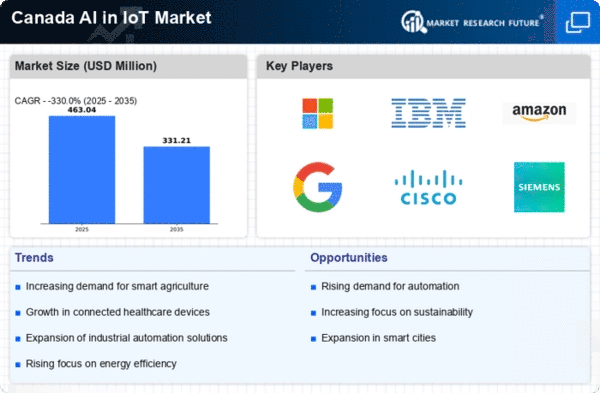
As per MRFR analysis, the AI in IoT Market Size was estimated at 478.85 USD Million in 2024. The ai in-iot market is projected to grow from 463.04 USD Million in 2025 to 331.21 USD Million by 2035, exhibiting a compound annual growth rate (CAGR) of -3.3% during the forecast period 2025 - 2035.

Key Market Trends & Highlights

The Canada AI in-IoT market is poised for substantial growth driven by technological advancements and increasing consumer demand.

  • Investment in smart infrastructure is surging, indicating a robust market trajectory.
  • Data security and privacy concerns are becoming paramount, influencing technology adoption.
  • Edge computing advancements are enhancing real-time data processing capabilities.
  • Rising demand for automation and government initiatives are key drivers propelling market expansion.

Market Size & Forecast

2024 Market Size 478.85 (USD Million)
2035 Market Size 331.21 (USD Million)
CAGR (2025 - 2035) -3.3%

Major Players

Microsoft (US), IBM (US), Amazon (US), Google (US), Cisco (US), Siemens (DE), General Electric (US), Intel (US), Oracle (US)

Canada Ai In Iot Market Trends

The AI in IoT Market is currently experiencing a transformative phase, characterized by rapid advancements in technology and increasing adoption across various sectors. Organizations are increasingly recognizing the potential of integrating artificial intelligence with Internet of Things devices to enhance operational efficiency and improve decision-making processes. This integration appears to facilitate real-time data analysis, predictive maintenance, and automation, which are crucial for optimizing resource management. As a result, businesses are likely to invest more in this technology, aiming to leverage its capabilities for competitive advantage. Moreover, the regulatory environment in Canada seems to be evolving to support innovation in the ai in-iot market. Government initiatives aimed at fostering research and development are likely to encourage collaboration between public and private sectors. This collaborative approach may lead to the creation of standards and frameworks that ensure the safe and ethical use of AI technologies. Consequently, the ai in-iot market is poised for growth, driven by both technological advancements and supportive policies that promote innovation and sustainability.

Increased Investment in Smart Infrastructure

Organizations are likely to allocate more resources towards developing smart infrastructure that integrates ai with IoT devices. This trend suggests a shift towards creating interconnected systems that enhance urban living and operational efficiency.

Focus on Data Security and Privacy

As the ai in-iot market expands, there appears to be a growing emphasis on ensuring data security and privacy. Companies are expected to adopt robust measures to protect sensitive information, reflecting a commitment to ethical practices.

Advancements in Edge Computing

The integration of edge computing with ai in the IoT landscape seems to be gaining traction. This trend indicates a move towards processing data closer to the source, which may enhance response times and reduce latency in various applications.

Canada Ai In Iot Market Drivers

Rising Demand for Automation

The AI in IoT Market in Canada is experiencing a notable surge in demand for automation across various sectors. Industries such as manufacturing, agriculture, and healthcare are increasingly adopting IoT devices integrated with AI capabilities to enhance operational efficiency. This trend is driven by the need to reduce labor costs and improve productivity. According to recent data, the automation market in Canada is projected to grow at a CAGR of approximately 10% over the next five years. As businesses seek to streamline processes and minimize human error, the integration of AI in IoT systems becomes essential. This rising demand for automation is likely to propel the growth of the ai in-iot market, as companies invest in smart technologies to remain competitive.

Increased Focus on Sustainability

Sustainability is becoming a central theme in the Canadian ai in-iot market, as businesses and consumers alike prioritize eco-friendly practices. The integration of AI with IoT devices allows for better resource management and energy efficiency, which aligns with the growing demand for sustainable solutions. For example, smart agriculture technologies that utilize AI can optimize water usage and reduce waste, contributing to environmental conservation. The Canadian government has set ambitious targets for reducing greenhouse gas emissions, which further encourages the adoption of sustainable technologies. This focus on sustainability is likely to drive innovation within the ai in-iot market, as companies develop solutions that not only meet regulatory requirements but also appeal to environmentally conscious consumers.

Government Initiatives and Support

Government initiatives in Canada are playing a crucial role in fostering the growth of the ai in-iot market. Various programs and funding opportunities are being introduced to encourage innovation and the adoption of smart technologies. For instance, the Canadian government has allocated significant resources to support research and development in AI and IoT sectors. This support is expected to enhance collaboration between public and private sectors, leading to the creation of advanced solutions. Furthermore, the government's commitment to digital transformation is likely to stimulate investments in the ai in-iot market, as businesses leverage these initiatives to enhance their technological capabilities and improve service delivery.

Growing Consumer Awareness and Adoption

Consumer awareness regarding the benefits of AI and IoT technologies is on the rise in Canada, which is positively influencing the ai in-iot market. As individuals become more informed about the advantages of smart devices, there is a corresponding increase in demand for connected solutions in homes and businesses. This trend is evident in the growing popularity of smart home devices, wearables, and industrial IoT applications. Market Research Future indicates that the adoption rate of smart home technologies is expected to reach 30% by 2026. This growing consumer awareness is likely to drive innovation and competition within the ai in-iot market, as companies strive to meet the evolving needs and preferences of tech-savvy consumers.

Advancements in Connectivity Technologies

The evolution of connectivity technologies, such as 5G, is significantly impacting the ai in-iot market in Canada. Enhanced connectivity enables faster data transmission and improved communication between devices, which is essential for the effective functioning of AI-driven IoT systems. As 5G networks continue to roll out across the country, businesses are likely to leverage these advancements to deploy more sophisticated IoT applications. This increased connectivity can facilitate real-time data analysis and decision-making, which are critical for industries like transportation and logistics. Consequently, the advancements in connectivity technologies are expected to bolster the growth of the ai in-iot market, as companies seek to harness the full potential of their IoT investments.


Market Segment Insights

By Component: Platforms (Largest) vs. Software Solutions (Fastest-Growing)

In the Canada AI in IoT Market, the distribution of market share among the three segment values reveals that Platforms currently hold the largest percentage, reflecting their established presence and integral role in various applications. Software Solutions, on the other hand, are rapidly gaining traction, driven by innovations and increasing demand for advanced analytics and automation, indicating significant potential for future growth. The growth trends within this segment are characterized by the proliferation of connected devices and the emphasis on seamless integration of AI technologies. The rise in IoT deployments across various industries is propelling the demand for both Software Solutions and Services. Furthermore, the focus on enhancing operational efficiency and obtaining actionable insights continues to drive investment in these areas, shaping the overall landscape of the Canada ai in-iot market.

Platforms (Dominant) vs. Software Solutions (Emerging)

Platforms are recognized as the dominant value within the component segment, providing foundational frameworks that enable connectivity and interoperability among various IoT devices and AI systems. Their resilience and adaptability ensure they meet the evolving needs of businesses in an increasingly digital environment. In contrast, Software Solutions are emerging as a critical component, emphasizing the development of tailored applications that enhance data processing and analytics capabilities. The growing interest in automation and real-time data utilization positions Software Solutions to become integral in helping businesses leverage insights for better decision-making, establishing themselves as valuable players in the Canada ai in-iot market.

By Technologies: ML and Deep Learning (Largest) vs. NLP (Fastest-Growing)

In the Canada AI in IoT Market, the distribution of market share among the Technologies segment reveals that ML and Deep Learning hold a commanding presence, largely due to their established applications and integration within various industries. This segment has become prominent due to its proven capabilities in processing vast amounts of data, providing high accuracy in predictive analytics, and delivering real-time insights which are crucial for IoT implementations. Conversely, NLP is emerging as the fastest-growing segment within the Technologies category. Driven by advancements in language processing capabilities and the increasing reliance on chatbots and virtual assistants, NLP is seeing significant adoption across customer service and data analysis sectors. As organizations strive to enhance user experiences through better interaction, the momentum for NLP technologies is rapidly increasing, positioning it for a substantial market share in the near future.

ML and Deep Learning (Dominant) vs. NLP (Emerging)

The dominant segment of ML and Deep Learning is characterized by its robust algorithms and methodologies that enable machines to learn from data patterns. This segment's integration into tailored IoT solutions enhances operational efficiencies and predictive analytics across industries. On the other hand, NLP stands out as the emerging contender, focusing on bridging the gap between human communication and machine understanding. Its rapid growth is fueled by demand for better user engagement tools and analytics platforms, making both segments essential for businesses looking to leverage AI in the Canada ai in-iot market.

By Vertical: Manufacturing (Largest) vs. Healthcare and Life Sciences (Fastest-Growing)

In the Canada AI in IoT Market, the vertical segment shows a diversified distribution of market share with Manufacturing leading significantly. Manufacturing holds a substantial portion of the market due to automation and efficiency improvements driven by AI and IoT technologies. Following this, verticals such as Retail and Energy and Utilities also contribute notably to the market landscape but do not match the dominance of Manufacturing. The growth trends indicate a shift towards Healthcare and Life Sciences as the fastest-growing segment within the Canada ai in-iot market. This growth is propelled by the increasing demand for remote patient monitoring and telehealth solutions, along with the need for operational efficiency in healthcare facilities. Additionally, advancements in AI technologies are being increasingly adopted in sectors like Transportation and Mobility to enhance logistic efficiencies and support smart city initiatives.

Manufacturing: Dominant vs. Healthcare and Life Sciences: Emerging

Manufacturing has established itself as a dominant force within the vertical segment of the Canada ai in-iot market, primarily due to its robust adoption of smart technologies that streamline operations and boost productivity. This sector leverages AI-driven analytics for predictive maintenance and supply chain optimization, leading to substantial operational cost savings. On the other hand, Healthcare and Life Sciences represents an emerging opportunity characterized by rapid digital transformation, where AI and IoT are being integrated into patient care and management systems. Innovations such as real-time health monitoring, data-driven diagnostics, and automated administrative processes are driving swift growth in this vertical, indicating a promising future as the sector adapts to increasing consumer health demands.

Get more detailed insights about Canada Ai In Iot Market

Key Players and Competitive Insights

The ai in-iot market is currently characterized by a dynamic competitive landscape, driven by rapid technological advancements and increasing demand for smart solutions across various sectors. Major players such as Microsoft (US), IBM (US), and Amazon (US) are strategically positioning themselves through innovation and partnerships, which collectively enhance their market presence. Microsoft (US) focuses on integrating AI capabilities into its IoT solutions, thereby facilitating seamless data analytics and operational efficiency. IBM (US) emphasizes its hybrid cloud offerings, which allow for enhanced data management and security in IoT applications. Meanwhile, Amazon (US) leverages its extensive cloud infrastructure to provide scalable IoT solutions, indicating a trend towards cloud-centric models in the market.

The business tactics employed by these companies reflect a concerted effort to optimize supply chains and localize manufacturing processes. The market structure appears moderately fragmented, with a mix of established players and emerging startups. This fragmentation allows for diverse offerings, yet the collective influence of key players like Microsoft (US) and IBM (US) tends to dominate the competitive dynamics, shaping customer expectations and driving innovation.

In October 2025, Microsoft (US) announced a strategic partnership with a leading Canadian telecommunications provider to enhance its IoT connectivity solutions. This collaboration aims to improve network reliability and expand the reach of its AI-driven IoT applications, which is crucial for industries such as manufacturing and logistics. The strategic importance of this partnership lies in its potential to bolster Microsoft's market share in Canada, particularly in sectors that require robust connectivity and data processing capabilities.

In September 2025, IBM (US) launched a new AI-powered analytics platform specifically designed for IoT data management. This platform integrates advanced machine learning algorithms to provide real-time insights, thereby enabling businesses to make informed decisions quickly. The introduction of this platform signifies IBM's commitment to enhancing its IoT offerings and reflects a broader trend towards data-driven decision-making in the industry.

In August 2025, Amazon (US) expanded its IoT services by introducing a new suite of tools aimed at small and medium-sized enterprises (SMEs). This initiative is designed to democratize access to advanced IoT technologies, allowing SMEs to leverage AI capabilities without significant upfront investment. The strategic importance of this move lies in Amazon's ability to capture a larger customer base, thereby reinforcing its position as a leader in the ai in-iot market.

As of November 2025, current competitive trends indicate a strong focus on digitalization, sustainability, and the integration of AI technologies within IoT frameworks. Strategic alliances are increasingly shaping the landscape, as companies recognize the value of collaboration in driving innovation. Looking ahead, competitive differentiation is likely to evolve, with a shift from price-based competition towards a focus on technological innovation and supply chain reliability. This transition underscores the importance of agility and responsiveness in meeting the evolving demands of the market.

Key Companies in the Canada Ai In Iot Market market include

Industry Developments

To strengthen its artificial intelligence capabilities, Telus said in September 2025 that it will pay $539 million to acquire the remaining shares of its digital services division, Telus Digital. OpenText unveiled their Aviator IoT platform in August 2025, fusing AI and IoT to provide supply chain monitoring, asset tracking, predictive maintenance, and safe connected device management.Accenture joined forces with Schaeffler and NVIDIA in July 2025 to create digital twins and robots driven by AI for supply chain optimization. Shopify improved e-commerce experiences by adding Shopify Magic and Sidekick to its AI portfolio in June 2025.

With an emphasis on scalable and secure infrastructure, Cisco unveiled AI-driven networking solutions for industrial IoT applications in May 2025. Google pledged $13 million in April 2025 to fund AI workforce development initiatives across Canada through its AI Opportunity Fund.With an emphasis on secure communications and the Internet of Things, BlackBerry stated in March 2025 that it anticipated an increase in IoT revenue to $225 million to $235 million for fiscal 2025. Microsoft stated in February 2025 that it would invest $2.7 billion over three years in Canada to improve its AI and cloud infrastructure.

Canada AI in IoT

Future Outlook

Canada Ai In Iot Market Future Outlook

The AI in IoT Market in Canada is projected to experience a decline of -3.3% CAGR from 2024 to 2035, driven by technological advancements and evolving consumer demands.

New opportunities lie in:

  • Development of AI-driven predictive maintenance solutions for industrial IoT devices.
  • Integration of smart energy management systems in commercial buildings.
  • Creation of customized IoT security frameworks for small and medium enterprises.

By 2035, the market is expected to stabilize, adapting to new technological landscapes.

Market Segmentation

Canada Ai In Iot Market Vertical Outlook

  • Manufacturing
  • Energy and Utilities
  • Transportation and Mobility
  • BFSI
  • Government and Defense
  • Retail
  • Healthcare and Life Sciences
  • Telecom
  • Others (agriculture, education, telecom, and tourism and hospitality)

Canada Ai In Iot Market Component Outlook

  • Platforms
  • Software Solutions
  • Services

Canada Ai In Iot Market Technologies Outlook

  • ML and Deep Learning
  • NLP

Report Scope

MARKET SIZE 2024 478.85(USD Million)
MARKET SIZE 2025 463.04(USD Million)
MARKET SIZE 2035 331.21(USD Million)
COMPOUND ANNUAL GROWTH RATE (CAGR) -3.3% (2024 - 2035)
REPORT COVERAGE Revenue Forecast, Competitive Landscape, Growth Factors, and Trends
BASE YEAR 2024
Market Forecast Period 2025 - 2035
Historical Data 2019 - 2024
Market Forecast Units USD Million
Key Companies Profiled Microsoft (US), IBM (US), Amazon (US), Google (US), Cisco (US), Siemens (DE), General Electric (US), Intel (US), Oracle (US)
Segments Covered Component, Technologies, Vertical
Key Market Opportunities Integration of advanced analytics in smart home devices enhances user experience and energy efficiency.
Key Market Dynamics Growing integration of artificial intelligence in Internet of Things applications drives innovation and competitive differentiation.
Countries Covered Canada

Leave a Comment

FAQs

What is the expected market size of the Canada AI in IoT Market in 2024?

The Canada AI in IoT Market is expected to be valued at 478.8 million USD in 2024.

What is the projected market size of the Canada AI in IoT Market by 2035?

By 2035, the Canada AI in IoT Market is expected to reach a value of 1,540.0 million USD.

What is the expected compound annual growth rate (CAGR) for the Canada AI in IoT Market between 2025 and 2035?

The expected CAGR for the Canada AI in IoT Market from 2025 to 2035 is 11.205%.

What are the values of the Canada AI in IoT Market segments for Platforms in 2024 and 2035?

The market value for Platforms in 2024 is 143.4 million USD and is projected to grow to 490.0 million USD by 2035.

What is the market value of Software Solutions in the Canada AI in IoT Market for 2024?

In 2024, the value of Software Solutions in the Canada AI in IoT Market is estimated at 142.2 million USD.

How much is the Services segment expected to be valued in the Canada AI in IoT Market by 2035?

The Services segment is projected to reach a value of 580.0 million USD by 2035.

Who are the major players in the Canada AI in IoT Market?

Some of the major players include RoboSense, Element AI, Sierra Wireless, Google, OpenText, Accenture, Shopify, Cisco, Telus, AWS, CGI, IBM, BlackBerry, Microsoft, and Ubisoft.

What are the key applications driving growth in the Canada AI in IoT Market?

Key applications driving growth include smart city development, industrial automation, healthcare, and smart consumer products.

What are the challenges facing the Canada AI in IoT Market?

Challenges include data privacy concerns, interoperability between devices, and the need for skilled labor in AI and IoT sectors.

What are the expected growth drivers for the Canada AI in IoT Market?

The expected growth drivers include rising demand for automation, advancements in AI technologies, and increased investment in IoT infrastructure.

Download Free Sample

Kindly complete the form below to receive a free sample of this Report

Compare Licence

×
Features License Type
Single User Multiuser License Enterprise User
Price $4,950 $5,950 $7,250
Maximum User Access Limit 1 User Upto 10 Users Unrestricted Access Throughout the Organization
Free Customization
Direct Access to Analyst
Deliverable Format
Platform Access
Discount on Next Purchase 10% 15% 15%
Printable Versions