Government Support and Incentives
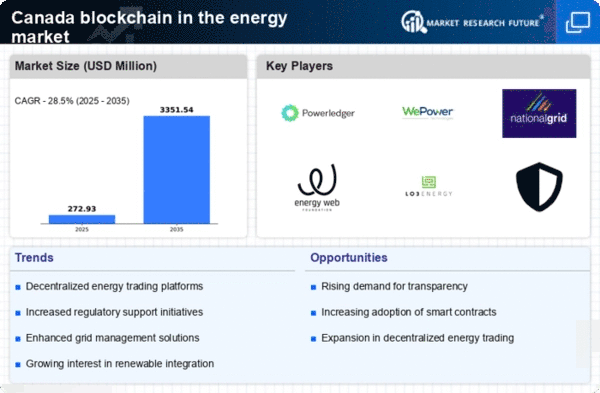
Government support plays a pivotal role in the growth of the blockchain in-energy market in Canada. Various provincial and federal initiatives aim to promote the adoption of innovative technologies in the energy sector. For instance, the Canadian government has allocated over $100 million in funding for clean technology projects, including those utilizing blockchain for energy management. This financial backing not only encourages research and development but also fosters collaboration between public and private sectors. As government policies continue to evolve, the blockchain in-energy market is likely to benefit from increased investment and regulatory support, further driving its expansion.
Integration of Smart Grids and IoT
The integration of smart grids and Internet of Things (IoT) technologies is driving innovation in the blockchain in-energy market in Canada. Smart grids facilitate real-time monitoring and management of energy resources, while IoT devices collect and transmit data to optimize energy consumption. The synergy between these technologies and blockchain can enhance grid reliability and efficiency. In 2025, it is projected that smart grid investments in Canada will exceed $5 billion, with a significant portion allocated to blockchain applications. This integration not only improves operational efficiency but also supports the transition to a more resilient and sustainable energy system, positioning the blockchain in-energy market for substantial growth.
Increased Demand for Renewable Energy
The blockchain in-energy market in Canada is experiencing a notable surge in demand for renewable energy sources. As consumers become more environmentally conscious, the shift towards sustainable energy solutions is evident. In 2025, renewable energy accounted for approximately 18% of Canada's total energy consumption, with projections suggesting this figure could rise to 30% by 2030. Blockchain technology facilitates the tracking and trading of renewable energy credits, enhancing transparency and trust among stakeholders. This increased demand for clean energy sources is likely to drive innovation and investment in the blockchain in-energy market, as companies seek to leverage decentralized platforms for energy trading and management.
Cost Efficiency in Energy Transactions
Cost efficiency is a critical driver for the blockchain in-energy market in Canada. Traditional energy transactions often involve multiple intermediaries, leading to increased costs and inefficiencies. Blockchain technology streamlines these processes by enabling peer-to-peer transactions, reducing the need for intermediaries. A study indicates that implementing blockchain solutions could reduce transaction costs by up to 40%. This potential for cost savings is attracting energy producers and consumers alike, as they seek to optimize their operations and enhance profitability. As the market matures, the emphasis on cost efficiency is expected to propel the adoption of blockchain solutions in energy transactions.
Consumer Empowerment through Decentralization
Consumer empowerment is emerging as a significant driver in the blockchain in-energy market in Canada. The decentralization of energy production allows consumers to generate, store, and trade energy independently. This shift is particularly relevant in the context of microgrids and community energy projects, where local participants can engage in energy trading. By 2025, it is estimated that over 15% of Canadian households will participate in decentralized energy systems. Blockchain technology enhances this empowerment by providing a secure and transparent platform for transactions, enabling consumers to take control of their energy usage and costs. This trend is likely to reshape the energy landscape in Canada.




















Leave a Comment