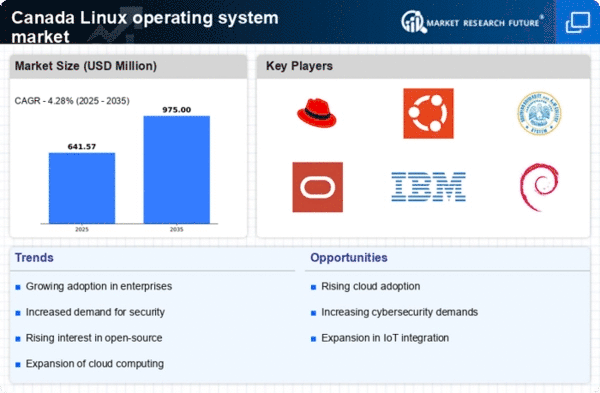
The linux operating-system market in Canada is characterized by a dynamic competitive landscape, driven by innovation, strategic partnerships, and a growing demand for open-source solutions. Key players such as Red Hat (US), Canonical (GB), and SUSE (DE) are at the forefront, each adopting distinct strategies to enhance their market presence. Red Hat (US) focuses on enterprise solutions and cloud services, leveraging its strong brand reputation to attract large organizations. Canonical (GB), known for its Ubuntu distribution, emphasizes user-friendly interfaces and community engagement, appealing to both individual users and businesses. Meanwhile, SUSE (DE) positions itself as a leader in enterprise-grade solutions, particularly in hybrid cloud environments, which is increasingly relevant in today's digital transformation landscape.
The business tactics employed by these companies reflect a moderately fragmented market structure, where collaboration and competition coexist. Localizing operations and optimizing supply chains are common strategies, allowing companies to respond swiftly to regional demands. The collective influence of these key players shapes the market, as they continuously innovate and adapt to changing consumer preferences and technological advancements.
In October 2025, Red Hat (US) announced a strategic partnership with a leading cloud provider to enhance its hybrid cloud offerings. This move is significant as it aligns with the growing trend of businesses seeking integrated solutions that combine on-premises and cloud environments. By strengthening its cloud capabilities, Red Hat (US) aims to capture a larger share of the enterprise market, which is increasingly migrating to hybrid models.
In September 2025, Canonical (GB) launched a new version of Ubuntu, focusing on improved security features and enhanced performance for IoT devices. This initiative is crucial as it addresses the rising concerns around cybersecurity in connected devices, positioning Canonical (GB) as a proactive player in the IoT space. The emphasis on security not only attracts new users but also reinforces the brand's commitment to providing reliable solutions in an evolving technological landscape.
In August 2025, SUSE (DE) expanded its presence in Canada by opening a new regional office aimed at supporting local businesses in their digital transformation journeys. This strategic expansion indicates SUSE's commitment to understanding and addressing the unique needs of the Canadian market. By establishing a local presence, SUSE (DE) enhances its customer engagement and support capabilities, which could lead to increased market share in the region.
As of November 2025, the competitive trends in the linux operating-system market are increasingly defined by digitalization, sustainability, and the integration of AI technologies. Strategic alliances are becoming more prevalent, as companies recognize the value of collaboration in driving innovation. The competitive differentiation is likely to evolve from traditional price-based competition to a focus on technological advancements, reliability in supply chains, and the ability to deliver tailored solutions that meet the specific needs of diverse customer segments.
























Leave a Comment