×
Request Free Sample ×

Kindly complete the form below to receive a free sample of this Report

* Please use a valid business email

Leading companies partner with us for data-driven Insights

clients tt-cursor
Hero Background

Carbon Thermoplastic Composites Market

ID: MRFR/CnM/4368-HCR
100 Pages
Anshula Mandaokar
October 2025

Carbon Thermoplastic Composites Market Research Report Information by Raw Material (PAN-Based and PITCH-Based), Thermoplastic Resin [Polyether Ether Ketone (PEEK), Polyetherimide (PEI), polyaryletherketone (PAEK), and Others], Application (Aerospace & Defense, Automotive, Wind Turbines, Sports Equipment, Construction and Marine) and Region (North America, Europe, Asia-Pacific, Latin America and the Middle East & Africa) - Forecast till 2035

Share:
Download PDF ×

We do not share your information with anyone. However, we may send you emails based on your report interest from time to time. You may contact us at any time to opt-out.

Carbon Thermoplastic Composites Market Infographic
Purchase Options

Carbon Thermoplastic Composites Market Summary

As per MRFR analysis, the Carbon Thermoplastic Composites Market was estimated at 12.53 USD Billion in 2024. The Carbon Thermoplastic Composites industry is projected to grow from 14.2 in 2025 to 49.63 by 2035, exhibiting a compound annual growth rate (CAGR) of 13.33 during the forecast period 2025 - 2035.

Key Market Trends & Highlights

The Carbon Thermoplastic Composites Market is poised for substantial growth driven by sustainability and technological advancements.

  • The market is increasingly influenced by a strong focus on sustainability initiatives across various industries.
  • Technological advancements are enhancing the performance and applications of carbon thermoplastic composites, particularly in aerospace.
  • North America remains the largest market, while the Asia-Pacific region is recognized as the fastest-growing area for these composites.
  • Key market drivers include the growing automotive sector and heightened demand from the aerospace industry, which are propelling innovation and development.

Market Size & Forecast

2024 Market Size 12.53 (USD Billion)
2035 Market Size 49.63 (USD Billion)
CAGR (2025 - 2035) 13.33%

Major Players

Toray Industries (JP), SABIC (SA), Solvay (BE), BASF (DE), Hexcel Corporation (US), Teijin Limited (JP), Mitsubishi Chemical Corporation (JP), Cytec Industries (US), Royal DSM (NL)

Carbon Thermoplastic Composites Market Trends

The Carbon Thermoplastic Composites Market is currently experiencing a notable transformation, driven by advancements in material science and increasing demand across various industries. These composites, known for their lightweight and high-strength properties, are becoming increasingly popular in sectors such as automotive, aerospace, and construction. The shift towards sustainable materials is also influencing market dynamics, as manufacturers seek to reduce their environmental footprint while maintaining performance standards. As a result, innovations in processing techniques and recycling methods are emerging, which could enhance the appeal of these composites in the marketplace. In addition, the Carbon Thermoplastic Composites Market appears to be benefiting from a growing emphasis on energy efficiency and performance optimization. Companies are investing in research and development to create more durable and versatile materials that can withstand extreme conditions. This trend suggests a potential for expanded applications, particularly in high-performance environments. Furthermore, collaborations between material producers and end-users are likely to foster the development of tailored solutions, thereby enhancing the overall market landscape. The future of this market seems promising, with ongoing advancements and a clear trajectory towards broader adoption across multiple sectors.

Sustainability Focus

The emphasis on sustainable practices is reshaping the Carbon Thermoplastic Composites Market. Manufacturers are increasingly prioritizing eco-friendly materials and processes, which aligns with global efforts to reduce carbon emissions and promote recycling. This trend indicates a shift towards more responsible production methods, potentially attracting environmentally conscious consumers.

Technological Advancements

Innovations in processing technologies are significantly impacting the Carbon Thermoplastic Composites Market. Enhanced manufacturing techniques are enabling the production of composites with superior properties, such as improved strength-to-weight ratios and enhanced durability. This trend suggests that ongoing research could lead to new applications and increased market penetration.

Collaborative Development

The trend of collaboration between material producers and end-users is gaining traction within the Carbon Thermoplastic Composites Market. Such partnerships are likely to facilitate the creation of customized solutions that meet specific industry needs. This collaborative approach may enhance product performance and broaden the scope of applications in various sectors.

Carbon Thermoplastic Composites Market Drivers

Market Growth Projections

The Global Carbon Thermoplastic Composites Market Industry is poised for substantial growth, with projections indicating a market size of 19.8 USD Billion in 2024 and an anticipated increase to 54.0 USD Billion by 2035. This growth trajectory suggests a compound annual growth rate of 9.54% from 2025 to 2035, highlighting the increasing adoption of carbon thermoplastic composites across various industries. The market's expansion is driven by factors such as technological advancements, rising demand for lightweight materials, and growing applications in renewable energy and aerospace sectors.

Growing Investment in Aerospace Sector

Investment in the aerospace sector is a key driver for the Global Carbon Thermoplastic Composites Market Industry. The aerospace industry increasingly seeks materials that offer high strength-to-weight ratios and excellent fatigue resistance, making carbon thermoplastic composites an attractive option. With the global aerospace market projected to grow substantially, manufacturers are likely to invest in these advanced materials to enhance aircraft performance and reduce operational costs. This trend is expected to contribute to the market's growth, as the industry anticipates reaching 54.0 USD Billion by 2035, reflecting the increasing reliance on innovative materials in aerospace applications.

Rising Demand for Lightweight Materials

The Global Carbon Thermoplastic Composites Market Industry experiences a notable increase in demand for lightweight materials across various sectors, particularly in automotive and aerospace. This shift is driven by the need for enhanced fuel efficiency and reduced emissions. For instance, the automotive sector is increasingly adopting carbon thermoplastic composites to lower vehicle weight, thereby improving fuel economy. As a result, the market is projected to reach 19.8 USD Billion in 2024, reflecting a growing trend towards sustainable manufacturing practices. This demand is likely to propel the industry forward as manufacturers seek innovative solutions to meet regulatory requirements and consumer expectations.

Increasing Applications in Renewable Energy

The Global Carbon Thermoplastic Composites Market Industry is significantly influenced by the increasing applications of composites in renewable energy sectors, particularly in wind energy. The lightweight and high-strength properties of carbon thermoplastic composites make them ideal for manufacturing wind turbine blades, which require materials that can withstand harsh environmental conditions while maintaining structural integrity. As the world shifts towards sustainable energy solutions, the demand for such composites is expected to rise. This trend aligns with the broader global initiative to reduce carbon footprints and promote clean energy technologies, thereby expanding the market's potential.

Technological Advancements in Composite Manufacturing

Technological advancements play a crucial role in the evolution of the Global Carbon Thermoplastic Composites Market Industry. Innovations in processing techniques, such as automated fiber placement and advanced molding technologies, enhance the efficiency and quality of composite production. These advancements not only reduce manufacturing costs but also improve the performance characteristics of the composites, making them more appealing to end-users. As a result, the market is expected to witness a compound annual growth rate of 9.54% from 2025 to 2035. This growth indicates a strong potential for the industry as manufacturers continue to invest in research and development to optimize production processes.

Environmental Regulations and Sustainability Initiatives

The Global Carbon Thermoplastic Composites Market Industry is shaped by stringent environmental regulations and sustainability initiatives that encourage the adoption of eco-friendly materials. Governments worldwide are implementing policies aimed at reducing carbon emissions and promoting sustainable manufacturing practices. This regulatory landscape compels industries to seek alternatives to traditional materials, driving the demand for carbon thermoplastic composites. As companies strive to comply with these regulations, the market is likely to expand, reflecting a broader commitment to sustainability and environmental responsibility across various sectors.

Market Segment Insights

By Application: Aerospace (Largest) vs. Automotive (Fastest-Growing)

In the Carbon Thermoplastic Composites Market, the application distribution reveals that the Aerospace sector holds the largest share, driven by the demand for lightweight materials that enhance fuel efficiency and performance. This segment benefits from stringent regulations and high-performance requirements, making it a crucial player in composite materials. The Automotive sector, while not the largest, is rapidly gaining ground, reflecting a shift towards sustainable practices and the increasing adoption of lightweight composites for electric and conventional vehicles.

Automotive: Dominant vs. Aerospace: Emerging

The Automotive application of Carbon Thermoplastic Composites is characterized by its dominant position, led by manufacturers seeking to reduce vehicle weight and improve fuel efficiency. This segment is driven by innovation, with the integration of these advanced materials in various parts such as chassis and interior components. Meanwhile, the Aerospace sector is emerging with significant potential, focusing on developing high-performance parts resistant to environmental factors. While it currently lags behind in volume, its growth is bolstered by technological advancements and a push towards sustainable aviation solutions.

By End Use: Structural Components (Largest) vs. Functional Components (Fastest-Growing)

In the Carbon Thermoplastic Composites Market, the end-use segment displays a diverse distribution of applications. Among these, Structural Components hold the most significant market share as industries such as automotive and aerospace increasingly adopt these materials for their lightweight and robust properties. In contrast, Functional Components, while currently smaller in share, have shown exceptional growth due to rising demand for advanced functionalities in various applications and the integration of smart technology in manufacturing processes. The growth trends within this segment continue to be driven by innovation and the need for enhanced performance. The push for sustainability and improved efficiency in production processes has led to a surge in the development of Functional Components. These components not only enhance product functionality but also align with increasing regulatory pressures for lower emissions and eco-friendly materials, making them an attractive option for manufacturers aiming to remain competitive in the market.

Structural Components (Dominant) vs. Functional Components (Emerging)

Structural Components are cemented as the dominant segment in the Carbon Thermoplastic Composites Market due to their extensive use in critical applications like automotive structures and aerospace frameworks. Their inherent properties, such as high strength-to-weight ratio and excellent thermal stability, make them ideal for applications requiring durability and performance under stress. On the other hand, Functional Components represent an emerging segment, appealing to manufacturers seeking innovative solutions. These components often incorporate advanced technologies, such as sensors and smart functionalities, which enhance the overall performance of products. As industries transition towards more integrated and technologically sophisticated designs, the demand for Functional Components is expected to see significant growth, making them a vital area of focus for future research and development.

By Material Type: Polypropylene (Largest) vs. Polyamide (Fastest-Growing)

The Carbon Thermoplastic Composites Market demonstrates a robust distribution of market share among various material types. Polypropylene stands out as the largest segment, leveraged for its cost-effectiveness and versatility in applications such as automotive and consumer goods. Polyamide, while comparatively smaller, is growing rapidly due to its superior strength and thermal resistance, making it increasingly popular in high-performance applications. Other materials like Polycarbonate and Polyethylene contribute to market diversity but lag behind in terms of share and growth.

Polypropylene (Dominant) vs. Polyamide (Emerging)

Polypropylene has claimed dominance in the Carbon Thermoplastic Composites Market, known for its lightweight properties and excellent chemical resistance. It is predominantly used in applications requiring flexibility and durability, thus appealing to a broad range of industries. In contrast, Polyamide is an emerging powerhouse that is witnessing heightened demand due to its exceptional mechanical properties and durability. Manufacturers are increasingly adopting Polyamide composites due to their performance in harsh environments. As sustainability becomes a priority, both materials are also witnessing innovations aimed at improving their ecological footprint, catering to a market that is progressively valuing sustainability.

By Manufacturing Process: Injection Molding (Largest) vs. Filament Winding (Fastest-Growing)

The 'Manufacturing Process' segment in the Carbon Thermoplastic Composites Market showcases significant diversity in techniques. Injection Molding holds the largest share due to its efficiency and scalability, widely adopted across various industries including automotive and aerospace. Compression Molding and Pultrusion are also notable participants, though their shares are comparatively smaller, catering mostly to specialized applications. The growth dynamics within this segment reveal a competitive landscape where each manufacturing process plays a crucial role in meeting the evolving demands for lightweight and high-strength materials.

Injection Molding (Dominant) vs. Compression Molding (Emerging)

Injection Molding stands out as the dominant manufacturing process in the Carbon Thermoplastic Composites Market, offering high efficiency and the ability to produce complex geometries. Its widespread adoption in the automotive sector highlights its capacity for high-volume production and detailed finish. Compression Molding, on the other hand, is emerging as a viable alternative, particularly for larger and thicker parts. This process is gaining traction due to its material efficiency and lower energy requirements. Both processes are ideally suited for specific applications, contributing to the overall growth and innovation within the market.

By Reinforcement Type: Carbon Fiber (Largest) vs. Natural Fiber (Fastest-Growing)

The Carbon Thermoplastic Composites Market is characterized by a diverse range of reinforcement types, with carbon fiber holding the largest market share. This segment is favored for its high strength-to-weight ratio, making it a crucial material in industries such as aerospace and automotive. Additionally, glass fiber also plays a significant role, appreciated for its cost-effectiveness and versatility in applications. The natural fiber segment, while currently smaller, is gaining traction due to increasing demand for sustainable materials in various sectors, which enhances its position in the market.

Carbon Fiber (Dominant) vs. Natural Fiber (Emerging)

Carbon fiber is recognized as the dominant reinforcement type in the Carbon Thermoplastic Composites Market, characterized by its excellent mechanical properties and durability. It is widely used in high-performance applications, which require robust materials, particularly in aerospace, automotive, and sports equipment. In contrast, natural fiber, categorized as an emerging option, offers eco-friendly benefits, appealing to industries focused on sustainability. Its unique properties, including lightweight and biodegradability, are capturing the interest of manufacturers aiming to reduce environmental impact. As consumer preferences shift towards greener alternatives, natural fiber is expected to see a significant rise in adoption.

Get more detailed insights about Carbon Thermoplastic Composites Market

Regional Insights

North America : Market Leader in Composites

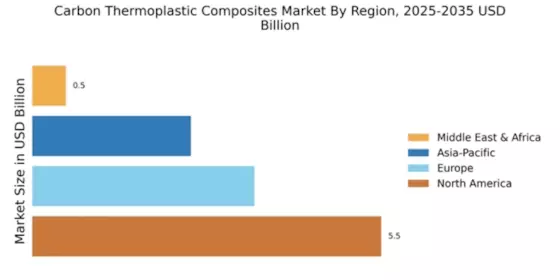
North America is poised to maintain its leadership in the Carbon Thermoplastic Composites Market, holding a significant market share of 5.5 in 2024. The region's growth is driven by increasing demand in aerospace, automotive, and renewable energy sectors, alongside supportive regulations promoting lightweight materials. The push for sustainability and performance efficiency further fuels this demand, making North America a hub for innovation in composite technologies. The competitive landscape is characterized by major players such as Toray Industries, Hexcel Corporation, and BASF, which are investing heavily in R&D to enhance product offerings. The U.S. leads the market, supported by a robust manufacturing base and advanced technological capabilities. The presence of key players ensures a dynamic market environment, fostering collaboration and innovation to meet evolving customer needs.

Europe : Innovation and Sustainability Focus

Europe is emerging as a significant player in the Carbon Thermoplastic Composites Market, with a market size of 3.5. The region's growth is driven by stringent regulations aimed at reducing carbon emissions and promoting sustainable materials. The automotive and aerospace industries are particularly influential, as they seek lightweight solutions to enhance fuel efficiency and performance. The European Union's Green Deal further catalyzes investment in advanced composite technologies, positioning Europe as a leader in sustainable innovation. Leading countries such as Germany, France, and the UK are at the forefront of this market, with companies like Solvay and BASF leading the charge. The competitive landscape is marked by a strong emphasis on R&D, with firms collaborating with academic institutions to develop cutting-edge solutions. The presence of regulatory bodies ensures compliance and fosters a culture of innovation, making Europe a vibrant market for carbon thermoplastic composites.

Asia-Pacific : Emerging Market Potential

Asia-Pacific is witnessing rapid growth in the Carbon Thermoplastic Composites Market, with a market size of 2.5. The region's expansion is fueled by increasing industrialization, particularly in countries like China and India, where demand for lightweight materials in automotive and aerospace sectors is surging. Government initiatives promoting advanced manufacturing and sustainability are also key drivers, creating a favorable environment for composite materials. China stands out as a leading country in this market, with significant investments in R&D and manufacturing capabilities. Key players such as Mitsubishi Chemical Corporation and Teijin Limited are actively expanding their presence in the region. The competitive landscape is evolving, with local manufacturers emerging to meet the growing demand, ensuring a dynamic market environment that fosters innovation and collaboration.

Middle East and Africa : Untapped Market Opportunities

The Middle East and Africa region is gradually emerging in the Carbon Thermoplastic Composites Market, with a market size of 0.53. The growth is primarily driven by increasing investments in infrastructure and automotive sectors, as countries seek to diversify their economies. The demand for lightweight materials is gaining traction, particularly in the construction and transportation industries, as they aim to enhance efficiency and reduce costs. Countries like South Africa and the UAE are leading the charge, with local companies beginning to explore the potential of carbon thermoplastic composites. The competitive landscape is still developing, with opportunities for international players to enter the market. As awareness of the benefits of composite materials grows, the region is expected to see increased adoption and innovation in this sector.

Key Players and Competitive Insights

The Carbon Thermoplastic Composites Market is currently characterized by a dynamic competitive landscape, driven by increasing demand for lightweight materials across various industries, including automotive, aerospace, and consumer goods. Key players such as Toray Industries (Japan), SABIC (Saudi Arabia), and Solvay (Belgium) are strategically positioning themselves through innovation and partnerships. For instance, Toray Industries (Japan) focuses on enhancing its product portfolio with advanced composite materials, while SABIC (Saudi Arabia) emphasizes sustainability in its manufacturing processes, aiming to reduce carbon footprints. These strategies collectively foster a competitive environment that prioritizes technological advancement and environmental responsibility.

In terms of business tactics, companies are increasingly localizing manufacturing to reduce lead times and optimize supply chains. The market structure appears moderately fragmented, with several key players exerting influence over specific segments. This fragmentation allows for niche players to emerge, yet the collective strength of major companies like BASF (Germany) and Hexcel Corporation (US) ensures that competition remains robust and innovation-driven.

In November 2025, BASF (Germany) announced a strategic partnership with a leading automotive manufacturer to develop next-generation carbon thermoplastic composites aimed at enhancing vehicle performance and sustainability. This collaboration is significant as it not only expands BASF's market reach but also aligns with the growing trend of integrating sustainable materials in automotive applications, potentially setting new industry standards.

In October 2025, Hexcel Corporation (US) unveiled a new line of carbon thermoplastic composites designed specifically for aerospace applications, which are expected to reduce weight by up to 20% compared to traditional materials. This development is crucial as it addresses the aerospace industry's ongoing quest for efficiency and performance, thereby reinforcing Hexcel's position as a leader in high-performance materials.

In September 2025, Solvay (Belgium) launched a comprehensive sustainability initiative aimed at achieving carbon neutrality in its production processes by 2030. This initiative not only enhances Solvay's brand reputation but also responds to increasing regulatory pressures and consumer demand for environmentally friendly products. Such strategic moves are indicative of a broader trend where companies are prioritizing sustainability as a core component of their operational strategies.

As of December 2025, the competitive trends within the Carbon Thermoplastic Composites Market are increasingly defined by digitalization, sustainability, and the integration of AI technologies. Strategic alliances are becoming more prevalent, as companies recognize the value of collaboration in driving innovation and enhancing supply chain resilience. Looking ahead, competitive differentiation is likely to evolve from traditional price-based competition to a focus on innovation, technological advancements, and reliable supply chains, reflecting a shift in market dynamics that prioritizes long-term sustainability and performance.

Key Companies in the Carbon Thermoplastic Composites Market market include

Industry Developments

February 2021

- Mitsubishi Chemical Corp. has set up its latest pilot unit for fiber-reinforced carbon thermoplastic materials. This new facility will be based in Fukui Prefecture (which is part of Honshu Island in Japan) and the operations are expected to start by the end of this year.

In the coming years, MCC also plans to sell the product as a new range in its KyronTM thermoplastic composite brand, rolling it out to the CFRTP market in Japan.Furthermore, in the light of stringent environmental policies, there is an urgent requirement for lighter weighted aircraft as well as automotive bodies in the mobility industry. MCC expects the utilization of CFRP to surge considerably in these sectors, as it imparts great strength and facilitate light weight properties.

The brand also says that it is proactively trying to bolster its CFRP business by producing new components that are capable of accommodating the changing consumer needs, offering timely and optimal solutions and technologies to the mobility industry.

Report Overview 

Future Outlook

Carbon Thermoplastic Composites Market Future Outlook

The Carbon Thermoplastic Composites Market is poised for growth at 13.33% CAGR from 2024 to 2035, driven by advancements in manufacturing technologies, increasing demand in automotive applications, and sustainability initiatives.

New opportunities lie in:

  • Development of lightweight automotive components for electric vehicles.
  • Expansion into aerospace applications with high-performance thermoplastic composites.
  • Investment in recycling technologies for thermoplastic composite materials.

By 2035, the market is expected to achieve substantial growth, solidifying its position as a key player in advanced materials.

Market Segmentation

Carbon Thermoplastic Composites Market End Use Outlook

  • Structural Components
  • Interior Components
  • Exterior Components
  • Functional Components

Carbon Thermoplastic Composites Market Application Outlook

  • Aerospace
  • Automotive
  • Consumer Electronics
  • Industrial
  • Sports Equipment

Carbon Thermoplastic Composites Market Material Type Outlook

  • Polypropylene
  • Polyamide
  • Polycarbonate
  • Polyethylene

Carbon Thermoplastic Composites Market Reinforcement Type Outlook

  • Carbon Fiber
  • Glass Fiber
  • Natural Fiber
  • Hybrid Fiber

Carbon Thermoplastic Composites Market Manufacturing Process Outlook

  • Injection Molding
  • Compression Molding
  • Filament Winding
  • Pultrusion

Report Scope

MARKET SIZE 202412.53(USD Billion)
MARKET SIZE 202514.2(USD Billion)
MARKET SIZE 203549.63(USD Billion)
COMPOUND ANNUAL GROWTH RATE (CAGR)13.33% (2024 - 2035)
REPORT COVERAGERevenue Forecast, Competitive Landscape, Growth Factors, and Trends
BASE YEAR2024
Market Forecast Period2025 - 2035
Historical Data2019 - 2024
Market Forecast UnitsUSD Billion
Key Companies ProfiledToray Industries (JP), SABIC (SA), Solvay (BE), BASF (DE), Hexcel Corporation (US), Teijin Limited (JP), Mitsubishi Chemical Corporation (JP), Cytec Industries (US), Royal DSM (NL)
Segments CoveredApplication, End Use, Material Type, Manufacturing Process, Reinforcement Type
Key Market OpportunitiesGrowing demand for lightweight materials in automotive and aerospace sectors drives Carbon Thermoplastic Composites Market expansion.
Key Market DynamicsRising demand for lightweight materials drives innovation and competition in the Carbon Thermoplastic Composites Market.
Countries CoveredNorth America, Europe, APAC, South America, MEA

Market Highlights

Author
Anshula Mandaokar
Team Lead - Research

Anshula Mandaokar holds an academic degree in Chemical Engineering and has been contributing to the field for more than 5 years. She has expertise in Market Research and Business Consulting and serves as a Team Lead for a reputed Market Research firm under the Chemicals and Materials domain spectrum. She has worked on multiple projects, generating explicit results in a quick turnaround time. Her understanding of data interpretation justifies her role as a leader.

Leave a Comment

FAQs

At what CAGR is the global carbon thermoplastic composites market predicted to grow over the forecast period?

The carbon thermoplastic composites market is predicted to grow at a 5% CAGR between 2025-2035.

What will be the possible market valuation of the carbon thermoplastic composites market?

The global carbon thermoplastic composites market is predicted to touch USD 42.32 billion by 2035.

Which region is expected to have maximum share in the carbon thermoplastic composites market?

North America is predicted to have maximum share in the carbon thermoplastic composites market during the forecast period.

Who are the key players profiled in the carbon thermoplastic composites market?

Notable players profiled in the carbon thermoplastic composites market include PlastiComp, Inc. (US), Covestro AG (Germany), Plasan Carbon Composites (US), Arkema S.A. (France), Mitsubishi Chemical Holdings Corporation (Japan), TEIJIN LIMITED (Japan), Hexcel Corporation (US), SGL Group (Germany), TORAY INDUSTRIES, INC. (Japan), Cytec Solvay Group (US), and DowAksa (Turkey).

What are the key factors that are adding to the growth of the carbon thermoplastic composites market?

Booming aerospace and defense industry, high preference for thermoplastic composites, growing demand for lightweight vehicles, and increasing automotive production are adding to the growth of the carbon thermoplastic composites market.

Download Free Sample

Kindly complete the form below to receive a free sample of this Report

Compare Licence

×
Features License Type
Single User Multiuser License Enterprise User
Price $4,950 $5,950 $7,250
Maximum User Access Limit 1 User Upto 10 Users Unrestricted Access Throughout the Organization
Free Customization
Direct Access to Analyst
Deliverable Format
Platform Access
Discount on Next Purchase 10% 15% 15%
Printable Versions