Segmentation Quick Reference
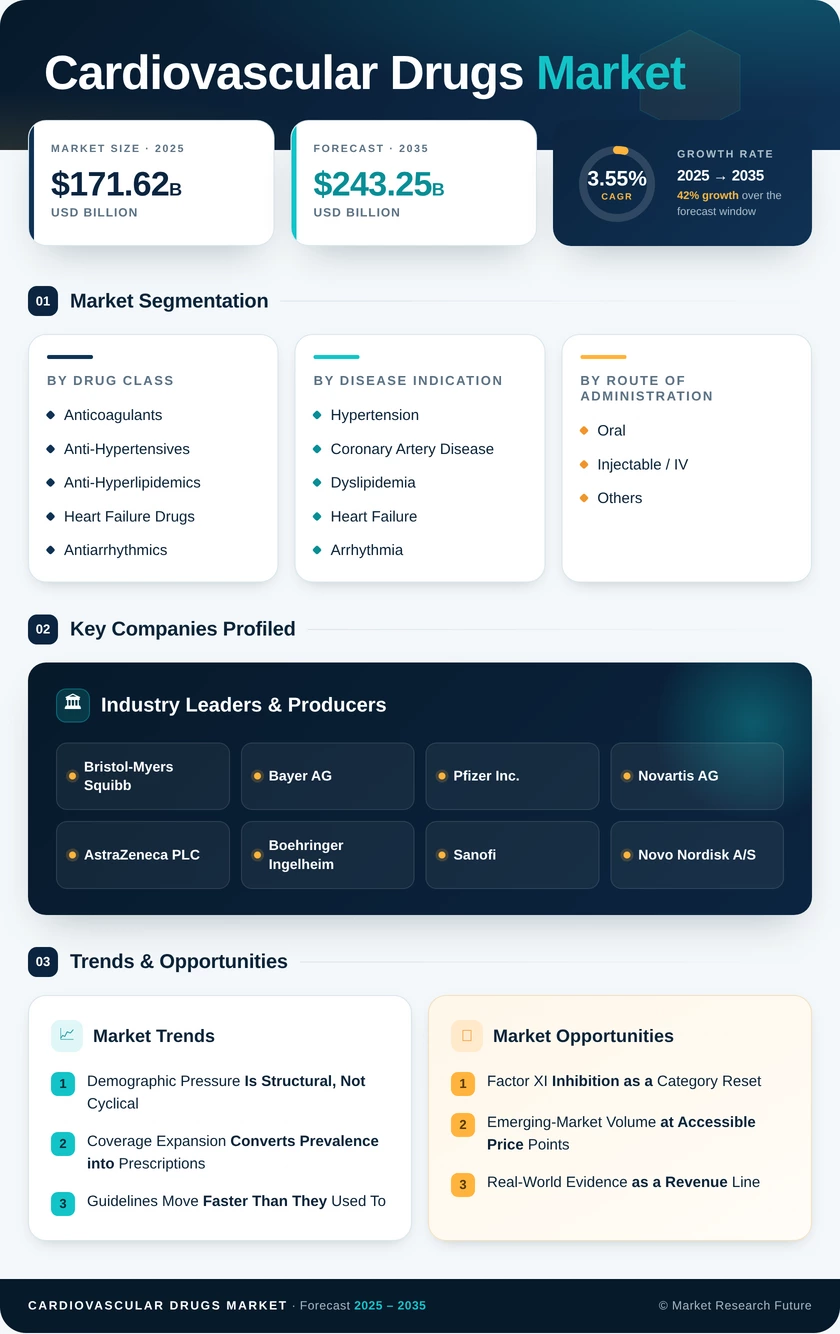
| Dimension | Sub-Segments | Dominant Segment | Fastest Growing Segment |
| By Drug Class | Anti-Hyperlipidemics, Anti-Hypertensives, Anticoagulants, Antiarrhythmics, Heart Failure Drugs, Others | Anticoagulants | Heart Failure Drugs |
| By Disease Indication | Hypertension, Coronary Artery Disease, Dyslipidemia, Heart Failure, Arrhythmia, Others | Hypertension | Heart Failure |
| By Route of Administration | Oral, Injectable / IV, Others | Oral | Others |
| By Distribution Channel | Hospital Pharmacies, Retail Pharmacies, Online Pharmacies, Others | Hospital Pharmacies | Online Pharmacies |
| By Region | North America, Europe, Asia-Pacific, South America, Middle East & Africa | North America | Asia-Pacific |
Market Segmentation Overview
By Drug Class
| Sub-Segment | Key Trend |
| Anti-Hyperlipidemics | Shift from daily statins toward long-interval siRNA and Lp(a)-targeted agents |
| Anti-Hypertensives | Deep genericization pushes value toward fixed-dose combinations. |
| Anticoagulants | Largest revenue pool entering a significant exclusivity transition. |
| Antiarrhythmics | Steady demand anchored to ablation-adjacent pharmacotherapy |
| Heart Failure Drugs | Four-pillar therapy lifts per-patient treatment value sharply. |
| Others | Rare cardiomyopathy and pulmonary hypertension niches command premium pricing. |
Drug class remains the most commercially decisive dimension. Value is migrating away from high-volume oral maintenance categories toward smaller cohorts treated with mechanistically differentiated agents, and that migration accelerates as anticoagulant exclusivity unwinds during the second half of the forecast window.
By Disease Indication
| Sub-Segment | Key Trend |
| Hypertension | Largest diagnosed pool, lowest revenue per treated patient |
| Coronary Artery Disease | Secondary prevention protocols sustain durable multi-drug regimens. |
| Dyslipidemia | Intensified LDL targets expand combination prescribing |
| Heart Failure | Hospitalization-avoidance economics drive reimbursement priority |
| Arrhythmia | Ageing-linked atrial fibrillation incidence supports steady growth. |
| Others | Valvular, congenital and amyloid indications broaden slowly. |
Indication mix explains why patient-count leadership and revenue leadership diverge. Sponsors increasingly design programs around indications where payers can quantify avoided acute care costs, which favors heart failure and dyslipidemia over conventional hypertension management.
By Route of Administration
| Sub-Segment | Key Trend |
| Oral | Dominant by volume; adherence variability limits real-world effectiveness |
| Injectable / IV | Long-interval subcutaneous dosing converts adherence risk into scheduled encounters. |
| Others | Transdermal and inhaled formats remain niche but growing. |
Route selection has become a commercial decision rather than a purely pharmacological one. Clinic-administered long-interval therapy delivers verifiable exposure data that supports outcomes-based contracts, an advantage daily oral regimens cannot easily replicate.
By Distribution Channel
| Sub-Segment | Key Trend |
| Hospital Pharmacies | Initiation channel for post-acute cardiovascular therapy |
| Retail Pharmacies | Chronic refill backbone across all developed geographies |
| Online Pharmacies | Fastest-growing channel on telehealth prescribing and home delivery |
| Others | Mail-order and specialty distribution serve high-cost therapies. |
Channel economics increasingly determine adherence outcomes. Digital dispensing generates refill-gap data that manufacturers and payers both value, giving online pharmacies strategic influence far exceeding their current revenue contribution.