Carpet And Rugs Market Summary
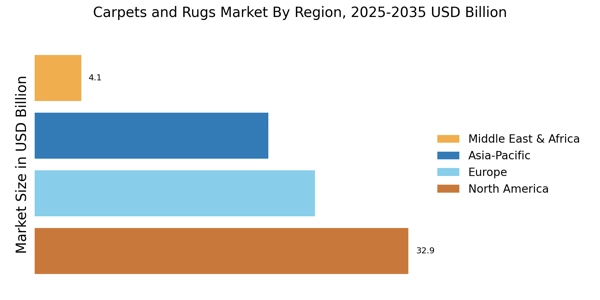
As per Market Research Future analysis, the Carpets and Rugs Market was estimated at 82.12 USD Billion in 2024. The Carpets and Rugs industry is projected to grow from 86.65 USD Billion in 2025 to 148.3 USD Billion by 2035, exhibiting a compound annual growth rate (CAGR) of 5.5% during the forecast period 2025 - 2035. North America holds the largest share of the global Carpets and Rugs Market at approximately 40%, driven by a large residential construction sector, strong consumer demand for premium flooring solutions, and a well-established manufacturing and retail infrastructure for woven and tufted carpet products. The United States is the leading country within North America, capturing approximately 33% of the global Carpets and Rugs Market share, supported by high homeownership rates, strong renovation activity, large-scale commercial flooring demand, and the dominance of major manufacturers such as Shaw Industries and Mohawk Industries. Woven Carpets dominate the Carpets and Rugs Market as the largest product type segment, accounting for approximately 35% of the global market share in 2025, preferred for their durability, aesthetic appeal, and suitability for both residential and commercial applications across premium and mid-range price segments.
Key Market Trends & Highlights
The Carpets and Rugs Market is experiencing a dynamic shift towards sustainability and customization, driven by technological advancements and changing consumer preferences.
- The North American market remains the largest, characterized by a strong demand for woven carpets.
- Asia-Pacific is emerging as the fastest-growing region, with increasing urbanization and disposable incomes fueling market expansion.
- Woven carpets dominate the market, while tufted carpets are witnessing rapid growth due to their affordability and versatility.
- Sustainability initiatives and rising disposable incomes are key drivers propelling the market forward.
Market Size & Forecast
| 2024 Market Size | 82.12 (USD Billion) |
| 2035 Market Size | 148.3 (USD Billion) |
| CAGR (2025 - 2035) | 5.52% |
Major Players
Mohawk Industries (US), Shaw Industries (US), Interface (US), Tandus Centiva (US), Beaulieu International Group (BE), Dixie Group (US), Balta Group (BE), Oriental Weavers (EG), Milliken & Company (US), Kraus Carpet (CA)