CCTV Market (2026 - 2035)

CCTV Market Size, Share & Research Report By Camera Type (Analogue Camera, and Internet Protocol (IP) Camera [Wired, and Wireless]), By Technology (CMOS Technology, and CCD Technology), By End User (Educational Centers, Hospitals, Hotels, Real Estates, Religious Places, Government, Retail, IT Sector, and Transport Sector), By Channel (Online Channel, and Offline Channel), and By Region (North America, Europe, Asia-Pacific, Middle East & Africa, and South America) - Industry Forecast Till 2035
ID: MRFR/SEM/0206-CR
200 Pages
Aarti Dhapte, Shubham Munde
Last Updated: June 22, 2026
CCTV Market

Market Size

Forecast Period2026-2035
CAGR (2026-2035)15.10%
2025 Market SizeUSD 53.35 Billion
2035 Market SizeUSD 220.50 Billion

Key Players

Hikvision
Dahua Technology
Axis Communications
Bosch Security Systems
Hanwha Vision
Honeywell
Opportunities
  • Unified Physical-Security-as-a-Service Platforms
  • Smart Transportation Corridor Surveillance
  • Emerging-Market Urbanization in Africa and South Asia

CCTV Market Summary

The global CCTV Market reached an estimated USD 53.35 Billion in 2025, positioning itself for a projected expansion from USD 62.20 Billion in 2026 to USD 220.50 Billion by 2035 at a CAGR of 15.10% during the forecast period. Two catalysts anchor this trajectory: smart-city mandates—India's Safe City Mission alone earmarked INR 2,700 Crore (~USD 325 million) across 15 cities [1]—and enterprise refresh cycles triggered by tightening data-protection regulations across the EU's AI Act and China's Personal Information Protection Law [2]. These policies are converting passive camera budgets into active surveillance-intelligence programs at a pace the industry has not seen in a decade.

Legacy analog CCTV systems, which still represent a declining but sizable installed base, are giving way to IP-based platforms equipped with on-camera inference chipsets and cloud-managed video subscriptions. The shift is not simply about higher resolution; it is about converting raw footage into structured metadata for traffic management, retail analytics, and workplace safety compliance. Global enterprise spending on intelligent video analytics surpassed USD 8.5 Billion in 2024, according to IHS Markit estimates, and continues to climb as edge-processing costs fall below USD 50 per camera [3].

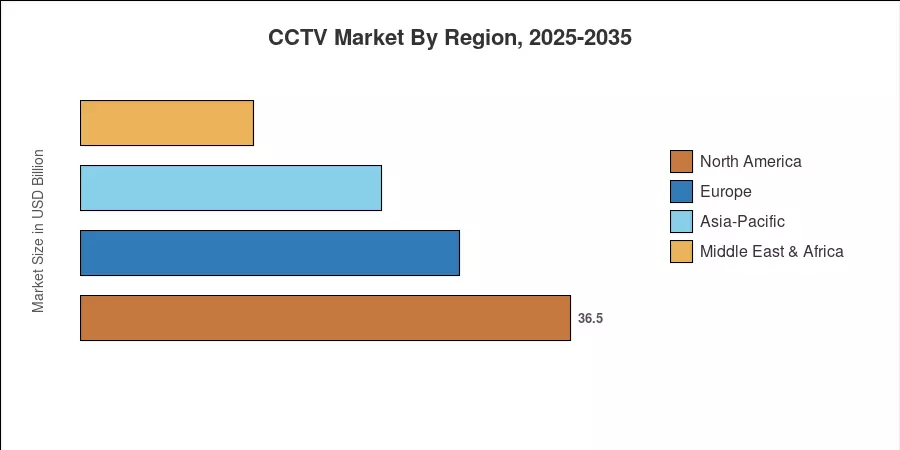
Asia-Pacific dominates the CCTV Market with a 37.1% revenue share in 2025, driven by government-led surveillance rollouts across China and India. The Middle East & Africa region is advancing at the fastest clip, registering a projected CAGR of 19.5% through 2035 as Gulf states invest in mega-project security and African nations digitize urban infrastructure. Europe holds the second-largest position, buoyed by GDPR-compliant upgrades and critical-infrastructure protection directives. As 5G coverage widens and bandwidth tariffs drop, the CCTV Market is poised to mature from a security cost center into a multi-purpose data asset.


Key Report Takeaways

• By Camera Type

  • IP cameras captured 44.2% of the CCTV Market share in 2025, reflecting the accelerating migration from analog infrastructure.
  • The 4K/Ultra-HD segment is forecast to grow at an 18.7% CAGR through 2035, driven by forensic-grade imaging requirements in government tenders.

• By End-User Vertical

  • Government and public safety led the CCTV Market with a 30.8% revenue share in 2025, underscoring the weight of homeland-security budgets.
  • Hospitality and healthcare verticals are expanding at a 16.1% CAGR, powered by patient-monitoring mandates and guest-experience analytics.

• By Region

  • Asia-Pacific accounted for 37.1% of the global CCTV Market revenue in 2025.
  • The Middle East & Africa is the fastest-growing region with a projected 19.5% CAGR through 2035.


Market Size and Forecast (2021–2035)

Market Research Future's sizing methodology combines bottom-up revenue aggregation from equipment and software vendors, validated against top-down macroeconomic indicators such as urban-security expenditure ratios and construction-permit data. Historical figures draw from company filings and customs-trade databases; forecast estimates apply segment-level CAGRs calibrated to policy timelines and technology adoption curves.
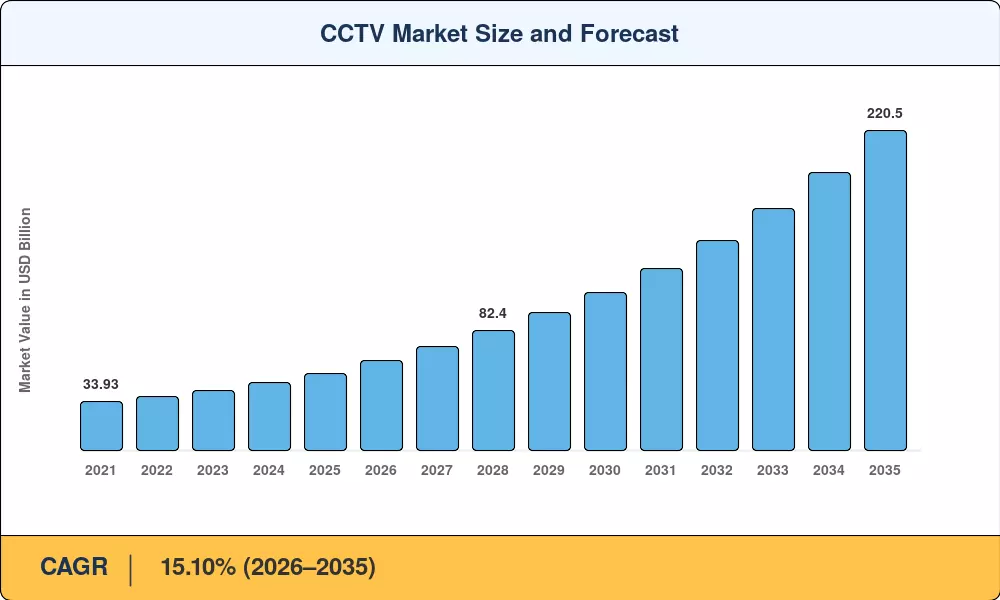
CCTV Market Size and Forecast
Our Impact
Enabled $4.3B Revenue Impact for Fortune 500 and Leading Multinationals
Partnering with 2000+ Global Organizations Each Year
30K+ Citations by Top-Tier Firms in the Industry

Driver Impact Analysis

Driver ~% Impact on CAGR Geographic Relevance Impact Timeline
Smart-City & Safe-City Government Mandates 22 Global Short-term (≤2 yr)
Edge-AI Chipset Cost Reduction 18 Global Medium-term (2–4 yr)
Cloud Video-Surveillance-as-a-Service (VSaaS) 16 North America, Europe Medium-term (2–4 yr)
Data-Protection & Privacy Regulation Refresh 14 Europe, Asia-Pacific Short-term (≤2 yr)
5G & Low-Latency Connectivity Expansion 12 Asia-Pacific, MEA Long-term (≥4 yr)
Critical-Infrastructure Protection Directives 10 Europe, North America Medium-term (2–4 yr)
Mega-Event Security Requirements 8 MEA, South America Short-term (≤2 yr)


Smart-City & Safe-City Government Mandates

National and municipal programs remain the single largest demand catalyst for the CCTV Market. India's Safe City Mission has committed INR 2,700 Crore (~USD 325 million) for surveillance infrastructure across 15 cities, while China's Xue Liang ("Sharp Eyes") program extended camera coverage to over 600 million units nationwide by 2024 [1]. These mandates convert discretionary security spending into allocated budget lines, compressing procurement timelines and favoring IP CCTV cameras with AI video analytics capabilities that can feed centralized command centers.

Edge-AI Chipset Cost Reduction

Semiconductor advances have compressed on-camera inference costs below USD 50 per unit, making real-time object detection feasible even in mid-range camera SKUs. Qualcomm's QCS8550 and Ambarella's CV72S platforms deliver over 16 TOPS of neural-network performance at under 5W, enabling edge-processed alerts that reduce cloud bandwidth by up to 70% [3]. This cost trajectory removes the last major barrier to AI adoption at the camera level and expands addressable use cases into retail analytics, occupancy management, and industrial quality control.

Cloud Video-Surveillance-as-a-Service (VSaaS)

The shift from on-premise NVR stacks to subscription-based cloud management is redefining procurement economics. VSaaS platforms allow enterprises to pay per camera per month, reducing upfront capital expenditure by 40–60% according to IHS Markit estimates [8]. Verkada, Eagle Eye Networks, and Rhombus have collectively raised over USD 1 Billion in venture funding since 2021, signaling investor confidence in recurring-revenue surveillance models that extend the CCTV Market beyond traditional hardware sales.

Data-Protection & Privacy Regulation Refresh

The EU AI Act's classification of public-space biometric surveillance as "high risk" compels operators to retrofit or replace non-compliant camera systems, creating a regulatory-driven upgrade cycle across Europe [2]. Similarly, China's PIPL and Brazil's LGPD are establishing consent and data-handling frameworks that advantage vendors offering built-in anonymization and audit-trail features. Compliance deadlines arriving between 2025 and 2027 are converting regulatory pressure into concrete purchase orders across the CCTV Market.


Restraints Impact Analysis

Impact percentages below represent each restraint's estimated drag on overall growth momentum. These figures are directional and should not be subtracted from the headline CAGR.

Restraint ~% Impact on CAGR Geographic Relevance Impact Timeline
Cybersecurity Vulnerabilities & Firmware Exploits –6 Global Short-term (≤2 yr)
Geopolitical Trade Restrictions on Chinese OEMs –5 North America, Europe Medium-term (2–4 yr)
Privacy Backlash & Biometric Surveillance Bans –4 Europe, North America Long-term (≥4 yr)
High Total Cost of Ownership for Legacy Replacements –3 South America, MEA Medium-term (2–4 yr)
Skilled Installer & Integrator Workforce Shortage –3 Global Long-term (≥4 yr)


Cybersecurity Vulnerabilities & Firmware Exploits

Connected cameras represent an expanding attack surface. The U.S. CISA issued 47 advisories related to IP camera firmware vulnerabilities in 2023 alone, and Mirai-variant botnets continued to exploit default credentials on over 300,000 devices globally [14]. This reality forces end-users to layer network-segmentation, encrypted transport, and regular firmware patching onto total cost calculations, slowing adoption among cost-sensitive small and medium enterprises and tempering growth in the broader CCTV Market.

Geopolitical Trade Restrictions on Chinese OEMs

The U.S. FCC's covered-equipment list and the NDAA Section 889 ban continue to exclude Hikvision and Dahua from federal procurement, while the European Commission is evaluating similar supply-chain security frameworks [15]. These restrictions compress the addressable market for the two largest global CCTV manufacturers and raise average selling prices in Western markets, creating a two-tier pricing structure that constrains volume growth for the CCTV Market in regulated geographies.

Privacy Backlash & Biometric Surveillance Bans

Municipal moratoriums on facial-recognition technology—active in San Francisco, Portland, and several EU member states—create legal uncertainty that delays procurement decisions [2]. While these bans target specific analytics layers rather than cameras themselves, they dampen investor appetite for large-scale deployments and encourage a wait-and-see approach among city planners evaluating the CCTV Market.


CCTV Market Opportunities

Unified Physical-Security-as-a-Service Platforms

Converged platforms that package access control, intrusion detection and video analytics into a single subscription will be a USD 12 Billion potential by 2030 [8]. As enterprises move away from siloed systems, a single dashboard is being adopted more and more by CCTV Market suppliers, providing the opportunity to up-sell adjacent security modules and lock in multi-year contracts.


Smart Transportation Corridor Surveillance

Intelligent traffic management systems and autonomous vehicle testing corridors require comprehensive video coverage with vehicle-classification and license-plate-recognition capabilities. In 2022–2026, the U.S. Department of Transportation’s SMART Grants program awarded USD 500 million for connected-infrastructure trials, directly subsidizing roadside CCTV installs [11].


Emerging-Market Urbanization in Africa and South Asia

Sub-Saharan Africa’s urban population is anticipated to triple by 2050, creating a huge greenfield need for city-scale monitoring networks [10]. Kenya’s Konza Technopolis and Rwanda’s Kigali Innovation City are early proof points for CCTV Market suppliers to build reference designs before competing municipalities expand.


Data Monetization Through Anonymized Video Analytics

Retailers and airport operators are trying out anonymized heatmap and footfall analytics services monetized via SaaS dashboards. This new income stream changes cameras from a cost center to a profit contributor. The analytics licensing generates 2-4× the margin of hardware alone [8]. The CCTV Market will gain from the fact that video-based data is becoming a tradeable enterprise asset.


Cybersecurity-Certified Camera Ecosystems

Western vendors differentiating through NDAA-compliant, SOC 2-audited product lines are commanding 15–25% price premiums in government and financial-sector tenders [15]. This compliance premium creates a defensible niche within the CCTV Market for manufacturers that invest early in supply-chain transparency and third-party security certifications.


CCTV Market Future Outlook

Autonomous AI-Driven Surveillance Operations

By the late 2020s, self-tuning camera networks will adjust field of view, exposure, and alert thresholds without human intervention. projects that 60% of large enterprises will deploy autonomous security-operations-center workflows by 2028, reducing false-alarm rates by 80% and labor costs by 30% [17]. The CCTV Market will shift value capture from hardware to software licensing as these autonomous capabilities become table stakes.

Platform Economics & Ecosystem Lock-In

Open-standard camera platforms (ONVIF Profile T/S) are losing ground to vertically integrated ecosystems where hardware, VMS, and analytics share a proprietary data layer. Verkada's model—selling cameras that function only within its cloud—illustrates how platform economics create recurring-revenue moats. Expect the CCTV Market to stratify into open-interop tiers for cost-sensitive buyers and premium walled-garden tiers for enterprises willing to pay for simplicity [8].

Sustainability & Circular-Economy Pressures

The EU's Ecodesign for Sustainable Products Regulation, expected to cover electronic security devices by 2028, will mandate minimum recycled-content thresholds, repairability scores, and digital product passports for cameras sold in Europe [18]. Manufacturers investing in modular designs and take-back programs will gain procurement preference, adding a sustainability dimension to the CCTV Market competitive landscape.

Privacy-Preserving Analytics at Scale

Federated learning and on-device anonymization techniques are enabling analytics without centralized storage of identifiable footage. The World Economic Forum's 2024 framework for responsible surveillance technology adoption encourages this approach [19]. As public acceptance becomes a deployment prerequisite, privacy-by-design architectures will determine which CCTV Market vendors win government and retail contracts in the 2030s.


CCTV Market Segmentation

By Camera Type

Segment Key Metric Primary Demand Driver
Analog USD 6.14 Billion (2025) Legacy installed base maintenance
IP 44.2% share (2025) Network connectivity & remote management
PTZ 14.8% CAGR (2026–2035) Perimeter security requiring pan-tilt-zoom
Thermal USD 3.47 Billion (2025) Border security & industrial hazard detection
4K/Ultra-HD 18.7% CAGR (2026–2035) Forensic-grade evidence requirements


The CCTV Market camera-type landscape is defined by the IP segment's dominance. Network cameras integrate natively with VMS platforms, support Power-over-Ethernet installation, and host on-board analytics, making them the default choice for new deployments across commercial and government verticals. Analog cameras persist in cost-constrained retrofit scenarios but face accelerating replacement cycles.

The 4K/Ultra-HD category is the fastest-expanding camera segment in the CCTV Market. Law enforcement and transportation agencies are specifying 4K as a minimum resolution for evidentiary recording, while falling sensor costs are making 4K cameras price-competitive with last-generation Full-HD models.

By Resolution

Segment Key Metric Primary Demand Driver
SD 8.3% share (2025) Legacy analog systems
HD 41.1% share (2025) Cost-performance balance for SMEs
Full-HD USD 14.22 Billion (2025) Mainstream commercial standard
4K and Above 16.8% CAGR (2026–2035) Forensic detail & wide-area coverage


HD resolution holds the largest share of the CCTV Market by resolution tier, serving as the workhorse format for small and mid-sized enterprise deployments where bandwidth constraints limit higher-resolution adoption. The 4K-and-above tier is gaining momentum as H.265/HEVC and emerging AV1 codecs cut storage requirements by 50% compared to prior-generation compression.

By Installation Type

Segment Key Metric Primary Demand Driver
Fixed 67.5% share (2025) Permanent indoor/outdoor installations
Mobile 15.5% CAGR (2026–2035) Rapid-deploy kits for events & construction


Fixed installations dominate the CCTV Market, but mobile and rapid-deploy platforms are gaining share as event-security, construction-site, and disaster-response use cases require temporary camera networks that can be activated in hours rather than weeks.

By Connectivity

Segment Key Metric Primary Demand Driver
Wired 69.2% share (2025) Reliability & bandwidth for high-resolution streams
Wireless 17.7% CAGR (2026–2035) 5G/Wi-Fi 6E enabling cable-free deployment


Wired connectivity retains a firm grip on the CCTV Market owing to Power-over-Ethernet's dual advantage of data transmission and camera power over a single cable. Wireless solutions are accelerating, however, as 5G private networks deliver the latency and throughput needed for real-time HD streaming without trenching costs.

By End-User Vertical

Segment Key Metric Primary Demand Driver
Government & Public Safety 30.8% share (2025) Homeland security & safe-city mandates
Transportation USD 7.47 Billion (2025) Rail, airport & highway monitoring
Industrial 14.5% CAGR (2026–2035) Process-quality & worker-safety compliance
BFSI USD 4.81 Billion (2025) Branch security & ATM fraud prevention
Retail 15.3% CAGR (2026–2035) Shrinkage reduction & footfall analytics
Hospitality 16.1% CAGR (2026–2035) Guest-experience & liability management
Healthcare USD 2.89 Billion (2025) Patient monitoring & pharmaceutical security
Education 14.9% CAGR (2026–2035) Campus-safety mandates


Government and public safety remains the CCTV Market's largest vertical, anchored by homeland-security budgets that treat surveillance as critical national infrastructure. Transportation is the second-largest vertical, fueled by rail-safety regulations and airport-expansion programs requiring perimeter and passenger-flow monitoring.


Regional Market Share Analysis

Region Key Metric Primary Investment Themes
Asia-Pacific 37.1% revenue share (2025) Government mandates, urban density, manufacturing QC
North America USD 13.87 Billion (2025) Critical infrastructure, VSaaS migration, NDAA compliance
Europe 21.8% revenue share (2025) GDPR/AI Act upgrades, transit security, smart buildings
South America 14.2% CAGR (2026–2035) Urban safety programs, retail loss prevention
Middle East & Africa 19.5% CAGR (2026–2035) Mega-project security, smart-city greenfield builds

The CCTV Market exhibits a distinct regional hierarchy shaped by government spending capacity, urbanization rates, and regulatory frameworks. Asia-Pacific leads on sheer volume, while the Middle East & Africa registers the highest growth trajectory through 2035.


North America

Country Key Metric Key Driver
US 78.5% of regional revenue (2025) NDAA compliance upgrades, school safety mandates [15]
Canada USD 1.73 Billion (2025) Cannabis-sector surveillance requirements
Mexico 15.8% CAGR (2026–2035) C5 emergency-response center expansion [9]


The U.S. dominates North American demand as federal agencies replace NDAA-banned equipment and K–12 school districts accelerate camera installations under state safety-grant programs. Canada's regulated cannabis industry has created a niche compliance-driven surveillance segment, while Mexico's C5 command centers continue to expand real-time monitoring across metropolitan zones.

Europe

Country Key Metric Key Driver
Germany 23.4% of regional revenue (2025) Industrie 4.0 factory automation monitoring [13]
UK USD 2.64 Billion (2025) Largest per-capita camera density globally [4]
France 14.6% CAGR (2026–2035) 2024 Olympics legacy infrastructure scaling [9]
Italy 10.2% of regional revenue (2025) Cultural-heritage site protection mandates
Spain 13.8% CAGR (2026–2035) Smart-tourism corridor investments
Nordic Countries USD 0.98 Billion (2025) Data-center perimeter security [13]
Russia 11.5% of regional revenue (2025) Safe City federal program [1]
Rest of Europe 13.2% CAGR (2026–2035) EU Cohesion Fund security grants


Europe's CCTV Market growth is anchored in regulatory compliance. The EU AI Act's 2025–2027 enforcement timeline is compelling operators to audit and upgrade camera fleets, while the NIS2 Directive drives critical-infrastructure entities to bolster physical perimeter security with certified IP systems.

Asia-Pacific

Country Key Metric Key Driver
China 52.3% of regional revenue (2025) Xue Liang ("Sharp Eyes") national program [1]
India 17.4% CAGR (2026–2035) Safe City Mission & Smart Cities Mission [1]
Japan USD 2.18 Billion (2025) Aging-society monitoring & disaster preparedness
South Korea 11.6% of regional revenue (2025) K-City autonomous-vehicle test corridors [11]
ASEAN 16.3% CAGR (2026–2035) Tourism-zone security & industrial-park growth
Rest of Asia-Pacific USD 1.45 Billion (2025) Infrastructure modernization


China's installed camera base—exceeding 600 million units—anchors Asia-Pacific's dominance in the CCTV Market. India is the region's fastest mover, with combined Safe City and Smart Cities Mission allocations channeling billions into urban surveillance. Japan's demographic challenges are converting elderly-care facilities into high-density camera environments for fall detection and patient monitoring.

South America

Country Key Metric Key Driver
Brazil 62.8% of regional revenue (2025) Urban-violence reduction programs [9]
Argentina 14.9% CAGR (2026–2035) Buenos Aires smart-city modernization
Rest of South America USD 1.04 Billion (2025) Mining-site perimeter surveillance


Brazil's public-safety crisis sustains the largest CCTV investment pipeline in South America, with São Paulo state deploying over 20,000 new cameras under its Detecta 2.0 platform. Argentina and Chile are following with municipal-level smart-city programs that prioritize centralized monitoring centers.

Middle East & Africa

Country Key Metric Key Driver
Saudi Arabia 31.5% of regional revenue (2025) NEOM & Vision 2030 mega-projects [9]
UAE USD 1.12 Billion (2025) Expo City Dubai & tourism-security infrastructure [9]
South Africa 16.8% CAGR (2026–2035) Private-security sector digitization [10]
Egypt 17.2% CAGR (2026–2035) New Administrative Capital surveillance build-out
Rest of MEA USD 0.78 Billion (2025) Smart-city pilot programs [10]


The Middle East & Africa represents the fastest-growing opportunity for the CCTV Market. Saudi Arabia's NEOM project alone requires tens of thousands of cameras across its 170-kilometer linear-city footprint, while Egypt's New Administrative Capital is installing a comprehensive surveillance backbone from greenfield. African markets south of the Sahara are digitizing private-security operations, replacing manned guarding with remote video monitoring.


CCTV Market By Region, 2025-2035

Competitive Benchmarking

The CCTV Market exhibits medium concentration, with the top five players commanding an estimated 55–62% of global revenue. The Herfindahl-Hirschman Index sits in the 1,200–1,500 range, indicating a moderately consolidated structure where two Chinese manufacturers hold outsized share but face growing competitive pressure from compliance-driven Western alternatives.

Company Est. Revenue Share Range Key Offerings for CCTV Market Strategic Positioning
Hikvision ~18–22% Full-stack IP cameras, NVRs, AI-enabled analytics Cost leader with vertical integration from chipsets to cloud
Dahua Technology ~12–15% IP/thermal cameras, VSaaS platform, smart-city solutions Price-aggressive challenger; strong APAC & MEA presence
Axis Communications (Canon) ~6–9% Network cameras, radar-video fusion, ONVIF leadership Premium cybersecurity positioning; open-platform ecosystem
Bosch Security Systems ~4–6% IP cameras, Video Analytics integrated suite Enterprise-grade reliability; building-automation cross-sell
Hanwha Vision ~4–6% Wisenet AI cameras, edge analytics, open VMS Growing NDAA-compliant portfolio for U.S. government
Honeywell ~3–5% Commercial security cameras, integrated building platforms Conglomerate cross-sell into HVAC and access control
Motorola Solutions (Avigilon) ~3–5% AI-powered cameras, Appearance Search, cloud VMS Analytics-first strategy; law-enforcement focus
IDIS ~2–4% DirectIP NVRs, enterprise cameras Plug-and-play simplicity; strong Korean & European base
Vivotek ~2–3% Edge-AI network cameras, cybersecurity-certified firmware Mid-market NDAA alternative for SMEs
Uniview ~2–4% IP cameras, smart-city platforms, thermal solutions Fast-growing Chinese OEM; expanding global distribution


Recent News & Developments


  • Hanwha Vision (March 2023): Rebranded from Hanwha Techwin and expanded its Wisenet AI camera lineup with on-device anomaly-detection algorithms for critical infrastructure.
  • Motorola Solutions (December 14, 2022): Completed the acquisition of Rave Mobile Safety, integrating mass-notification capabilities with Avigilon camera platforms for unified campus-security response [12].


CCTV Market Report Scope

Parameter Detail
Market Scope Global CCTV Market covering hardware, software, and managed services
Study Period 2021–2035
CAGR (Forecast) 15.10% (2026–2035)
Base Year Market Size USD 53.35 Billion (2025)
Forecast Endpoint USD 220.50 Billion (2035)
Fastest Growing Segment 4K/Ultra-HD cameras (18.7% CAGR)
Companies Profiled 10 (Hikvision, Dahua, Axis, Bosch, Hanwha Vision, Honeywell, Motorola Solutions, IDIS, Vivotek, Uniview)
Valuation Currency USD Billion


FAQs

How does total cost of ownership differ between analog and IP camera deployments?
IP systems cost 20–35% more upfront but eliminate analog cabling and DVR hardware. Over a five-year lifecycle, IP deployments typically deliver 15–25% lower total cost of ownership through remote management and reduced truck rolls [3].
What cybersecurity certifications should buyers prioritize for government-grade CCTV procurement?
Prioritize NDAA Section 889 compliance, FIPS 140-3 encryption validation, and SOC 2 Type II attestation. These three certifications collectively address supply-chain trust, data-at-rest protection, and operational security controls [15].
How are privacy-preserving analytics changing procurement specifications in the CCTV Market?
Buyers now require on-device anonymization that strips personally identifiable information before footage leaves the camera. This shifts evaluation criteria from resolution benchmarks toward edge-processing capability and privacy-certification readiness [19].
What role does Power-over-Ethernet play in reducing installation costs for the CCTV Market?
PoE delivers power and data through a single Cat6 cable, eliminating separate electrical runs. This reduces cabling labor by 30–40% and simplifies UPS backup architecture for mid-sized deployments [3].
How are insurance incentives influencing CCTV adoption in commercial real estate?
Property insurers in North America and Europe offer 5–15% premium discounts for verified AI-enabled surveillance coverage. These incentives shorten payback periods and are accelerating adoption among Class B office and retail landlords [20].
What distinguishes cloud-managed VSaaS from traditional on-premise VMS in the CCTV Market?
VSaaS shifts storage and compute to the cloud, converting capital expenditure into monthly operational spend. It also enables automatic firmware updates and remote health monitoring that on-premise NVR stacks cannot match at scale [8].
How does 5G private networking change wireless CCTV deployment economics?
5G slicing delivers guaranteed bandwidth and sub-10ms latency for camera feeds without public-network congestion. This makes wireless CCTV viable for high-density venues where trenching fiber is cost-prohibitive [7].    
Author
Author
Author Profile
Aarti Dhapte LinkedIn
AVP - Research
A consulting professional focused on helping businesses navigate complex markets through structured research and strategic insights. I partner with clients to solve high-impact business problems across market entry strategy, competitive intelligence, and opportunity assessment. Over the course of my experience, I have led and contributed to 100+ market research and consulting engagements, delivering insights across multiple industries and geographies, and supporting strategic decisions linked to $500M+ market opportunities. My core expertise lies in building robust market sizing, forecasting, and commercial models (top-down and bottom-up), alongside deep-dive competitive and industry analysis. I have played a key role in shaping go-to-market strategies, investment cases, and growth roadmaps, enabling clients to make confident, data-backed decisions in dynamic markets.
Co-Author
Co-Author Profile
Shubham Munde LinkedIn
Team Lead - Research
Shubham brings over 7 years of expertise in Market Intelligence and Strategic Consulting, with a strong focus on the Automotive, Aerospace, and Defense sectors. Backed by a solid foundation in semiconductors, electronics, and software, he has successfully delivered high-impact syndicated and custom research on a global scale. His core strengths include market sizing, forecasting, competitive intelligence, consumer insights, and supply chain mapping. Widely recognized for developing scalable growth strategies, Shubham empowers clients to navigate complex markets and achieve a lasting competitive edge. Trusted by start-ups and Fortune 500 companies alike, he consistently converts challenges into strategic opportunities that drive sustainable growth.

Research Approach


Secondary Research

The secondary research process involved comprehensive analysis of regulatory databases, technology standards repositories, peer-reviewed engineering journals, security industry publications, and authoritative public safety organizations. Key sources included the U.S. Department of Homeland Security (DHS) Science & Technology Directorate, National Institute of Standards and Technology (NIST) Cybersecurity and Privacy Frameworks, European Committee for Standardization (CEN/CENELEC) for video surveillance standards, International Electrotechnical Commission (IEC) for camera testing standards, National Security Agency (NSA) and Cybersecurity & Infrastructure Security Agency (CISA) for critical infrastructure protection guidelines, Federal Communications Commission (FCC) for RF transmission regulations, European Union Agency for Cybersecurity (ENISA) for IoT and surveillance security, ASIS International, Security Industry Association (SIA), British Security Industry Association (BSIA), National Center for State Courts for judicial security statistics, Bureau of Justice Statistics (BJS), United Nations Office on Drugs and Crime (UNODC) for global crime and safety statistics, European Crime Prevention Network (EUCPN), National Retail Federation (NRF) Loss Prevention data, International Association of Chiefs of Police (IACP) technology adoption surveys, National Association of State Chief Information Officers (NASCIO) cybersecurity reports, Eurostat Digital Economy & Society Statistics, World Bank Open Data on urbanization and infrastructure investments, and national interior ministry reports from China, India, UAE, and UK. These sources were used to collect installation statistics, regulatory compliance data, technology adoption studies, crime prevention efficacy research, smart city investment trends, and competitive landscape analysis for IP cameras, analog systems, CMOS/CCD technologies, and cloud-based surveillance platforms.


Primary Research

To gather both qualitative and quantitative insights, supply-side and demand-side stakeholders were interviewed during the primary research phase. Chief executive officers, CTOs, VPs of hardware engineering, directors of product lines, and heads of channel strategies from CCTV manufacturers, semiconductor foundries (which produce image sensors), video management software (VMS) developers, and cloud service providers for surveillance were examples of supply-side sources. Chief security officers (CSOs), IT directors, facilities managers, procurement officers from retail chains, hospital security administrators, school campus safety directors, government transportation authorities, and smart city project managers were among the demand-side sources.

Primary research validated market segmentation across camera types (IP vs. analog), technology platforms (CMOS vs. CCD), vertical adoption patterns, pricing strategies by distribution channel, and integration trends with AI/IoT platforms.

Primary Respondent Breakdown:

By Designation: C-level Primaries (28%), Director Level (31%), Others (41%)

By Region: North America (32%), Europe (29%), Asia-Pacific (34%), Rest of World (5%)


Market Size Estimation

Global market valuation was derived through shipment volume analysis and revenue mapping across the value chain. The methodology included:

Identification of 60+ key manufacturers and component suppliers across North America, Europe, Asia-Pacific, Latin America, and Middle East & Africa

Product mapping across IP cameras (wired/wireless), analog cameras, CMOS sensors, CCD sensors, video management software (VMS), network video recorders (NVR), digital video recorders (DVR), and cloud storage services

Analysis of reported and modeled annual revenues specific to CCTV hardware, software, and services portfolios

Coverage of manufacturers representing 75-80% of global market share in 2024

Extrapolation using bottom-up (camera unit shipments × ASP by technology type and region) and top-down (manufacturer revenue validation, semiconductor supplier bill-of-materials estimates) approaches to derive segment-specific valuations for camera types, technology platforms, end-user verticals, and distribution channels

Download Free Sample

Kindly complete the form below to receive a free sample of this Report

Download PDF ×

We do not share your information with anyone. However, we may send you emails based on your report interest from time to time. You may contact us at any time to opt-out.