Author

Rahul Gotadki

Cell Harvesting Market Research Report: Size, Share, Trend Analysis By Product Type (Manual Cell Harvesters, Automated Cell Harvesters), By Applications (Biopharmaceutical Application, Stem Cell Research), End User (Pharmaceutical Companies) - Growth Outlook & Industry Forecast 2025 To 2035
As per Market Research Future analysis, the Cell Harvesting Market Size was estimated at 6.288 USD Billion in 2024. The Cell Harvesting industry is projected to grow from 6.841 USD Billion in 2025 to 15.89 USD Billion by 2035, exhibiting a compound annual growth rate (CAGR) of 8.79% during the forecast period 2025 - 2035
The Cell Harvesting Market is poised for substantial growth driven by technological advancements and increasing demand for cell-based therapies.
| 2024 Market Size | 6.288 (USD Billion) |
| 2035 Market Size | 15.89 (USD Billion) |
| CAGR (2025 - 2035) | 8.79% |
Thermo Fisher Scientific (US), Merck KGaA (DE), BD (US), Lonza Group (CH), Miltenyi Biotec (DE), STEMCELL Technologies (CA), Corning Incorporated (US), F. Hoffmann-La Roche Ltd (CH)
Our Impact
Enabled $4.3B Revenue Impact for Fortune 500 and Leading Multinationals
Partnering with 2000+ Global Organizations Each Year
30K+ Citations by Top-Tier Firms in the Industry
The Cell Harvesting Market is currently experiencing a dynamic evolution, driven by advancements in biotechnology and increasing demand for cell-based therapies. This sector encompasses various techniques for isolating and collecting cells from biological samples, which are essential for research and therapeutic applications. The growing prevalence of chronic diseases and the rising focus on personalized medicine are propelling the need for efficient cell harvesting methods. Furthermore, the integration of automation and innovative technologies is enhancing the efficiency and accuracy of these processes, thereby attracting significant interest from both researchers and healthcare providers. In addition, regulatory frameworks are becoming more supportive of cell-based therapies, which may further stimulate growth in the Cell Harvesting Market. As the industry adapts to these changes, there is a noticeable shift towards more sustainable practices, including the use of ethically sourced materials and environmentally friendly techniques. This trend reflects a broader societal demand for responsible innovation in healthcare. Overall, the Cell Harvesting Market appears poised for substantial growth, with numerous opportunities for stakeholders to explore in the coming years.
The Cell Harvesting Market is witnessing rapid technological innovations that enhance the efficiency and precision of cell collection processes. Automation and robotics are increasingly being integrated into harvesting techniques, which may reduce human error and improve throughput. These advancements not only streamline operations but also enable researchers to focus on more complex tasks, potentially accelerating the pace of scientific discovery.
There seems to be a growing trend of favorable regulatory environments surrounding cell-based therapies. As governments and health authorities recognize the potential of these therapies, they are likely to implement more supportive policies. This shift could facilitate faster approvals and encourage investment in the Cell Harvesting Market, ultimately leading to increased availability of innovative treatments.
The Cell Harvesting Market is increasingly aligning with sustainability goals, reflecting a broader commitment to ethical practices. Companies are exploring environmentally friendly methods and ethically sourced materials for cell collection. This trend not only addresses consumer concerns but also positions organizations as responsible players in the healthcare sector, potentially enhancing their reputation and market appeal.
The shift towards personalized medicine is reshaping the Cell Harvesting Market. As healthcare moves away from one-size-fits-all approaches, the need for tailored therapies that cater to individual patient profiles becomes paramount. This trend necessitates the efficient harvesting of specific cell types, which can be utilized in personalized treatment plans. The market for personalized medicine is projected to grow significantly, with estimates suggesting it could reach USD 2 trillion by 2030. This growth is likely to drive demand for specialized cell harvesting techniques that can accommodate the unique requirements of personalized therapies. Thus, the Cell Harvesting Market is expected to expand in response to this evolving healthcare paradigm.
The Cell Harvesting Market is experiencing a notable surge in demand for cell-based therapies, driven by advancements in regenerative medicine and personalized healthcare. As the prevalence of chronic diseases continues to rise, the need for effective treatment options becomes increasingly critical. According to recent data, the cell therapy market is projected to reach USD 20 billion by 2026, indicating a robust growth trajectory. This demand is further fueled by the increasing number of clinical trials focusing on cell therapies, which require efficient cell harvesting techniques. Consequently, the Cell Harvesting Market is poised to benefit from this trend, as healthcare providers seek innovative solutions to meet the growing therapeutic needs of patients.
Investment in stem cell research is a key driver for the Cell Harvesting Market. As researchers and institutions allocate more resources towards understanding stem cell biology and its applications, the demand for effective cell harvesting techniques intensifies. Recent reports indicate that funding for stem cell research has increased significantly, with government and private sectors investing billions annually. This influx of capital supports the development of advanced cell harvesting technologies, which are essential for isolating and purifying stem cells for therapeutic use. Consequently, the Cell Harvesting Market stands to gain from this trend, as enhanced research capabilities lead to more innovative applications and therapies in regenerative medicine.
Technological innovations play a pivotal role in shaping the Cell Harvesting Market. The introduction of automated cell harvesting systems and advanced bioprocessing technologies has significantly enhanced the efficiency and yield of cell recovery processes. For instance, the integration of microfluidics and automation in cell harvesting has streamlined workflows, reducing processing times and minimizing contamination risks. As a result, the market for automated cell harvesting solutions is expected to witness substantial growth, with estimates suggesting a compound annual growth rate of over 15% in the coming years. These innovations not only improve operational efficiency but also contribute to the overall quality of cell-based products, thereby driving the Cell Harvesting Market forward.
Regulatory support is a crucial factor influencing the Cell Harvesting Market. Governments and regulatory bodies are increasingly recognizing the potential of cell therapies and are streamlining approval processes to facilitate their development. Initiatives aimed at expediting the review of cell-based products are becoming more common, which encourages investment and innovation within the sector. For instance, the introduction of fast-track designations for promising cell therapies has led to a more favorable environment for research and commercialization. This regulatory landscape not only enhances the viability of cell harvesting technologies but also fosters growth within the Cell Harvesting Market, as companies seek to align their products with evolving regulatory standards.
In the Cell Harvesting Market, the product type segment is chiefly dominated by Automated Cell Harvesters, which hold a substantial market share due to their efficiency and consistency in processing cell samples. Manual Cell Harvesters, while traditionally used, are experiencing a decline in market share as the healthcare and research sectors increasingly lean towards automation for streamlined operations. This trend exemplifies the shift towards more technologically advanced solutions in the industry.
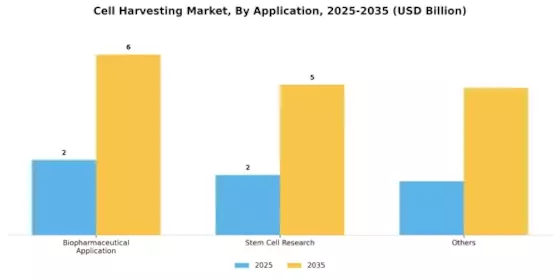
Cell Harvesters: Automated (Dominant) vs. Manual (Emerging)
Automated Cell Harvesters represent the dominant force in the Cell Harvesting Market, being increasingly adopted due to their ability to enhance throughput and reduce error margins in cell processing. This type of harvester is particularly favored in large-scale laboratory environments, where precision and efficiency are paramount. In contrast, Manual Cell Harvesters are emerging in certain niche applications, especially in settings requiring more hands-on techniques or where cost considerations are critical. While they may not match the automation in speed, they remain essential for specific protocols where human expertise is indispensable.
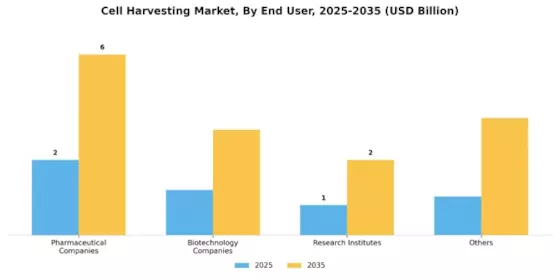
In the Cell Harvesting Market, the distribution of application segments showcases a clear dominance by the Biopharmaceutical Application, which plays a pivotal role in driving market expansion. This segment commands the majority share, emphasizing the reliance of pharmaceutical companies on effective cell harvesting techniques to produce therapeutics. Meanwhile, Stem Cell Research is emerging as a vital segment, steadily gaining traction due to its implications in regenerative medicine and innovative therapies. The Others category encompasses niche applications, contributing marginally in comparison to the leading segments.
Application Focus: Biopharmaceutical Application (Dominant) vs. Stem Cell Research (Emerging)
The Biopharmaceutical Application segment stands as the dominant player in the Cell Harvesting Market, capitalizing on advancements in bioprocessing and the urgent need for new therapies targeting complex diseases. Companies invest significantly in technologies that optimize cell retrieval processes, thereby underpinning the pharmaceutical industry's evolution. In contrast, Stem Cell Research, characterized as an emerging application, is rapidly gaining importance, fueled by breakthroughs in stem cell therapies and regenerative medicine. This segment benefits from increased funding and interest from both public and private sectors, providing a fertile ground for innovative applications in personalized medicine and health care solutions.
In the Cell Harvesting Market, Biotechnology Companies hold the largest share, driven by their focus on innovative therapies and the increasing demand for cellular treatments. On the other hand, Pharmaceutical Companies are witnessing significant growth rates as they increasingly adopt cell harvesting techniques in drug development and personalized medicine, capturing an expanding market share. Research Institutes and Others collectively form a smaller segment, leveraging their research capabilities but not matching the extensive needs of the leading sectors.
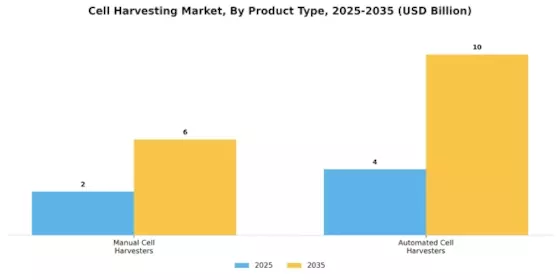
Biotechnology Companies (Dominant) vs. Pharmaceutical Companies (Emerging)
Biotechnology Companies are at the forefront of the Cell Harvesting Market, leveraging advanced technologies for cell therapy, regenerative medicine, and personalized treatment approaches. Their dominance is attributed to the increasing investments in R&D and a focus on developing novel therapeutics that require efficient cell extraction methods. In contrast, Pharmaceutical Companies are emerging rapidly, adopting cell harvesting techniques to enhance drug discovery processes, making them key players in the evolving landscape. Both sectors drive innovation and collaboration, influencing market trends and the adoption of new techniques.
Get more detailed insights about Cell Harvesting Market Request Free Sample
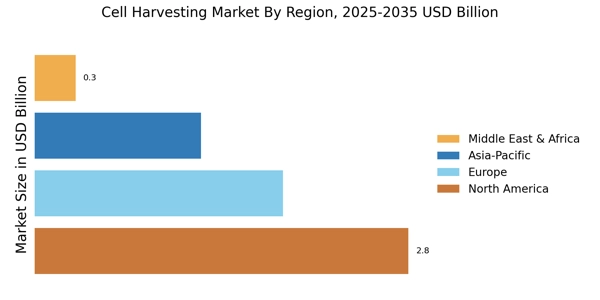
North America is the largest market for cell harvesting, accounting for approximately 45% of the global share. The region's growth is driven by advanced healthcare infrastructure, increasing investments in biotechnology, and a strong focus on research and development. Regulatory support from agencies like the FDA further catalyzes market expansion, ensuring safety and efficacy in cell harvesting technologies. The United States leads the market, with significant contributions from Canada. Key players such as Thermo Fisher Scientific, BD, and STEMCELL Technologies are headquartered here, fostering a competitive landscape. The presence of these industry leaders, along with ongoing collaborations between academia and industry, enhances innovation and drives market growth in North America.
Europe is the second-largest market for cell harvesting, holding around 30% of the global share. The region's growth is propelled by increasing investments in regenerative medicine and cell therapies, alongside supportive regulatory frameworks from the European Medicines Agency (EMA). Countries like Germany and the UK are at the forefront, driving demand for advanced cell harvesting solutions. Germany is the leading country in this market, followed closely by the UK and France. The competitive landscape features key players such as Merck KGaA and Miltenyi Biotec, which are actively involved in research and development. The collaboration between public and private sectors enhances innovation, making Europe a promising region for future growth in cell harvesting technologies.
Asia-Pacific is witnessing rapid growth in the cell harvesting market, accounting for approximately 20% of the global share. The region's expansion is driven by increasing healthcare expenditures, a growing population, and rising awareness of advanced therapeutic options. Countries like China and India are emerging as key players, supported by government initiatives to boost biotechnology and healthcare sectors. China is the largest market in the region, with significant contributions from India and Japan. The competitive landscape is characterized by the presence of both local and international players, including Lonza Group and Corning Incorporated. The increasing focus on research and development, along with favorable government policies, is expected to further enhance market growth in Asia-Pacific.
The Middle East and Africa region is gradually emerging in the cell harvesting market, holding about 5% of the global share. The growth is driven by increasing investments in healthcare infrastructure and a rising demand for advanced medical technologies. Countries like South Africa and the UAE are leading the way, supported by government initiatives aimed at improving healthcare services and biotechnology research. South Africa is the largest market in this region, with the UAE following closely. The competitive landscape is still developing, with a mix of local and international players beginning to establish a presence. As the region continues to invest in healthcare and biotechnology, the cell harvesting market is expected to see significant growth in the coming years.
The Cell Harvesting Market is currently characterized by a dynamic competitive landscape, driven by advancements in biotechnology and increasing demand for cell-based therapies. Key players such as Thermo Fisher Scientific (US), Merck KGaA (DE), and BD (US) are strategically positioned to leverage their extensive product portfolios and innovative capabilities. Thermo Fisher Scientific (US) focuses on enhancing its cell harvesting technologies through continuous innovation, while Merck KGaA (DE) emphasizes strategic partnerships to expand its market reach. BD (US) is actively pursuing digital transformation initiatives to optimize its operational efficiency, thereby shaping a competitive environment that is increasingly reliant on technological advancements and strategic collaborations.
In terms of business tactics, companies are localizing manufacturing and optimizing supply chains to enhance responsiveness to market demands. The Cell Harvesting Market appears moderately fragmented, with a mix of established players and emerging companies. The collective influence of these key players is significant, as they drive innovation and set industry standards, thereby shaping the overall market structure.
In August 2025, Thermo Fisher Scientific (US) announced the launch of a new automated cell harvesting system designed to improve efficiency and reduce contamination risks in laboratory settings. This strategic move is likely to enhance their competitive edge by addressing critical pain points faced by researchers, thereby solidifying their position as a leader in the market.
In September 2025, Merck KGaA (DE) entered into a collaboration with a leading academic institution to develop next-generation cell harvesting technologies. This partnership is indicative of Merck's commitment to innovation and could potentially accelerate the development of novel solutions that meet the evolving needs of the biopharmaceutical industry.
In July 2025, BD (US) unveiled a new digital platform aimed at streamlining the cell harvesting process through real-time data analytics. This initiative not only enhances operational efficiency but also positions BD as a forward-thinking player in the market, likely attracting customers seeking advanced technological solutions.
As of October 2025, the Cell Harvesting Market is witnessing trends such as digitalization, sustainability, and the integration of artificial intelligence. Strategic alliances are increasingly shaping the competitive landscape, enabling companies to pool resources and expertise. Looking ahead, competitive differentiation is expected to evolve, with a shift from price-based competition to a focus on innovation, technology, and supply chain reliability. This transition underscores the importance of adaptability and forward-thinking strategies in maintaining a competitive advantage.

ADS-TEC is a producer and provider of high-quality, long-lasting Industrial IT systems, as well as high-performance battery systems and full storage solutions. ADS-in-house TEC's development is characterized by over 35 years of experience and professional skill in system development. ADS-TEC, a medium-sized company, employs around 240 people at two locations in Germany. The headquarters were transferred from Leinfelden-Echterdingen to a new facility in Nuertingen, near Stuttgart, in May 2014. The headquarters are supplemented by a manufacturing facility in Wilsdruff, near Dresden.
Argos Technologies delivers one-of-a-kind equipment and materials to help life scientists improve science. We stock the whole Argos Technologies product range, including the famous PolarSafe® products, for liquid handling, microbiology, cell biology, general laboratory, tabletop equipment, and cryogenic storage. Cryogenic storage racks and boxes, cryogenic vials and caps, upright freezer racks, labels, pipettes, pipette controllers, cell spreaders, mini centrifuges, centrifuge tubes, tube rotators, and other items are available in Agro technologies.
Intended Audience
The Cell Harvesting Market is projected to grow at 8.79% CAGR from 2025 to 2035, driven by advancements in biotechnology, increasing demand for cell therapies, and rising investments in regenerative medicine.
New opportunities lie in:
By 2035, the Cell Harvesting Market is expected to achieve substantial growth, reflecting its critical role in biotechnology.
| MARKET SIZE 2024 | 6.288(USD Billion) |
| MARKET SIZE 2025 | 6.841(USD Billion) |
| MARKET SIZE 2035 | 15.89(USD Billion) |
| COMPOUND ANNUAL GROWTH RATE (CAGR) | 8.79% (2025 - 2035) |
| REPORT COVERAGE | Revenue Forecast, Competitive Landscape, Growth Factors, and Trends |
| BASE YEAR | 2024 |
| Market Forecast Period | 2025 - 2035 |
| Historical Data | 2019 - 2024 |
| Market Forecast Units | USD Billion |
| Key Companies Profiled | Thermo Fisher Scientific (US), Merck KGaA (DE), BD (US), Lonza Group (CH), Miltenyi Biotec (DE), STEMCELL Technologies (CA), Corning Incorporated (US), F. Hoffmann-La Roche Ltd (CH) |
| Segments Covered | Product Type, Applications |
| Key Market Opportunities | Advancements in automated cell harvesting technologies enhance efficiency and scalability in the Cell Harvesting Market. |
| Key Market Dynamics | Technological advancements and regulatory changes drive innovation and competition in the cell harvesting market. |
| Countries Covered | North America, Europe, APAC, South America, MEA |
The Cell Harvesting Market was valued at 6.288 USD Billion in 2024.
The market is projected to reach 15.89 USD Billion by 2035.
The expected CAGR for the Cell Harvesting Market during 2025 - 2035 is 8.79%.
The Automated Cell Harvesters segment is expected to grow from 3.788 USD Billion to 10.39 USD Billion by 2035.
The Biopharmaceutical Application segment is projected to increase from 2.5 USD Billion to 6.0 USD Billion by 2035.
Key players include Thermo Fisher Scientific, Merck KGaA, BD, Lonza Group, and Miltenyi Biotec.
The Stem Cell Research application is likely to grow from 2.0 USD Billion to 5.0 USD Billion by 2035.


The secondary research process involved comprehensive analysis of regulatory databases, peer-reviewed scientific journals, clinical publications, and authoritative biotechnology organizations. Key sources included the US Food & Drug Administration (FDA) Center for Biologics Evaluation and Research, European Medicines Agency (EMA) Committee for Advanced Therapies, International Society for Cell & Gene Therapy (ISCT), International Society for Stem Cell Research (ISSCR), American Association for the Advancement of Science (AAAS), National Institutes of Health (NIH) National Center for Advancing Translational Sciences (NCATS), National Center for Biotechnology Information (NCBI/PubMed), CDC National Center for Health Statistics, World Health Organization (WHO) Global Health Observatory, EU Eurostat Health Database, Organisation for Economic Co-operation and Development (OECD) Health Statistics, and national biotechnology ministry reports from key markets. These sources were used to collect cell therapy manufacturing statistics, regulatory approval data for cell harvesting systems, clinical safety studies, biopharmaceutical production trends, and market landscape analysis for manual cell harvesters, automated cell harvesters, and bioprocessing technologies.
Qualitative and quantitative insights were obtained by interviewing supply-side and demand-side stakeholders during the primary research process. CEOs, VPs of Product Development, regulatory affairs chiefs, and commercial directors from cell harvesting system manufacturers, bioprocessing equipment OEMs, and cell therapy technology providers comprised the supply-side sources. Demand-side sources included procurement leads from biopharmaceutical manufacturing facilities and contract development and manufacturing organizations (CDMOs), principal investigators from stem cell research institutes, process development heads, manufacturing directors, and chief scientific officers from pharmaceutical and biotechnology companies. Market segmentation was validated, product pipeline timelines were confirmed, and insights regarding clinical adoption patterns, bioprocessing efficiency metrics, pricing strategies, and reimbursement dynamics for cell-based therapies were obtained through primary research.
Primary Respondent Breakdown:
By Designation: C-level Primaries (32%), Director Level (31%), Others (37%)
By Region: North America (38%), Europe (29%), Asia-Pacific (26%), Rest of World (7%)
Global market valuation was derived through revenue mapping and bioprocessing volume analysis. The methodology included:
Identification of 40+ key manufacturers across North America, Europe, Asia-Pacific, and Latin America
Product mapping across manual cell harvesters, automated cell harvesters, and integrated bioprocessing systems
Analysis of reported and modeled annual revenues specific to cell harvesting portfolios
Coverage of manufacturers representing 70-75% of global market share in 2024
Extrapolation using bottom-up (bioprocessing volume × ASP by country/region) and top-down (manufacturer revenue validation) approaches to derive segment-specific valuations for biopharmaceutical applications, stem cell research, and other emerging applications
Kindly complete the form below to receive a free sample of this Report

“This is really good guys. Excellent work on a tight deadline. I will continue to use you going forward and recommend you to others. Nice job”


“Thanks. It’s been a pleasure working with you, please use me as reference with any other Intel employees.”


“Thanks for sending the report it gives us a good global view of the Betaïne market.”


“Thank you, this will be very helpful for OQS.”


“We found the report very insightful! we found your research firm very helpful. I'm sending this email to secure our future business.”


“I am very pleased with how market segments have been defined in a relevant way for my purposes (such as "Portable Freezers & refrigerators" and "last-mile"). In general the report is well structured. Thanks very much for your efforts.”


“I have been reading the first document or the study, ,the Global HVAC and FP market report 2021 till 2026. Must say, good info! I have not gone in depth at all parts, but got a good indication of the data inside!”


“We got the report in time, we really thank you for your support in this process. I also thank to all of your team as they did a great job.”


“The Automotive 48V ECU Components Procurement Intelligence Study” was a complex project, but the Market Research Future (MRFR) team handled it with quality, agility, and customer-centricity. They delivered all requested data on time and within the agreed scope. The team, including Shubhendra Anand and Rahul Gotadki, was always readily available to clarify questions and swiftly implement necessary adjustments, driving the project to a successful conclusion within a very demanding timeframe.
I would also like to specifically commend Akshay Agarwal for his responsiveness and support at every stage—from our initial inquiry on May 6th through to final delivery on June 18th. His dedication made the entire process seamless.”



