Download Free Sample
Kindly complete the form below to receive a free sample of this Report
Cell Isolation Market Research Report: Size, Share, Trend Analysis By Cell Type (Human Cells and Animal Cells), By Techniques (Centrifugation, Surface Marker, and Filtration), And By Region (North America, Europe, Asia-Pacific, And Rest Of The World) - Growth Outlook & Industry Forecast 2025 To 2035
As per MRFR analysis, the Cell Isolation Market Size was estimated at 6.8 USD Billion in 2024. The Cell Isolation industry is projected to grow from 8.01 USD Billion in 2025 to 41.21 USD Billion by 2035, exhibiting a compound annual growth rate (CAGR) of 17.8% during the forecast period 2025 - 2035.
The Cell Isolation Market is experiencing robust growth driven by technological advancements and increasing demand for personalized medicine.
| 2024 Market Size | 6.8 (USD Billion) |
| 2035 Market Size | 41.21 (USD Billion) |
| CAGR (2025 - 2035) | 17.8% |
Thermo Fisher Scientific (US), BD (US), Miltenyi Biotec (DE), Beckman Coulter (US), Stemcell Technologies (CA), Merck KGaA (DE), Bio-Rad Laboratories (US), Qiagen (DE), Lonza Group (CH)
The Cell Isolation Market is currently experiencing a transformative phase, driven by advancements in technology and increasing demand for personalized medicine. The growing emphasis on research and development in cellular therapies and regenerative medicine is propelling the need for efficient cell isolation techniques. As healthcare systems evolve, the focus on precision medicine necessitates the isolation of specific cell types for targeted therapies, thereby enhancing treatment efficacy. Furthermore, the rise in chronic diseases and the aging population are contributing to the expansion of this market, as researchers seek innovative solutions to address complex health challenges. In addition, the Cell Isolation Market is witnessing a surge in the adoption of automated systems and microfluidics technologies. These innovations streamline the isolation process, reduce contamination risks, and improve overall efficiency. The integration of artificial intelligence and machine learning into cell isolation protocols is also emerging, potentially revolutionizing the way researchers approach cell sorting and analysis. As the market continues to evolve, stakeholders must remain vigilant to emerging trends and technologies that could shape the future landscape of cell isolation, ensuring they are well-positioned to meet the demands of a rapidly changing environment.
The Cell Isolation Market is increasingly influenced by technological innovations that enhance the efficiency and accuracy of cell separation processes. Automation and microfluidics are becoming integral, allowing for high-throughput isolation with minimal human intervention. These advancements not only improve productivity but also reduce the likelihood of contamination, which is crucial for maintaining sample integrity.
The rising trend towards personalized medicine is significantly impacting the Cell Isolation Market. As healthcare shifts towards tailored therapies, the need for specific cell types for individualized treatments becomes paramount. This trend drives demand for advanced isolation techniques that can cater to the unique requirements of diverse patient populations.
The expansion of regenerative medicine is another key trend shaping the Cell Isolation Market. As researchers explore cellular therapies for various conditions, the need for effective cell isolation methods becomes increasingly critical. This trend highlights the importance of isolating stem cells and other specialized cell types to facilitate innovative treatment options.
The Global Cell Isolation Market Industry is experiencing a surge in demand for personalized medicine, which tailors treatment to individual patient profiles. This trend is driven by advancements in genomics and biotechnology, enabling more precise therapeutic approaches. As healthcare systems increasingly adopt personalized strategies, the need for effective cell isolation techniques becomes paramount. In 2024, the market is projected to reach 6.8 USD Billion, reflecting the growing emphasis on customized treatments. This shift not only enhances patient outcomes but also propels the development of innovative cell isolation technologies, thereby expanding the market's scope.
The Cell Isolation Market is notably diverse, with Cell Therapy holding the largest market share. This segment is pivotal due to its applications in regenerative medicine and advanced therapeutic techniques. Following Cell Therapy, Stem Cell Research and Cancer Research capture significant portions of the market, reflecting their crucial roles in cutting-edge medical research and treatment. Tissue Engineering also features prominently, underpinning the growing demand for innovative medical solutions. Growth trends in the Cell Isolation Market are largely driven by advances in medical technology and increasing investments in research and development. The surge in demand for personalized medicine and novel therapies highlights the significance of effective cell isolation techniques. As the industry continues to evolve, Cancer Research is emerging swiftly as the fastest-growing segment, fueled by the pressing need for effective cancer treatments and innovative therapeutic approaches.
Application: Cell Therapy (Dominant) vs. Regenerative Medicine (Emerging)
Cell Therapy stands out as the dominant application within the Cell Isolation Market, characterized by its role in developing cutting-edge treatments for various diseases and disorders. It is at the forefront of integrating advanced technologies with biological processes, enabling significant advancements in healthcare. On the other hand, Regenerative Medicine is emerging rapidly, focusing on repairing, replacing, or regenerating damaged tissues and organs. This segment benefits from innovation and increased understanding of cellular mechanisms, positioning itself as a critical player in addressing unmet medical needs. The synergy between these two applications showcases the evolution of the market, where Cell Therapy leads, but Regenerative Medicine is progressively carving its niche.
In the Cell Isolation Market, Magnetic Bead Separation holds the largest market share, driven by its widespread adoption and versatility across various applications. This technique leverages magnetic properties of beads for targeted cell extraction, ensuring high specificity and efficiency. In comparison, Fluorescence-Activated Cell Sorting (FACS) is rapidly gaining traction as a fast-growing segment. Its ability to sort live cells with precision based on fluorescence signals positions it as an increasingly popular choice among researchers and clinical applications.
Magnetic Bead Separation (Dominant) vs. Fluorescence-Activated Cell Sorting (Emerging)
Magnetic Bead Separation remains the dominant technique within the Cell Isolation Market due to its scalability and adaptability in different biological contexts. It is commonly used in both research and therapeutic applications, facilitating the isolation of various cell types with minimal disruption. On the other hand, Fluorescence-Activated Cell Sorting (FACS) is an emerging technique that offers high precision in isolating specific cell populations, making it ideal for applications requiring live cell sorting. Its rapid growth is attributed to technological advancements that enhance sorting speed and accuracy, positioning FACS as a vital tool in modern biological research.
In the Cell Isolation Market, the distribution of market share among end users reveals distinct preferences and demands. Pharmaceutical Companies hold the largest segment, benefiting from advanced research capabilities and a steady flow of new drug development projects. Following closely are Biotechnology Companies, which are rapidly expanding their operations and investing in innovative technologies. Research Laboratories, Clinical Laboratories, and Academic Institutions also contribute to the market but to a lesser extent, indicating a concentrated preference for advanced applications within pharmaceutical settings. Growth trends for the Cell Isolation Market are significantly influenced by increasing investments in pharmaceutical research, particularly in personalized medicine and regenerative therapies. The rapid growth of Biotechnology Companies is driven by the need for efficient isolation techniques in developing new therapeutics and diagnostics. Moreover, the collaboration between academic institutions and commercial entities fosters innovation and application of cell isolation technologies, positioning the market for continued growth in the coming years.
Pharmaceutical Companies (Dominant) vs. Academic Institutions (Emerging)
Pharmaceutical Companies are the dominant players in the Cell Isolation Market, leveraging extensive resources for research and development. Their position stems from the demand for precise cell isolation techniques in drug discovery and development processes, facilitating advancements in targeted therapies. In contrast, Academic Institutions represent an emerging segment, focusing on foundational research and the development of new methodologies in cell biology. These institutions play a crucial role in innovating cell isolation techniques, often leading to breakthroughs that can be commercialized by larger entities. The collaboration between these two segments highlights a synergy that drives innovation and enables the translation of laboratory findings to practical applications in clinical and therapeutic settings.
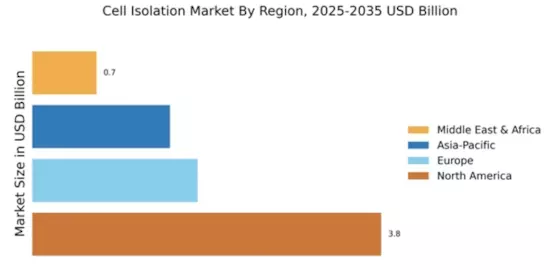
North America continues to lead the cell isolation market, holding a significant share of 3.8 billion in 2024. The region's growth is driven by increasing investments in biotechnology and healthcare, alongside a rising demand for advanced cell therapies. Regulatory support from agencies like the FDA further catalyzes innovation and market expansion, ensuring compliance and safety in cell isolation techniques. The competitive landscape is robust, with key players such as Thermo Fisher Scientific, BD, and Beckman Coulter dominating the market. The U.S. is the primary contributor, benefiting from a strong research infrastructure and a high concentration of biotechnology firms. This environment fosters collaboration and innovation, positioning North America as a hub for cell isolation advancements.
Europe's cell isolation market is valued at 1.8 billion, reflecting a growing interest in regenerative medicine and personalized therapies. The region benefits from stringent regulatory frameworks that ensure high-quality standards, driving demand for reliable cell isolation technologies. Countries like Germany and the UK are at the forefront, supported by government initiatives aimed at enhancing research and development in biotechnology. The competitive landscape features prominent players such as Miltenyi Biotec and Merck KGaA, which are leveraging innovative technologies to capture market share. The presence of well-established research institutions further strengthens the market, fostering partnerships that enhance product development. As Europe continues to invest in healthcare innovation, the cell isolation market is poised for significant growth.
The Asia-Pacific region, valued at 1.5 billion, is witnessing rapid growth in the cell isolation market, driven by increasing healthcare expenditure and advancements in biotechnology. Countries like China and Japan are leading this growth, supported by government initiatives aimed at enhancing research capabilities and healthcare infrastructure. The rising prevalence of chronic diseases is also fueling demand for effective cell therapies and isolation techniques. The competitive landscape is evolving, with key players such as Stemcell Technologies and Lonza Group expanding their presence in the region. Collaborations between local firms and international companies are becoming common, enhancing innovation and market penetration. As the region continues to prioritize healthcare advancements, the cell isolation market is expected to thrive in the coming years.
The Middle East and Africa (MEA) region, valued at 0.7 billion, presents an emerging market for cell isolation, albeit with unique challenges. The growth is driven by increasing investments in healthcare infrastructure and a rising focus on biotechnology research. However, regulatory hurdles and limited access to advanced technologies can impede market expansion. Countries like South Africa and the UAE are making strides in improving their healthcare systems, which is expected to boost demand for cell isolation solutions. The competitive landscape is still developing, with a few key players like Bio-Rad Laboratories and Qiagen establishing a foothold. Local firms are increasingly collaborating with international companies to enhance their capabilities and market reach. As the region continues to evolve, the cell isolation market is anticipated to grow, driven by ongoing healthcare improvements and research initiatives.
The Cell Isolation Market is currently characterized by a dynamic competitive landscape, driven by advancements in technology and increasing demand for personalized medicine. Key players such as Thermo Fisher Scientific (US), BD (US), and Miltenyi Biotec (DE) are at the forefront, each adopting distinct strategies to enhance their market presence. For instance, Thermo Fisher Scientific (US) emphasizes innovation through continuous product development, while BD (US) focuses on strategic partnerships to expand its technological capabilities. Miltenyi Biotec (DE) appears to prioritize regional expansion, particularly in emerging markets, thereby shaping a competitive environment that is both collaborative and competitive.
In terms of business tactics, companies are increasingly localizing manufacturing to reduce costs and optimize supply chains. The market structure is moderately fragmented, with several key players exerting considerable influence. This fragmentation allows for niche players to thrive, while larger companies leverage their resources to dominate market segments. The collective influence of these key players fosters a competitive atmosphere that encourages innovation and efficiency.
In November 2025, BD (US) announced a strategic partnership with a leading biotechnology firm to enhance its cell isolation technologies. This collaboration is expected to accelerate the development of novel solutions, thereby positioning BD (US) as a leader in the market. The strategic importance of this partnership lies in its potential to combine resources and expertise, ultimately leading to improved product offerings and market share.
In October 2025, Thermo Fisher Scientific (US) launched a new line of cell isolation products designed specifically for research applications. This launch reflects the company's commitment to innovation and its understanding of market needs. By addressing specific research challenges, Thermo Fisher Scientific (US) is likely to strengthen its competitive position and attract a broader customer base.
In September 2025, Miltenyi Biotec (DE) expanded its operations in Asia by establishing a new manufacturing facility. This move not only enhances its production capabilities but also signifies a strategic effort to tap into the growing demand for cell isolation technologies in the region. The establishment of this facility may provide Miltenyi Biotec (DE) with a competitive edge in terms of supply chain efficiency and responsiveness to market demands.
As of December 2025, current trends in the Cell Isolation Market include a strong emphasis on digitalization, sustainability, and the integration of artificial intelligence (AI) into product development. Strategic alliances are increasingly shaping the landscape, allowing companies to pool resources and expertise. Looking ahead, competitive differentiation is likely to evolve from traditional price-based competition to a focus on innovation, technological advancements, and supply chain reliability. This shift underscores the importance of adaptability and forward-thinking strategies in maintaining a competitive edge.

The Cell Isolation Market is projected to grow at a 17.8% CAGR from 2025 to 2035, driven by advancements in biotechnology, increasing research funding, and rising demand for personalized medicine.
New opportunities lie in:
By 2035, the Cell Isolation Market is expected to achieve substantial growth, reflecting its critical role in healthcare advancements.
| MARKET SIZE 2024 | 6.8(USD Billion) |
| MARKET SIZE 2025 | 8.01(USD Billion) |
| MARKET SIZE 2035 | 41.21(USD Billion) |
| COMPOUND ANNUAL GROWTH RATE (CAGR) | 17.8% (2025 - 2035) |
| REPORT COVERAGE | Revenue Forecast, Competitive Landscape, Growth Factors, and Trends |
| BASE YEAR | 2024 |
| Market Forecast Period | 2025 - 2035 |
| Historical Data | 2019 - 2024 |
| Market Forecast Units | USD Billion |
| Key Companies Profiled | Thermo Fisher Scientific (US), BD (US), Miltenyi Biotec (DE), Beckman Coulter (US), Stemcell Technologies (CA), Merck KGaA (DE), Bio-Rad Laboratories (US), Qiagen (DE), Lonza Group (CH) |
| Segments Covered | Application, Technique, End User |
| Key Market Opportunities | Advancements in microfluidics and automation enhance efficiency in the Cell Isolation Market. |
| Key Market Dynamics | Rising demand for advanced cell isolation technologies drives innovation and competition among market players. |
| Countries Covered | North America, Europe, APAC, South America, MEA |
The Cell Isolation Market was valued at 6.8 USD Billion in 2024.
The market is expected to reach a valuation of 41.21 USD Billion by 2035.
The expected CAGR for the Cell Isolation Market during 2025 - 2035 is 17.8%.
The Cancer Research segment is projected to grow from 1.8 USD Billion in 2024 to 10.5 USD Billion by 2035.
Fluorescence-Activated Cell Sorting is anticipated to grow from 2.0 USD Billion in 2024 to 12.0 USD Billion by 2035.
Pharmaceutical Companies are likely to lead, growing from 2.0 USD Billion in 2024 to 12.0 USD Billion by 2035.


Kindly complete the form below to receive a free sample of this Report

“This is really good guys. Excellent work on a tight deadline. I will continue to use you going forward and recommend you to others. Nice job”


“Thanks. It’s been a pleasure working with you, please use me as reference with any other Intel employees.”


“Thanks for sending the report it gives us a good global view of the Betaïne market.”


“Thank you, this will be very helpful for OQS.”


“We found the report very insightful! we found your research firm very helpful. I'm sending this email to secure our future business.”


“I am very pleased with how market segments have been defined in a relevant way for my purposes (such as "Portable Freezers & refrigerators" and "last-mile"). In general the report is well structured. Thanks very much for your efforts.”


“I have been reading the first document or the study, ,the Global HVAC and FP market report 2021 till 2026. Must say, good info! I have not gone in depth at all parts, but got a good indication of the data inside!”


“We got the report in time, we really thank you for your support in this process. I also thank to all of your team as they did a great job.”


“The Automotive 48V ECU Components Procurement Intelligence Study” was a complex project, but the Market Research Future (MRFR) team handled it with quality, agility, and customer-centricity. They delivered all requested data on time and within the agreed scope. The team, including Shubhendra Anand and Rahul Gotadki, was always readily available to clarify questions and swiftly implement necessary adjustments, driving the project to a successful conclusion within a very demanding timeframe.
I would also like to specifically commend Akshay Agarwal for his responsiveness and support at every stage—from our initial inquiry on May 6th through to final delivery on June 18th. His dedication made the entire process seamless.”



