Certificate Authority Market

Key Players: DigiCert, Sectigo, GlobalSign, Entrust, GoDaddy, IdenTrust, AWS (Amazon Certificate Manager), Google Trust Services

Certificate Authority Market

Certificate Authority Market Size, Share and Research Report By Component (Certificate Types, Services), By Organization Size (Large Enterprises, Small and Medium Enterprises), By End-User Vertical (BFSI, Healthcare & Life Sciences, Retail & E-Commerce, IT & Telecom, Government & Defense, Others), By Certificate Validation Level (Domain Validation, Extended Validation, Organization Validation), By Deployment Model (Cloud, On-Premise) and By Regional (North America, Europe, South America, Asia Pacific, Middle East and Africa) - Industry Forecast to 2035.
ID: MRFR/ICT/28151-HCR
100 Pages
Nirmit Biswas, Aarti Dhapte
Last Updated: June 19, 2026

Certificate Authority Market Summary

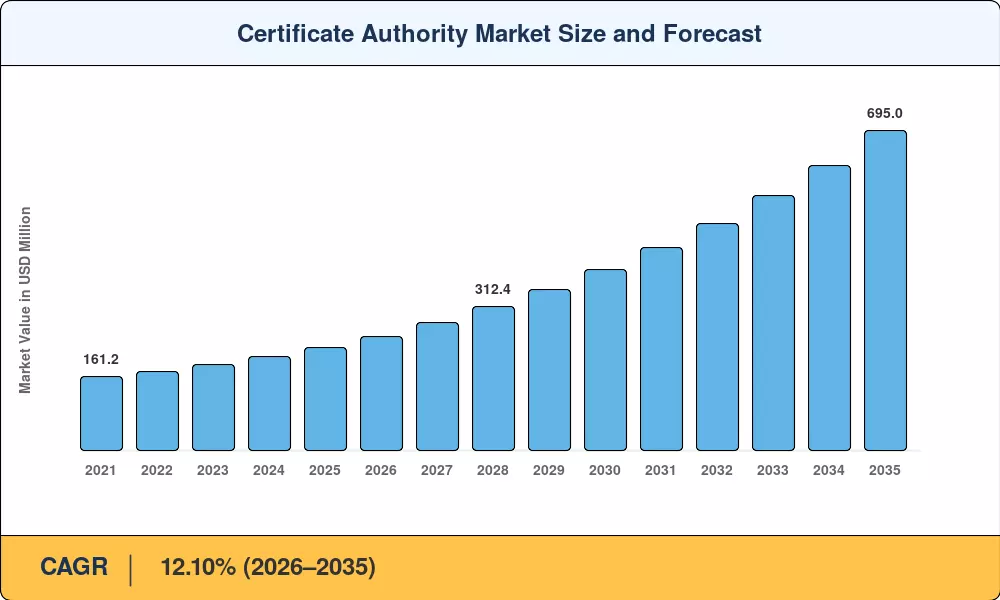
The certificate authority market was valued at USD 223.30 million in 2025 and is projected to reach USD 248.60 million by 2026, climbing to USD 695.00 million by 2035 at a compound annual growth rate of 12.10% during the forecast period (2026–2035). Two structural forces are accelerating demand: browser vendors — led by Apple and Google — have compressed maximum certificate validity to 90 days, triggering a wave of enterprise automation investment, while NIST's post-quantum cryptography standards (FIPS 203–205, finalized August 2024) are compelling organizations to run parallel hybrid key hierarchies [1]. These policy-driven mandates have turned certificate lifecycle management from a periodic IT task into a continuous, high-frequency operational requirement.

The technology shift underway is unmistakable. Legacy manual provisioning workflows that once handled a few hundred certificates per enterprise are giving way to API-first issuance platforms embedded directly inside CI/CD pipelines and infrastructure-as-code toolchains. Hyperscalers such as AWS, Google Cloud, and Microsoft Azure now offer native private certificate authority services that compress deployment from days to seconds. estimated that the average large enterprise manages over 300,000 machine identities, a figure growing 20% annually [2]. This explosion of non-human identities — containers, microservices, IoT endpoints — has made the certificate authority market a cornerstone of zero-trust architecture adoption.

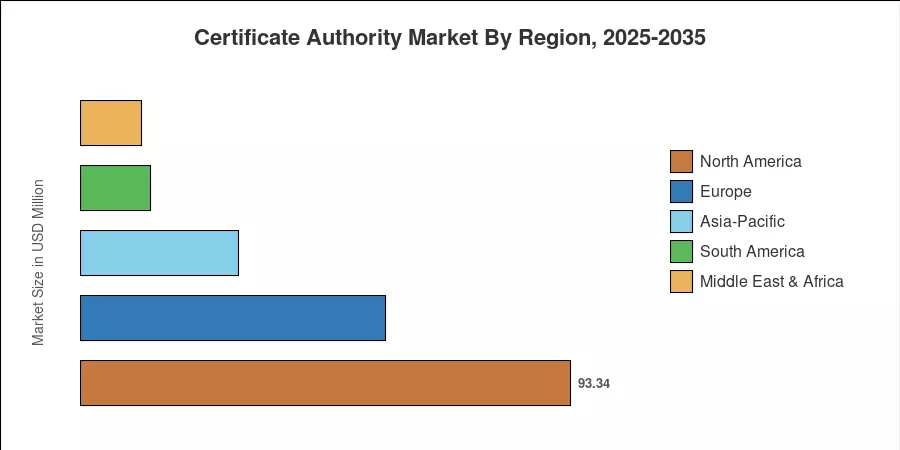
North America commanded a 41.8% share of the certificate authority market in 2025, supported by aggressive federal zero-trust mandates under Executive Order 14028 and the Cybersecurity and Infrastructure Security Agency's binding operational directives [3]. Asia-Pacific is registering the fastest regional CAGR at 13.5% through 2035, fueled by India's Digital Personal Data Protection Act and China's expanding Cybersecurity Law requirements. Europe holds the second-largest regional share at approximately 26.0%, driven by eIDAS 2.0 trust service provider regulations. The next decade will see the certificate authority market evolve from a trust infrastructure niche into a mission-critical automation layer spanning every connected endpoint.


Key Report Takeaways

• By Component

  • Certificate types captured 51.6% of the certificate authority market share in 2025, reflecting enterprise demand for SSL/TLS, code-signing, and email-security certificates
  • Services revenue is expanding at a 12.8% CAGR through 2035, driven by managed PKI and certificate lifecycle automation consulting

• By Organization Size & End-User Vertical

  • Large enterprises accounted for 67.9% of the certificate authority market revenue in 2025, owing to complex multi-domain environments requiring centralized issuance
  • BFSI led end-user verticals with a 31.2% share in 2025, as PCI-DSS 4.0 and open-banking API mandates require continuous certificate validation
  • Healthcare and life sciences are forecast to grow at a 13.5% CAGR through 2035, propelled by HIPAA encryption mandates and connected medical device proliferation

• By Region

  • North America maintained a 41.8% share of the certificate authority market in 2025
  • Asia-Pacific is registering the fastest CAGR at 13.5%, with India and China driving digital infrastructure investments


Market Size and Forecast (2021–2035)

Market Research Future's sizing methodology triangulates supply-side revenues from publicly listed certificate authority vendors, demand-side enterprise IT security budgets, and third-party certificate transparency log volumes. Historical estimates (2021–2024) draw on audited company filings, while the forecast period (2026–2035) applies a calibrated growth model anchored to digital identity proliferation rates and regulatory enforcement timelines.
Certificate Authority Market Size and Forecast
Our Impact
Enabled $4.3B Revenue Impact for Fortune 500 and Leading Multinationals
Partnering with 2000+ Global Organizations Each Year
30K+ Citations by Top-Tier Firms in the Industry

Driver Impact Analysis

Driver ~% Impact on CAGR Geographic Relevance Impact Timeline
Shortened certificate validity mandates 18–22% Global Short-term (≤2 yr)
Zero-trust architecture adoption 15–20% North America, Europe Medium-term (2–4 yr)
Machine identity explosion (IoT/containers) 14–18% Global Long-term (≥4 yr)
Post-quantum cryptography migration 10–14% North America, Europe, APAC Long-term (≥4 yr)
Cloud-native private CA services 12–16% Global Short-term (≤2 yr)
Regulatory compliance (PCI-DSS 4.0, HIPAA, eIDAS 2.0) 10–14% Europe, North America Medium-term (2–4 yr)
DevOps and CI/CD pipeline integration 8–12% Global Short-term (≤2 yr)


Shortened Certificate Validity Mandates

Apple's announcement requiring 45-day maximum certificate lifespans by 2027 — building on the current 90-day trajectory — has fundamentally altered certificate authority market economics [4]. Organizations that previously renewed certificates annually now face near-continuous issuance cycles. The CA/Browser Forum Ballot SC-081 established the industry roadmap, and enterprises unable to automate face operational outages that cost an average of USD 5,600 per minute according to Ponemon Institute research [8]. This urgency is converting manual certificate management budgets into long-term subscription contracts for automated platforms.

Zero-Trust Architecture Adoption

The U.S. federal government's OMB Memorandum M-22-09 mandated that all agencies achieve zero-trust maturity by the end of fiscal year 2024, directly increasing demand for certificate-based mutual TLS authentication across government networks [3]. The Cybersecurity and Infrastructure Security Agency allocated USD 2.9 billion in grants under the State and Local Cybersecurity Grant Program, a significant portion targeting identity and access management infrastructure [9]. Private-sector adoption is following the government playbook, with estimating that 60% of Global 2000 enterprises will implement certificate-based device authentication by 2027 [10].

Machine Identity Proliferation

projects that machine identities will outnumber human identities by a factor of 45:1 in the average enterprise by 2028 [2]. Kubernetes environments alone generate ephemeral certificates for every pod-to-pod communication, creating issuance volumes that legacy certificate authorities cannot sustain. Venafi's 2024 Machine Identity Report found that 83% of organizations experienced certificate-related outages in the prior 12 months, with average remediation costs exceeding USD 300,000 per incident [11]. This pain point is converting the certificate authority market from a cost center into a business continuity investment.

Post-Quantum Cryptography Migration

NIST finalized three post-quantum cryptographic standards in August 2024 — ML-KEM, ML-DSA, and SLH-DSA — triggering a multi-year migration that every certificate hierarchy must undertake [1]. The National Security Agency issued CNSA Suite 2.0 guidance requiring all national security systems to begin transitioning by 2025. Hybrid certificates that bundle classical and post-quantum algorithms are already being tested by DigiCert and Entrust, creating a new revenue stream for certificate authority vendors offering migration consulting and dual-algorithm issuance.


Restraints Impact Analysis

Restraint estimates represent directional headwinds that moderate the certificate authority market growth trajectory. These factors do not reduce the CAGR proportionally but capture friction points that slow adoption or compress margins in specific segments.

Restraint ~% Negative Impact on CAGR Geographic Relevance Impact Timeline
Free DV certificate proliferation (Let's Encrypt) –8 to –12% Global Short-term (≤2 yr)
Integration complexity with legacy IT –6 to –10% Global Medium-term (2–4 yr)
Fragmented regulatory standards –5 to –8% Multi-region Long-term (≥4 yr)
Certificate mis-issuance and trust erosion –4 to –7% Global Medium-term (2–4 yr)
Talent shortage in PKI specialists –3 to –6% Global Long-term (≥4 yr)


Free Domain Validation Certificate Pressure

Let's Encrypt surpassed 400 million active certificates in 2024, offering zero-cost domain validation that commoditizes the entry-level segment of the certificate authority market [12]. While free certificates serve basic HTTPS encryption, they compress pricing across the entire DV tier and force commercial to differentiate through higher-assurance products, managed services, and enterprise platform features. ISRG's annual budget of approximately USD 5 million to operate Let's Encrypt demonstrates how efficiently non-profit infrastructure can serve the long tail of websites, putting sustained margin pressure on for-profit competitors.

Legacy IT Integration Complexity

Large enterprises often operate heterogeneous environments spanning mainframes, on-premise Active Directory forests, multi-cloud deployments, and operational technology networks — each with distinct certificate enrollment protocols. A 2024 Keyfactor survey found that 62% of enterprises use three or more certificate authority tools simultaneously, creating visibility gaps and policy conflicts [13]. This fragmentation raises implementation timelines and consulting costs, slowing the transition from manual provisioning to fully automated lifecycle management and limiting the near-term addressable opportunity for platform vendors.

Talent Shortage in PKI Operations

The (ISC)² 2024 Cybersecurity Workforce Study estimated a global shortage of 4 million cybersecurity professionals, with PKI and cryptography specialists representing one of the thinnest talent pools [15]. Enterprises report six-to-nine-month hiring cycles for PKI architects, delaying deployment projects and inflating professional services costs for certificate authority vendors.


Certificate Authority Market Opportunities

Post-Quantum Certificate Migration Services

A multi-year consultancy and platform opportunity to move to quantum resistant algorithms that is worth hundreds of millions of dollars internationally. Certificate authority providers providing hybrid certificate issuance, algorithm-agility toolkits, and migration readiness assessments will generate premium service revenue until 2035. Early movers such as DigiCert have already issued test PQC certificates and positioned themselves to secure enterprise migration contracts as NIST compliance deadlines tighten.


IoT and OT Device Identity-as-a-Service

The number of connected devices is anticipated to surpass 30 billion worldwide by 2030 [16], yet less than 10% of them presently have unique cryptographic IDs. This is a gap that can be filled by the certificate authority industry with lightweight certificate enrollment protocols such as EST (Enrollment over Secure Transport) and device identity-as-a-service platforms designed for constrained-resource endpoints. The Industrial IoT verticals – energy grids, production floors, autonomous vehicles – are high-value prospects with certificate lifetimes, revocation policies, and compliance needs that are very different from standard online PKI.


SME Cloud-Native Certificate Automation

Small and medium firms, which are developing at the fastest organizational CAGR through 2035, constitute an underpenetrated area of the certificate authority market. SMEs may transition from laborious, spreadsheet-tracked operations to fully automated subscriptions with cloud-native CA products that package issuance, renewal and revocation into a single API call – with no on-premise equipment required. And pricing approaches based on certificate volume vs per-seat licensing align vendor and buyer incentives with growth.


Emerging-Market Digital Identity Programs

India’s Aadhaar-linked digital signature ecosystem, Brazil’s ICP-Brasil certificate framework and Saudi Arabia National Cybersecurity Authority programs are generating sovereign demand for domestically hosted certificate authority infrastructure. These markets provide huge populations with increasing e-government take-up that certificate authority suppliers the opportunity to develop early dominance in fast-growing regions where international providers currently have a small share.


Certificate Intelligence and Risk Analytics

As certificate inventories grow into the millions, enterprises need analytics layers that detect expiring certificates, rogue issuance, and compliance drift in real time. Data monetization opportunities exist for CA vendors that aggregate anonymized certificate telemetry to produce threat intelligence feeds, benchmark industry posture scores, and offer predictive outage prevention — transforming commodity issuance into a recurring analytics subscription.


Certificate Authority Market Future Outlook

Autonomous Certificate Lifecycle Management

Artificial intelligence will transform the certificate authority market from reactive administration to predictive, self-healing operations by the early 2030s. Machine-learning models that forecast certificate expiry risks, detect anomalous issuance patterns, and auto-remediate misconfigurations will reduce human oversight requirements by an estimated 70% according to projections [2]. Vendors that embed AI-driven policy engines directly into their issuance platforms will command premium pricing and higher retention rates.

Platform Consolidation and Subscription Economics

The certificate authority market is shifting from per-certificate transaction pricing toward platform subscription models that bundle issuance, discovery, analytics, and compliance reporting. This transition mirrors the broader SaaS evolution and favors vendors with comprehensive certificate lifecycle platforms over point-solution providers. estimates that by 2030, 65% of enterprise certificate spending will flow through consolidated platform contracts rather than piecemeal purchases [19].

Quantum-Safe Infrastructure Buildout

The 2030–2035 window will see the transition from hybrid classical-quantum certificates to quantum-only hierarchies as cryptographically relevant quantum computers approach viability. The World Economic Forum's Quantum Economy Network has called for USD 7 billion in global infrastructure investment to support the migration [20]. Certificate authority vendors that have developed quantum-agile root hierarchies will benefit from replacement cycles spanning every connected device and server worldwide — a generational upgrade opportunity for the certificate authority market.

Sovereign Trust Ecosystems and Digital Identity Convergence

National digital identity programs — the EU Digital Identity Wallet, India's DigiLocker, and Saudi Arabia's Absher platform — are converging with certificate authority infrastructure to create citizen-centric trust ecosystems. By 2035, the certificate authority market will serve not only machine-to-machine authentication but also citizen-to-government and citizen-to-business identity verification at scale. The European Commission projects that 80% of EU citizens will use digital identity wallets by 2030, each relying on qualified certificate issuance [6].


Certificate Authority Market Segmentation

By Component

Segment Key Metric Primary Demand Driver
Certificate Types 51.6% share (2025) SSL/TLS, code-signing, email-security demand
Services 12.8% CAGR (2026–2035) Managed PKI, migration consulting


Certificate types dominate the certificate authority market component mix, reflecting the structural reality that every secured endpoint requires at least one digital certificate. SSL/TLS certificates remain the largest sub-segment, but code-signing and document-signing certificates are gaining share as software supply-chain security mandates expand. Extended validation and organization validation certificates command higher unit pricing, insulating commercial from DV commoditization pressure.

Services are the faster-growing component, fueled by enterprise demand for managed PKI offerings that abstract away the complexity of running private certificate hierarchies. Professional services tied to post-quantum migration assessments, compliance auditing, and multi-cloud CA integration are generating high-margin revenue streams for established players.

By Organization Size

Segment Key Metric Primary Demand Driver
Large Enterprises 67.9% share (2025) Complex multi-domain, multi-cloud environments
Small and Medium Enterprises 12.8% CAGR (2026–2035) Cloud-native CA adoption, API-first issuance


Large enterprises anchor the certificate authority market due to certificate inventories that routinely exceed 100,000 units across hybrid infrastructure. Financial institutions, technology conglomerates, and government agencies drive the bulk of managed PKI and extended validation spending. SMEs represent the highest growth trajectory as cloud-native CA platforms lower the barrier to automated certificate management — eliminating the need for dedicated PKI staff.

By End-User Vertical

Segment Key Metric Primary Demand Driver
BFSI 31.2% share (2025) PCI-DSS 4.0, open-banking API encryption
Healthcare & Life Sciences 13.5% CAGR (2026–2035) HIPAA, connected medical devices
Retail & E-Commerce USD 28.90 Million (2025) Payment gateway security, consumer trust
IT & Telecom CAGR 12.9% 5G network slicing, edge compute certificates
Government & Defense USD 31.40 Million (2025) Zero-trust mandates, national PKI frameworks
Others CAGR 11.8% Education, manufacturing, energy


BFSI commands the largest end-user share of the certificate authority market, driven by PCI-DSS 4.0's requirement for TLS 1.2+ on all cardholder data environments and open-banking regulations mandating mutual TLS for API communications between financial institutions and third-party providers [6]. Healthcare is the fastest-growing vertical as connected medical devices, telehealth platforms, and electronic health record exchanges all require certificate-based device and user authentication under HIPAA security rules.

By Certificate Validation Level

Segment Key Metric Primary Demand Driver
Domain Validation 56.0% share (2025) High-volume, low-cost automated issuance
Extended Validation 13.1% CAGR (2026–2035) Regulatory compliance, brand trust
Organization Validation USD 42.50 Million (2025) Mid-tier enterprise authentication


Domain validation certificates dominate by volume, powered by automated ACME protocol issuance and the widespread adoption of free DV certificates through Let's Encrypt and Cloudflare. Extended validation certificates are growing fastest as regulated industries — banking, healthcare, government — increasingly mandate the highest assurance level for customer-facing web properties and API endpoints.

By Deployment Model

Segment Key Metric Primary Demand Driver
Cloud 62.1% share (2025) IaaC integration, hyperscaler native CA services
On-Premise CAGR 10.8% Air-gapped environments, sovereign data mandates


Cloud deployment leads the certificate authority market as organizations embed certificate issuance directly into cloud infrastructure provisioning workflows. AWS Certificate Manager, Google Cloud, and Azure Key Vault have normalized cloud-native CA consumption. On-premise deployments persist in defense, critical infrastructure, and jurisdictions with data-sovereignty requirements that prohibit cloud-hosted root keys.


Regional Market Share Analysis

Region Key Metric Primary Investment Themes
North America 41.8% share (2025) Zero-trust mandates, federal CMMC compliance
Europe 26.0% share (2025) eIDAS 2.0, GDPR encryption requirements
Asia-Pacific 13.5% CAGR (2026–2035) National digital ID programs, cloud-first policies
South America USD 13.40 Million (2025) E-government modernization, ICP-Brasil expansion
Middle East & Africa USD 11.60 Million (2025) Smart-city initiatives, national cybersecurity strategies
Total USD 223.30 Million (2025)

The certificate authority market exhibits significant regional variation driven by regulatory maturity, cloud adoption rates, and digital infrastructure investment. North America leads in spending intensity, while Asia-Pacific delivers the strongest growth trajectory, fueled by national digitization programs.


North America

Country Key Metric Key Driver
US 78.3% of regional share Federal zero-trust mandates (EO 14028)
Canada 13.1% of regional share Critical infrastructure protection regulations
Mexico CAGR 13.8% Financial-sector digital transformation


The United States dominates the North American certificate authority market spending, anchored by binding operational directives from CISA requiring federal agencies to inventory and automate all public-facing certificates [3]. Canada's CCCS (Canadian Centre for Cyber Security) has issued guidance aligning federal PKI with NIST PQC timelines, while Mexico's CNBV financial regulator is tightening e-signature and TLS requirements for fintech platforms, making it the fastest-growing country in the subregion.

Europe

Country Key Metric Key Driver
Germany 22.4% of regional share BSI certification requirements
UK 19.8% of regional share Post-Brexit UK DIATF trust framework
France CAGR 12.6% ANSSI-certified sovereign cloud mandates
Italy 11.3% of regional share AgID digital identity standards
Spain CAGR 12.2% Digital Spain 2026 program
Nordic Countries 9.7% of regional share BankID and national eID infrastructure
Russia CAGR 10.5% Domestic CA substitution mandates
Rest of Europe 14.1% of regional share EU Cyber Resilience Act compliance


Europe's certificate authority market is being reshaped by the eIDAS 2.0 regulation, which establishes qualified trust service providers as legally binding issuers of electronic certificates across all 27 member states [6]. Germany's Federal Office for Information Security (BSI) requires government suppliers to use nationally certified, creating a protected domestic segment. The UK's post-Brexit Digital Identity and Attributes Trust Framework introduces distinct certification requirements, compelling global CA vendors to maintain separate compliance tracks for EU and UK operations.

Asia-Pacific

Country Key Metric Key Driver
China 31.5% of regional share Cybersecurity Law and domestic CA mandates
India CAGR 14.8% CCA-regulated digital signature ecosystem
Japan 18.2% of regional share ISMAP cloud security certification
South Korea CAGR 13.9% KISA electronic certificate standards
ASEAN CAGR 14.2% Cross-border digital trade frameworks
Rest of Asia-Pacific 11.6% of regional share Emerging smart-city programs


Asia-Pacific represents the fastest-growing region in the certificate authority market, driven by government-mandated digital identity ecosystems. India's Controller of Certifying Authorities (CCA) oversees a regulated CA hierarchy that supports Aadhaar-linked e-signatures and GST invoicing, creating persistent demand for compliant issuance platforms. China's requirement that domestically operated websites use state-approved continues to drive a parallel trust ecosystem distinct from the WebTrust model used globally [17].

South America

Country Key Metric Key Driver
Brazil 62.8% of regional share ICP-Brasil national PKI infrastructure
Argentina CAGR 13.1% E-invoicing certificate requirements
Rest of South America 18.5% of regional share Fintech regulatory modernization


Brazil's ICP-Brasil framework, managed by the Instituto Nacional de Tecnologia da Informação, operates the largest national PKI in Latin America, requiring digital certificates for tax filings, e-invoicing, and legal proceedings. Argentina's AFIP tax authority mandates digital certificates for all corporate filings, sustaining steady demand growth. Cross-border digital trade agreements within Mercosur are encouraging harmonized certificate standards that will expand the addressable certificate authority market across the region.

Middle East & Africa

Country Key Metric Key Driver
Saudi Arabia 28.4% of regional share NCA cybersecurity framework compliance
UAE 24.6% of regional share Smart Dubai and TDRA regulations
South Africa CAGR 12.7% POPIA encryption mandates
Egypt CAGR 13.3% National e-signature law modernization
Rest of MEA 22.5% of regional share Digital government transformation programs


Saudi Arabia's National Cybersecurity Authority has established mandatory certificate and encryption standards for all critical infrastructure operators under Vision 2030's digital transformation agenda [18]. The UAE's Telecommunications and Digital Government Regulatory Authority requires government entities to use locally accredited for citizen-facing services. South Africa's Protection of Personal Information Act (POPIA) and Egypt's updated electronic signature regulations are creating new compliance-driven demand across the African continent.


Certificate Authority Market By Region, 2025-2035

Competitive Benchmarking

The certificate authority market exhibits medium concentration, with the top five players accounting for an estimated 55–62% of global revenue. The Herfindahl-Hirschman Index sits in the 1,200–1,600 range, indicating a moderately competitive structure where established trust brands coexist with cloud-native challengers and free-tier disruptors. Competition is increasingly defined by platform breadth — vendors that combine issuance, discovery, automation, analytics, and compliance in a single platform are consolidating enterprise wallet share.

Company Est. Revenue Share Range Key Offerings Strategic Positioning
DigiCert ~14–18% CertCentral platform, PQC-ready certificates, IoT device trust Market leader in EV/OV and enterprise PKI
Sectigo ~10–14% Sectigo Certificate Manager, ACME automation Largest commercial CA by certificate volume
GlobalSign ~7–10% Atlas PKI platform, IoT identity services Enterprise and IoT dual focus
Entrust ~6–9% Entrust PKI-as-a-Service, nShield HSMs Integrated security and identity platform
GoDaddy ~5–8% SSL certificates, managed SSL services SME-focused distribution channel
IdenTrust ~4–7% Federal Bridge CA, trust chain for Let's Encrypt Government and institutional trust roots
AWS (Amazon Certificate Manager) ~4–6% ACM public/private CA, IaaC integration Hyperscaler-native certificate provisioning
Google Trust Services ~3–5% Public CA, Chrome Root Program alignment Browser-aligned issuance strategy
SSL.com ~2–4% Affordable EV/OV, document signing Cost-competitive alternative for mid-market
Certum (Asseco Group) ~2–3% EU qualified trust services, eIDAS compliance European regulatory specialization


Recent News & Developments


  • NIST (August 2024): Published final post-quantum cryptographic standards FIPS 203, 204, and 205, triggering formal certificate hierarchy migration planning across government and enterprise sectors [1]


  • European Commission (November 2024): Published eIDAS 2.0 implementing acts defining technical standards for qualified website authentication certificates, directly expanding the European certificate authority market [6]


Certificate Authority Market Report Scope

Parameter Detail
Market Scope Global certificate authority market covering certificate types, services, validation levels, deployment models, organization sizes, and end-user verticals
Study Period 2021–2035
Base Year 2025
Forecast Period 2026–2035
CAGR 12.10% (2026–2035)
Market Size (2025) USD 223.30 Million
Market Size (2035) USD 695.00 Million
Fastest Growing Segment Healthcare & Life Sciences (by end-user); SMEs (by organization size); Asia-Pacific (by region)
Companies Profiled DigiCert, Sectigo, GlobalSign, Entrust, GoDaddy, IdenTrust, AWS, Google Trust Services, SSL.com, Certum
Valuation Currency USD Million


FAQs

How do certificate outages affect enterprise revenue beyond direct downtime costs?

Certificate-related outages trigger cascading failures across payment gateways, API integrations, and customer-facing portals. Ponemon Institute research estimates average incident costs exceed USD 300,000, excluding brand reputation damage and customer churn [8].

What differentiates a managed PKI service from a standalone certificate purchase?

Managed PKI bundles issuance, automated renewal, revocation, and compliance reporting into a single subscription. Standalone purchases require enterprises to handle each lifecycle stage independently, increasing operational overhead [13].

How should procurement teams evaluate post-quantum readiness among CA vendors?

Prioritize vendors offering hybrid certificates with NIST-approved algorithms (ML-KEM, ML-DSA) and algorithm-agility architecture. Ask for production PQC test environments and published migration timelines [1].

Which industries face the highest certificate authority compliance burden?

Financial services (PCI-DSS 4.0), healthcare (HIPAA), and government (FISMA/FedRAMP) face the strictest requirements. Each mandates specific validation levels and key management practices [6].

How does the certificate authority market address IoT device identity at scale?

Lightweight protocols like EST and SCEP enable constrained devices to enroll certificates without full TLS handshakes. Device identity-as-a-service platforms automate provisioning across millions of endpoints [16].

What pricing model trends are reshaping commercial certificate authority contracts?

Vendors are shifting from per-certificate pricing to volume-based subscription tiers that include automated discovery and renewal. This model aligns vendor revenue with enterprise certificate growth [19].

How do sovereign CA mandates in China and Russia affect global certificate authority market dynamics?

Both nations require domestically approved for local web properties, creating parallel trust ecosystems. Global vendors must maintain separate root hierarchies or partner with local operators [17].


Author
Author
Author Profile
Nirmit Biswas LinkedIn
Senior Research Analyst
With 5+ years of expertise in Market Intelligence and Strategic Research, Nirmit Biswas specializes in ICT, Semiconductors, and BFSI. Backed by an MBA in Financial Services and a Computer Science foundation, Nirmit blends technical depth with business acumen. He has successfully led 100+ projects for global enterprises and startups, including Amazon, Cisco, L&T and Huawei, delivering market estimations, competitive benchmarking, and GTM strategies. His focus lies in transforming complex data into clear, actionable insights that drive growth, innovation, and investment decisions. Recognized for bridging engineering innovation with executive strategy, Nirmit helps businesses navigate dynamic markets with confidence.
Co-Author
Co-Author Profile
Aarti Dhapte LinkedIn
AVP - Research
A consulting professional focused on helping businesses navigate complex markets through structured research and strategic insights. I partner with clients to solve high-impact business problems across market entry strategy, competitive intelligence, and opportunity assessment. Over the course of my experience, I have led and contributed to 100+ market research and consulting engagements, delivering insights across multiple industries and geographies, and supporting strategic decisions linked to $500M+ market opportunities. My core expertise lies in building robust market sizing, forecasting, and commercial models (top-down and bottom-up), alongside deep-dive competitive and industry analysis. I have played a key role in shaping go-to-market strategies, investment cases, and growth roadmaps, enabling clients to make confident, data-backed decisions in dynamic markets.
Download Free Sample

Kindly complete the form below to receive a free sample of this Report

Download PDF ×

We do not share your information with anyone. However, we may send you emails based on your report interest from time to time. You may contact us at any time to opt-out.