Chewing Gum Market (2026 - 2035)

Chewing Gum Market Size, Share, Industry Trend & Analysis Research Report: By Type (Sugar-Free Chewing Gum, Sugar-Based Chewing Gum), By Packaging (Pouches, Bottles, Boxes, Others), By Distribution Channel (Supermarkets/Hypermarkets, Convenience/Grocery Stores, Online Retail, Others), By Geography (North America, Europe, Asia-Pacific, South America, Middle East & Africa) - Forecast to 2035
ID: MRFR/FnB/10299-HCR
128 Pages
Varsha More
Last Updated: June 25, 2026
Chewing Gum Market
Market Size
Forecast Period2026-2035
CAGR (2026-2035)4.23%
2026 Market SizeUSD 15.95 Billion
2035 Market SizeUSD 23.15 Billion
Key Players
Mars
Inc.
Mondelez International
Perfetti Van Melle
Lotte Corporation
Cloetta AB
Opportunities
  • Biodegradable Gum Base Commercialization
  • Direct-to-Consumer Subscription Models
  • Emerging-Market Penetration in Southeast Asia and Africa

Chewing Gum Market Summary

The global Chewing Gum Market stood at USD 15.35 billion in 2025 and is projected to reach USD 15.95 billion in 2026 before climbing to USD 23.15 billion by 2035, registering a CAGR of 4.23% across the forecast window. This trajectory reflects a consumer base that increasingly views gum not just as a confection but as a delivery vehicle for oral health benefits, energy boosts, and stress relief. Rising demand for sugar-free variants — now accounting for nearly two-thirds of global revenue — has reshaped product development priorities across the Chewing Gum Market, compelling manufacturers to reformulate around plant-derived sweeteners and functional additives [1].

The transformation underway in the Chewing Gum Market centers on moving beyond conventional chicle-based recipes toward synthetic and biodegradable gum bases that address both performance and environmental concerns. The European Commission's Single-Use Plastics Directive, which classifies traditional gum residue alongside plastic waste, has accelerated R&D investment estimated at over USD 320 million industry-wide between 2023 and 2025 [2]. Clean-label positioning and recyclable packaging formats are replacing legacy wrappers, while digital shelf analytics now guide assortment decisions at major retail chains.

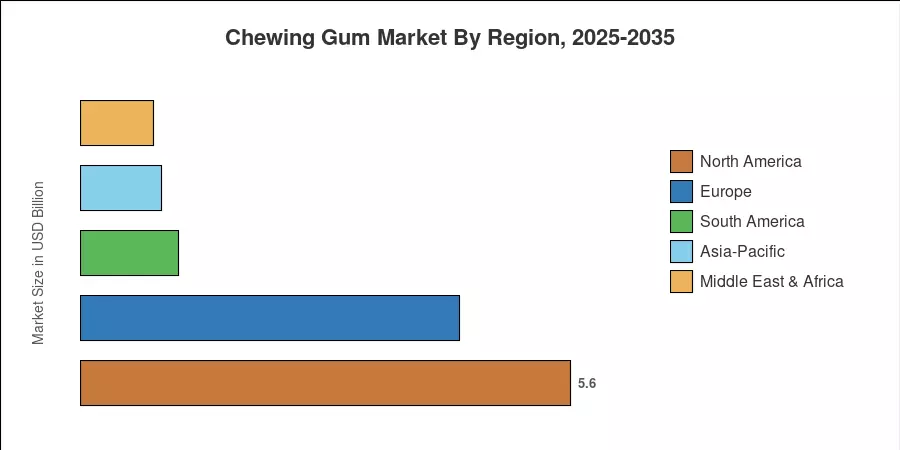
North America commands approximately 36.5% of the global Chewing Gum Market revenue, supported by entrenched per-capita consumption habits and robust convenience-store infrastructure. Asia-Pacific represents the fastest-growing region at a projected 6.02% CAGR through 2035, driven by urbanization, rising disposable incomes, and aggressive social-media marketing campaigns targeting younger demographics. Europe holds the second-largest share at roughly 28.2%, anchored by premiumization trends in Western markets. The decade ahead will reward companies that can balance health-forward innovation with the impulse-purchase dynamics that still drive the category.


Key Report Takeaways

• By Type

  • The sugar-free segment captured approximately 63.5% of the Chewing Gum Market in 2025, reflecting a decisive consumer shift toward reduced-calorie and dental-friendly products.
  • Sugar-based chewing gum is forecast to grow at a 3.18% CAGR through 2035, sustained by traditional confectionery demand in emerging economies.

• By Packaging

  • Pouches led with a 53.2% revenue share in 2025 across the Chewing Gum Market, favored for portability and resealability.
  • Bottles are projected to expand at a 5.48% CAGR, gaining traction in office and automotive consumption occasions.

• By Distribution Channel

  • Supermarkets and hypermarkets held a 48.4% share of the Chewing Gum Market revenue in 2025.
  • Online retail channels are anticipated to register a 6.32% CAGR between 2026 and 2035, fueled by subscription models and bundled oral-care offerings.

• By Region

  • North America accounted for 36.5% of the global Chewing Gum Market value in 2025.
  • Asia-Pacific is positioned to achieve a 6.02% CAGR through 2035, the highest among all regions.


Chewing Gum Market Size and Forecast (2021–2035)

Market Research Future's estimates draw on a triangulated methodology combining top-down industry sizing from trade-association data, bottom-up company-level revenue analysis, and demand-side consumer-survey validation. Historical figures (2021–2024) reflect audited sales reported by leading confectionery producers, while forecast projections (2026–2035) incorporate macroeconomic inputs, regulatory scanning, and retail-channel growth modeling.
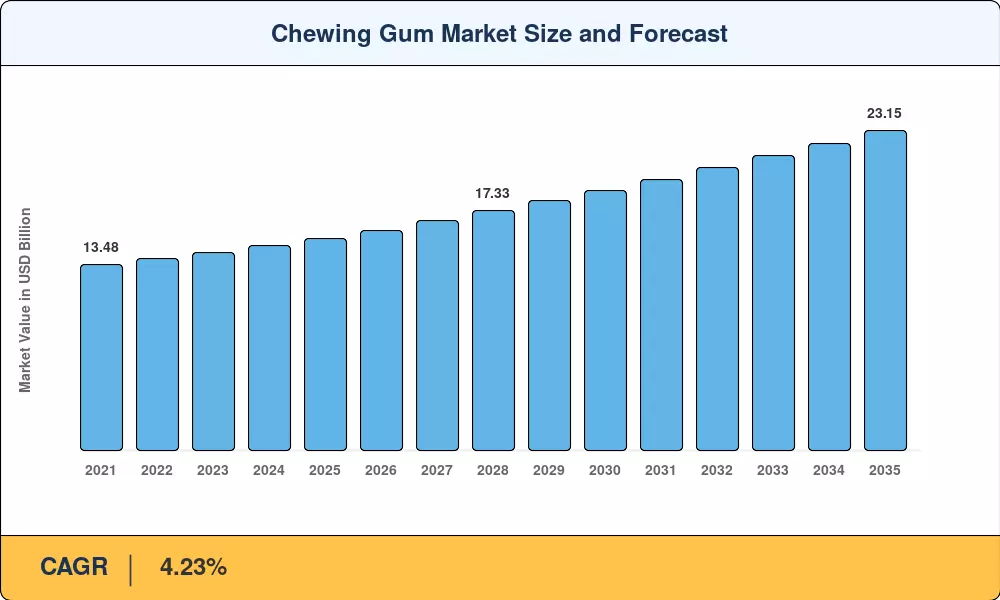
Chewing Gum Market Size and Forecast
Our Impact
Enabled $4.3B Revenue Impact for Fortune 500 and Leading Multinationals
Partnering with 2000+ Global Organizations Each Year
30K+ Citations by Top-Tier Firms in the Industry

Driver Impact Analysis

Driver ~% Impact on CAGR Geographic Relevance Impact Timeline
Rising demand for sugar-free gum ~22% Global Short-term (≤2 yr)
Functional ingredient integration ~18% North America, Europe Medium-term (2–4 yr)
Impulse-purchase channel resilience ~15% Global Short-term (≤2 yr)
Urbanization in the Asia-Pacific ~14% Asia-Pacific Long-term (≥4 yr)
E-commerce and subscription growth ~12% North America, Europe Medium-term (2–4 yr)
Premiumization and clean-label trends ~10% Europe, North America Medium-term (2–4 yr)
Oral health awareness campaigns ~9% Global Long-term (≥4 yr)


Rising Demand for Sugar-Free Gum

Consumer preference for reduced-sugar products has become the single strongest growth lever in the Chewing Gum Market. The WHO's 2024 updated guidelines recommending that free sugars remain below 5% of daily caloric intake have prompted retailers in 38 countries to expand shelf space for sugar-free confectionery by an average of 12% year-over-year [1]. In the United States alone, sugar-free gum now represents over 70% of unit sales at convenience stores, according to NCA retail audit data [4].

Functional Ingredient Integration

Gum manufacturers are increasingly embedding vitamins, caffeine, CBD, probiotics, and collagen peptides into their formulations, targeting health-conscious consumers willing to pay a 25–40% premium over conventional sticks [3]. Mondelez International reported that its functional gum SKUs grew 18% faster than the company's base portfolio in FY2024, signaling strong market validation.

Impulse-Purchase Channel Resilience

For the chewing gum market, which mostly depends on impulsive purchases, checkout aisle location is still a crucial touchpoint. Even though self-checkout and digital kiosks are changing retail environments, gum's strategic placement at busy retail locations still contributes significantly to transaction volume. Data shows that the vast majority of these transactions are still unplanned, highlighting the continued significance of point-of-purchase displays and physical shelf exposure in preserving category velocity.


Urbanization and Rising Incomes in Asia-Pacific

Long-term drivers for the confectionery sector are the ASEAN region's continued urbanization and the middle class's explosive growth. The market for portable, individually packaged foods is expanding as disposable incomes rise and lifestyles become more hectic. In important economies like India, Indonesia, and Vietnam, where convenience and brand availability are becoming more and more important to the consumer experience, this generational transition is facilitating the growth of contemporary retail commerce.


Restraints Impact Analysis

The percentages below indicate directional headwinds; they are not linearly deductible from the growth rate.

Restraint ~% Impact on CAGR Geographic Relevance Impact Timeline
Environmental regulations on gum waste –8% Europe, North America Medium-term (2–4 yr)
Raw-material cost volatility –6% Global Short-term (≤2 yr)
Declining gum-chewing frequency among Gen Z –5% North America, Europe Long-term (≥4 yr)
Regulatory scrutiny on artificial sweeteners –4% Europe Medium-term (2–4 yr)
Competition from mints and oral-care strips –3% Global Long-term (≥4 yr)


Environmental Regulations on Gum Waste

Due to their prevalence in urban settings, traditional gum bases—which frequently use synthetic polymers—continue to be the focus of considerable environmental scrutiny. The industry is concentrating more on voluntary sustainable packaging and biodegradable base development to proactively reduce the risk of future EPR-related levies and align with wider circular economy goals, even as EU-wide legislative frameworks like the Packaging and Packaging Waste Regulation continue to develop.


Declining Gum-Chewing Frequency Among Younger Cohorts

In 2024 global confectionery survey revealed that gum-chewing occasions among 18–24-year-olds declined 11% between 2019 and 2024, as younger consumers gravitate toward functional beverages and dissolvable oral-care formats [10]. The Chewing Gum Market faces a generational engagement challenge that demands innovation in formats, flavors, and digital marketing to recapture attention.

Regulatory Scrutiny on Artificial Sweeteners

Artificial sweeteners are nevertheless subject to strict regulations, with organizations like the EFSA regularly reevaluating their safety. Manufacturers are under pressure to vary their formulations, even though recent scientific findings have shown the continued safety of conventional sweeteners like acesulfame-K. In response, the industry is investigating natural high-intensity sweeteners like xylitol and stevia, but these changes necessitate managing supply-chain complexity and increased raw material costs.


Chewing Gum Market Opportunities

Biodegradable Gum Base Commercialization

The economic potential of plant-based and chicle-derived gum bases has been proven by niche brands like Chicza and Peppersmith. These biodegradable formulations are anticipated to gain more momentum as consumer interest in sustainable packaging increases and environmental restrictions change, offering a high-growth substitute for conventional synthetic bases in the European market.


Direct-to-Consumer Subscription Models

Online subscription platforms for gum and oral-care bundles present an untapped revenue stream. Brands that pair personalized flavor assortments with recurring delivery achieve 2.5× higher lifetime customer value compared to single-purchase retail, according to a 2024 consumer-packaged-goods report [6].

Emerging-Market Penetration in Southeast Asia and Africa

Per-capita gum consumption in Indonesia and Nigeria remains below 100 grams annually, compared with over 500 grams in the United States. Affordable stick-pack formats priced at USD 0.10–0.25 can unlock high-volume growth, particularly through kiosk and street-vendor distribution networks.

Functional and Nutraceutical Gum Development

The convergence of confectionery and wellness creates room for gum products delivering measurable health benefits — from caffeine-infused gum for athletes to probiotic gum targeting gut health. The global functional foods sector, valued at over USD 280 billion in 2025, provides a large addressable adjacency for the Chewing Gum Market [3].

Data-Driven Retail Optimization

Smart planogram analytics and AI-powered demand-sensing tools allow manufacturers to optimize checkout placement, seasonal flavor rotations, and regional SKU assortments. Early adopters have reported 6–10% improvements in sell-through rates, pointing to meaningful margin expansion across the Chewing Gum Market.


Chewing Gum Market Future Outlook

Functional and Wellness Gum as a Health Platform

The next decade will see chewing gum evolve from a confectionery staple into a recognized health-delivery platform. Clinical trials underway at multiple universities are testing gum-based delivery of vitamins B12 and D, melatonin, and nicotine-replacement therapies, with the WHO projecting a 30% increase in oral-delivery nutraceutical formats by 2032 [3].

Sustainability-First Product Design

Biodegradable gum bases, compostable wrappers, and carbon-neutral manufacturing will shift from niche positioning to baseline expectations in the Chewing Gum Market. The Ellen MacArthur Foundation estimates that confectionery packaging represents 4.2% of global flexible-packaging waste; brands achieving circular-packaging certification will gain preferential shelf placement at major European and North American retailers [2].

Digital Retail and Personalization

AI-powered demand forecasting and personalized subscription engines will reshape how consumers discover and purchase gum. By 2030, an estimated 18–22% of the Chewing Gum Market revenue in North America could flow through digital channels, up from roughly 8% in 2025, driven by algorithm-curated flavor recommendations and smart-replenishment integrations [6].

Premiumization and Experience-Led Branding

Limited-edition collaborations, region-specific flavor profiles, and experiential pop-up activations will differentiate premium gum brands willing to invest in storytelling. The Chewing Gum Market's average selling price is projected to rise 2.1% annually through 2035, outpacing volume growth and signaling a structural shift toward value over volume.


Chewing Gum Market Segmentation

By Type

Segment Key Metric Primary Demand Driver
Sugar-Free Chewing Gum 63.5% share (2025) Health-conscious consumer preference
Sugar-Based Chewing Gum 3.18% CAGR (2026–2035) Traditional confectionery demand in emerging markets


Sugar-free chewing gum dominates the Chewing Gum Market and continues to widen its lead. Dental associations in over 40 countries now recommend sugar-free gum as part of post-meal oral-hygiene routines, lending medical credibility that conventional sugar-based variants cannot match. The segment's growth is further supported by the broadening availability of stevia and monk-fruit sweeteners that deliver taste profiles comparable to sugar without the caloric load.

Sugar-based gum retains a loyal following in price-sensitive markets across South America, South Asia, and parts of Africa, where traditional bubble-gum formats remain deeply integrated into cultural snacking habits. Volume growth in these regions offsets share erosion in developed markets.

By Packaging

Segment Key Metric Primary Demand Driver
Pouches 53.2% share (2025) Portability and resealability
Bottles 5.48% CAGR (2026–2035) Desk and car console consumption
Boxes USD 2.42 Billion (2025) Multi-pack retail promotions
Others 7.5% share (2025) Novelty and limited-edition formats


Pouches have become the default format across the Chewing Gum Market, offering the ziplock resealability and pocket-friendly form factor that on-the-go consumers demand. Bottles, favored for shared and repeat consumption occasions, are the fastest-growing packaging type and increasingly appear in office-supply and automotive-accessory retail channels.

By Distribution Channel

Segment Key Metric Primary Demand Driver
Supermarkets/Hypermarkets 48.4% share (2025) Checkout-aisle impulse placement
Convenience/Grocery Stores USD 4.62 Billion (2025) Proximity and frequency of visits
Online Retail 6.32% CAGR (2026–2035) Subscription models and bundled offers
Others 8.2% share (2025) Vending, duty-free, and pharmacy channels


Supermarkets and hypermarkets remain the dominant sales channel for the Chewing Gum Market, leveraging high foot traffic and strategic checkout positioning. Online retail is reshaping purchase behavior — DTC brands like Neuro Gum and Simply Gum have demonstrated that curated digital experiences and influencer partnerships can build loyal followings outside traditional shelf competition [6].


Regional Market Share Analysis

Region Key Metric Primary Investment Themes
North America 36.5% share (2025) Premiumization, functional SKUs
Europe USD 4.33 Billion (2025) Clean-label reformulation, EPR compliance
Asia-Pacific 6.02% CAGR (2026–2035) Urbanization, modern trade expansion
South America USD 1.12 Billion (2025) Affordable formats, flavor localization
Middle East & Africa 5.38% CAGR (2026–2035) Youth demographics, convenience retail
Total USD 15.35 Billion (2025)

The Chewing Gum Market exhibits distinct regional consumption patterns shaped by cultural habits, regulatory environments, and retail infrastructure maturity.


North America

Country Key Metric Key Driver
US 78.3% of regional share Convenience-store density, functional gum demand
Canada 4.82% CAGR Health-conscious consumer trends
Mexico USD 0.48 Billion (2025) Growing middle class, modern-trade penetration


North America's dominance in the Chewing Gum Market rests on deeply embedded consumption habits and a convenience-retail footprint exceeding 150,000 stores in the US alone. The American Dental Association's endorsement of sugar-free gum as a supplementary oral-hygiene tool continues to drive category credibility, while premium brands command retail prices 35–50% above mass-market equivalents [8].

Europe

Country Key Metric Key Driver
Germany 22.1% of regional share Strong confectionery tradition
UK 4.51% CAGR Sugar-tax spillover to gum preference
France USD 0.52 Billion (2025) Flavor innovation and pharmacy-channel gum
Italy 3.92% CAGR On-the-go consumption culture
Spain 8.4% of regional share Tourism-driven impulse purchases
Nordic Countries 4.68% CAGR High sugar-free penetration
Russia USD 0.31 Billion (2025) Price-sensitive volume demand
Rest of Europe 12.7% of regional share Mixed maturity markets


European Chewing Gum Market dynamics are shaped by the EU's aggressive stance on single-use plastics and sugar-reduction targets. The UK's Soft Drinks Industry Levy has indirectly boosted sugar-free gum sales, as health-conscious consumers extend reduced-sugar preferences across snack categories [2].

Asia-Pacific

Country Key Metric Key Driver
China 34.8% of regional share Massive consumer base, e-commerce penetration
India 7.14% CAGR Rapid urbanization, youth demographics
Japan USD 0.62 Billion (2025) Functional gum innovation leader
South Korea 5.82% CAGR K-beauty crossover, oral-care positioning
ASEAN 18.5% of regional share Modern-trade expansion in tier-2 cities
Rest of Asia-Pacific 4.95% CAGR Varied market maturity


Asia-Pacific represents the highest-growth frontier for the Chewing Gum Market. China's e-commerce platforms — particularly Douyin and Tmall — have become primary launch channels for new gum flavors, while India's organized retail expansion adds an estimated 8,000 modern-trade outlets annually [5].

South America

Country Key Metric Key Driver
Brazil 58.2% of regional share Largest consumer base in the region
Argentina 4.15% CAGR Confectionery culture resilience
Rest of South America USD 0.24 Billion (2025) Fragmented distribution


Brazil anchors the South American Chewing Gum Market through its extensive street-vendor and bakery distribution networks. Arcor and local brands compete aggressively on price, though multinational entrants are gaining ground with sugar-free premium lines in São Paulo and Rio de Janeiro [13].

Middle East & Africa

Country Key Metric Key Driver
Saudi Arabia 28.4% of regional share High per-capita confectionery spend
UAE 5.72% CAGR Tourism and duty-free retail
South Africa USD 0.14 Billion (2025) Modern-retail adoption
Egypt 5.15% CAGR Youth population growth
Rest of MEA 24.8% of regional share Emerging opportunity


The MEA Chewing Gum Market benefits from a young and growing population — the median age across Sub-Saharan Africa is just 19 years. Duty-free channels in Dubai and Riyadh serve as important brand-awareness touchpoints, while Saudi Arabia's Vision 2030 entertainment-sector expansion is boosting confectionery consumption at event venues [14].


Chewing Gum Market By Region, 2025-2035

Competitive Benchmarking

The Chewing Gum Market exhibits medium concentration, with the top five players collectively controlling an estimated 55–62% of global revenue. The Herfindahl-Hirschman Index sits in the moderate range, reflecting a landscape where two global leaders — Mars (Wrigley) and Mondelez — compete alongside strong regional players and an expanding cohort of specialty brands targeting functional and sustainable niches.

Company Est. Revenue Share Range Key Offerings Strategic Positioning
Mars, Inc. (Wrigley) ~18–22% Extra, Orbit, 5 Gum, Doublemint Global leader; broadest portfolio and distribution reach
Mondelez International ~12–16% Trident, Stride, Dentyne Strong sugar-free positioning in the Americas
Perfetti Van Melle ~8–11% Mentos Gum, Happydent, Vigorsol European and Asian market strength
Lotte Corporation ~6–9% Xylitol, Fit's, Acuo Dominant in Japan and South Korea
The Hershey Company ~3–5% Ice Breakers Gum Leveraging confectionery brand equity
Cloetta AB ~2–4% Jenkki, Läkerol Nordic sugar-free specialist
Arcor Group ~2–3% Topline, Beldent Latin American price-leader
Peppersmith ~1–2% Peppersmith English Peppermint UK-based natural gum pioneer
Ford Gum & Machine Company ~1–2% Gumball and vending gum Niche vending-machine channel
Ferndale Confectionery ~1–2% Private-label gum manufacturing B2B and contract manufacturing


Recent News & Developments


  • Trident Vibes (May 2025): After a successful exclusive debut at a significant US retailer, Trident Vibes has introduced its sugar-free Cotton Candy flavored gum to the national retail market. It comes in a 40-piece bottle. The brand claims that this new gum targets younger audiences, especially Gen Z, as well as health-conscious consumers with its sweet, nostalgic cotton candy flavor and sugar-free recipe.
  • Milliways (April 2025): Milliways, a British plastic-free chewing gum company, has entered the French market by providing biodegradable, plant-based gum as a substitute for traditional plastic-based gums. In addition to its traditional mint variants, the brand launched new flavors inspired by French tastes: Strawberry, Cherry, and Eucalyptus Mint, which are sold in 10- and 30-piece packs at major French retailers.


Chewing Gum Market Report Scope

Parameter Detail
Market Scope Global Chewing Gum Market by Type, Packaging, Distribution Channel, and Geography
Study Period 2021–2035
CAGR (2026–2035) 4.23%
Base Year Value USD 15.35 Billion (2025)
2026 Market Size USD 15.95 Billion
2035 Market Size USD 23.15 Billion
Fastest Growing Region Asia-Pacific
Fastest Growing Segment Online Retail (by distribution channel)
Companies Profiled Mars (Wrigley), Mondelez, Perfetti Van Melle, Lotte, Hershey, Cloetta, Arcor, Peppersmith, Ford Gum, Ferndale Confectionery
Valuation Currency USD Billion


FAQs

How does the polyvinyl acetate content in the gum base affect recyclability claims?
Most conventional gum bases contain 20–30% polyvinyl acetate, which is not recyclable through standard municipal streams. Brands marketing recyclable gum must switch to plant-derived chicle or synthetic biodegradable polymers [20].
What shelf-life considerations should retailers evaluate for functional gum SKUs?
Active ingredients like probiotics and vitamins degrade faster than standard flavoring agents, typically reducing shelf life to 9–12 months versus 18 months for conventional gum. Temperature-controlled storage is often required [3].
How do private-label gum brands impact pricing strategy for the Chewing Gum Market?
Private-label gum undercuts national brands by 30–40% at retail, compressing category margins. Branded players counter with functional differentiation and limited-edition flavors to justify premium pricing [19].
What role does vending-machine placement play in the Chewing Gum Market?
Vending accounts for roughly 4–6% of global gum sales, concentrated in Japan and parts of Europe. Smart vending with contactless payment is expanding this niche channel [12].
How are tariff structures affecting cross-border gum trade in the Chewing Gum Market?
Import duties on confectionery range from 5% to 25% depending on sugar content and origin. Sugar-free gum often qualifies for lower tariff classifications under HS Code 1704, reducing landed costs [9].
What testing protocols validate dental-health claims on the Chewing Gum Market's sugar-free products?
The ADA Seal of Acceptance requires randomized controlled trials demonstrating plaque-acid neutralization within 20 minutes of chewing. Only products meeting this threshold earn the endorsement [8].
How do flavor-encapsulation technologies differentiate premium gum in the Chewing Gum Market?
Microencapsulation locks flavor compounds in polymer shells that rupture sequentially during chewing, extending perceived flavor duration from 5 minutes to over 20 minutes [7].    
Author
Author
Author Profile
Varsha More LinkedIn
Senior Research Analyst
Experienced business professional with a demonstrated history of working in the CFnB industry. Skilled in market research, and market estimation. Strong professional with a Masters focused in marketing management.
Download Free Sample

Kindly complete the form below to receive a free sample of this Report

Download PDF ×

We do not share your information with anyone. However, we may send you emails based on your report interest from time to time. You may contact us at any time to opt-out.
















