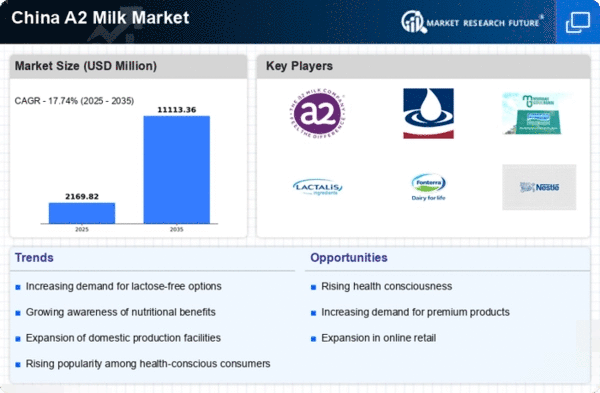
The a2 milk market exhibits a dynamic competitive landscape, characterized by a growing consumer preference for health-oriented dairy products. Key growth drivers include increasing awareness of lactose intolerance and the perceived health benefits associated with a2 milk. Major players such as a2 Milk Company (NZ), Fonterra Co-operative Group (NZ), and Lactalis Ingredients (FR) are strategically positioned to capitalize on these trends. a2 Milk Company (NZ) focuses on innovation and brand differentiation, leveraging its unique product offerings to enhance market share. In contrast, Fonterra Co-operative Group (NZ) emphasizes regional expansion and supply chain optimization, aiming to strengthen its foothold in the Asian market. Lactalis Ingredients (FR) appears to be pursuing strategic partnerships to enhance its product portfolio, thereby shaping a competitive environment that is increasingly focused on health and wellness.
The business tactics employed by these companies reflect a moderately fragmented market structure, where localized manufacturing and supply chain efficiencies play crucial roles. Companies are increasingly localizing production to reduce costs and improve responsiveness to market demands. This approach not only enhances operational efficiency but also allows for better alignment with local consumer preferences. The collective influence of these key players is significant, as they drive innovation and set industry standards, thereby shaping the overall market dynamics.
In October 2025, a2 Milk Company (NZ) announced a strategic partnership with a leading health food retailer to expand its distribution channels across China. This move is likely to enhance its market penetration and increase brand visibility among health-conscious consumers. By aligning with a retailer that shares its values, a2 Milk Company (NZ) may effectively tap into a growing segment of the market that prioritizes health and wellness, thereby reinforcing its competitive position.
In September 2025, Fonterra Co-operative Group (NZ) launched a new line of a2 milk products specifically tailored for the Chinese market, incorporating local flavors and preferences. This initiative underscores Fonterra's commitment to regional customization, which could potentially resonate well with local consumers. By adapting its product offerings, Fonterra may not only enhance customer loyalty but also differentiate itself from competitors who offer more generic products.
In August 2025, Lactalis Ingredients (FR) expanded its production capabilities in China by investing in a new facility dedicated to a2 milk production. This strategic investment is indicative of Lactalis's long-term commitment to the a2 milk segment and its recognition of the growing demand in the region. By increasing production capacity, Lactalis may position itself to better meet consumer demand and capitalize on emerging market opportunities.
As of November 2025, current competitive trends in the a2 milk market are increasingly defined by digitalization, sustainability, and the integration of AI technologies. Companies are leveraging digital platforms to enhance consumer engagement and streamline operations. Strategic alliances are becoming more prevalent, as firms recognize the value of collaboration in navigating complex market dynamics. Looking ahead, competitive differentiation is likely to evolve, shifting from price-based competition to a focus on innovation, technology, and supply chain reliability. This transition may ultimately redefine the competitive landscape, as companies strive to meet the evolving needs of health-conscious consumers.
The A2 milk China market share has expanded steadily as Chinese consumers place greater emphasis on digestive comfort, infant nutrition quality, and premium dairy sourcing. A2 milk has gained recognition for its perceived digestive benefits, making it especially attractive to families, elderly consumers, and health-conscious urban populations. The market share growth is supported by rising awareness of protein differentiation in milk, increased trust in premium nutrition products, and a strong preference for imported or high-quality dairy offerings within China’s evolving dairy landscape.