×
Request Free Sample ×

Kindly complete the form below to receive a free sample of this Report

* Please use a valid business email

Leading companies partner with us for data-driven Insights

clients tt-cursor
Hero Background

China Automotive Aftermarket Industry

ID: MRFR/AT/43124-HCR
200 Pages
Garvit Vyas
October 2025

China Automotive Aftermarket Research Report By Channels (Authorized repair, Independent repair), By Vehicle Age (0-4 years, 4-8 years, Above 8 years), By Vehicle Type (Passenger vehicle, Commercial vehicle) and By Service Type (Parts, Services)- Forecast to 2035

Share:
Download PDF ×

We do not share your information with anyone. However, we may send you emails based on your report interest from time to time. You may contact us at any time to opt-out.

China Automotive Aftermarket Industry Infographic
Purchase Options

China Automotive Aftermarket Industry Summary

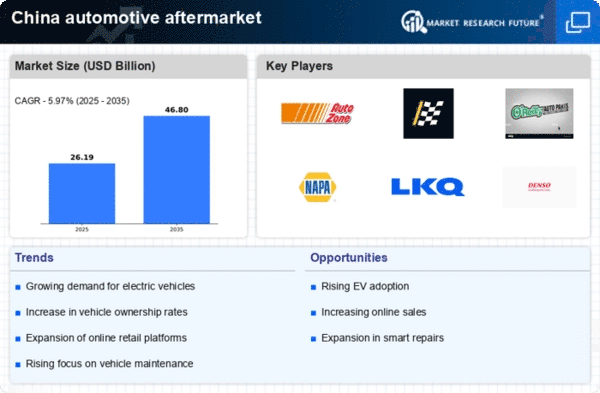
As per MRFR analysis, the China automotive aftermarket market Size was estimated at 24.72 USD Billion in 2024. The China automotive aftermarket market is projected to grow from 26.19 USD Billion in 2025 to 46.8 USD Billion by 2035, exhibiting a compound annual growth rate (CAGR) of 5.97% during the forecast period 2025 - 2035.

Key Market Trends & Highlights

The China automotive aftermarket market is experiencing dynamic growth driven by technological advancements and changing consumer behaviors.

  • The rise of electric vehicle components is reshaping the aftermarket landscape, indicating a shift towards sustainable automotive solutions.
  • Digital transformation in services is enhancing customer engagement and operational efficiency within the automotive aftermarket.
  • E-commerce is rapidly growing in parts sales, reflecting a significant change in consumer purchasing habits and preferences.
  • Increasing vehicle ownership and rising consumer awareness of vehicle maintenance are key drivers propelling market expansion.

Market Size & Forecast

2024 Market Size 24.72 (USD Billion)
2035 Market Size 46.8 (USD Billion)
CAGR (2025 - 2035) 5.97%

Major Players

AutoZone (US), Advance Auto Parts (US), O'Reilly Automotive (US), NAPA Auto Parts (US), LKQ Corporation (US), Denso Corporation (JP), Bosch (DE), Magna International (CA), Tenneco (US), Valeo (FR)

China Automotive Aftermarket Industry Trends

The automotive aftermarket market in China is experiencing notable transformations, driven by various factors including technological advancements and changing consumer preferences. The rise of electric vehicles (EVs) is reshaping the landscape, as more consumers opt for sustainable transportation solutions. This shift necessitates a reevaluation of aftermarket services and products, as traditional components may not align with the needs of EVs. Additionally, the increasing integration of digital technologies into vehicles is prompting a demand for advanced diagnostic tools and software solutions, which could enhance service efficiency and customer satisfaction. Moreover, the growing trend of online retailing is influencing purchasing behaviors within the automotive aftermarket market. Consumers are increasingly turning to e-commerce platforms for parts and accessories, seeking convenience and competitive pricing. This trend may lead to a more fragmented market, as smaller players gain access to a broader customer base through online channels. As the automotive aftermarket market continues to evolve, stakeholders must adapt to these changes to remain competitive and meet the expectations of a more informed and tech-savvy consumer base.

Rise of Electric Vehicle Components

The shift towards electric vehicles is prompting a demand for specialized components and services tailored to EVs. This trend indicates a need for aftermarket providers to adapt their offerings to include batteries, charging systems, and other related technologies.

Digital Transformation in Services

The integration of digital technologies into vehicles is driving the need for advanced diagnostic tools and software solutions. This trend suggests that service providers must invest in technology to enhance operational efficiency and improve customer experiences.

Growth of E-commerce in Parts Sales

The increasing popularity of online shopping is reshaping how consumers purchase automotive parts and accessories. This trend highlights the importance of establishing a strong online presence to capture the evolving purchasing behaviors of consumers.

China Automotive Aftermarket Industry Drivers

Increasing Vehicle Ownership

The automotive aftermarket market in China is experiencing growth due to the rising number of vehicles on the road. As urbanization continues, more individuals are purchasing cars, leading to an increase in demand for aftermarket services and products. In 2025, the vehicle ownership rate is projected to reach approximately 300 million units, which represents a significant opportunity for the automotive aftermarket market. This surge in vehicle numbers necessitates regular maintenance, repairs, and upgrades, thereby driving the demand for aftermarket parts and services. Furthermore, as vehicles age, the need for replacement parts becomes more pronounced, indicating a robust market potential for suppliers and service providers in the automotive aftermarket market.

Government Regulations and Standards

Government regulations and standards play a crucial role in shaping the automotive aftermarket market in China. Stricter emissions regulations and safety standards are driving the demand for compliant aftermarket parts and services. In 2025, it is anticipated that compliance with these regulations could lead to a 20% increase in the demand for certified aftermarket products. This regulatory environment encourages manufacturers and service providers to innovate and improve the quality of their offerings. As a result, the automotive aftermarket market is likely to experience growth driven by the need for high-quality, compliant parts that meet government standards, thereby enhancing consumer trust and safety.

Technological Advancements in Automotive Repair

The automotive aftermarket market in China is significantly influenced by technological advancements in repair and maintenance processes. Innovations such as advanced diagnostic tools and automated repair systems are enhancing service efficiency and accuracy. In 2025, it is estimated that the adoption of such technologies could increase service efficiency by up to 30%. This trend not only improves customer satisfaction but also reduces operational costs for service providers. As a result, the automotive aftermarket market is likely to see a shift towards more tech-savvy service centers that can offer high-quality repairs and maintenance. The integration of technology into the automotive aftermarket market is expected to attract a younger demographic, further expanding the customer base.

Rising Consumer Awareness of Vehicle Maintenance

Consumer awareness regarding the importance of regular vehicle maintenance is on the rise in China, positively impacting the automotive aftermarket market. Educational campaigns and increased access to information through digital platforms have led to a more informed consumer base. In 2025, surveys indicate that approximately 70% of vehicle owners are likely to prioritize regular maintenance, which could lead to a 15% increase in demand for aftermarket services. This heightened awareness encourages consumers to invest in quality parts and services, thereby fostering a competitive environment among aftermarket suppliers. As consumers become more discerning, the automotive aftermarket market is expected to evolve, with a focus on quality and reliability.

Expansion of E-commerce Platforms for Parts Sales

The automotive aftermarket market in China is witnessing a transformation due to the expansion of e-commerce platforms dedicated to parts sales. With the increasing penetration of the internet and mobile devices, consumers are increasingly turning to online platforms for purchasing automotive parts. In 2025, it is projected that online sales of automotive parts could account for over 25% of the total market share. This shift not only provides convenience for consumers but also allows for competitive pricing and a wider selection of products. As e-commerce continues to grow, the automotive aftermarket market is likely to see a significant increase in sales volume, prompting traditional retailers to adapt their strategies to remain competitive.


Market Segment Insights

By Type: Parts (Largest) vs. Accessories (Fastest-Growing)

The China automotive aftermarket market exhibits a varied distribution of market share among its segments. Currently, Parts hold the largest share, driven by the substantial demand for essential replacement components in vehicles. Accessories, while smaller in share, are gaining traction, appealing to car owners looking to enhance personalization and functionality. This dynamic showcases the divergent needs of consumers in the aftermarket landscape. In terms of growth trends, Accessories are experiencing the fastest growth, fueled by the rising interest in vehicle customization and upgrades. The increasing disposable income of consumers in China also drives demand for both Parts and Accessories, as individuals seek to improve their vehicles' performance and aesthetics. Service Equipment and Lubricants continue to be crucial, supporting the overall maintenance ecosystem as vehicle ownership rises in the region.

Parts (Dominant) vs. Accessories (Emerging)

In the China automotive aftermarket market, Parts represent the dominant segment, characterized by their essential role in vehicle maintenance and repair. This segment includes a wide range of components, from engines to braking systems, making it vital for vehicle longevity and safety. The growing vehicle population and aging fleet significantly boost demand for replacement Parts. On the other hand, Accessories are an emerging segment, appealing to consumers interested in enhancing their vehicles' performance and aesthetics. This segment is driven by trends in vehicle customization, with consumers willing to invest in aftermarket upgrades for better functionality and style. The interplay between these segments highlights the evolving preferences of car owners within the automotive aftermarket.

By Sales Channel: Online (Largest) vs. Offline Retail (Fastest-Growing)

The sales channel distribution in the China automotive aftermarket market reveals that online sales dominate the landscape, accounting for a significant portion of the overall market share. This channel benefits from the growing trend of e-commerce and digital purchases among consumers, particularly due to convenience and accessibility. Offline retail remains a key player, particularly for consumers seeking direct engagement and immediate product acquisition. Growth trends in this segment are largely driven by shifting consumer preferences towards online shopping, especially among younger demographics. The convenience and competitive pricing associated with online channels are compelling factors. Meanwhile, offline retail is experiencing a resurgence as consumers appreciate personalized service and tangible product assessment before purchasing. The fastest growth in this area can be attributed to enhanced in-store experiences and effective local marketing strategies.

Online (Dominant) vs. Wholesale (Emerging)

Online sales have established themselves as the dominant channel in the China automotive aftermarket market due to the surge in digital commerce and consumer behavior that favors online shopping. This channel offers 24/7 accessibility and a wide range of products with competitive pricing models, catering to the tech-savvy consumer base. On the other hand, the wholesale segment is emerging as an important player, primarily supporting businesses and retailers by providing bulk products at reduced costs. The wholesale market's growth is propelled by increasing demand from small retailers and workshops that seek to optimize their procurement processes. Together, these segments illustrate the diverse strategies employed within the market, with online maintaining its stronghold while wholesale carves out an essential niche.

By Vehicle Type: Passenger Cars (Largest) vs. Commercial Vehicles (Fastest-Growing)

In the China automotive aftermarket market, the segment distribution reveals that Passenger Cars hold the largest market share. This category benefits from high consumer demand due to the significant number of cars on the road and the growing middle-class population favoring personal vehicles. Commercial Vehicles, while smaller in share compared to Passenger Cars, are experiencing rapid growth as logistics and transportation needs increase, driven by e-commerce and urbanization trends. As urban development progresses and the e-commerce sector expands, the demand for Commercial Vehicles continues to rise, marking it as the fastest-growing segment in the automotive aftermarket. Additionally, government incentives and infrastructure investments are boosting the growth potential of Heavy-Duty Vehicles, further diversifying the aftermarket landscape. The Motorcycle segment, although stable, shows moderate growth fueled by urban mobility solutions and the rising popularity of two-wheelers for commuting.

Passenger Cars (Dominant) vs. Motorcycles (Emerging)

Passenger Cars represent the dominant segment within the China automotive aftermarket market due to a robust consumer preference and an expansive user base. This segment encompasses a wide range of vehicles, which secures substantial aftermarket services such as maintenance, repairs, and aftermarket accessories. On the other hand, Motorcycles are an emerging segment, gaining traction particularly in urban areas where affordability and maneuverability are key advantages. The rising popularity of motorcycles for daily commuting and short-distance travel in congested cities illustrates the evolving mobility preferences of Chinese consumers. As a result, while Passenger Cars dominate the segment, Motorcycles are carving out an increasing share of the market, driven by both economic factors and urban mobility trends.

By Service Type: Maintenance Services (Largest) vs. Repair Services (Fastest-Growing)

In the service type segment of the China automotive aftermarket market, maintenance services hold the largest share, reflecting the sustained demand for preventive care among vehicle owners. This segment is crucial as it ensures longevity and performance, capturing a significant portion of service revenues. Repair services, on the other hand, are witnessing accelerated growth due to increasing vehicle usage and the rising complexity of automotive technology, necessitating skilled technicians for effective service execution. The growth trends in this segment are primarily driven by an aging vehicle fleet and heightened consumer awareness regarding automotive upkeep. Consumers are increasingly seeking professional repair services, thus propelling this segment's expansion. Additionally, the rising adoption of advanced automotive technologies fuels the need for specialized repair services, which continue to emerge as a critical market driver, promising sustained growth in the coming years.

Maintenance Services (Dominant) vs. Modification Services (Emerging)

Maintenance services are characterized by routine checks and preventive care, making them the dominant force in the service type segment of the China automotive aftermarket market. They provide essential upkeep, influencing consumer choices for long-term vehicle performance and safety. In contrast, modification services are emerging rapidly, driven by growing consumer interest in personalizing vehicles for enhanced aesthetics and performance. These services cater to niche markets, offering customization options that attract younger demographics. Although currently smaller, modification services are on an upward trajectory, indicating a shift in consumer preferences towards more personalized vehicle experiences.

Get more detailed insights about China Automotive Aftermarket Industry

Key Players and Competitive Insights

The automotive aftermarket market in China is characterized by a dynamic competitive landscape, driven by rapid technological advancements and evolving consumer preferences. Key players are increasingly focusing on innovation, digital transformation, and strategic partnerships to enhance their market positioning. Companies such as Denso Corporation (Japan), Bosch (Germany), and LKQ Corporation (US) are at the forefront of this competitive environment, leveraging their extensive product portfolios and technological expertise to capture market share. Denso Corporation (Japan) emphasizes its commitment to sustainability and innovation, while Bosch (Germany) continues to invest heavily in digital solutions and smart automotive technologies, thereby shaping the competitive dynamics of the market.

In terms of business tactics, localization of manufacturing and supply chain optimization are pivotal strategies employed by these companies. The market structure appears moderately fragmented, with a mix of large multinational corporations and smaller regional players. This fragmentation allows for diverse offerings and competitive pricing, yet the influence of major players like Bosch (Germany) and LKQ Corporation (US) remains substantial, as they set benchmarks for quality and innovation.

In October 2025, Denso Corporation (Japan) announced a strategic partnership with a leading Chinese electric vehicle manufacturer to develop advanced battery management systems. This collaboration is likely to enhance Denso's footprint in the burgeoning electric vehicle segment, aligning with global trends towards electrification and sustainability. Such strategic moves not only bolster Denso's market position but also reflect a broader industry shift towards integrating advanced technologies in aftermarket solutions.

In September 2025, Bosch (Germany) launched a new digital platform aimed at streamlining the supply chain for automotive parts in China. This initiative is expected to improve efficiency and reduce lead times, thereby enhancing customer satisfaction. By investing in digital infrastructure, Bosch positions itself as a leader in the digital transformation of the automotive aftermarket, which is increasingly critical in a market that values speed and reliability.

In August 2025, LKQ Corporation (US) expanded its operations by acquiring a regional parts distributor in China. This acquisition is indicative of LKQ's strategy to strengthen its distribution network and enhance its service capabilities. By consolidating its presence in key regions, LKQ aims to leverage economies of scale and improve its competitive edge in the aftermarket sector.

As of November 2025, current trends in the automotive aftermarket market include a pronounced shift towards digitalization, sustainability, and the integration of artificial intelligence. Strategic alliances are becoming increasingly important, as companies seek to pool resources and expertise to navigate the complexities of the market. The competitive landscape is evolving, with a noticeable transition from price-based competition to a focus on innovation, technology, and supply chain reliability. This shift suggests that companies that prioritize these aspects will likely emerge as leaders in the future.

Key Companies in the China Automotive Aftermarket Industry market include

Industry Developments

China Automotive Aftermarket has seen significant developments recently, particularly in the realm of electric vehicles and technology integration. Companies like BYD and NIO are expanding their market share in electric automotive components and services, reflecting a growing consumer interest in EVs. In October 2023, Dongfeng Motor announced the launch of new service centers specifically for electric vehicle maintenance, underscoring the shift in consumer demand. Moreover, major partnerships are forming, such as SAIC Motor's collaboration with Baidu on smart driving technology, enhancing the aftermarket services available.

In terms of market valuation, Geely and Great Wall Motors have reported substantial growth, attributed to advancements in their supply chains and customer service innovations. During the past few years, acquisitions like FAW Group's purchase of a controlling stake in Tianjin FAW Xiali in August 2022 have streamlined operations and improved market position. This competitive landscape indicates that companies are adapting to rapidly changing consumer preferences and technological advancements, propelling the automotive aftermarket sector in China forward.

China Automotive Aftermarket Segmentation Insights

    • Automotive Aftermarket Channels Outlook

      • Authorized repair
      • Independent repair
    • Automotive Aftermarket Vehicle Age Outlook

      • 0-4 years
      • 4-8 years
      • Above 8 years
    • Automotive Aftermarket Vehicle Type Outlook

      • Passenger vehicle
      • Commercial vehicle
    • Automotive Aftermarket Service Type Outlook

      • Parts
      • Services

Future Outlook

China Automotive Aftermarket Industry Future Outlook

The automotive aftermarket market in China is projected to grow at a 5.97% CAGR from 2024 to 2035, driven by increasing vehicle ownership, technological advancements, and rising consumer demand for maintenance services.

New opportunities lie in:

  • Expansion of e-commerce platforms for auto parts sales.
  • Development of advanced driver-assistance system (ADAS) retrofitting services.
  • Investment in sustainable automotive repair technologies and practices.

By 2035, the automotive aftermarket market is expected to be robust, driven by innovation and evolving consumer preferences.

Market Segmentation

China Automotive Aftermarket Industry Type Outlook

  • Parts
  • Accessories
  • Tires
  • Lubricants
  • Service Equipment

China Automotive Aftermarket Industry Service Type Outlook

  • Maintenance Services
  • Repair Services
  • Installation Services
  • Modification Services

China Automotive Aftermarket Industry Vehicle Type Outlook

  • Passenger Cars
  • Commercial Vehicles
  • Motorcycles
  • Heavy-Duty Vehicles

China Automotive Aftermarket Industry Sales Channel Outlook

  • Online
  • Offline Retail
  • Wholesale
  • Direct Sales

Report Scope

MARKET SIZE 2024 24.72(USD Billion)
MARKET SIZE 2025 26.19(USD Billion)
MARKET SIZE 2035 46.8(USD Billion)
COMPOUND ANNUAL GROWTH RATE (CAGR) 5.97% (2024 - 2035)
REPORT COVERAGE Revenue Forecast, Competitive Landscape, Growth Factors, and Trends
BASE YEAR 2024
Market Forecast Period 2025 - 2035
Historical Data 2019 - 2024
Market Forecast Units USD Billion
Key Companies Profiled AutoZone (US), Advance Auto Parts (US), O'Reilly Automotive (US), NAPA Auto Parts (US), LKQ Corporation (US), Denso Corporation (JP), Bosch (DE), Magna International (CA), Tenneco (US), Valeo (FR)
Segments Covered Type, Sales Channel, Vehicle Type, Service Type
Key Market Opportunities Integration of advanced telematics and connected vehicle technologies in the automotive aftermarket market.
Key Market Dynamics Rising demand for electric vehicle components drives innovation and competition in the automotive aftermarket sector.
Countries Covered China

Leave a Comment

FAQs

What is the expected market size of the China Automotive Aftermarket Market in 2024?

The China Automotive Aftermarket Market is expected to be valued at 24.72 billion USD in 2024.

What will the market value of the China Automotive Aftermarket Market be in 2035?

In 2035, the market is projected to reach a value of 36.76 billion USD.

What is the expected CAGR for the China Automotive Aftermarket Market from 2025 to 2035?

The expected CAGR for the market from 2025 to 2035 is 3.672 percent.

What is the market size of the authorized repair channel in 2024?

The authorized repair channel is anticipated to be valued at 10.5 billion USD in 2024.

How much is the independent repair channel expected to be valued in 2035?

The independent repair channel is projected to reach a value of 20.36 billion USD in 2035.

What are the key players in the China Automotive Aftermarket Market?

Major players in the market include Dongfeng Motor, Great Wall Motors, SAICGMWuling, and BYD among others.

What is the market value for authorized repair in 2035?

The authorized repair segment is expected to grow to 15.75 billion USD by 2035.

What trends are driving the growth of the China Automotive Aftermarket Market?

Emerging trends include increased vehicle ownership and advancements in automotive technology.

How does the competitive landscape of the market appear in terms of players?

The market features significant competition among established brands and emerging companies such as NIO and Xpeng Motors.

What are the growth opportunities for the China Automotive Aftermarket Market?

Opportunities exist in the expansion of electric vehicle component services and online retail solutions.

Download Free Sample

Kindly complete the form below to receive a free sample of this Report

Compare Licence

×
Features License Type
Single User Multiuser License Enterprise User
Price $4,950 $5,950 $7,250
Maximum User Access Limit 1 User Upto 10 Users Unrestricted Access Throughout the Organization
Free Customization
Direct Access to Analyst
Deliverable Format
Platform Access
Discount on Next Purchase 10% 15% 15%
Printable Versions