Download Free Sample
Kindly complete the form below to receive a free sample of this Report
China Cell Surface Markers Market Research Report By Product (Antibody, PCR Array), By Application (Research, Clinical), By Source (Mice, Rat), and By Cell Type (T Cells, B Cells, NK Cells) - Growth & Industry Forecast 2025 To 2035
As per Market Research Future analysis, the China Cell Surface Markers Market size was estimated at 32.2 USD Million in 2024. The Cell Surface-markers market is projected to grow from 34.39 USD Million in 2025 to 66.49 USD Million by 2035, exhibiting a compound annual growth rate (CAGR) of 6.8% during the forecast period 2025 - 2035
The China cell surface-markers market is poised for substantial growth driven by technological advancements and increasing demand for personalized medicine.
| 2024 Market Size | 32.2 (USD Million) |
| 2035 Market Size | 66.49 (USD Million) |
| CAGR (2025 - 2035) | 6.81% |
Thermo Fisher Scientific (US), BD (US), Merck KGaA (DE), Bio-Rad Laboratories (US), Miltenyi Biotec (DE), Beckman Coulter (US), Abcam (GB), R&D Systems (US)
Our Impact
Enabled $4.3B Revenue Impact for Fortune 500 and Leading Multinationals
Partnering with 2000+ Global Organizations Each Year
30K+ Citations by Top-Tier Firms in the Industry
The China Cell Surface Markers Market is currently experiencing notable growth. This growth is driven by advancements in biotechnology and increasing applications in diagnostics and therapeutics. The rising prevalence of chronic diseases and the demand for personalized medicine are contributing factors. These factors appear to enhance the market's potential. Furthermore, The integration of innovative technologies, such as flow cytometry and mass cytometry, is likely to propel the development of novel cell surface markers. This development will expand their utility in research and clinical settings. As the market evolves, regulatory frameworks and quality control measures are becoming increasingly stringent, which may influence the pace of innovation and market entry for new products. In addition, The emphasis on research and development within academic and clinical laboratories fosters a competitive landscape. Collaborations between research institutions and biotechnology firms seem to be on the rise, potentially leading to breakthroughs in the identification and application of cell surface markers. The market's trajectory suggests a shift towards more targeted therapies. This shift could redefine treatment paradigms in various diseases. Overall, the cell surface-markers market is poised for significant advancements, with a focus on enhancing diagnostic accuracy and therapeutic efficacy.
Recent innovations in technologies such as flow cytometry and mass cytometry are transforming the cell surface-markers market. These advancements facilitate more precise identification and characterization of cell surface markers, enhancing their application in both research and clinical diagnostics.
The increasing focus on personalized medicine is driving the need for specific cell surface markers. This trend indicates a shift towards tailored therapeutic approaches, which may improve patient outcomes and optimize treatment strategies.
The evolving regulatory landscape is influencing the cell surface-markers market. Stricter guidelines and quality control measures are being implemented, which could impact product development timelines and market entry for new technologies.
The cell surface-markers market in China is experiencing a surge in research funding, which is likely to enhance the development of innovative diagnostic and therapeutic solutions. Government initiatives and private investments are increasingly directed towards biotechnology and life sciences, with funding allocations reaching approximately $10 billion in recent years. This financial support is expected to facilitate advancements in the understanding of cell surface markers, thereby driving their application in various medical fields. As research institutions and universities collaborate with industry players, the potential for breakthroughs in cancer immunotherapy and autoimmune diseases appears promising. Consequently, the influx of capital into research is a significant driver for the cell surface-markers market, fostering an environment conducive to innovation and growth.
The growing awareness and acceptance of precision medicine in China is a notable driver for the cell surface-markers market. As healthcare professionals and patients increasingly recognize the benefits of tailored treatment approaches, the demand for biomarkers, including cell surface markers, is expected to rise. This shift towards personalized healthcare is supported by educational initiatives and public health campaigns aimed at informing stakeholders about the advantages of precision medicine. The market for precision medicine in China is projected to reach $30 billion by 2027, indicating a robust growth trajectory. Consequently, the emphasis on individualized treatment strategies is likely to enhance the utilization of cell surface markers in clinical settings.
Technological innovations in diagnostic methodologies are significantly influencing the cell surface-markers market. The introduction of high-throughput screening and multiplex assays has enhanced the ability to analyze multiple cell surface markers simultaneously, improving diagnostic accuracy and efficiency. In China, the market for diagnostic devices is expected to grow at a CAGR of 10% over the next five years, driven by the increasing adoption of advanced technologies. These advancements not only facilitate early disease detection but also enable the development of targeted therapies. As healthcare systems prioritize precision medicine, the integration of sophisticated diagnostic tools into clinical practice is likely to bolster the demand for cell surface markers.
The rising incidence of chronic diseases in China is a critical driver for the cell surface-markers market. With conditions such as cancer, diabetes, and cardiovascular diseases becoming more prevalent, there is an urgent need for effective diagnostic and therapeutic tools. Reports indicate that cancer cases in China are projected to reach 5 million annually by 2030, necessitating advanced solutions for early detection and treatment. Cell surface markers play a pivotal role in identifying disease states and monitoring treatment responses. As healthcare providers seek to improve patient outcomes, the demand for cell surface markers in diagnostics and personalized medicine is likely to escalate, thereby propelling market growth.
Collaborative efforts between academic institutions and industry players are emerging as a vital driver for the cell surface-markers market. In China, partnerships are being formed to facilitate the translation of research findings into practical applications. These collaborations often result in the development of novel diagnostic tools and therapeutic agents that leverage cell surface markers. With an increasing number of joint ventures and research consortia, the synergy between academia and industry is expected to accelerate innovation. Such partnerships not only enhance the research capabilities but also provide access to funding and resources, thereby fostering a conducive environment for the growth of the cell surface-markers market.
In the China cell surface-markers market, Drug Discovery commands the largest market share, driven by robust investments from pharmaceutical companies in innovative therapies and personalized medicine. Diagnostics also plays a crucial role and is rapidly gaining traction as more healthcare providers recognize the importance of precise biomarkers for disease detection, leading to an increasing adoption rate in clinical settings. Growth trends in this segment are influenced by the rising prevalence of diseases and the demand for effective diagnostic tools and treatments. The advances in technology, including multiplex assays and high-throughput screening, are propelling the Drug Discovery segment forward, while the push for early diagnosis in healthcare fuels the rapid expansion of the Diagnostics segment, marking it as a key area of growth in the upcoming years.
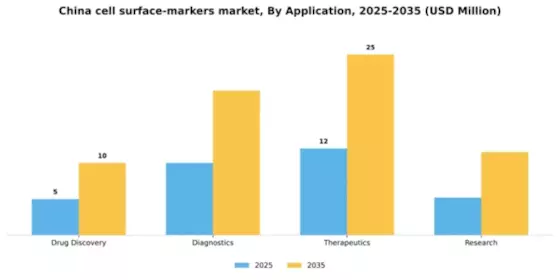
Drug Discovery (Dominant) vs. Diagnostics (Emerging)
The Drug Discovery segment remains the dominant force in the market, characterized by its extensive use of cell surface markers in the development of targeted therapies and novel drug candidates. It thrives on continuous research and collaborations with biotech firms, which enhance its capabilities for innovative drug solutions. Conversely, the Diagnostics segment is emerging strongly, as advancements in biomarker research contribute to more sensitive and specific diagnostic tests. This segment is adapting to the growing demand for personalized medicine and point-of-care testing, positioning itself as an essential player in disease management and treatment monitoring. Both segments are critical, yet they serve distinct yet overlapping needs within the healthcare landscape.
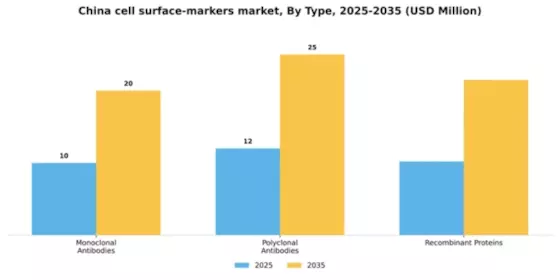
In the China cell surface-markers market, Monoclonal Antibodies lead the market share, primarily due to their wide-ranging applications in diagnostics and therapeutics. Following closely are Polyclonal Antibodies, which are used in various clinical settings, while Recombinant Proteins, although currently smaller, demonstrate significant potential for growth due to their specific advantages in research and therapeutic applications. The growth trends in this segment are driven by increased research in personalized medicine and a surge in demand for advanced diagnostics. Monoclonal Antibodies continue to dominate, but Recombinant Proteins are emerging rapidly as the fastest-growing segment. The development of novel therapeutic proteins and improvements in biotechnology are propelling this growth, as researchers and pharmaceutical companies seek innovative solutions for complex diseases.
Monoclonal Antibodies (Dominant) vs. Recombinant Proteins (Emerging)
Monoclonal Antibodies are currently the dominant segment within the China cell surface-markers market, attributed to their specificity and efficacy in targeting disease markers. They are widely utilized in cancer therapies and autoimmune diseases, making them integral to modern clinical practices. Meanwhile, Recombinant Proteins are recognized as an emerging segment, benefiting from advancements in genetic engineering techniques. These proteins exhibit enhanced potency and specificity, making them increasingly preferred in research applications and therapeutic development. Both segments exhibit a robust competitive landscape, with continued innovation anticipated to further enrich their market presence and applications in the healthcare sector.
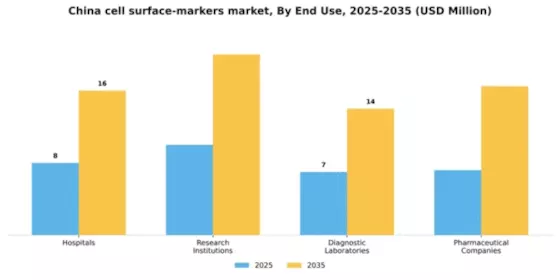
In the China cell surface-markers market, Hospitals represent the largest segment, capturing a significant share due to their essential role in patient diagnostics and treatment. The increasing number of healthcare facilities and the rising demand for precision medicine are further solidifying Hospitals' prominent position. Conversely, Research Institutions are emerging as the fastest-growing segment, driven by the need for advanced research capabilities and better understanding of cellular mechanisms. Growth in the China cell surface-markers market is propelled by innovation in medical technologies and the increasing focus on personalized healthcare solutions. Research Institutions are benefitting from increased funding and collaborations which drive advancements in research. The rise in chronic diseases necessitates innovative diagnostic solutions, creating heightened demand across all segments, especially in Research Institutions as they strive to develop new therapeutic strategies.
Hospitals: Dominant vs. Research Institutions: Emerging
Hospitals are the dominant players in the China cell surface-markers market, largely due to their established infrastructure and substantial patient base. Their focus on enhancing diagnostic accuracy and therapeutic options makes them critical users of cell surface markers. On the other hand, Research Institutions are emerging rapidly, fueled by partnerships with pharmaceutical companies and increasing government investments in scientific research. They focus on fundamental research and innovation, contributing significantly to advancements in cell surface marker applications. This dynamic interplay between dominant and emerging segments is crucial for the continued evolution of biomedical research and diagnostics in China.
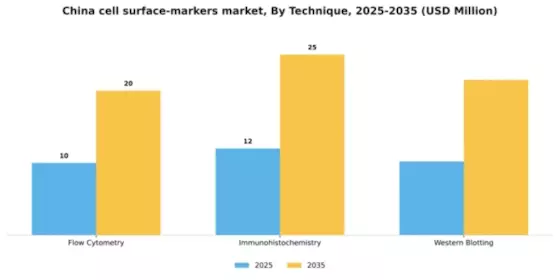
In the China cell surface-markers market, Flow Cytometry holds the largest market share, significantly outperforming other techniques. It is primarily favored for its efficiency and accuracy in analyzing multiple markers simultaneously, which is crucial for research and clinical diagnostics. Immunohistochemistry follows closely, emerging as the fastest-growing segment fueled by advancements in antibody technologies and a growing demand for precise localization of proteins in tissue sections. The growth trends in this segment are heavily influenced by innovations and the increasing adoption of personalized medicine. As healthcare evolves, there is a rising need for advanced diagnostic tools that can deliver reliable and rapid results. The synergy between Flow Cytometry's established capabilities and Immunohistochemistry's emerging technologies will likely shape the future landscape of the cell surface-markers market, catering to diverse applications in research and diagnostics.
Flow Cytometry (Dominant) vs. Immunohistochemistry (Emerging)
Flow Cytometry is recognized as the dominant technique in the market, lauded for its ability to measure multiple parameters of single cells in a fluid stream, offering high throughput and precision. This technology is invaluable in immunology, oncology, and hematology, making it the preferred choice among researchers and clinicians. On the other hand, Immunohistochemistry is rapidly gaining traction as an emerging technique, thanks to its ability to visualize specific antigens in tissues, providing insights into cellular localization and function. The advancement in antibody development and staining technologies has propelled Immunohistochemistry into the spotlight, presenting significant opportunities for growth in research and diagnostics.
Get more detailed insights about China Cell Surface Markers Market Request Free Sample
The cell surface-markers market exhibits a dynamic competitive landscape, characterized by rapid innovation and strategic collaborations among key players. Major companies such as Thermo Fisher Scientific (US), BD (US), and Merck KGaA (DE) are at the forefront, leveraging their extensive research capabilities and product portfolios to drive growth. Thermo Fisher Scientific (US) focuses on enhancing its product offerings through continuous innovation, while BD (US) emphasizes strategic partnerships to expand its market reach. Merck KGaA (DE) appears to be concentrating on regional expansion, particularly in Asia, to capitalize on the growing demand for advanced diagnostic tools. Collectively, these strategies contribute to a competitive environment that is increasingly shaped by technological advancements and collaborative efforts.Key business tactics within the market include localizing manufacturing and optimizing supply chains to enhance operational efficiency. The competitive structure is moderately fragmented, with several players vying for market share. However, the influence of major companies is substantial, as they set industry standards and drive innovation. This competitive dynamic encourages smaller firms to adopt niche strategies or seek partnerships to remain relevant in the market.
In October Thermo Fisher Scientific (US) announced the launch of a new line of cell surface-markers specifically designed for immunotherapy applications. This strategic move is significant as it aligns with the increasing focus on personalized medicine and the growing demand for targeted therapies. By expanding its product range, Thermo Fisher Scientific (US) positions itself to capture a larger share of the market, particularly among oncology researchers and clinicians.
In September BD (US) entered into a collaboration with a leading biotechnology firm to develop novel cell surface-markers for use in advanced cell therapies. This partnership is indicative of BD's commitment to innovation and its strategy to enhance its product offerings through collaborative research. Such alliances not only bolster BD's technological capabilities but also enable it to stay ahead of emerging trends in the cell therapy space.
In August Merck KGaA (DE) completed the acquisition of a smaller biotech company specializing in cell surface-marker technologies. This acquisition is likely to enhance Merck KGaA's research and development capabilities, allowing it to accelerate the introduction of new products into the market. The integration of this technology could provide Merck KGaA with a competitive edge, particularly in the rapidly evolving field of immuno-oncology.
As of November current trends in the cell surface-markers market are increasingly defined by digitalization, sustainability, and the integration of artificial intelligence (AI) into research and development processes. Strategic alliances are becoming more prevalent, as companies recognize the value of collaboration in driving innovation. Looking ahead, competitive differentiation is expected to evolve, with a notable shift from price-based competition to a focus on technological advancements, innovation, and supply chain reliability. This transition underscores the importance of agility and responsiveness in meeting the demands of a rapidly changing market.


In recent months, the China Cell Surface Markers Market has seen significant developments. Companies like Cayman Chemical, Abcam, and BD are actively enhancing their product portfolios to cater to the growing demand for diagnostic and research applications. The Chinese government's investment in biotechnology, particularly in personalized medicine, is propelling market expansion, with notable support for companies like Thermo Fisher Scientific and Bio-Rad Laboratories. In October 2023, AAT Bioquest announced a strategic partnership with a leading Chinese institution to advance cell surface marker research, reflecting the increased collaboration between domestic and international companies.
Merger and acquisition activity is also noteworthy; in August 2023, Merck Millipore acquired a local biotech firm to enhance its capabilities in cell surface marker research, a move that aligns with China's pivotal role in the global biopharmaceutical landscape. Additionally, the overall market valuation has supported an increase in R&D investments, fostering innovations among companies like Miltenyi Biotec and Santa Cruz Biotechnology. Recent trends indicate a shift towards the integration of advanced technologies in cell surface marker applications, which is set to reshape the industry dynamics in China further.
The Cell Surface Markers Market in China is projected to grow at a 6.81% CAGR from 2025 to 2035, driven by advancements in biotechnology and increasing demand for personalized medicine.
New opportunities lie in:
By 2035, the market is expected to achieve substantial growth, reflecting its critical role in healthcare advancements.
| MARKET SIZE 2024 | 32.2(USD Million) |
| MARKET SIZE 2025 | 34.39(USD Million) |
| MARKET SIZE 2035 | 66.49(USD Million) |
| COMPOUND ANNUAL GROWTH RATE (CAGR) | 6.81% (2025 - 2035) |
| REPORT COVERAGE | Revenue Forecast, Competitive Landscape, Growth Factors, and Trends |
| BASE YEAR | 2024 |
| Market Forecast Period | 2025 - 2035 |
| Historical Data | 2019 - 2024 |
| Market Forecast Units | USD Million |
| Key Companies Profiled | Thermo Fisher Scientific (US), BD (US), Merck KGaA (DE), Bio-Rad Laboratories (US), Miltenyi Biotec (DE), Beckman Coulter (US), Abcam (GB), R&D Systems (US) |
| Segments Covered | Application, Type, End Use, Technique |
| Key Market Opportunities | Advancements in personalized medicine drive demand for innovative cell surface-markers in diagnostics and therapeutics. |
| Key Market Dynamics | Rising demand for innovative diagnostics drives growth in the cell surface-markers market amid regulatory advancements. |
| Countries Covered | China |
The overall market valuation was $32.2 Million in 2024.
The projected valuation for 2035 is $66.49 Million.
The expected CAGR during the forecast period 2025 - 2035 is 6.81%.
Key players include Thermo Fisher Scientific, BD, Merck KGaA, Bio-Rad Laboratories, Miltenyi Biotec, Beckman Coulter, Abcam, and R&D Systems.
The main application segments include Drug Discovery, Diagnostics, Therapeutics, and Research.
The valuation range for the Diagnostics segment was $10.0 Million to $20.0 Million.
The projected valuation range for the Therapeutics segment by 2035 is $12.0 Million to $25.0 Million.
Prominent end-use segments include Hospitals, Research Institutions, Diagnostic Laboratories, and Pharmaceutical Companies.
The valuation range for Monoclonal Antibodies was $10.0 Million to $20.0 Million.
Common techniques include Flow Cytometry, Immunohistochemistry, and Western Blotting.


Kindly complete the form below to receive a free sample of this Report

“This is really good guys. Excellent work on a tight deadline. I will continue to use you going forward and recommend you to others. Nice job”


“Thanks. It’s been a pleasure working with you, please use me as reference with any other Intel employees.”


“Thanks for sending the report it gives us a good global view of the Betaïne market.”


“Thank you, this will be very helpful for OQS.”


“We found the report very insightful! we found your research firm very helpful. I'm sending this email to secure our future business.”


“I am very pleased with how market segments have been defined in a relevant way for my purposes (such as "Portable Freezers & refrigerators" and "last-mile"). In general the report is well structured. Thanks very much for your efforts.”


“I have been reading the first document or the study, ,the Global HVAC and FP market report 2021 till 2026. Must say, good info! I have not gone in depth at all parts, but got a good indication of the data inside!”


“We got the report in time, we really thank you for your support in this process. I also thank to all of your team as they did a great job.”


“The Automotive 48V ECU Components Procurement Intelligence Study” was a complex project, but the Market Research Future (MRFR) team handled it with quality, agility, and customer-centricity. They delivered all requested data on time and within the agreed scope. The team, including Shubhendra Anand and Rahul Gotadki, was always readily available to clarify questions and swiftly implement necessary adjustments, driving the project to a successful conclusion within a very demanding timeframe.
I would also like to specifically commend Akshay Agarwal for his responsiveness and support at every stage—from our initial inquiry on May 6th through to final delivery on June 18th. His dedication made the entire process seamless.”



