×
Request Free Sample ×

Kindly complete the form below to receive a free sample of this Report

* Please use a valid business email

Leading companies partner with us for data-driven Insights

clients tt-cursor
Hero Background

China Geospatial Analytics Market

ID: MRFR/ICT/59013-HCR
200 Pages
Aarti Dhapte
October 2025

China Geospatial Analytics Market Research Report By Service (Consulting, Integration and Deployment, Support and Maintenance), By Type (Surface and Field Analytics, Network and Location Analytics, Geo visualization, Other types), and By Technology (Remote Sensing GIS GPS, Other technologies)- Forecast to 2035

Share:
Download PDF ×

We do not share your information with anyone. However, we may send you emails based on your report interest from time to time. You may contact us at any time to opt-out.

China Geospatial Analytics Market Infographic
Purchase Options

China Geospatial Analytics Market Summary

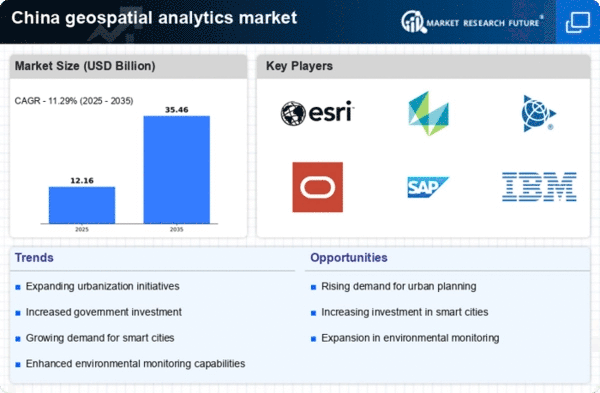
As per MRFR analysis, the geospatial analytics market size was estimated at 10.93 USD Billion in 2024. The geospatial analytics market is projected to grow from 12.16 USD Billion in 2025 to 35.46 USD Billion by 2035, exhibiting a compound annual growth rate (CAGR) of 11.29% during the forecast period 2025 - 2035.

Key Market Trends & Highlights

The China The geospatial analytics market is poised for substantial growth. This growth is driven by technological advancements and urbanization.

  • The integration of AI and Machine Learning is transforming data analysis in the geospatial analytics sector.
  • Smart City initiatives are driving demand for innovative geospatial solutions, particularly in urban planning.
  • Sustainability and environmental monitoring are becoming increasingly critical in shaping geospatial analytics applications.
  • Government investment in infrastructure and rising demand for location-based services are key drivers propelling market expansion.

Market Size & Forecast

2024 Market Size 10.93 (USD Billion)
2035 Market Size 35.46 (USD Billion)
CAGR (2025 - 2035) 11.29%

Major Players

Esri (US), Hexagon (SE), Trimble (US), Oracle (US), SAP (DE), IBM (US), Microsoft (US), Google (US)

China Geospatial Analytics Market Trends

The geospatial analytics market is experiencing notable growth, driven by advancements in technology and increasing demand for location-based services. In recent years, the integration of artificial intelligence and machine learning into geospatial analytics has enhanced data processing capabilities, allowing for more accurate and timely insights. This evolution is particularly relevant in sectors such as urban planning, transportation, and environmental monitoring, where spatial data plays a crucial role in decision-making. Furthermore, the rise of smart cities in China has led to a surge in the adoption of geospatial technologies, as municipalities seek to optimize resources and improve citizen services. Moreover, the emphasis on sustainability and environmental protection is shaping the landscape of the geospatial analytics market. Organizations are increasingly utilizing spatial data to assess environmental impacts and manage natural resources effectively. The Chinese government has been proactive in promoting the use of geospatial technologies to support its environmental policies, which further fuels market growth. As the demand for real-time data and analytics continues to rise, the geospatial analytics market is poised for further expansion, with innovative applications emerging across various industries.

Integration of AI and Machine Learning

The incorporation of artificial intelligence and machine learning into geospatial analytics is transforming data analysis. These technologies enable more sophisticated modeling and predictive analytics, enhancing the ability to derive insights from complex spatial datasets.

Smart City Initiatives

The push for smart city development in China is significantly influencing the geospatial analytics market. Municipalities are leveraging spatial data to improve urban infrastructure, optimize traffic management, and enhance public services, thereby driving demand for advanced geospatial solutions.

Sustainability and Environmental Monitoring

There is a growing focus on sustainability within the geospatial analytics market. Organizations are increasingly using spatial data to monitor environmental changes, assess resource management, and support governmental policies aimed at environmental protection.

China Geospatial Analytics Market Drivers

Urbanization and Population Growth

Rapid urbanization and population growth in China are key drivers of the geospatial analytics market. As cities expand, the need for effective urban planning and resource management becomes paramount. Geospatial analytics provides essential tools for analyzing urban dynamics, optimizing land use, and managing public services. The urban population in China is projected to reach 1 billion by 2030, necessitating advanced analytics to address challenges such as traffic congestion and environmental sustainability. This demographic shift is likely to propel the geospatial analytics market, with an expected growth rate of around 14% over the next few years, as municipalities increasingly adopt data-driven approaches to urban management.

Advancements in Satellite Technology

Technological advancements in satellite imagery and remote sensing are significantly impacting the geospatial analytics market in China. The launch of new satellites with enhanced capabilities allows for more accurate and timely data collection. This is particularly relevant for sectors such as agriculture, environmental monitoring, and urban planning. The Chinese government has invested heavily in satellite technology, which is expected to bolster the geospatial analytics market by providing high-resolution data for analysis. As a result, the market is anticipated to expand by approximately 10% annually, driven by the increasing availability of precise geospatial data that supports informed decision-making.

Increased Focus on Disaster Management

The geospatial analytics market is experiencing growth in China due to an increased focus on disaster management and response strategies. Natural disasters, such as floods and earthquakes, pose significant risks to communities, prompting the government to invest in advanced analytics for risk assessment and emergency planning. Geospatial analytics enables authorities to visualize hazard zones, assess vulnerabilities, and develop effective response strategies. The Chinese government has recognized the importance of integrating geospatial data into disaster management frameworks, which is likely to drive market growth at a rate of approximately 11% annually. This focus on resilience and preparedness underscores the critical role of geospatial analytics in safeguarding communities.

Government Investment in Infrastructure

The geospatial analytics market in China is experiencing a surge. This surge is due to substantial government investment in infrastructure development. The Chinese government has allocated billions of dollars towards enhancing transportation networks, urban planning, and public services. This investment is likely to drive demand for geospatial analytics solutions, as they provide critical insights for optimizing infrastructure projects. For instance, the National Development and Reform Commission has emphasized the importance of integrating geospatial data into planning processes. As a result, the geospatial analytics market is projected to grow at a compound annual growth rate (CAGR) of approximately 15% over the next five years, reflecting the increasing reliance on data-driven decision-making in infrastructure projects.

Rising Demand for Location-Based Services

The geospatial analytics market is witnessing a significant increase in demand for location-based services across various sectors in China. Industries such as retail, logistics, and telecommunications are leveraging geospatial data to enhance customer experiences and optimize operations. For example, retailers are utilizing geospatial analytics to identify optimal store locations and tailor marketing strategies based on consumer behavior patterns. This trend is expected to contribute to a market growth rate of around 12% annually, as businesses recognize the value of location intelligence in gaining competitive advantages. Consequently, the geospatial analytics market is becoming increasingly integral to strategic planning and operational efficiency.


Market Segment Insights

By Service: Consulting (Largest) vs. Support and Maintenance (Fastest-Growing)

In the China geospatial analytics market, the service segment is distinctively characterized by a hierarchical distribution of market share among its core components: Consulting, Integration and Deployment, and Support and Maintenance. Consulting emerges as the largest segment, dominating market dynamics with its extensive range of expert advisory services tailored to the geospatial analytics infrastructure needs. Meanwhile, Support and Maintenance is recognized for its rapid growth, driven by increasing demand for reliable operational support and system upkeep, making it an indispensable element of the service offering. Over recent years, the growth trends within this segment have been significantly shaped by technological advancements and the evolving landscape of geospatial technologies. Organizations are increasingly allocating resources toward Integration and Deployment services to harness the full potential of their geospatial data, while the rising complexity of systems has propelled Support and Maintenance into a position of prominence. As businesses seek to optimize performance and ensure seamless integration of geospatial solutions, the demand for these services is expected to continue its upward trajectory, influenced by ongoing digitization and smart city initiatives.

Consulting (Dominant) vs. Support and Maintenance (Emerging)

Consulting stands out as a dominant force within the service segment of the China geospatial analytics market, providing critical insights and strategic directions for businesses aiming to leverage geospatial data effectively. This segment encompasses a wide range of offerings, including feasibility studies, technology assessments, and project management services that empower organizations to make informed decisions. On the other hand, Support and Maintenance is emerging rapidly, characterized by its integral role in ensuring the continuous functioning of geospatial systems. As businesses increasingly rely on these systems for operational efficiency, robust support frameworks are being developed. This shift reflects a growing recognition of the importance of ongoing maintenance to mitigate risks and enhance the longevity of geospatial analytics solutions.

By Type: Surface and Field Analytics (Largest) vs. Network and Location Analytics (Fastest-Growing)

In the China geospatial analytics market, Surface and Field Analytics leads the segment with a significant market share, dominating due to its widespread application in agriculture, environmental monitoring, and urban planning. The segment benefits from advanced technologies, including satellite imagery and sensors that provide real-time data, enhancing decision-making capabilities within various industries. Conversely, Network and Location Analytics is emerging rapidly, driven by increasing demand for location-based services and smart city initiatives. As businesses and local governments invest in infrastructure and technology, this segment is expected to witness substantial growth as organizations seek actionable insights to improve operational efficiency and customer engagement. The growth of Network and Location Analytics is propelled by factors like the Internet of Things (IoT) integration, increasing urbanization, and the rising need for optimized logistics and transportation solutions. As organizations leverage advanced algorithms and analytics, they are better positioned to analyze complex datasets and make informed decisions. Moreover, the expansion of mobile technologies and applications will likely drive the adoption of location analytics, making it a vital component of the geospatial analytics market in the region. This evolution in analytical capabilities promises a robust future for both segments, with Surface and Field Analytics continuing its dominance while Network and Location Analytics flourishes.

Surface and Field Analytics (Dominant) vs. Network and Location Analytics (Emerging)

Surface and Field Analytics holds a dominant position in the China geospatial analytics market, characterized by its robust applications in agriculture, land management, and environmental studies. This segment employs comprehensive data collection methods, including remote sensing and field surveys, to provide critical insights for sustainable resource management. The evolving technology landscape enhances its capabilities, allowing for precise data analysis and visualization, which is essential for effective planning and resource allocation. Meanwhile, Network and Location Analytics is proving to be an emerging force within the market. With its focus on optimizing networks and improving logistics, this segment capitalizes on the growing emphasis on smart city development and digital infrastructure. Its ability to deliver real-time data and actionable insights positions it as a key player in enhancing operational efficiencies for businesses and municipalities alike.

By Technology: GIS (Largest) vs. Remote Sensing (Fastest-Growing)

In the China geospatial analytics market, the distribution among technology segments shows GIS leading with a significant market share, attributed to its broad application across various industries like urban planning, environmental monitoring, and agriculture. Remote Sensing follows as the fastest-growing segment, propelled by advances in satellite technology and the increasing demand for high-resolution imagery. Looking ahead, the growth trends indicate that GIS will continue to dominate due to its established infrastructure and integration capabilities, while Remote Sensing is expected to see rapid expansion driven by innovations in data analytics and machine learning. With the government emphasizing smart city initiatives and infrastructure development, both segments are well-positioned for further growth.

Technology: GIS (Dominant) vs. Remote Sensing (Emerging)

GIS is characterized by its capability to analyze spatial data effectively, making it indispensable for decision-making processes in various sectors. It dominates the market due to its extensive functionalities, including data visualization, analysis, and integration with other technologies. In contrast, Remote Sensing is emerging swiftly, with its ability to provide real-time data and insights from satellites and aerial imagery driving its adoption. As businesses and governments increasingly prioritize data-driven decisions, Remote Sensing's potential for growth and application in environmental monitoring and disaster management is significant, positioning it as a key player in the evolving landscape of geospatial technologies.

Get more detailed insights about China Geospatial Analytics Market

Key Players and Competitive Insights

The geospatial analytics market in China is characterized by a dynamic competitive landscape, driven by rapid technological advancements and increasing demand for data-driven decision-making across various sectors. Key players such as Esri (US), Hexagon (SE), and Trimble (US) are strategically positioned to leverage their innovative capabilities and extensive product portfolios. Esri (US) focuses on enhancing its geographic information system (GIS) solutions, while Hexagon (SE) emphasizes smart digital realities through its advanced sensor technologies. Trimble (US) is actively pursuing partnerships to expand its reach in the construction and agriculture sectors, indicating a trend towards collaborative innovation that shapes the competitive environment.

The market structure appears moderately fragmented, with several players vying for market share. Companies are increasingly localizing their operations and optimizing supply chains to enhance efficiency and responsiveness to regional demands. This competitive structure allows for a diverse range of offerings, catering to various industries, including urban planning, transportation, and environmental management. The collective influence of these key players fosters a robust ecosystem that encourages innovation and technological advancements.

In October 2025, Esri (US) announced a strategic partnership with a leading Chinese telecommunications company to enhance its cloud-based GIS services. This collaboration aims to integrate advanced analytics and real-time data processing capabilities, thereby improving the accessibility and usability of geospatial data for local enterprises. The strategic importance of this partnership lies in its potential to significantly enhance Esri's market penetration in China, aligning with the growing trend of digital transformation in the region.

In September 2025, Hexagon (SE) launched a new suite of geospatial solutions tailored for smart city applications in China. This initiative focuses on integrating AI and IoT technologies to provide real-time insights for urban management. The launch underscores Hexagon's commitment to sustainability and innovation, positioning the company as a leader in the smart city movement, which is gaining momentum in urban areas across China.

In August 2025, Trimble (US) expanded its operations in China by establishing a new research and development center dedicated to geospatial technologies. This move is indicative of Trimble's long-term strategy to invest in local talent and foster innovation within the region. By enhancing its R&D capabilities, Trimble aims to develop customized solutions that address the unique challenges faced by Chinese industries, thereby strengthening its competitive position.

As of November 2025, the competitive trends in the geospatial analytics market are increasingly defined by digitalization, sustainability, and the integration of AI technologies. Strategic alliances are becoming pivotal in shaping the landscape, as companies seek to combine their strengths to deliver comprehensive solutions. The shift from price-based competition to a focus on innovation, technology, and supply chain reliability is evident, suggesting that future competitive differentiation will hinge on the ability to adapt to evolving market demands and technological advancements.

Key Companies in the China Geospatial Analytics Market market include

Industry Developments

In June 2024, SuperMap introduced SuperMap GIS 2024 along with its Geospatial AI Technology Foundation (SuperMap AIF) at GISTC 2024 in Beijing.The launch introduced notable innovations, featuring AI-driven 3D automated city modeling that can generate intricate 3D scenes of a 35 km² city in hours instead of months, AI spatial planning tools for automating map drafting, and cross-platform deployment capabilities designed for urban planning, environmental governance, and infrastructure management.

SuperMap has established a strategic partnership with Huawei, combining Kunpeng and Ascend computing infrastructure with AIF platforms to enhance the deployment of geospatial models and foster the development of a localized AI ecosystem in China.As of April 2024, SuperMap formed a strategic partnership with GTI (Global Technology Integrator) in Hong Kong, with the objective of facilitating the integration of smart city GIS and BIM in urban settings throughout Greater China.

Tencent simultaneously advanced its geospatial AI capabilities by implementing the Tencent HD Map AI System (THMA). The active-learning labeling platform, established in late 2022 and functioning throughout 2023, processes more than 30,000 km of road network labeling daily across China. Tencent Map is utilized for autonomous driving, navigation, and urban analytics initiatives.At the national level, the National Administration of Surveying, Mapping and Geoinformation and China National Geographic Information System have continued to strengthen GIS data infrastructure and advance standardization; however, no significant new public releases have been reported since 2023.

Future Outlook

China Geospatial Analytics Market Future Outlook

The Geospatial Analytics Market in China is projected to grow at 11.29% CAGR from 2024 to 2035, driven by advancements in technology, increased data availability, and demand for location-based services.

New opportunities lie in:

  • Development of AI-driven predictive analytics tools for urban planning.
  • Integration of geospatial data with IoT for real-time monitoring solutions.
  • Expansion of mobile geospatial applications for enhanced consumer engagement.

By 2035, the market is expected to achieve substantial growth, driven by innovative applications and technological advancements.

Market Segmentation

China Geospatial Analytics Market Type Outlook

  • Surface and Field Analytics
  • Network and Location Analytics
  • Geovisualization
  • Other types

China Geospatial Analytics Market Service Outlook

  • Consulting
  • Integration and Deployment
  • Support and Maintenance

China Geospatial Analytics Market Technology Outlook

  • Remote Sensing
  • GIS
  • GPS
  • Other technologies

Report Scope

MARKET SIZE 2024 10.93(USD Billion)
MARKET SIZE 2025 12.16(USD Billion)
MARKET SIZE 2035 35.46(USD Billion)
COMPOUND ANNUAL GROWTH RATE (CAGR) 11.29% (2024 - 2035)
REPORT COVERAGE Revenue Forecast, Competitive Landscape, Growth Factors, and Trends
BASE YEAR 2024
Market Forecast Period 2025 - 2035
Historical Data 2019 - 2024
Market Forecast Units USD Billion
Key Companies Profiled Esri (US), Hexagon (SE), Trimble (US), Oracle (US), SAP (DE), IBM (US), Microsoft (US), Google (US)
Segments Covered Service, Type, Technology
Key Market Opportunities Integration of artificial intelligence in geospatial analytics enhances decision-making across various industries.
Key Market Dynamics Rising demand for location-based services drives innovation and competition in the geospatial analytics market.
Countries Covered China

Leave a Comment

FAQs

What is the projected market size of the China Geospatial Analytics Market in 2024?

The China Geospatial Analytics Market is expected to be valued at 12.0 USD Billion in 2024.

What will be the estimated market size of the China Geospatial Analytics Market by 2035?

By 2035, the market is anticipated to reach a value of 38.0 USD Billion.

What is the expected CAGR for the China Geospatial Analytics Market from 2025 to 2035?

The market is projected to grow at a CAGR of 11.048 % between 2025 and 2035.

Who are the key players in the China Geospatial Analytics Market?

Major players include Tencent, Huawei, Alibaba, and the China Aerospace Science and Technology Corporation.

What are the market values of consulting services in the China Geospatial Analytics Market for 2024 and 2035?

Consulting services are valued at 3.0 USD Billion in 2024, rising to 9.5 USD Billion by 2035.

What is the market size for integration and deployment services in the China Geospatial Analytics Market in 2024?

Integration and deployment services are expected to be valued at 4.5 USD Billion in 2024.

What will be the market value for support and maintenance services in the China Geospatial Analytics Market by 2035?

Support and maintenance services are projected to reach a value of 14.5 USD Billion by 2035.

What trends are influencing the growth of the China Geospatial Analytics Market?

Increasing demand for data-driven decision-making and advancements in technology are key trends influencing market growth.

How does the China Geospatial Analytics Market compare to global markets?

While the market is significant, its growth is primarily driven by local demand and innovation in geospatial technologies.

What challenges does the China Geospatial Analytics Market face?

Challenges include regulatory hurdles and the need for skilled professionals in geospatial analytics.

Download Free Sample

Kindly complete the form below to receive a free sample of this Report

Compare Licence

×
Features License Type
Single User Multiuser License Enterprise User
Price $4,950 $5,950 $7,250
Maximum User Access Limit 1 User Upto 10 Users Unrestricted Access Throughout the Organization
Free Customization
Direct Access to Analyst
Deliverable Format
Platform Access
Discount on Next Purchase 10% 15% 15%
Printable Versions