×
Request Free Sample ×

Kindly complete the form below to receive a free sample of this Report

* Please use a valid business email

Leading companies partner with us for data-driven Insights

clients tt-cursor
Hero Background

South Korea Geospatial Analytics Market

ID: MRFR/ICT/59009-HCR
200 Pages
Aarti Dhapte
October 2025

South Korea Geospatial Analytics Market Research Report By Service (Consulting, Integration and Deployment, Support and Maintenance), By Type (Surface and Field Analytics, Network and Location Analytics, Geov-isualization, Other types), and By Technology (Remote Sensing GIS GPS, Other technologies)- Forecast to 2035

Share:
Download PDF ×

We do not share your information with anyone. However, we may send you emails based on your report interest from time to time. You may contact us at any time to opt-out.

South Korea Geospatial Analytics Market Infographic
Purchase Options

South Korea Geospatial Analytics Market Summary

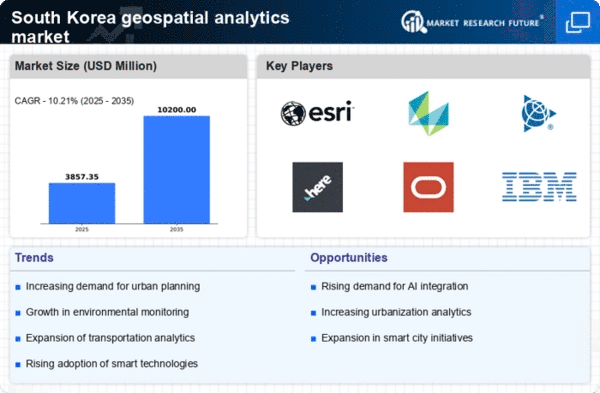
As per MRFR analysis, the geospatial analytics market size was estimated at 3500.0 USD Million in 2024. The geospatial analytics market is projected to grow from 3857.35 USD Million in 2025 to 10200.0 USD Million by 2035, exhibiting a compound annual growth rate (CAGR) of 10.21% during the forecast period 2025 - 2035.

Key Market Trends & Highlights

The South Korea geospatial analytics market is experiencing robust growth driven by technological advancements and increasing demand for smart solutions.

  • The integration of AI in geospatial analytics is transforming data processing capabilities.
  • Government initiatives and support are fostering innovation and investment in the geospatial sector.
  • The rise of location-based services is enhancing user engagement and operational efficiency.
  • Technological advancements in data processing and the increased demand for smart city solutions are key drivers of market growth.

Market Size & Forecast

2024 Market Size 3500.0 (USD Million)
2035 Market Size 10200.0 (USD Million)
CAGR (2025 - 2035) 10.21%

Major Players

Esri (US), Hexagon (SE), Trimble (US), HERE Technologies (NL), Oracle (US), IBM (US), Microsoft (US), Google (US), SAP (DE)

South Korea Geospatial Analytics Market Trends

The geospatial analytics market in South Korea is experiencing significant growth. This growth is driven by advancements in technology and increasing demand for location-based services. The integration of artificial intelligence and machine learning into geospatial analytics tools enhances data processing capabilities. This allows for more accurate insights and predictions. Furthermore, the government's emphasis on smart city initiatives and infrastructure development fosters an environment conducive to the adoption of geospatial technologies. As organizations across various sectors recognize the value of spatial data, investments in geospatial analytics are likely to rise, leading to innovative applications in urban planning, transportation, and environmental management. In addition, the proliferation of mobile devices and the Internet of Things (IoT) contributes to the expansion of the geospatial analytics market. With more data being generated from various sources, the ability to analyze and visualize this information becomes increasingly critical. South Korean companies are leveraging geospatial analytics to optimize operations, enhance customer experiences, and improve decision-making processes. As the market evolves, collaboration between public and private sectors may further accelerate the development and implementation of geospatial solutions, positioning South Korea as a leader in this dynamic field.

Integration of AI in Geospatial Analytics

The incorporation of artificial intelligence into geospatial analytics tools is transforming data analysis. AI algorithms enhance the ability to process vast amounts of spatial data, leading to improved accuracy and efficiency in decision-making. This trend is particularly relevant in sectors such as urban planning and disaster management, where timely and precise information is crucial.

Government Initiatives and Support

The South Korean government actively promotes the use of geospatial technologies through various initiatives. Investments in smart city projects and infrastructure development create a favorable environment for the growth of the geospatial analytics market. This support encourages collaboration between public agencies and private enterprises, fostering innovation and application of geospatial solutions.

Rise of Location-Based Services

There is a growing demand for location-based services across multiple industries in South Korea. Businesses are increasingly utilizing geospatial analytics to enhance customer engagement and optimize operations. This trend reflects a broader shift towards data-driven strategies, where spatial insights play a pivotal role in shaping business decisions.

South Korea Geospatial Analytics Market Drivers

Increased Demand for Smart City Solutions

The push towards smart city initiatives in South Korea is significantly influencing the geospatial analytics market. With the government investing heavily in urban infrastructure, the need for effective geospatial data to manage resources and services is paramount. The market is projected to grow by approximately 20% as municipalities adopt geospatial analytics for traffic management, waste management, and public safety. These solutions enable city planners to optimize operations and improve the quality of life for residents. The integration of geospatial analytics into smart city frameworks is likely to become a cornerstone of urban development strategies.

Technological Advancements in Data Processing

The geospatial analytics market in South Korea is experiencing a surge due to rapid advancements in data processing technologies. Innovations in cloud computing and big data analytics are enabling organizations to handle vast amounts of geospatial data efficiently. This has led to a projected growth rate of approximately 15% annually in the sector. Enhanced data processing capabilities allow for real-time analysis and visualization, which are crucial for sectors such as urban planning and disaster management. As organizations increasingly rely on data-driven decision-making, the demand for sophisticated geospatial analytics tools is likely to rise, further propelling the market forward.

Growing Importance of Environmental Monitoring

Environmental concerns are increasingly driving the geospatial analytics market in South Korea. The need for effective monitoring of natural resources and urban environments has led to a heightened demand for geospatial solutions. The market is projected to expand by 18% as organizations utilize geospatial analytics for environmental assessments, pollution tracking, and resource management. This trend is particularly relevant in the context of climate change, where accurate data is essential for developing sustainable practices. The ability to visualize and analyze environmental data spatially is becoming indispensable for both public and private sectors.

Rising Investment in Infrastructure Development

Investment in infrastructure development is a key driver of the geospatial analytics market in South Korea. The government has committed substantial resources to enhance transportation networks and public facilities, creating a demand for geospatial analytics to inform planning and execution. The market is expected to grow by 19% as stakeholders utilize geospatial data to optimize project outcomes and ensure efficient resource allocation. This trend underscores the critical role of geospatial analytics in supporting large-scale infrastructure projects, enabling better decision-making and project management.

Expansion of Mobile and Location-Based Technologies

The proliferation of mobile devices and location-based technologies is reshaping the geospatial analytics market in South Korea. As more consumers utilize smartphones equipped with GPS capabilities, businesses are increasingly leveraging geospatial data to enhance customer experiences. The market is anticipated to grow by 22% as companies adopt location-based services for targeted marketing and improved service delivery. This trend highlights the importance of real-time geospatial data in understanding consumer behavior and preferences. Consequently, businesses are investing in geospatial analytics tools to gain a competitive edge in the market.


Market Segment Insights

By Service: Consulting (Largest) vs. Support and Maintenance (Fastest-Growing)

In the South Korea geospatial analytics market, the service segment is primarily dominated by consulting, which holds the largest share. This segment benefits from growing demand as various industries seek to leverage geospatial data for decision-making and operational efficiency. Integration and Deployment services also contribute significantly, although they represent a smaller proportion than consulting. Support and Maintenance services have been gaining traction and are becoming increasingly integral as organizations continue to adopt geospatial technologies. The growth trends in the service segment are driven by the rising need for advanced analytics and the increasing complexity of geospatial solutions. Factors such as the digital transformation across sectors and advancements in technology are fueling demand for integration and maintenance services. Moreover, the growing emphasis on data accuracy and real-time analytics is propelling support services as businesses require ongoing assistance to maximize the potential of their geospatial investments.

Consulting (Dominant) vs. Support and Maintenance (Emerging)

Consulting services in the South Korea geospatial analytics market are characterized by a comprehensive approach to implementing geospatial technologies, offering tailored solutions that address specific industry needs. This segment benefits from extensive expertise and experience, positioning itself as a leader in driving the adoption of geospatial insights across sectors. In contrast, Support and Maintenance represents an emerging segment, where the focus is on ensuring the operational continuity and efficiency of geospatial systems. Organizations are increasingly recognizing the importance of having reliable support structures in place, leading to a surge in demand for these services. As a result, while Consulting services dominate in terms of market share, Support and Maintenance is quickly becoming essential for sustaining technological investments.

By Type: Surface and Field Analytics (Largest) vs. Network and Location Analytics (Fastest-Growing)

In the South Korea geospatial analytics market, Surface and Field Analytics holds the largest market share, showcasing its dominance in various applications including agriculture, environmental monitoring, and urban planning. This segment capitalizes on the growing need for precise field data and spatial analysis, making it essential across multiple industries. Conversely, Network and Location Analytics is emerging quickly, gaining traction due to the rise in smart city initiatives and real-time data analysis requirements. This segment is increasingly recognized for its role in optimizing logistics and transport networks. As the market continues to evolve, digital transformation and cloud-based solutions are key growth drivers for both segments. Surface and Field Analytics benefits from advancements in sensor technology and data processing capabilities, facilitating improved decision-making. Meanwhile, Network and Location Analytics is propelled by increased investments in IoT infrastructure and location-based services, making it an integral part of smart solutions in urban development. The push towards efficient communication and resource allocation positions both segments for significant future growth.

Surface and Field Analytics (Dominant) vs. Network and Location Analytics (Emerging)

Surface and Field Analytics dominates the South Korea geospatial analytics market by providing critical data analysis tools that enhance operational efficiency across sectors such as agriculture and environmental management. Its ability to integrate with remote sensing technologies makes it indispensable for real-time monitoring and decision-making. In contrast, Network and Location Analytics is rapidly emerging, characterized by its capability to analyze complex networks and spatial relationships. This segment is increasingly vital for industries focusing on logistics, urban transport planning, and retail site selection. Both segments exhibit unique features that cater to diverse customer needs, thereby solidifying their positions in an ever-growing market.

By Technology: Remote Sensing (Largest) vs. GIS (Fastest-Growing)

In the South Korea geospatial analytics market, Remote Sensing holds the largest market share, dominating the landscape of technological applications. This segment benefits immensely from advancements in satellite imagery and aerial photography, which provide crucial data insights for various sectors, including agriculture, urban planning, and environmental management. On the other hand, GIS is identified as the fastest-growing segment, driven by an increasing demand for spatial data analysis across numerous industries. The integration of GIS with other technologies, such as big data and cloud computing, enhances its capabilities and fosters wider adoption, stimulating growth in sectors like transportation, healthcare, and public safety.

Technology: Remote Sensing (Dominant) vs. GIS (Emerging)

Remote Sensing stands out as the dominant technology in the South Korea geospatial analytics market, facilitating the collection and analysis of geographical data from a distance. This technology plays a pivotal role in applications involving complex data sets, enabling users to monitor environmental changes and conduct risk assessments effectively. Conversely, GIS, identified as an emerging technology, is revolutionizing the way spatial information is utilized. With its ability to visualize, analyze, and interpret data, GIS aids in making informed decisions across various fields, fostering growth and expanding its relevance in areas such as infrastructure development and disaster response.

Get more detailed insights about South Korea Geospatial Analytics Market

Key Players and Competitive Insights

The geospatial analytics market in South Korea is characterized by a dynamic competitive landscape, driven by rapid technological advancements and increasing demand for location-based services. Key players such as Esri (US), Hexagon (SE), and Trimble (US) are strategically positioned to leverage their innovative capabilities and extensive product portfolios. Esri (US) focuses on enhancing its geographic information system (GIS) solutions, while Hexagon (SE) emphasizes smart digital realities through its advanced sensor technologies. Trimble (US) is actively pursuing partnerships to expand its reach in the construction and agriculture sectors, indicating a trend towards sector-specific solutions that cater to diverse market needs. Collectively, these strategies contribute to a competitive environment that is increasingly oriented towards innovation and tailored offerings.

In terms of business tactics, companies are localizing their operations to better serve the South Korean market, optimizing supply chains to enhance efficiency. The competitive structure appears moderately fragmented, with several players vying for market share. However, the influence of major companies is substantial, as they set benchmarks for technological advancements and service quality. This competitive interplay fosters an environment where smaller firms may struggle to keep pace, yet also encourages innovation as they seek to differentiate themselves.

In October 2025, Esri (US) announced a partnership with a leading South Korean telecommunications company to integrate advanced GIS capabilities into smart city initiatives. This collaboration is strategically significant as it positions Esri (US) at the forefront of urban development projects, potentially enhancing its market share in the rapidly growing smart city sector. The integration of GIS technology into urban planning is likely to streamline processes and improve decision-making for city planners.

In September 2025, Hexagon (SE) launched a new suite of geospatial analytics tools tailored for the manufacturing sector, focusing on real-time data processing and analytics. This move underscores Hexagon's (SE) commitment to innovation and its strategy to penetrate niche markets. By providing specialized solutions, Hexagon (SE) may enhance its competitive edge and attract clients seeking to optimize their manufacturing processes through data-driven insights.

In August 2025, Trimble (US) expanded its partnership with a prominent agricultural technology firm to enhance precision farming solutions. This strategic action reflects Trimble's (US) focus on integrating geospatial analytics with agricultural practices, potentially leading to improved crop yields and resource management. Such collaborations are indicative of a broader trend towards sector-specific applications of geospatial technologies, which may redefine competitive dynamics in the market.

As of November 2025, the competitive trends in the geospatial analytics market are increasingly shaped by digitalization, sustainability, and the integration of artificial intelligence (AI). Strategic alliances are becoming more prevalent, as companies recognize the value of collaboration in driving innovation and expanding their service offerings. Looking ahead, competitive differentiation is likely to evolve, with a shift from price-based competition to a focus on technological innovation, reliability in supply chains, and the ability to deliver tailored solutions that meet the specific needs of diverse industries.

Key Companies in the South Korea Geospatial Analytics Market market include

Industry Developments

SK Telecom has led multiple flagship initiatives. In May 2024, SKT collaborated with Swift Navigation to introduce Skylark, a carrier-grade network providing centimeter-level GNSS accuracy throughout Korea, applicable for ADAS, drones, and robotics.Empirical testing demonstrated that tracking accuracy surpassed 99% integrity in vehicles, thereby facilitating applications like the Korea Forest Service's high-precision forestry surveys. SKT’s LITMUS platform, designed for urban behavioral insights, enhanced traffic congestion prediction by 24% in pilot cities through AI analysis of anonymized mobile subscriber data, resulting in a GLOMO award.

In August 2023, SKT launched a simulator and analytics solution designed to assess communication quality within Urban Air Mobility (UAM) networks, facilitating drone/UAV operations at altitudes of up to 600 m and speeds ranging from 100 to 150 km/h.As a member of the KUAM Dream Team, Tmap Mobility, in collaboration with Hanwha Aerospace and SK Telecom, signed memoranda of understanding in May 2023 with South Gyeongsang and other provinces to implement aerial mobility strategies, combining mobility-as-a-service platforms with mapping and flight routing functionalities.

In early 2024, Samsung SDS, a subsidiary of Samsung Electronics, implemented a metro-wide digital twin platform throughout Seoul’s metro system. This platform facilitates disaster simulation, infrastructure monitoring, and urban planning by utilizing real-time IoT and geospatial data.KT Corporation introduced AI-driven geospatial logistics analytics in Q1 2024, facilitating reduced delivery times and optimized fleet management for prominent Korean e-commerce companies.

Future Outlook

South Korea Geospatial Analytics Market Future Outlook

The Geospatial Analytics Market is projected to grow at 10.21% CAGR from 2024 to 2035, driven by advancements in AI, IoT integration, and increased demand for location-based services.

New opportunities lie in:

  • Development of AI-driven predictive analytics tools for urban planning.
  • Integration of geospatial data with IoT for real-time asset tracking.
  • Creation of customized mapping solutions for e-commerce logistics optimization.

By 2035, the market is expected to achieve substantial growth, driven by innovative applications and technological advancements.

Market Segmentation

South Korea Geospatial Analytics Market Type Outlook

  • Surface and Field Analytics
  • Network and Location Analytics
  • Geovisualization
  • Other types

South Korea Geospatial Analytics Market Service Outlook

  • Consulting
  • Integration and Deployment
  • Support and Maintenance

South Korea Geospatial Analytics Market Technology Outlook

  • Remote Sensing
  • GIS
  • GPS
  • Other technologies

Report Scope

MARKET SIZE 2024 3500.0(USD Million)
MARKET SIZE 2025 3857.35(USD Million)
MARKET SIZE 2035 10200.0(USD Million)
COMPOUND ANNUAL GROWTH RATE (CAGR) 10.21% (2024 - 2035)
REPORT COVERAGE Revenue Forecast, Competitive Landscape, Growth Factors, and Trends
BASE YEAR 2024
Market Forecast Period 2025 - 2035
Historical Data 2019 - 2024
Market Forecast Units USD Million
Key Companies Profiled Esri (US), Hexagon (SE), Trimble (US), HERE Technologies (NL), Oracle (US), IBM (US), Microsoft (US), Google (US), SAP (DE)
Segments Covered Service, Type, Technology
Key Market Opportunities Integration of artificial intelligence in geospatial analytics enhances decision-making and operational efficiency.
Key Market Dynamics Rising demand for real-time data analytics drives innovation and competition in the geospatial analytics market.
Countries Covered South Korea

Leave a Comment

FAQs

What is the expected market size of the South Korea Geospatial Analytics Market in 2024?

The South Korea Geospatial Analytics Market is expected to be valued at 3.5 USD Billion in 2024.

What is the projected market size for the South Korea Geospatial Analytics Market by 2035?

By 2035, the South Korea Geospatial Analytics Market is projected to reach a value of 10.5 USD Billion.

What is the expected CAGR for the South Korea Geospatial Analytics Market from 2025 to 2035?

The expected CAGR for the South Korea Geospatial Analytics Market from 2025 to 2035 is 10.503 percent.

Which service segment is valued the highest in the South Korea Geospatial Analytics Market for 2024?

In 2024, the Consulting service segment is valued at 1.2 USD Billion in the South Korea Geospatial Analytics Market.

What is the value of the Integration and Deployment segment in the South Korea Geospatial Analytics Market for 2024?

The Integration and Deployment segment is valued at 1.0 USD Billion in 2024 within the South Korea Geospatial Analytics Market.

What is the market value of the Support and Maintenance segment in 2024 for the South Korea Geospatial Analytics Market?

The Support and Maintenance segment of the South Korea Geospatial Analytics Market is valued at 1.3 USD Billion in 2024.

Who are the key players in the South Korea Geospatial Analytics Market?

Key players in the South Korea Geospatial Analytics Market include T map mobility, Hanwha Aerospace, Samsung Electronics, SK Telecom, and LG Electronics.

What are the primary growth drivers for the South Korea Geospatial Analytics Market?

The primary growth drivers for the South Korea Geospatial Analytics Market include increasing demand for location-based services and advancements in technology.

How has the global scenario impacted the South Korea Geospatial Analytics Market?

The global scenario has emphasized the importance of geospatial data, driving innovations and investments in the South Korea Geospatial Analytics Market.

What opportunities exist in the South Korea Geospatial Analytics Market through 2035?

Opportunities in the South Korea Geospatial Analytics Market through 2035 include expanding applications in transportation, urban planning, and environmental management.

Download Free Sample

Kindly complete the form below to receive a free sample of this Report

Compare Licence

×
Features License Type
Single User Multiuser License Enterprise User
Price $4,950 $5,950 $7,250
Maximum User Access Limit 1 User Upto 10 Users Unrestricted Access Throughout the Organization
Free Customization
Direct Access to Analyst
Deliverable Format
Platform Access
Discount on Next Purchase 10% 15% 15%
Printable Versions