×
Request Free Sample ×

Kindly complete the form below to receive a free sample of this Report

* Please use a valid business email

Leading companies partner with us for data-driven Insights

clients tt-cursor
Hero Background

Germany Geospatial Analytics Market

ID: MRFR/ICT/59010-HCR
200 Pages
Aarti Dhapte
October 2025

Germany Geospatial Analytics Market Research Report By Service (Consulting, Integration and Deployment, Support and Maintenance), By Type (Surface and Field Analytics, Network and Location Analytics, Geo-visualization, Other types), and By Technology (Remote Sensing GIS GPS, Other technologies)- Forecast to 2035

Share:
Download PDF ×

We do not share your information with anyone. However, we may send you emails based on your report interest from time to time. You may contact us at any time to opt-out.

Germany Geospatial Analytics Market Infographic
Purchase Options

Germany Geospatial Analytics Market Summary

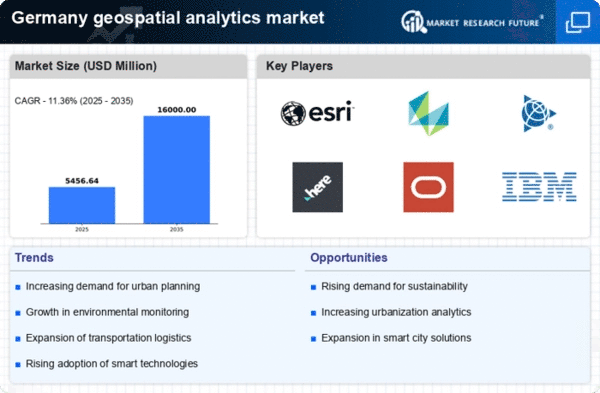
As per MRFR analysis, the geospatial analytics market size was estimated at 4900.0 USD Million in 2024. The geospatial analytics market is projected to grow from 5456.64 USD Million in 2025 to 16000.0 USD Million by 2035, exhibiting a compound annual growth rate (CAGR) of 11.36% during the forecast period 2025 - 2035.

Key Market Trends & Highlights

The Germany geospatial analytics market is poised for substantial growth driven by technological advancements and increasing demand for location-based services.

  • The integration of AI and Machine Learning is transforming data analysis in the geospatial analytics market.
  • Smart Cities and Urban Planning initiatives are driving the adoption of geospatial technologies in urban environments.
  • Sustainability and Environmental Monitoring are becoming critical components of geospatial analytics applications.
  • Rising demand for location-based services and government initiatives are key drivers propelling market growth.

Market Size & Forecast

2024 Market Size 4900.0 (USD Million)
2035 Market Size 16000.0 (USD Million)
CAGR (2025 - 2035) 11.36%

Major Players

Esri (US), Hexagon (SE), Trimble (US), HERE Technologies (NL), Oracle (US), IBM (US), Microsoft (US), Google (US), SAP (DE)

Germany Geospatial Analytics Market Trends

the geospatial analytics market is experiencing notable growth, driven by advancements in technology and increasing demand for location-based services. The integration of artificial intelligence and machine learning into geospatial analytics tools enhances data processing capabilities, allowing for more accurate insights and predictions. Furthermore, the rise of smart cities and the Internet of Things (IoT) fosters a greater reliance on geospatial data for urban planning and infrastructure development. As organizations recognize the value of spatial data in decision-making, investments in geospatial technologies are likely to increase, indicating a robust future for this sector. In addition, the regulatory environment in Germany supports the expansion of the geospatial analytics market. Government initiatives aimed at promoting digitalization and data sharing create a conducive atmosphere for innovation. The emphasis on sustainability and environmental monitoring further propels the demand for geospatial solutions, as businesses and public entities seek to optimize resource management and reduce their ecological footprint. Overall, the geospatial analytics market appears poised for continued growth, with various sectors leveraging spatial intelligence to enhance operational efficiency and strategic planning.

Integration of AI and Machine Learning

The incorporation of artificial intelligence and machine learning technologies into geospatial analytics tools is transforming data analysis. These advancements enable organizations to process vast amounts of spatial data more efficiently, leading to improved accuracy in insights and predictions. As a result, businesses are increasingly adopting these technologies to enhance their decision-making processes.

Smart Cities and Urban Planning

The development of smart cities in Germany is significantly influencing the geospatial analytics market. Urban planners and local governments are utilizing geospatial data to optimize infrastructure, improve public services, and enhance the quality of life for residents. This trend indicates a growing reliance on spatial intelligence for effective urban management.

Sustainability and Environmental Monitoring

There is a rising focus on sustainability within the geospatial analytics market, driven by the need for environmental monitoring and resource management. Organizations are leveraging geospatial solutions to track environmental changes, assess impacts, and implement strategies for sustainable development. This trend reflects a broader commitment to ecological responsibility across various sectors.

Germany Geospatial Analytics Market Drivers

Government Initiatives and Investments

Government initiatives aimed at enhancing infrastructure and urban development significantly influence the geospatial analytics market. The German government has been investing in smart city projects, which necessitate the integration of geospatial technologies for effective planning and management. For example, the Federal Ministry of Transport and Digital Infrastructure has allocated substantial funds to improve transportation networks, which rely heavily on geospatial data for analysis and decision-making. This commitment to infrastructure development is likely to drive the adoption of geospatial analytics solutions, as public agencies seek to optimize resource allocation and improve service delivery, thereby expanding the market.

Emergence of Big Data and Cloud Computing

The emergence of big data and cloud computing technologies is reshaping the landscape of the geospatial analytics market in Germany. The ability to process and analyze vast amounts of geospatial data in real-time is becoming increasingly feasible due to advancements in cloud infrastructure. This shift allows organizations to access powerful analytics tools without the need for extensive on-premises resources. As a result, businesses across various sectors are adopting cloud-based geospatial analytics solutions to enhance their operational efficiency and scalability. The market is anticipated to grow by 10% annually as more organizations leverage big data and cloud technologies to drive their geospatial analytics initiatives.

Rising Demand for Location-Based Services

The increasing reliance on location-based services is a pivotal driver for the geospatial analytics market. Businesses across various sectors, including retail, logistics, and transportation, are leveraging geospatial data to enhance operational efficiency and customer engagement. For instance, the retail sector utilizes geospatial analytics to optimize store locations and tailor marketing strategies based on consumer behavior patterns. This trend is reflected in the market's growth, with a projected increase of approximately 15% annually through 2026. As organizations recognize the value of precise location data, the demand for advanced geospatial analytics solutions is expected to surge, further propelling the market forward.

Advancements in Satellite and Drone Technologies

Technological advancements in satellite and drone capabilities are transforming the geospatial analytics market in Germany. The proliferation of high-resolution satellite imagery and the increasing use of drones for data collection enable more accurate and timely geospatial analysis. These technologies facilitate applications in agriculture, environmental monitoring, and urban planning, allowing stakeholders to make informed decisions based on real-time data. The market is projected to grow by 12% annually as organizations adopt these innovative technologies to enhance their analytical capabilities. Consequently, the integration of advanced satellite and drone technologies is likely to be a key driver in the evolution of the geospatial analytics market.

Growing Importance of Data-Driven Decision Making

The shift towards data-driven decision-making is a crucial factor propelling the geospatial analytics market in Germany. Organizations are increasingly recognizing the value of data in informing strategic decisions, leading to a heightened demand for geospatial analytics solutions. Industries such as healthcare, finance, and real estate are utilizing geospatial data to gain insights into market trends and consumer behavior. This trend is underscored by a reported increase in the adoption of analytics tools, with approximately 70% of companies in Germany indicating a commitment to data-driven strategies. As businesses continue to prioritize data analytics, the geospatial analytics market is expected to experience robust growth.


Market Segment Insights

By Service: Consulting (Largest) vs. Support and Maintenance (Fastest-Growing)

In the Germany geospatial analytics market, the service segment is primarily divided into Consulting, Integration and Deployment, and Support and Maintenance. Among these, Consulting holds the largest market share, driven by the increasing demand for expert guidance in data interpretation and spatial analysis. On the other hand, Support and Maintenance is rapidly gaining traction, highlighted by its significant growth potential as companies seek reliable solutions to maintain and enhance their geospatial systems. The growth trends in this segment are influenced by a variety of factors, including advancements in technology and the rising importance of data-driven decision making. Companies are investing more in technical support to ensure operational efficiency and continuity, which has positioned Support and Maintenance as the fastest-growing service segment. Meanwhile, the growing complexity of projects requires continuous consulting support, thereby creating a balanced demand across all service areas.

Consulting (Dominant) vs. Support and Maintenance (Emerging)

Consulting in the Germany geospatial analytics market is characterized by its deep expertise and tailored solutions, catering to various sectors such as urban planning and environmental management. It serves as the backbone for other service offerings, ensuring that clients make informed decisions based on comprehensive analyses. In contrast, Support and Maintenance represents an emerging value in this segment, focusing on providing ongoing assistance and troubleshooting for geospatial tools. This service has become increasingly critical as organizations rely more heavily on geospatial technologies, making responsive support vital for operational success. The adaptability and specialized knowledge in both Consulting and Support and Maintenance are core to their effectiveness and relevance in a dynamically evolving market.

By Type: Surface and Field Analytics (Largest) vs. Geovisualization (Fastest-Growing)

In the Germany geospatial analytics market, 'Surface and Field Analytics' holds the largest market share, primarily driven by the demand for precise geographical representations and environmental monitoring. This segment is crucial for industries like agriculture and urban planning, where accurate data and analytics contribute significantly to operational efficiency and decision-making. Conversely, 'Geovisualization' is gaining traction as the fastest-growing segment, appealing to businesses that seek interactive and user-friendly data presentations. The integration of advanced visualization technologies has enhanced its adoption across various sectors, from logistics to environmental science. Growth trends indicate a robust expansion in both segments, fueled by technological advancements and increasing reliance on data-driven insights. Businesses are increasingly recognizing the importance of geospatial analytics in enhancing productivity and gaining a competitive edge. The rise of smart cities, IoT applications, and big data analytics is further driving the demand for these services, enabling more accurate location-based decision-making and fostering innovation within the market.

Surface and Field Analytics (Dominant) vs. Geovisualization (Emerging)

'Surface and Field Analytics' is characterized by its extensive applications in land use planning, resource management, and agricultural optimization, making it a dominant force in the Germany geospatial analytics market. This segment benefits from advancements in remote sensing and precision agriculture, which enhance data accuracy and utility. Meanwhile, 'Geovisualization' is emerging as an innovative approach, blending data analysis with visual methods to interpret complex geospatial data effectively. Its rising popularity stems from the increasing need for accessible and communicative data representation, making it attractive for businesses looking to enhance their analytical capabilities. Both segments are pivotal in shaping a future where data-driven decision-making is paramount.

By Technology: GIS (Largest) vs. Remote Sensing (Fastest-Growing)

In the Germany geospatial analytics market, GIS holds the largest share, reflecting its essential role in spatial data management and analysis. Remote Sensing, while currently smaller in share, is rapidly catching up due to advancements in satellite technology and increasing applications in environmental monitoring and urban planning. Demand for integration between these technologies is expected to drive further growth in both segments. The growth trends within the technology segment indicate a robust expansion driven by the rise of smart cities and the need for real-time data analysis. GIS technology continues to evolve, integrating with other technologies like IoT and big data analytics, enhancing its capabilities. Remote Sensing is fueled by increased funding in environmental projects and technological innovations that allow for more accurate and timely data collection, making it the fastest-growing sector within this market.

Technology: GIS (Dominant) vs. Remote Sensing (Emerging)

GIS is the dominant technology in the segment due to its wide-ranging applications in urban planning, transportation, and infrastructure management. Its comprehensive database and analytical capabilities make it indispensable for decision-makers. On the other hand, Remote Sensing is an emerging technology that has been gaining traction in the market, primarily due to its ability to provide critical data through satellite imagery and aerial surveys. This technology offers unique insight into land use changes and environmental conditions, thus supporting various sectors such as agriculture, forestry, and disaster management. The interplay between these technologies is crucial, with GIS increasingly relying on data obtained from Remote Sensing to enhance its analytical frameworks.

Get more detailed insights about Germany Geospatial Analytics Market

Key Players and Competitive Insights

The geospatial analytics market in Germany is characterized by a dynamic competitive landscape, driven by technological advancements and increasing demand for data-driven decision-making across various sectors. Key players such as Esri (US), HERE Technologies (NL), and SAP (DE) are strategically positioned to leverage their innovative capabilities and regional expertise. Esri (US) focuses on enhancing its geographic information system (GIS) solutions, while HERE Technologies (NL) emphasizes real-time location data services. SAP (DE) integrates geospatial analytics into its enterprise resource planning (ERP) systems, thereby enhancing operational efficiency for its clients. Collectively, these strategies foster a competitive environment that prioritizes innovation and customer-centric solutions.

In terms of business tactics, companies are increasingly localizing their operations to better serve the German market, optimizing supply chains to enhance efficiency. The competitive structure of the market appears moderately fragmented, with several players vying for market share. However, the influence of major companies is substantial, as they set industry standards and drive technological advancements that smaller firms often follow.

In October 2025, HERE Technologies (NL) announced a partnership with a leading automotive manufacturer to integrate advanced geospatial analytics into their navigation systems. This collaboration is likely to enhance the accuracy and efficiency of route planning, thereby improving user experience and positioning HERE as a leader in automotive geospatial solutions. The strategic importance of this partnership lies in its potential to expand HERE's market reach and solidify its role in the rapidly evolving automotive sector.

In September 2025, SAP (DE) launched a new suite of geospatial analytics tools designed to support sustainability initiatives for businesses. This move reflects a growing trend towards integrating environmental considerations into business operations. By providing tools that enable companies to visualize and analyze their environmental impact, SAP is not only enhancing its product offerings but also aligning with global sustainability goals, which could attract a broader customer base.

In August 2025, Esri (US) unveiled a new cloud-based platform that allows users to access and analyze geospatial data in real-time. This innovation is significant as it caters to the increasing demand for agile and scalable solutions in the market. By enhancing accessibility and usability, Esri is likely to strengthen its competitive position and attract new clients seeking modern analytics solutions.

As of November 2025, the competitive trends in the geospatial analytics market are increasingly defined by digitalization, sustainability, and the integration of artificial intelligence (AI). Strategic alliances among key players are shaping the landscape, fostering innovation and enhancing service offerings. The shift from price-based competition to a focus on technological advancement and supply chain reliability is evident. Companies that prioritize innovation and adaptability are likely to differentiate themselves in this evolving market.

Key Companies in the Germany Geospatial Analytics Market market include

Industry Developments

In November 2023, Hexagon AB announced its acquisition of Seequent’s geothermal simulation company, Flow State Solutions. This move enhances its subsurface modeling capabilities and broadens its footprint in Germany’s energy sector.In July 2024, Hexagon's acquisition of indurad, an autonomous mine mapping firm, significantly improved its digital reality solutions for industrial applications, particularly in railway and construction infrastructure in Germany.

Esri Deutschland GmbH has maintained its leadership in the transformation of Germany's national smart-city and public-sector GIS initiatives. In the City of Stuttgart's Smart City concept (early 2024), Esri ArcGIS Reality Studio facilitated the processing of DSM, ortho-images, point clouds, and 3D meshes to enhance urban planning workflows, demonstrating ongoing municipal engagement with Esri platforms.

During the first quarter of 2024, TomTom enhanced its B2B geospatial presence in Europe by entering into several commercial agreements with German companies, including GEVAS (traffic management), Spotzi (geomarketing analytics), and CleverMaps (location intelligence). This development solidifies TomTom's position as a significant data provider within Germany's analytics landscape.Bentley Systems, via its subsidiary Seequent, enhanced its infrastructure market capabilities by acquiring Flow State Solutions in October 2023, thereby supporting geothermal and digital twin modeling pertinent to Germany's energy transition infrastructure.

Future Outlook

Germany Geospatial Analytics Market Future Outlook

The Geospatial Analytics Market is projected to grow at 11.36% CAGR from 2024 to 2035, driven by advancements in AI, IoT integration, and increased demand for location-based services.

New opportunities lie in:

  • Development of AI-driven predictive analytics tools for urban planning.
  • Integration of geospatial data with IoT for real-time asset tracking.
  • Creation of customized geospatial solutions for environmental monitoring.

By 2035, the market is expected to achieve substantial growth, driven by innovative applications and technological advancements.

Market Segmentation

Germany Geospatial Analytics Market Type Outlook

  • Surface and Field Analytics
  • Network and Location Analytics
  • Geovisualization
  • Other types

Germany Geospatial Analytics Market Service Outlook

  • Consulting
  • Integration and Deployment
  • Support and Maintenance

Germany Geospatial Analytics Market Technology Outlook

  • Remote Sensing
  • GIS
  • GPS
  • Other technologies

Report Scope

MARKET SIZE 2024 4900.0(USD Million)
MARKET SIZE 2025 5456.64(USD Million)
MARKET SIZE 2035 16000.0(USD Million)
COMPOUND ANNUAL GROWTH RATE (CAGR) 11.36% (2024 - 2035)
REPORT COVERAGE Revenue Forecast, Competitive Landscape, Growth Factors, and Trends
BASE YEAR 2024
Market Forecast Period 2025 - 2035
Historical Data 2019 - 2024
Market Forecast Units USD Million
Key Companies Profiled Esri (US), Hexagon (SE), Trimble (US), HERE Technologies (NL), Oracle (US), IBM (US), Microsoft (US), Google (US), SAP (DE)
Segments Covered Service, Type, Technology
Key Market Opportunities Integration of artificial intelligence in geospatial analytics enhances decision-making and operational efficiency.
Key Market Dynamics Rising demand for real-time data analytics drives innovation and competition in the geospatial analytics market.
Countries Covered Germany

Leave a Comment

FAQs

What is the projected market size of the Germany Geospatial Analytics Market in 2024?

The Germany Geospatial Analytics Market is expected to be valued at 3.6 USD Billion in 2024.

What is the expected market size of the Germany Geospatial Analytics Market by 2035?

By 2035, the market is projected to reach a value of 12.5 USD Billion.

What is the expected compound annual growth rate (CAGR) for the Germany Geospatial Analytics Market between 2025 to 2035?

The market is expected to grow at a CAGR of 11.981% during the period from 2025 to 2035.

Which service segment is projected to have the highest value within the Germany Geospatial Analytics Market by 2035?

The Consulting services segment is expected to reach a value of 4.4 USD Billion by 2035.

Who are the major players in the Germany Geospatial Analytics Market?

Key players include HERE Technologies, Hexagon, SAP, Oracle, and Esri among others.

What is the market value of the Support and Maintenance segment in 2024?

The Support and Maintenance segment is estimated to be valued at 1.1 USD Billion in 2024.

What is the expected market value for Integration and Deployment services by 2035?

Integration and Deployment services are projected to reach a value of 4.7 USD Billion by 2035.

What are the growth drivers influencing the Germany Geospatial Analytics Market?

The growth drivers include increasing demand for data-driven decision making and advancements in location-based technologies.

How do the trends in geospatial analytics impact its applications in various industries?

Current trends enhance applications in sectors like urban planning, transportation, and environmental management.

What is the market value of the overall Germany Geospatial Analytics Market in 2025?

While specific projections for 2025 are not available, the market is expected to continue its growth, building on the 2024 value.

Download Free Sample

Kindly complete the form below to receive a free sample of this Report

Compare Licence

×
Features License Type
Single User Multiuser License Enterprise User
Price $4,950 $5,950 $7,250
Maximum User Access Limit 1 User Upto 10 Users Unrestricted Access Throughout the Organization
Free Customization
Direct Access to Analyst
Deliverable Format
Platform Access
Discount on Next Purchase 10% 15% 15%
Printable Versions