×
Request Free Sample ×

Kindly complete the form below to receive a free sample of this Report

* Please use a valid business email

Leading companies partner with us for data-driven Insights

clients tt-cursor
Hero Background

China Green Steel Market

ID: MRFR/CnM/47023-HCR
200 Pages
Chitranshi Jaiswal
October 2025

China Green Steel Market Research Report By Method of Production (Hydrogen-Based Reduction, Electrolysis, Biomass Direct Reduction, Recycling), By End Use Industry (Construction, Automotive, Manufacturing, Energy), By Form (Flat Steel, Long Steel, Steel Products) andBy Quality Grade (High Strength Steel, Low Alloy Steel, Stainless Steel)- Forecast to 2035

Share:
Download PDF ×

We do not share your information with anyone. However, we may send you emails based on your report interest from time to time. You may contact us at any time to opt-out.

China Green Steel Market Infographic
Purchase Options

China Green Steel Market Summary

As per analysis, the China green steel market is projected to grow from USD 106.74 Million in 2024 to USD 226.84 Million by 2025, exhibiting a compound annual growth rate (CAGR) of 112.52% during the forecast period (2025 - 2035).

Key Market Trends & Highlights

The China green steel market is poised for substantial growth driven by sustainability initiatives and technological advancements.

  • The construction segment remains the largest consumer of green steel, reflecting a robust demand for sustainable building materials.
  • The automotive components segment is currently the fastest-growing area, indicating a shift towards eco-friendly manufacturing practices.
  • Government policies and regulations are increasingly shaping the market landscape, promoting the adoption of green steel technologies.
  • Key market drivers include government support and rising consumer demand for sustainable steel, which are likely to propel market expansion.

Market Size & Forecast

2024 Market Size 106.74 (USD Million)
2035 Market Size 426307.84 (USD Million)
CAGR (2025 - 2035) 112.52%

Major Players

Baowu Steel Group (CN), Ansteel Group (CN), Shougang Group (CN), Jiangsu Shagang Group (CN), Hebei Iron and Steel Group (CN), China Steel Corporation (CN), Nippon Steel Corporation (JP), Tata Steel Limited (IN), POSCO (KR)

China Green Steel Market Trends

The China green steel market is currently experiencing a transformative phase, driven by the nation's commitment to reducing carbon emissions and enhancing sustainability within the steel industry. The Chinese government has implemented various policies aimed at promoting the use of renewable energy sources in steel production, which appears to be reshaping the landscape of this sector. As a result, many steel manufacturers are investing in innovative technologies that facilitate the production of low-carbon steel. This shift not only aligns with national environmental goals but also responds to increasing demand from consumers and industries for greener products. Moreover, the emphasis on circular economy principles is gaining traction within the China green steel market. Steel producers are exploring methods to recycle scrap metal and utilize alternative materials, which could potentially reduce reliance on traditional iron ore. This trend indicates a broader movement towards sustainable practices, as companies seek to minimize waste and enhance resource efficiency. The interplay between government initiatives, technological advancements, and market demand suggests that the China green steel market is poised for significant growth in the coming years, reflecting a broader commitment to environmental stewardship and sustainable development.

Government Policies and Regulations

The Chinese government has established a framework of policies aimed at promoting green steel production. These regulations encourage manufacturers to adopt cleaner technologies and reduce carbon emissions, thereby fostering a more sustainable industry. This regulatory environment is likely to drive innovation and investment in green steel initiatives.

Technological Advancements in Production

Innovations in production techniques are emerging as a key trend within the China green steel market. Companies are increasingly adopting advanced technologies, such as hydrogen-based steelmaking and electric arc furnaces, which may significantly lower carbon footprints. These advancements could enhance efficiency and sustainability in steel manufacturing.

Growing Demand for Sustainable Products

There is a noticeable increase in consumer and industrial demand for sustainable steel products in China. As awareness of environmental issues rises, businesses are seeking greener alternatives to traditional steel. This trend suggests that the market for green steel is likely to expand, driven by both consumer preferences and corporate responsibility.

Market Segment Insights

By Application: Construction (Largest) vs. Automotive (Fastest-Growing)

In the China green steel market, the application segment exhibits varied market share distribution, with construction leading the charge. This is due to the massive investments in infrastructure projects fueling demand for green steel, which is favored for its sustainability and reduced carbon footprint. The automotive industry follows closely, experiencing significant interest as manufacturers seek innovative materials to meet stringent regulatory frameworks and consumer expectations for environmentally friendly vehicles. The growth trends within the application segment are driven primarily by governmental policies supporting green initiatives and technological advancements in steel production. As the automotive sector increasingly pivots towards electrification and lightweighting, green steel is emerging as a critical material. The shipbuilding, machinery, and energy sectors are also witnessing gradual adoption of green steel, but their growth rates trail behind that of construction and automotive applications.

Construction (Dominant) vs. Automotive (Emerging)

In the China green steel market, construction stands out as the dominant application, characterized by high demand for sustainable materials in structural development projects. This segment is supported by government investments in infrastructure, pushing the envelope for eco-friendly practices. In contrast, the automotive sector is emerging robustly, driven by the need for light-weighting and improvements in fuel efficiency, aligning with environmental regulations. As manufacturers aim to produce greener vehicles, the shift towards materials like green steel is becoming more pronounced. The distinct characteristics of these segments highlight that while construction has a firm grip on current market dynamics, automotive is rapidly evolving, suggesting a promising future trajectory as electric vehicle adoption escalates.

By End Use: Building Materials (Largest) vs. Automotive Components (Fastest-Growing)

In the China green steel market, the end use segment is predominantly driven by the building materials industry, which holds a significant share due to the increasing demand for sustainable construction solutions. Building materials such as steel beams, rebar, and sheets are essential in modern infrastructure, and their production has seen a substantial shift towards greener practices. Meanwhile, automotive components are emerging as the fastest-growing segment, driven by regulatory pressures for emissions reductions and the automotive industry's pivot towards electrification and lightweighting strategies. As the green steel market evolves, the automotive components sector is expected to witness rapid growth, fueled by the increasing adoption of electric vehicles and eco-friendly manufacturing processes. Awareness of the environmental impact of traditional steel production has led to an upsurge in demand for green steel solutions in automotive manufacturing. This trend is further encouraged by government initiatives and incentives that aim to promote sustainable practices within the automotive industry.

Building Materials (Dominant) vs. Automotive Components (Emerging)

The building materials segment remains a dominant force within the China green steel market, characterized by its widespread use in construction and infrastructure projects. This segment benefits from a strong focus on sustainable building practices, as China continues to urbanize and develop its infrastructure. The integration of green steel into construction materials not only complies with increasing regulations but also attracts environmentally conscious consumers. In contrast, the automotive components segment is emerging rapidly as manufacturers pivot to green steel for producing vehicle components. This shift is largely driven by the increasing numbers of electric vehicles and the global automotive industry's commitment to reducing carbon footprints. The automotive sector's integration of lightweight and sustainable materials is critical for improving energy efficiency and performance in vehicles, positioning it as a significant player in the green steel market.

By Production Method: Electric Arc Furnace (Largest) vs. Recycling (Fastest-Growing)

The China green steel market is witnessing significant shifts in its production methods, with Electric Arc Furnace (EAF) accounting for the largest share among the production techniques. This method leverages scrap steel and contributes to reduced carbon emissions, aligning with China's sustainability goals. Meanwhile, Recycling is identified as the fastest-growing method, driven primarily by increased scrap availability and favorable government policies promoting circular economy practices.

Electric Arc Furnace (Dominant) vs. Hydrogen Reduction (Emerging)

Electric Arc Furnace (EAF) technology remains the dominant production method in the China green steel market due to its established efficiency and sustainability credentials. It primarily uses processed scrap steel, minimizing reliance on virgin raw materials and showcasing lower carbon footprints. In contrast, Hydrogen Reduction, emerging as a novel production approach, holds great promise for the future of green steel. Leveraging hydrogen as a reducing agent, this method aims to eliminate carbon emissions during production, echoing China's strategic commitment to green initiatives. As technological advancements further develop, Hydrogen Reduction could potentially reshape the production landscape, capturing a remarkable share in response to environmental concerns and regulatory changes.

By Material Type: Steel Slabs (Largest) vs. Steel Coils (Fastest-Growing)

In the China green steel market, the material type segment showcases varying market share distributions among steel slabs, steel sheets, steel bars, and steel coils. Steel slabs dominate this segment due to their widespread application in construction and manufacturing, leading to a larger market foothold. Conversely, steel sheets and bars follow suit but hold a smaller share compared to slabs, highlighting the diverse preferences of end-users in different industries. The position of these materials illustrates the importance of accessibility and versatility in catering to industrial demands. In terms of growth trends, steel coils are emerging as the fastest-growing segment within this landscape, driven by increasing demand in the automotive and construction industries, which prefer lighter materials that offer high strength. The push for sustainability and eco-friendly initiatives is encouraging investments in technologies that enhance the production of green steel, particularly for coils. Meanwhile, slabs maintain steady growth due to their established role in major industrial applications, balancing the market dynamics between established and emerging technologies.

Steel Slabs (Dominant) vs. Steel Coils (Emerging)

Steel slabs, known for their substantial thickness and durability, play a critical role in the China green steel market as the dominant segment. They are primarily utilized in heavy construction, infrastructure projects, and heavy machinery manufacturing, serving industries that demand robust and resilient materials. Meanwhile, steel coils are positioned as an emerging segment, aligning with current trends favoring lighter and more flexible materials for applications in the automotive sector and sleek construction designs. As the demand for environmentally-friendly production processes increases, steel coils are expected to gain traction, supported by advancements in manufacturing methods that reduce carbon footprints, making them highly competitive in the green steel landscape.

By Technology Adoption: Traditional Steelmaking (Largest) vs. Innovative Steelmaking (Fastest-Growing)

In the China green steel market, the technology adoption landscape varies significantly among different methods. Traditional steelmaking currently holds the largest market share, owing to its established practices and existing infrastructure. However, as environmental policies tighten and sustainability becomes a pressing issue, there is a noticeable shift towards innovative steelmaking techniques that prioritize lower emissions and higher efficiency. These newer methods are gaining traction among manufacturers looking to stay compliant and competitive, signaling a gradual transition in the market.

Technology: Traditional Steelmaking (Dominant) vs. Innovative Steelmaking (Emerging)

Traditional steelmaking, while still dominant, is facing increasing pressure to evolve due to sustainability concerns. This established technology relies on coal and other high-emission processes but benefits from a mature supply chain and significant industrial expertise. On the other hand, innovative steelmaking, which utilizes electric arc furnaces and alternative iron-making methods, is emerging rapidly. These technologies promise reduced carbon footprints and align with China’s strategic goals for greener production. With substantial investments and rising demand for sustainable steel, innovative methods are poised to reshape the industry, attracting interest from stakeholders aiming for long-term viability.

Get more detailed insights about China Green Steel Market

Key Players and Competitive Insights

The green steel market in China is characterized by a rapidly evolving competitive landscape, driven by increasing environmental regulations and a growing demand for sustainable materials. Major players such as Baowu Steel Group (China), Ansteel Group (China), and Shougang Group (China) are at the forefront of this transformation, each adopting distinct strategies to enhance their market positioning. Baowu Steel Group (China) has focused on innovation through the development of low-carbon steel production technologies, while Ansteel Group (China) has pursued strategic partnerships to bolster its research capabilities in green steel production. Shougang Group (China) is actively investing in digital transformation initiatives to optimize its manufacturing processes, thereby enhancing efficiency and reducing emissions. Collectively, these strategies contribute to a competitive environment that emphasizes sustainability and technological advancement.

In terms of business tactics, companies are increasingly localizing manufacturing and optimizing supply chains to enhance operational efficiency. The market structure appears moderately fragmented, with several key players exerting influence over their respective segments. This fragmentation allows for a diverse range of innovations and approaches to green steel production, fostering a competitive atmosphere where companies must continuously adapt to maintain their market share.

In November 2025, Baowu Steel Group (China) announced a partnership with a leading technology firm to develop advanced carbon capture and storage solutions. This strategic move is significant as it aligns with global sustainability goals and positions Baowu as a leader in reducing carbon emissions in steel production. The collaboration is expected to enhance Baowu's technological capabilities and further its commitment to sustainable practices.

In October 2025, Ansteel Group (China) launched a new initiative aimed at increasing the use of recycled materials in its steel production processes. This initiative is crucial as it not only reduces waste but also lowers the carbon footprint associated with raw material extraction. By prioritizing recycling, Ansteel is likely to improve its sustainability profile and appeal to environmentally conscious consumers.

In September 2025, Shougang Group (China) unveiled a state-of-the-art facility designed to integrate AI technologies into its production lines. This facility is expected to enhance operational efficiency and reduce energy consumption, reflecting a broader trend towards digitalization in the industry. The integration of AI may provide Shougang with a competitive edge by enabling real-time data analysis and process optimization.

As of December 2025, the competitive trends in the green steel market are increasingly defined by digitalization, sustainability, and the integration of advanced technologies. Strategic alliances among key players are shaping the landscape, fostering innovation and collaboration. The shift from price-based competition to a focus on technological advancement and supply chain reliability is evident, suggesting that future competitive differentiation will hinge on the ability to innovate and adapt to evolving market demands.


Key Companies in the China Green Steel Market market include

Industry Developments

Recent news in the China Green Steel Market reflects significant developments in sustainability and firm strategies. In September 2023, China Baowu Steel Group announced its ambition to produce carbon-neutral steel by 2050, reinforcing its leadership role. Meanwhile, Wuhan Iron and Steel Corporation has ramped up investments in green technologies, aligning with national policies that emphasize the reduction of carbon emissions in heavy industries. The merger landscape has recently seen activity, with Shandong Iron and Steel Group exploring acquisition opportunities to enhance its green steel production capabilities.

The rising emphasis on electric arc furnace technology, promoted by companies like Sino Steel and Tianjin Steel Group, indicates a shift towards more sustainable practices. In the past two years, initiatives to promote hydrogen-based steelmaking have gained momentum, with HBIS Group investing heavily in research. Furthermore, the market valuation of companies such as Shagang Group has increased significantly due to rising demand for sustainable products, further influencing operational strategies across the sector.

Future Outlook

China Green Steel Market Future Outlook

The China green steel market is projected to grow at a staggering 112.52% CAGR from 2024 to 2035, driven by regulatory support, technological advancements, and increasing demand for sustainable materials.

New opportunities lie in:

  • Investment in hydrogen-based steel production technologies.
  • Development of carbon capture and storage solutions for steel plants.
  • Partnerships with renewable energy providers for sustainable energy sourcing.

By 2035, the green steel market in China is poised for substantial growth and innovation.

Market Segmentation

China Green Steel Market End Use Outlook

  • Building Materials
  • Automotive Components
  • Industrial Equipment
  • Consumer Goods

China Green Steel Market Application Outlook

  • Construction
  • Automotive
  • Shipbuilding
  • Machinery
  • Energy

China Green Steel Market Material Type Outlook

  • Steel Slabs
  • Steel Sheets
  • Steel Bars
  • Steel Coils

China Green Steel Market Production Method Outlook

  • Electric Arc Furnace
  • Direct Reduced Iron
  • Hydrogen Reduction
  • Recycling

China Green Steel Market Technology Adoption Outlook

  • Traditional Steelmaking
  • Innovative Steelmaking
  • Carbon Capture Utilization
  • Renewable Energy Integration

Report Scope

MARKET SIZE 2024106.74(USD Million)
MARKET SIZE 2025226.84(USD Million)
MARKET SIZE 2035426307.84(USD Million)
COMPOUND ANNUAL GROWTH RATE (CAGR)112.52% (2024 - 2035)
REPORT COVERAGERevenue Forecast, Competitive Landscape, Growth Factors, and Trends
BASE YEAR2024
Market Forecast Period2025 - 2035
Historical Data2019 - 2024
Market Forecast UnitsUSD Million
Key Companies ProfiledBaowu Steel Group (CN), Ansteel Group (CN), Shougang Group (CN), Jiangsu Shagang Group (CN), Hebei Iron and Steel Group (CN), China Steel Corporation (CN), Nippon Steel Corporation (JP), Tata Steel Limited (IN), POSCO (KR)
Segments CoveredApplication, End Use, Production Method, Material Type, Technology Adoption
Key Market OpportunitiesGrowing demand for low-carbon steel driven by stringent environmental regulations and consumer preferences in the China green steel market.
Key Market DynamicsChina's green steel market experiences rapid growth driven by stringent environmental regulations and technological advancements.
Countries CoveredChina

Leave a Comment

FAQs

What is the current market size of the China Green Steel Market in 2024?

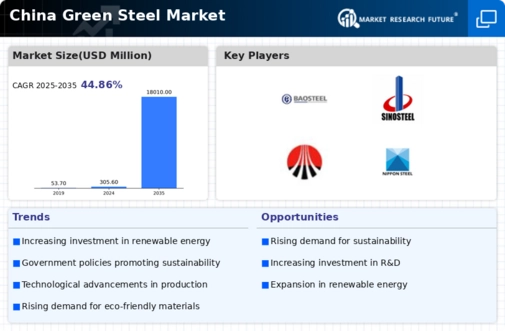
In 2024, the China Green Steel Market is expected to be valued at 305.55 USD Million.

What is the projected market size for the China Green Steel Market by 2035?

By 2035, the market is anticipated to reach a value of 18010.0 USD Million.

What is the expected compound annual growth rate (CAGR) for the China Green Steel Market?

The market is expected to experience a CAGR of 44.86% from 2025 to 2035.

Who are the key players in the China Green Steel Market?

Key players include China Baowu Steel Group, Wuhan Iron and Steel Corporation, and Shandong Iron and Steel Group among others.

What market value is attributed to Hydrogen-Based Reduction in 2024?

Hydrogen-Based Reduction is valued at 80.0 USD Million in the year 2024.

What is the projected market value for Recycling by 2035?

Recycling is expected to be valued at 8010.0 USD Million by 2035.

What are the growth drivers for the China Green Steel Market?

The growth is driven by increasing demand for sustainable and eco-friendly steel production methods.

What are the projected values for Electrolysis in 2024 and 2035?

Electrolysis is expected to be valued at 60.0 USD Million in 2024 and projected to reach 4000.0 USD Million by 2035.

What challenges does the China Green Steel Market face?

Challenges include the high initial investment and technological advancements required for green steel production.

How does the market for Biomass Direct Reduction compare in 2024 and 2035?

Biomass Direct Reduction is valued at 40.0 USD Million in 2024 and is projected to grow to 3000.0 USD Million by 2035.

Download Free Sample

Kindly complete the form below to receive a free sample of this Report

Compare Licence

×
Features License Type
Single User Multiuser License Enterprise User
Price $4,950 $5,950 $7,250
Maximum User Access Limit 1 User Upto 10 Users Unrestricted Access Throughout the Organization
Free Customization
Direct Access to Analyst
Deliverable Format
Platform Access
Discount on Next Purchase 10% 15% 15%
Printable Versions