Download Free Sample
Kindly complete the form below to receive a free sample of this Report
China Healthcare Cold Chain Logistics Market Research Report By Mode of Delivery (Last-Mile Delivery, Hubs-to-Distributor), By Product (Vaccines, Biopharmaceuticals, Clinical Trial Materials), By Services (Transportation, Storage, Packaging, Labeling, Others), By End User (Hospitals Clinics, Pharmaceutical, Biopharmaceutical, Biotechnology Companies, Others) and By Temperature Range (Ambient, Refrigerated, Frozen, Cryogenic) - Growth & Industry Forecast 2025 To 2035
As per analysis, the China healthcare cold chain logistics market is projected to grow from USD 344.2 Million in 2025 to USD 516.6 Million by 2035, exhibiting a compound annual growth rate (CAGR) of 4.19% during the forecast period (2025 - 2035).
The China healthcare cold chain logistics market is poised for robust growth driven by technological advancements and increasing demand for biologics.
| 2024 Market Size | 329.0 (USD Million) |
| 2035 Market Size | 516.6 (USD Million) |
| CAGR (2025 - 2035) | 4.19% |
Sinotrans Limited (CN), China National Pharmaceutical Group (CN), SF Express (CN), YTO Express Group (CN), ZTO Express (CN), JD Logistics (CN), DHL Supply Chain (DE), Kuehne + Nagel (CH), DB Schenker (DE)
Our Impact
Enabled $4.3B Revenue Impact for Fortune 500 and Leading Multinationals
Partnering with 2000+ Global Organizations Each Year
30K+ Citations by Top-Tier Firms in the Industry
The China Healthcare Cold Chain Logistics Market is currently experiencing a transformative phase, driven by the increasing demand for temperature-sensitive pharmaceuticals and biologics. This sector is characterized by its intricate network of refrigerated storage and transportation systems, which are essential for maintaining the efficacy of medical products. The rise in chronic diseases and the growing emphasis on vaccine distribution have further intensified the need for robust cold chain solutions. As a result, stakeholders are investing in advanced technologies and infrastructure to enhance operational efficiency and ensure compliance with stringent regulatory standards. Moreover, the market landscape is evolving with the integration of digital solutions, which facilitate real-time monitoring and tracking of temperature-sensitive shipments. This technological advancement not only improves supply chain visibility but also mitigates risks associated with temperature excursions. The increasing collaboration between logistics providers and healthcare organizations is likely to foster innovation and streamline processes. Overall, the china healthcare cold chain logistics market appears poised for growth, driven by the confluence of regulatory pressures, technological advancements, and the rising demand for high-quality healthcare products.
Regulatory compliance plays a pivotal role in shaping the China healthcare cold chain logistics market. The government has established stringent guidelines to ensure the safe transportation and storage of temperature-sensitive products. The National Medical Products Administration (NMPA) has implemented regulations that mandate specific temperature ranges for various pharmaceuticals, which necessitates robust cold chain logistics solutions. As of January 2026, compliance with these regulations is not merely a legal obligation but also a competitive advantage for logistics providers. Companies that invest in compliant cold chain systems are likely to gain market share, as healthcare providers increasingly prioritize partnerships with reliable logistics firms. The emphasis on regulatory adherence is expected to drive investments in advanced cold chain technologies, further propelling the growth of the industry.
The rapid expansion of e-commerce in the healthcare sector is reshaping the China healthcare cold chain logistics market. Online pharmacies and health product retailers are increasingly utilizing cold chain logistics to ensure the safe delivery of temperature-sensitive products directly to consumers. As of January 2026, the e-commerce healthcare market in China is projected to surpass USD 50 billion, creating a substantial demand for efficient cold chain solutions. This trend is further fueled by changing consumer preferences, as patients seek convenient access to medications and health products. Consequently, logistics providers are adapting their operations to accommodate the unique challenges posed by e-commerce, such as last-mile delivery and real-time tracking. The integration of cold chain logistics into e-commerce platforms is likely to enhance customer satisfaction and drive growth in the healthcare logistics sector.
Investment in infrastructure development is a critical driver of the China healthcare cold chain logistics market. The Chinese government has recognized the importance of a robust cold chain infrastructure to support the growing healthcare sector. As of January 2026, significant investments are being made in building temperature-controlled warehouses and transportation networks across the country. This infrastructure development is essential for ensuring the safe and efficient distribution of pharmaceuticals and biologics. Moreover, the establishment of specialized cold chain facilities in key regions is expected to enhance the overall logistics capabilities, thereby reducing delivery times and costs. The focus on infrastructure improvement aligns with the government's broader healthcare initiatives, which aim to enhance access to quality healthcare services for the population. This investment trend is likely to sustain the growth momentum of the cold chain logistics market in China.
The increasing demand for biologics and vaccines is significantly influencing the China healthcare cold chain logistics market. With the rise in chronic diseases and an aging population, the need for biologics, which often require stringent temperature controls, is on the rise. In 2025, the market for biologics in China was estimated to be worth over USD 30 billion, indicating a robust growth trajectory. This surge in demand necessitates an efficient cold chain logistics system to ensure the safe delivery of these products. Additionally, the Chinese government is actively promoting vaccination programs, further amplifying the need for reliable cold chain solutions. As a result, logistics providers are compelled to enhance their capabilities to meet the growing requirements of the healthcare sector, thereby driving the overall growth of the cold chain logistics market.
The China healthcare cold chain logistics market is experiencing a notable transformation due to rapid technological advancements. Innovations such as IoT-enabled temperature monitoring systems and automated storage solutions are enhancing the efficiency and reliability of cold chain operations. For instance, the integration of real-time tracking systems allows for precise temperature control, which is crucial for maintaining the integrity of sensitive pharmaceuticals. As of 2025, the market for cold chain logistics in China is projected to reach approximately USD 10 billion, driven by these technological improvements. Furthermore, the adoption of blockchain technology is anticipated to enhance traceability and transparency in the supply chain, thereby fostering trust among stakeholders. This technological evolution not only streamlines operations but also aligns with the increasing regulatory demands for stringent temperature control in the healthcare sector.
In the China healthcare cold chain logistics market, the application segment plays a critical role, with pharmaceuticals holding the largest market share, notably due to the extensive distribution of branded medications and generics. In contrast, the vaccines segment is gaining significant traction, fueled by increasing government initiatives for immunization programs and the rising awareness surrounding vaccine-preventable diseases. Additionally, biologics and blood products also contribute to market dynamics, albeit with varying degrees of share and growth potential. Growth trends in this segment are propelled by several factors, such as the expanding biopharmaceutical sector and increased investments in healthcare infrastructure. Moreover, the ongoing emphasis on temperature-sensitive logistics ensures that essential products like vaccines and biologics maintain their efficacy during transit. As a result, clinical trials are increasingly leveraging cold chain solutions to safeguard in-trial medicines, reflecting a shift towards enhanced regulatory compliance and patient safety protocols.
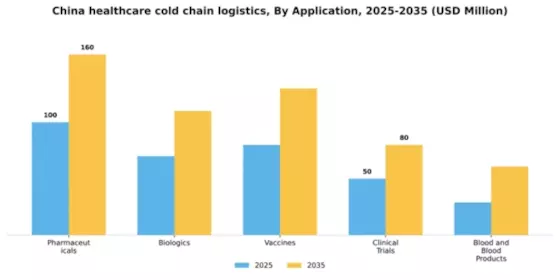
Pharmaceuticals (Dominant) vs. Clinical Trials (Emerging)
Pharmaceuticals represent the dominant force within the China healthcare cold chain logistics market, driven by a robust pipeline of innovative products and a significant demand for temperature-sensitive storage solutions. These pharmaceuticals require precise temperature management to ensure product integrity from production to delivery, which presents logistics providers with a lucrative opportunity. On the other hand, clinical trials are emerging as a vital segment in the market, focusing on consistently reliable cold chain solutions to facilitate the transportation of investigational drugs under stringent conditions. As pharmaceutical companies increasingly prioritize fast-tracking clinical trials and adhering to compliance standards, the integration of advanced tracking technologies and temperature controls within cold chain logistics is becoming essential for trial success.
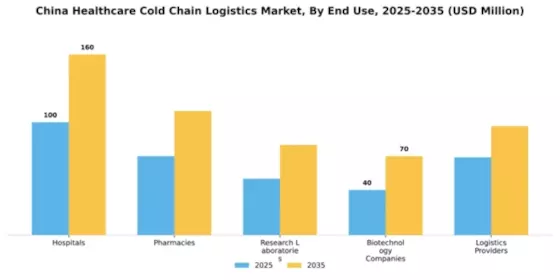
In the China healthcare cold chain logistics market, hospitals account for the largest share, driven by their extensive need for reliable temperature-controlled supply chains to ensure the safety of medications and sensitive medical products. Following hospitals, pharmacies and research laboratories also play significant roles, although their market shares are relatively smaller compared to hospitals. Biotechnology companies are emerging as key players, gradually increasing their share as the relevance of biologic drugs continues to expand.
Pharmacies: Dominant vs. Research Laboratories: Emerging
Pharmacies are positioned as a dominant force within the cold chain logistics sector, benefiting from their pivotal role in distributing temperature-sensitive medications and vaccines directly to the consumer. Their established networks facilitate efficient logistics, ensuring timely delivery under stringent temperature controls. Conversely, research laboratories present an emerging sector that is rapidly gaining traction in the market. As the focus on innovative drug development intensifies, research labs require specialized cold chain solutions to manage sensitive biological samples and compounds, emphasizing the need for sophisticated tracking and handling capabilities.
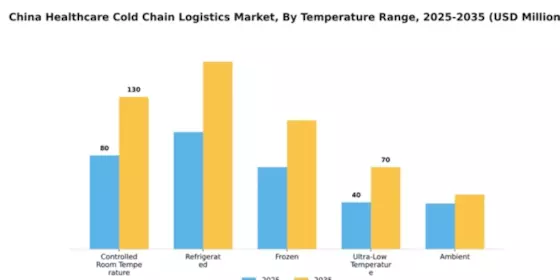
The healthcare cold chain logistics market in China showcases a diversified temperature range strategy for the preservation of products. Among these, the refrigerated segment stands out as the largest, holding the most significant share of the market. It is predominantly utilized for medications, vaccines, and biological samples, ensuring that these sensitive items maintain their efficacy during transport. In contrast, the frozen and ultra-low temperature segments, while smaller in overall market share, have been witnessing rapid growth, driven by the increasing demand for vaccines and biologics that require lower temperature storage solutions. The growth trends in this segment are largely propelled by the expanding biopharmaceuticals industry in China, alongside a rising awareness of vaccine management against infectious diseases. As the country strengthens its healthcare infrastructure, the demand for reliable cold chain logistics services continues to escalate. Moreover, the emphasis on regulatory compliance and quality standards is encouraging investments in advanced temperature-controlled logistics systems, which further supports the growth of the frozen segment, making it one of the most attractive areas in the market.
Refrigerated (Dominant) vs. Ultra-Low Temperature (Emerging)
The refrigerated segment remains dominant in China's healthcare cold chain logistics market due to its broad applicability and established practices. It plays a crucial role in transporting pharmaceuticals and laboratory samples at controlled temperatures, ensuring that they retain their properties and efficacy. On the other hand, the ultra-low temperature segment is emerging as a significant market player, driven by the increased requirements for storing sensitive biopharmaceuticals and cell therapies that necessitate such stringent conditions. As innovations in cryogenic technologies advance and the demand for life-saving medicinal products rises, ultra-low temperature solutions are likely to capture a more substantial share of the market, complementing the established refrigerated segment in meeting the comprehensive needs of the healthcare sector.
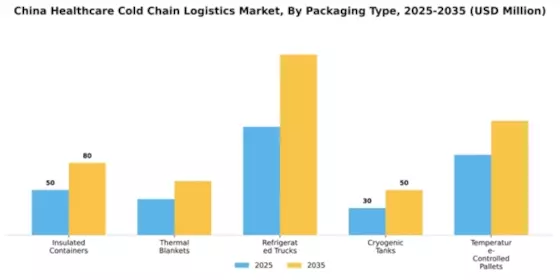
In the China healthcare cold chain logistics market, the segment of Packaging Type has witnessed significant diversification. Insulated containers dominate the landscape, forming the largest share due to their widespread use in transporting sensitive pharmaceutical products. Following closely are refrigerated trucks and thermal blankets, which are crucial for maintaining the required temperature during transit. Cryogenic tanks and temperature-controlled pallets are also gaining traction, catering to specific healthcare applications, thus responding to varied storage and transport needs of the industry.
Insulated Containers (Dominant) vs. Cryogenic Tanks (Emerging)
Insulated containers play a dominant role in the cold chain logistics for the healthcare sector, owing to their effectiveness in safeguarding temperature-sensitive products. These containers are highly efficient, ensuring that pharmaceuticals, vaccines, and biologics maintain their requisite conditions throughout transportation. On the other hand, cryogenic tanks are emerging as a vital solution, particularly for products requiring ultra-low temperatures. The rise of advanced healthcare applications, including genetically manufactured drugs, drives the demand for these tanks, showcasing their growing importance in the logistics landscape. As the market evolves, both types of packaging are integral to maintaining the integrity of healthcare supply chains.
In the China healthcare cold chain logistics market, the transport mode segment is characterized by the varying market shares of different transportation methods. Road transport is holding the largest share due to its extensive network and flexibility in reaching various healthcare facilities, particularly in urban settings. In contrast, air transport, while represented by a smaller share, is quickly gaining traction due to its speed and ability to maintain strict temperature controls, crucial for sensitive medical supplies. The growth of the transport mode segment is influenced by several factors, including the rapid expansion of healthcare infrastructure and increasing demand for temperature-sensitive pharmaceuticals and vaccines. The preference for air transport is significantly driven by the rising need for urgent deliveries and global health initiatives that require swift distribution of medical supplies. Meanwhile, road transport continues to benefit from advancements in vehicle technology and route optimization, solidifying its position as a leader in this market.
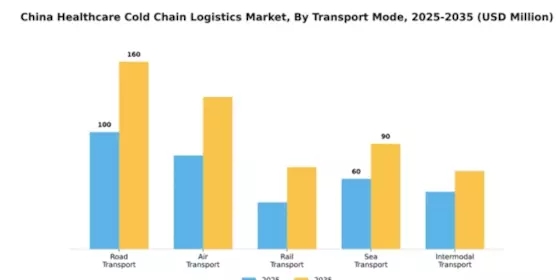
Road Transport (Dominant) vs. Air Transport (Emerging)
Road transport remains the dominant force in the China healthcare cold chain logistics market due to its unmatched accessibility and adaptability. It is highly favored for its ability to provide door-to-door delivery, which is essential for distributing medical products to remote facilities and hospitals. The robust road network in China enables efficient distribution, ensuring that temperature-sensitive products are delivered promptly and safely. On the other hand, air transport is emerging as a vital player, driven by the need for rapid delivery of healthcare products. Its importance has surged, especially during health emergencies when the swift distribution of vaccines and medications is critical. This mode is increasingly being adopted for long-distance transport of high-value healthcare products, supported by advancements in cargo handling and temperature management technologies.
Get more detailed insights about China Healthcare Cold Chain Logistics Market Request Free Sample
The healthcare cold chain logistics market in China is characterized by a dynamic competitive landscape, driven by increasing demand for temperature-sensitive pharmaceuticals and biologics. Key players are actively pursuing strategies that emphasize innovation, operational efficiency, and strategic partnerships. Sinotrans Limited (CN) has positioned itself as a leader in this sector by focusing on digital transformation and enhancing its logistics capabilities. Meanwhile, China National Pharmaceutical Group (CN) is leveraging its extensive distribution network to optimize supply chain processes, thereby improving service delivery and customer satisfaction. These strategies collectively contribute to a competitive environment that is increasingly focused on reliability and efficiency.
In terms of business tactics, companies are localizing manufacturing and optimizing supply chains to better meet the demands of the healthcare sector. The market appears moderately fragmented, with several key players exerting significant influence. This fragmentation allows for a variety of operational strategies, which can lead to increased competition and innovation among firms. The collective influence of these players shapes the market structure, fostering an environment where agility and responsiveness are paramount.
In December 2025, SF Express (CN) announced the launch of a new cold chain logistics facility in Shanghai, aimed at enhancing its capacity to handle temperature-sensitive medical products. This strategic move is likely to bolster its market position by improving service levels and reducing delivery times for critical healthcare products. The facility is expected to utilize advanced temperature monitoring technologies, which could set a new standard for operational excellence in the sector.
In November 2025, JD Logistics (CN) unveiled a partnership with a leading biopharmaceutical company to develop a dedicated cold chain logistics solution tailored for vaccine distribution. This collaboration underscores JD Logistics' commitment to innovation and its strategic focus on expanding its capabilities in the healthcare segment. By aligning with a biopharmaceutical leader, JD Logistics may enhance its reputation and operational expertise in handling sensitive medical products, thereby gaining a competitive edge.
In October 2025, DHL Supply Chain (DE) expanded its cold chain logistics services in China through the acquisition of a local logistics provider specializing in healthcare. This acquisition is indicative of DHL's strategy to strengthen its foothold in the Chinese market and enhance its service offerings. By integrating local expertise with its global logistics network, DHL Supply Chain could potentially improve its operational efficiency and responsiveness to market demands.
As of January 2026, current trends in the healthcare cold chain logistics market include a pronounced shift towards digitalization, sustainability, and the integration of AI technologies. Strategic alliances are increasingly shaping the competitive landscape, allowing companies to pool resources and expertise. The evolution of competitive differentiation appears to be moving away from price-based competition towards a focus on innovation, technology, and supply chain reliability. This shift suggests that companies that prioritize these aspects may be better positioned to thrive in the future.


Recent developments in the China Healthcare Cold Chain Logistics Market indicate a growing emphasis. This is on efficient temperature-controlled supply chains. This is particularly in response to the COVID-19 pandemic. It is also due to the rising demand for pharmaceuticals and vaccines. Companies such as Sinotrans Limited, Kerry Logistics, and JD Logistics have been expanding their cold chain capacities. This caters to the increasing volume of temperature-sensitive goods.
In September 2023, SF Express announced an investment to enhance its cold chain network. This signals its commitment to meeting regulatory standards and improving service efficiency. Similarly, in August 2023, DHL Supply Chain introduced advanced tracking technologies. This is to optimize cold chain operations. This ensures compliance and real-time monitoring.
Reports from the last couple of years reveal significant market growth. With nearly a 25% increase in 2022. This was largely driven by the urgent need for reliable vaccine distribution. Moreover, in October 2022, China National Pharmaceutical Group expanded its cold storage facilities. This supports larger volumes of biologics.
The competitive landscape includes companies like COSCO Shipping and ZTO Express. These are also exploring strategic collaborations. This is to strengthen their market positions in the evolving healthcare landscape.
The China healthcare cold chain logistics market is projected to grow at a 4.19% CAGR from 2025 to 2035, driven by increasing demand for temperature-sensitive pharmaceuticals and advancements in logistics technology.
New opportunities lie in:
By 2035, the market is expected to be robust, driven by innovation and strategic partnerships.
| MARKET SIZE 2024 | 329.0(USD Million) |
| MARKET SIZE 2025 | 344.2(USD Million) |
| MARKET SIZE 2035 | 516.6(USD Million) |
| COMPOUND ANNUAL GROWTH RATE (CAGR) | 4.19% (2024 - 2035) |
| REPORT COVERAGE | Revenue Forecast, Competitive Landscape, Growth Factors, and Trends |
| BASE YEAR | 2024 |
| Market Forecast Period | 2025 - 2035 |
| Historical Data | 2019 - 2024 |
| Market Forecast Units | USD Million |
| Key Companies Profiled | Sinotrans Limited (CN), China National Pharmaceutical Group (CN), SF Express (CN), YTO Express Group (CN), ZTO Express (CN), JD Logistics (CN), DHL Supply Chain (DE), Kuehne + Nagel (CH), DB Schenker (DE) |
| Segments Covered | Application, End Use, Temperature Range, Packaging Type, Transport Mode |
| Key Market Opportunities | Integration of advanced tracking technologies enhances efficiency in the china healthcare cold chain logistics market. |
| Key Market Dynamics | Rising demand for temperature-sensitive pharmaceuticals drives innovation in China's healthcare cold chain logistics sector. |
| Countries Covered | China |
The market valuation was 329.0 USD Million in 2024.
The projected valuation for 2035 is 516.6 USD Million.
The expected CAGR from 2025 to 2035 is 4.19%.
Key players include Sinotrans Limited, China National Pharmaceutical Group, SF Express, and JD Logistics.
Primary applications include pharmaceuticals, biologics, vaccines, clinical trials, and blood products.
The market segments by end use include hospitals, pharmacies, research laboratories, and biotechnology companies.
Temperature ranges include controlled room temperature, refrigerated, frozen, ultra-low temperature, and ambient.
Common packaging types include insulated containers, thermal blankets, refrigerated trucks, and cryogenic tanks.
Transport modes include road, air, rail, sea, and intermodal transport.
The refrigerated trucks segment was valued at 120.0 USD Million in 2024.


Kindly complete the form below to receive a free sample of this Report

“This is really good guys. Excellent work on a tight deadline. I will continue to use you going forward and recommend you to others. Nice job”


“Thanks. It’s been a pleasure working with you, please use me as reference with any other Intel employees.”


“Thanks for sending the report it gives us a good global view of the Betaïne market.”


“Thank you, this will be very helpful for OQS.”


“We found the report very insightful! we found your research firm very helpful. I'm sending this email to secure our future business.”


“I am very pleased with how market segments have been defined in a relevant way for my purposes (such as "Portable Freezers & refrigerators" and "last-mile"). In general the report is well structured. Thanks very much for your efforts.”


“I have been reading the first document or the study, ,the Global HVAC and FP market report 2021 till 2026. Must say, good info! I have not gone in depth at all parts, but got a good indication of the data inside!”


“We got the report in time, we really thank you for your support in this process. I also thank to all of your team as they did a great job.”


“The Automotive 48V ECU Components Procurement Intelligence Study” was a complex project, but the Market Research Future (MRFR) team handled it with quality, agility, and customer-centricity. They delivered all requested data on time and within the agreed scope. The team, including Shubhendra Anand and Rahul Gotadki, was always readily available to clarify questions and swiftly implement necessary adjustments, driving the project to a successful conclusion within a very demanding timeframe.
I would also like to specifically commend Akshay Agarwal for his responsiveness and support at every stage—from our initial inquiry on May 6th through to final delivery on June 18th. His dedication made the entire process seamless.”



