Download Free Sample
Kindly complete the form below to receive a free sample of this Report
South Korea Healthcare Cold Chain Logistics Market Research Report By Mode of Delivery (Last-Mile Delivery, Hubs-to-Distributor), By Product (Vaccines, Biopharmaceuticals, Clinical Trial Materials), By Services (Transportation, Storage, Packaging, Labeling, Others), By End User (Hospitals Clinics, Pharmaceutical, Biopharmaceutical, Biotechnology Companies, Others) and By Temperature Range (Ambient, Refrigerated, Frozen, Cryogenic) - Growth & Industry Forecast 2025 To 2035
The South Korea healthcare cold chain logistics market is experiencing significant growth driven by the increasing demand for temperature-sensitive pharmaceuticals and biologics. With the government's push for advanced healthcare infrastructure, there is a noticeable emphasis on the need for regulatory compliance in temperature control to maintain the integrity of medical products. This has led to the adoption of more sophisticated cold chain technologies, such as IoT tracking systems that monitor temperature in real time, ensuring the quality of products from manufacturers to end-users.
Opportunities in this market include the expansion of telemedicine and home care services, which are becoming increasingly popular in South Korea.As more healthcare providers shift towards remote diagnostics and treatment, there is a rising need for reliable cold chain logistics to transport vaccines and other sensitive materials safely. Additionally, the growing population and the increasing prevalence of chronic diseases fuel the demand for more healthcare services, which in turn emphasizes the need for efficient logistics solutions that can handle complex supply chains while adhering to stringent regulations.
South Korea South Korea Healthcare Cold Chain Logistics Market Cold Chain Logistics Market Segmentation
South Korea South Korea Healthcare Cold Chain Logistics Market Cold Chain Logistics Market By Mode of Delivery (USD Million, 2019-2035)
Last-Mile Delivery
Hubs-to-Distributor
South Korea South Korea Healthcare Cold Chain Logistics Market Cold Chain Logistics Market By Product (USD Million, 2019-2035)
Vaccines
Biopharmaceuticals
Clinical Trial Materials
South Korea South Korea Healthcare Cold Chain Logistics Market Cold Chain Logistics Market By Services (USD Million, 2019-2035)
Transportation
Storage
Packaging
Labeling
Others
South Korea South Korea Healthcare Cold Chain Logistics Market Cold Chain Logistics Market By End User (USD Million, 2019-2035)
Hospitals Clinics
South Korea Healthcare Cold Chain Logistics Market
Biopharmaceutical
Biotechnology Companies
Others
South Korea South Korea Healthcare Cold Chain Logistics Market Cold Chain Logistics Market By Temperature Range (USD Million, 2019-2035)
Ambient
Refrigerated
Frozen
Cryogenic
The South Korea healthcare cold chain logistics market is experiencing significant growth driven by the increasing demand for temperature-sensitive pharmaceuticals and biologics. With the government's push for advanced healthcare infrastructure, there is a noticeable emphasis on the need for regulatory compliance in temperature control to maintain the integrity of medical products. This has led to the adoption of more sophisticated cold chain technologies, such as IoT tracking systems that monitor temperature in real time, ensuring the quality of products from manufacturers to end-users.
Opportunities in this market include the expansion of telemedicine and home care services, which are becoming increasingly popular in South Korea.As more healthcare providers shift towards remote diagnostics and treatment, there is a rising need for reliable cold chain logistics to transport vaccines and other sensitive materials safely. Additionally, the growing population and the increasing prevalence of chronic diseases fuel the demand for more healthcare services, which in turn emphasizes the need for efficient logistics solutions that can handle complex supply chains while adhering to stringent regulations.
South Korea Healthcare Cold Chain Logistics Market Segment Insights
Healthcare Cold Chain Logistics Market Mode of Delivery Insights
The Mode of Delivery segment within the South Korea Healthcare Cold Chain Logistics Market plays a critical role in ensuring the integrity and efficacy of healthcare products, especially in a landscape marked by significant advancements in medical technologies and increased demand for temperature-sensitive pharmaceuticals and vaccines. Last-Mile Delivery has become an essential focus area, as it addresses the final leg of the distribution process, ensuring that sensitive products reach their final destination in optimal condition.
With a rapidly growing population and an aging demographic, South Korea's healthcare system is increasingly relying on efficient last-mile delivery solutions to meet patient needs, especially in metropolitan areas where the demand is highest.
Parallelly, Hubs-to-Distributor services serve as pivotal components in the distribution network, facilitating the transfer of goods from centralized warehouses to various healthcare distributors. This segment is crucial for maintaining the cold chain during transportation, especially for temperature-sensitive products such as biopharmaceuticals and certain diagnostic agents. The Hubs-to-Distributor approach not only enhances distribution efficiency but also supports compliance with regulatory standards by ensuring proper handling and storage throughout the delivery process.
The robustness of these delivery modes is further supported by advancements in technology, which allows for real-time tracking and monitoring, adding an extra layer of assurance for logistics managers and healthcare providers alike.
As South Korea continues to advance its healthcare infrastructure, the demand for efficient and reliable cold chain logistics is anticipated to increase, driven by the evolving pharmaceutical landscape, regulations around health and safety, and the growing emphasis on patient-centric care. The focus on optimizing mode of delivery, with Last-Mile Delivery and Hubs-to-Distributor strategies, reflects a broader trend toward ensuring quality in healthcare logistics. Additionally, disruptions caused by global events have highlighted the importance of resilient supply chains, which further emphasizes the significance of these delivery methods in maintaining the quality and availability of essential healthcare products.
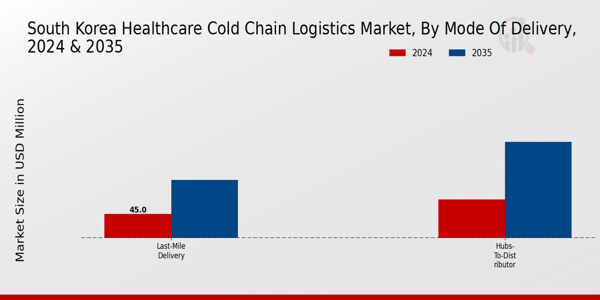
Source: Primary Research, Secondary Research, Market Research Future Database and Analyst Review
Healthcare Cold Chain Logistics Market Product Insights
The South Korea Healthcare Cold Chain Logistics Market, particularly focused on the Product segment, is significantly driven by key areas such as Vaccines, Biopharmaceuticals, and Clinical Trial Materials, each playing an essential role in the healthcare continuum. With South Korea's robust healthcare infrastructure and a growing demand for advanced medical therapies, the need for specialized transportation and storage solutions has become paramount.
Vaccines are critical for public health initiatives, especially in combating infectious diseases, thus necessitating strict temperature controls to maintain efficacy.Similarly, Biopharmaceuticals, known for their complex structures and sensitive nature, represent a considerable share of the market, requiring reliable cold chain processes to ensure product integrity. Clinical Trial Materials are vital for the advancement of medical science, hingeing on efficient logistics to guarantee timely delivery of temperature-sensitive products to trial sites across the country.
As South Korea continues to enhance its healthcare policies, the emphasis on proper logistics for these segments underlines their importance in achieving health objectives while ensuring patient safety and treatment success.The focus on cold chain integrity supports not only market growth but also the overall improvement of healthcare delivery in the region.
Healthcare Cold Chain Logistics Market Services Insights
The Services segment within the South Korea Healthcare Cold Chain Logistics Market plays a pivotal role in ensuring the proper handling of temperature-sensitive pharmaceutical products. With healthcare demands continuously rising in South Korea, this segment includes crucial functions such as Transportation, Storage, Packaging, Labeling, and Others, each of which supports the overall efficiency and efficacy of cold chain logistics. Transportation is particularly vital, as it guarantees that products remain at optimal temperatures during transit, thereby preventing spoilage and maintaining product integrity.Storage solutions, equipped with advanced refrigeration technologies, help in managing inventory efficiently while ensuring compliance with strict regulatory standards.
Packaging is another significant aspect, with specialized materials and designs necessary to insulate products and maintain their required temperatures. Labeling also plays a crucial role in providing vital information for proper handling and traceability. The South Korean government's emphasis on healthcare improvements and innovations further amplifies the need for robust cold chain logistics, representing a significant opportunity for growth in this sector.Overall, the Services segment is central to sustaining the high standards of healthcare delivery in South Korea, as it upholds the quality and safety of healthcare products throughout their lifecycle.
Healthcare Cold Chain Logistics Market End User Insights
The South Korea Healthcare Cold Chain Logistics Market features a diverse range of end users, each playing a crucial role in the preservation and transportation of temperature-sensitive medical products. Hospitals and clinics are significant players in ensuring that sensitive medications and vaccines maintain their required temperatures, reflecting their essential position in this market.
The pharmaceutical sector's growth is notably fueled by stringent regulations regarding drug storage and transport, driving demand for reliable cold chain solutions.Concurrently, biopharmaceutical and biotechnology companies rely heavily on advanced cold chain logistics to maintain the efficacy of biologic products, indicating their key role in the South Korean healthcare ecosystem. Additionally, other users of healthcare logistics, such as research institutions and laboratories, emphasize the diverse applications and importance of effective cold chain systems in South Korea.
With the rise of personalized medicine and biologics, the demand for specialized cold chain services continues to grow, enhancing the overall dynamics of the South Korea Healthcare Cold Chain Logistics Market, supported by a rapidly evolving healthcare landscape.The emphasis on technological advancements further illustrates the commitment to ensuring the integrity of healthcare products across all end-user sectors.
Healthcare Cold Chain Logistics Market Temperature Range Insights
The Temperature Range segment of the South Korea Healthcare Cold Chain Logistics Market plays a crucial role in ensuring the safe and effective distribution of pharmaceutical and biological products. Each category within this segment, including Ambient, Refrigerated, Frozen, and Cryogenic, contributes significantly to market dynamics. The Refrigerated segment is particularly important for maintaining the efficacy of temperature-sensitive medications, while the Frozen segment is vital for the preservation of vaccines and biologics, which require strict temperature control to maintain their integrity.The Cryogenic aspect is gaining traction, especially given the increasing demand for advanced therapies like cell and gene treatments.
The demand for precise temperature management is driven by the growing healthcare needs within South Korea, where innovations in the medical field coincide with rising patient expectations for high-quality care. The South Korean government has been supportive of healthcare advancements, which enhances the importance of a robust cold chain system. Amidst the rising complexities of global supply chains, ensuring effective temperature control remains a core component of the logistics strategy, facilitating the safe provision of vital healthcare products to various medical facilities across the region.
The South Korea Healthcare Cold Chain Logistics Market has seen significant development due to the increasing demand for temperature-sensitive pharmaceuticals, biologics, and medical devices. The efficiency of cold chain logistics ensures that these products maintain their required temperatures throughout the supply chain, from manufacturers to end-users, thereby upholding their efficacy and safety. Competitiveness in this market is shaped by factors such as technological adoption, innovative logistic solutions, and regulatory compliance, as the local market is characterized by established players who leverage specific strengths to enhance their operations.
As South Korea continues to expand its healthcare infrastructure and invest in technology, the competitive landscape is expected to evolve, with a growing emphasis on sustainability and efficiency in cold chain practices.Samsung SDS plays a pivotal role in the South Korea Healthcare Cold Chain Logistics Market, as it combines advanced information technology with logistics solutions to improve supply chain performance. The company leverages its expertise in IoT and data analytics, providing real-time monitoring and control of temperature-sensitive products. This technology-driven approach not only enhances operational efficiency but also ensures compliance with stringent healthcare regulations.
Samsung SDS has a strong market presence supported by its established brand reputation and extensive experience in the logistics sector. Their commitment to innovation allows them to adapt quickly to changing market demands, positioning them as a leader in providing reliable cold chain logistics tailored specifically for the healthcare industry.DHL Supply Chain has marked its presence prominently within the South Korea Healthcare Cold Chain Logistics Market, focusing on tailored logistics solutions that support the temperature-sensitive nature of healthcare products.
The company offers a range of services including warehousing, transportation, and distribution that are specifically designed to meet the unique requirements of the healthcare sector. DHL Supply Chain's strengths lie in its global network and state-of-the-art technology that ensures efficient cold chain management, alongside its adherence to compliance standards. The South Korean market benefits from its established infrastructure and deep understanding of local regulations. Moreover, DHL has pursued strategic mergers and acquisitions to bolster its capabilities, ensuring that it remains competitive and capable of offering innovative solutions to meet the growing demands of the healthcare logistics sector in South Korea.
In recent months, the South Korea Healthcare Cold Chain Logistics Market has experienced significant developments. Samsung SDS showcased advancements in integrated logistics solutions enhancing pharmaceutical supply chains as of September 2023. The growing demand for temperature-sensitive pharmaceuticals, particularly due to expanding COVID-19 vaccination efforts, has pressured companies like DHL Supply Chain and FedEx to enhance their cold storage capabilities.
Moreover, in July 2023, Geodis announced its strategic expansion in South Korea, spearheading the integration of digital supply chain management in healthcare logistics. Notably, Nippon Express and CJ Logistics are increasingly collaborating to optimize cross-border healthcare logistics operations. In terms of mergers and acquisitions, December 2022 saw Kuehne + Nagel acquire certain healthcare transportation assets of an unnamed South Korean entity, further consolidating their position in the market. Over the past few years, the market valuation has grown significantly due to rapid advancements in technology and heightened collaboration among logistics providers, reflecting an uptick in operational efficiency and customer satisfaction.
The South Korean government's commitment to bolstering its healthcare infrastructure has further fueled this market's progression.
| Report Attribute/Metric Source: | Details |
| MARKET SIZE 2023 | 112.5(USD Million) |
| MARKET SIZE 2024 | 117.5(USD Million) |
| MARKET SIZE 2035 | 292.4(USD Million) |
| COMPOUND ANNUAL GROWTH RATE (CAGR) | 8.641% (2025 - 2035) |
| REPORT COVERAGE | Revenue Forecast, Competitive Landscape, Growth Factors, and Trends |
| BASE YEAR | 2024 |
| MARKET FORECAST PERIOD | 2025 - 2035 |
| HISTORICAL DATA | 2019 - 2024 |
| MARKET FORECAST UNITS | USD Million |
| KEY COMPANIES PROFILED | Samsung SDS, DHL Supply Chain, Geodis, Nippon Express, Korea Express, Kuehne + Nagel, Seah Logistics, Damco, XPO Logistics, FedEx, United Parcel Service, Hanjin Transportation, Lotte Global Logistics, CJ Logistics, DB Schenker |
| SEGMENTS COVERED | Mode of Delivery, Product, Services, End User, Temperature Range |
| KEY MARKET OPPORTUNITIES | Increased demand for biopharmaceuticals, Growth in e-commerce healthcare services, Advanced temperature monitoring technologies, Expansion of vaccine distribution networks, Rising focus on regulatory compliance |
| KEY MARKET DYNAMICS | Rising biopharmaceutical demand, Stringent regulatory requirements, Technological advancements in logistics, Increasing investment in infrastructure, Growing focus on temperature monitoring |
| COUNTRIES COVERED | South Korea |


Kindly complete the form below to receive a free sample of this Report

“This is really good guys. Excellent work on a tight deadline. I will continue to use you going forward and recommend you to others. Nice job”


“Thanks. It’s been a pleasure working with you, please use me as reference with any other Intel employees.”


“Thanks for sending the report it gives us a good global view of the Betaïne market.”


“Thank you, this will be very helpful for OQS.”


“We found the report very insightful! we found your research firm very helpful. I'm sending this email to secure our future business.”


“I am very pleased with how market segments have been defined in a relevant way for my purposes (such as "Portable Freezers & refrigerators" and "last-mile"). In general the report is well structured. Thanks very much for your efforts.”


“I have been reading the first document or the study, ,the Global HVAC and FP market report 2021 till 2026. Must say, good info! I have not gone in depth at all parts, but got a good indication of the data inside!”


“We got the report in time, we really thank you for your support in this process. I also thank to all of your team as they did a great job.”


“The Automotive 48V ECU Components Procurement Intelligence Study” was a complex project, but the Market Research Future (MRFR) team handled it with quality, agility, and customer-centricity. They delivered all requested data on time and within the agreed scope. The team, including Shubhendra Anand and Rahul Gotadki, was always readily available to clarify questions and swiftly implement necessary adjustments, driving the project to a successful conclusion within a very demanding timeframe.
I would also like to specifically commend Akshay Agarwal for his responsiveness and support at every stage—from our initial inquiry on May 6th through to final delivery on June 18th. His dedication made the entire process seamless.”



