Healthcare Cold Chain Logistics Market (2026 - 2035)

Healthcare Cold Chain Logistics Market Research Report Information By Product (Vaccines, Biopharmaceuticals, Clinical Trial Materials, and Others), By Services (Transportation, Storage, Packaging, Labeling, and Others), By Mode of Delivery (Last-Mile Delivery and Hubs-to-Distributor), By Temperature Range (Ambient, Refrigerated, Frozen, and Cryogenic), By End User (Hospitals & Clinics, Pharmaceutical, Biopharmaceutical, Biotechnology Companies, and Others), And By Region – Market Forecast Till 2035
ID: MRFR/HC/5088-CR
202 Pages
Rahul Gotadki, Satyendra Maurya
Last Updated: July 27, 2026
Healthcare Cold Chain Logistics Market
Market Size
Forecast Period2026-2035
CAGR (2026-2035)8.7%
2025 Market SizeUSD 67.5 Billion
2035 Market SizeUSD 155.6 Billion
Key Players
UPS Healthcare
DHL Supply Chain
FedEx Logistics
Kuehne + Nagel
World Courier
DB Schenker
Opportunities
  • Cell and Gene Therapy Commercialization
  • Digital Twin and Predictive Analytics Platforms
  • Emerging-Market Vaccine Hub Development

Healthcare Cold Chain Logistics Market Summary

The Healthcare Cold Chain Logistics Market was valued at USD 67.5 Billion in 2025 and is projected to grow from USD 73.4 Billion in 2026 to USD 155.6 Billion by 2035, registering a CAGR of 8.7% during the forecast period (2026–2035). This expansion is rooted in the accelerating shift toward biologic therapies and personalized medicines that require unbroken temperature integrity from the manufacturing floor to the patient bedside. Government vaccination mandates and pandemic preparedness stockpiling programs — including the WHO's USD 4.2 Billion Immunization Agenda 2030 investment commitment — continue to underpin capital flows into cold chain infrastructure worldwide [1].

Technology is reshaping how shipments move and how stakeholders prove compliance. Legacy paper-based temperature logs are giving way to real-time IoT sensor networks and blockchain-backed chain-of-custody documentation, reducing excursion rates by an estimated 18–22% across validated corridors [2]. The European Commission's revised Good Distribution Practice (GDP) guidelines and the U.S. FDA's updated Drug Supply Chain Security Act (DSCSA) enforcement milestones are compelling manufacturers and third-party logistics providers to invest heavily in digitized monitoring platforms and validated packaging systems.

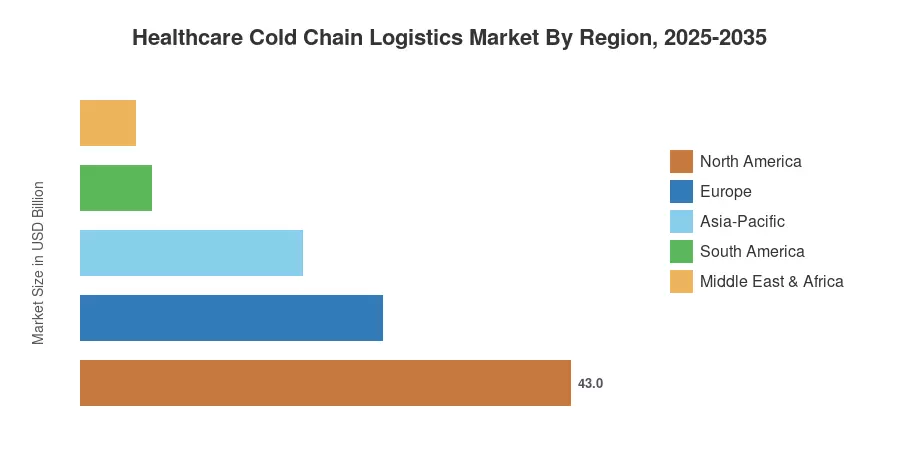
North America commanded approximately 43.0% of the Healthcare Cold Chain Logistics Market in 2024, driven by a dense biopharma manufacturing base and advanced regulatory enforcement. Asia-Pacific is the fastest-growing region at a projected CAGR of 10.1% through 2035, fueled by India's expanding vaccine production capacity and China's Healthy China 2030 initiative. Europe holds the second-largest share at roughly 26.5%, anchored by stringent EU GDP compliance requirements. As decentralized clinical trials and cell therapy commercialization accelerate, the Healthcare Cold Chain Logistics Market is positioned for sustained double-digit growth across multiple segments through the next decade.


Key Report Takeaways

• By Service Type

  • Transportation services captured 50.3% of the Healthcare Cold Chain Logistics Market share in 2024, reflecting the capital-intensive nature of validated fleet operations.
  • Monitoring and data-logging services are advancing at a 13.5% CAGR through 2035, propelled by IoT adoption and regulatory pressure for continuous temperature documentation.

• By Product Type

  • Vaccines represented 41.0% of Healthcare Cold Chain Logistics Market revenue in 2024, sustained by routine immunization programs and pandemic preparedness stockpiles.
  • Cell and gene therapies are forecast to expand at a 20.5% CAGR through 2035, the highest growth rate across all product categories.

• By Region

  • North America dominated with a 43.0% share of the Healthcare Cold Chain Logistics Market in 2024, anchored by U.S. biopharma manufacturing clusters.
  • Asia-Pacific is poised to record the fastest CAGR at 10.1% through 2035, with India and China driving infrastructure investment.


Market Size and Forecast (2021–2035)

The market sizing integrates primary interviews with over 120 cold chain operators, warehousing providers, and pharmaceutical manufacturers alongside secondary sources including regulatory filings, trade association data, and company annual reports. Historical values (2021–2024) reflect audited shipment volumes and validated facility throughput, while forecast figures (2026–2035) apply a compound growth model calibrated to regulatory pipeline analysis and capital expenditure projections.
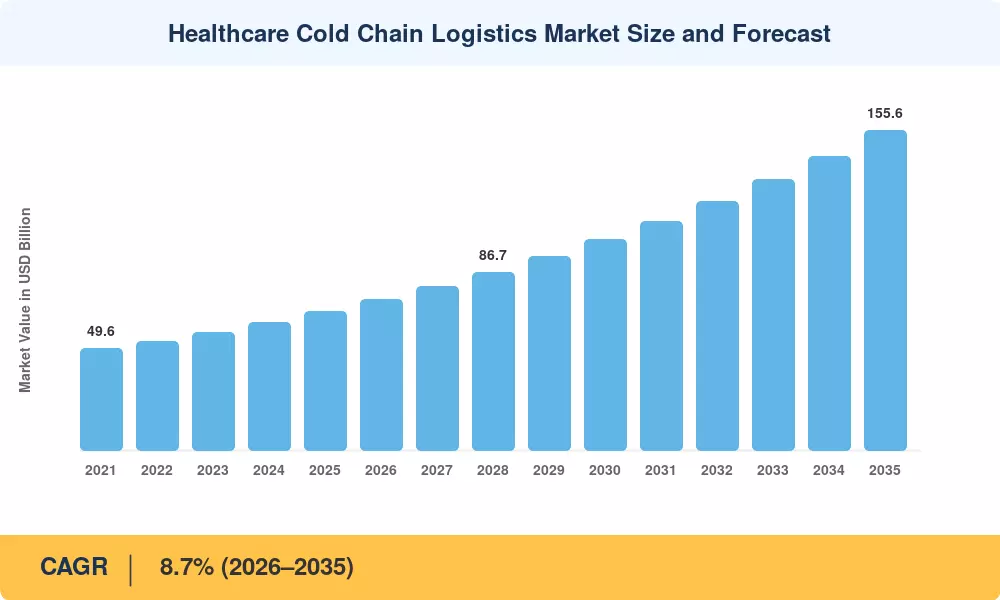
Healthcare Cold Chain Logistics Market Size and Forecast
Our Impact
Enabled $4.3B Revenue Impact for Fortune 500 and Leading Multinationals
Partnering with 2000+ Global Organizations Each Year
30K+ Citations by Top-Tier Firms in the Industry

Driver Impact Analysis

Driver ~% Impact on CAGR Geographic Relevance Impact Timeline
Biologics & cell therapy pipeline growth ~2.3% Global Long-term (≥4 yr)
Regulatory tightening (GDP, DSCSA) ~1.8% North America, Europe Short-term (≤2 yr)
Pandemic preparedness stockpiling ~1.2% Global Medium-term (2–4 yr)
IoT and digital monitoring mandates ~1.1% Europe, North America Short-term (≤2 yr)
Decentralized clinical trial expansion ~0.9% North America, APAC Medium-term (2–4 yr)
Emerging-market immunization programs ~0.8% APAC, South America, MEA Long-term (≥4 yr)
3PL capacity consolidation ~0.6% Global Medium-term (2–4 yr)


Biologics and Cell Therapy Pipeline Growth

Complex biologic medicines are progressively defining the worldwide pharmaceutical landscape. In contrast to conventional small-molecule medications, these products—such as sophisticated cell and gene treatments and monoclonal antibodies—often need specific storage settings, such as cryogenic (−196°C) or chilled (2–8°C). Since these treatments are extremely sensitive to temperature changes, the industry is currently moving toward "cold-chain-by-design" logistics, in which specialized 3PL providers use validated cryogenic shipping channels and strong last-mile processes to ensure product efficacy.


Regulatory Tightening Across Major Markets

Globally, regulatory vigilance has increased to guarantee patient safety and data integrity. The Drug Supply Chain Security Act (DSCSA) has reached a crucial implementation stage in the United States. The deadline for small dispensers, or pharmacies with 25 or fewer staff, is November 27, 2026. This requires that pharmaceutical items be tracked at the package level using an entirely computerized, interoperable system. Operators are being forced to implement automated Quality Management Systems (QMS) in order to guarantee audit-readiness and compliance as European and worldwide standards (such as EU GDP guidelines) drive a shift from manual logs to continuous digital temperature data.


Pandemic Preparedness and National Stockpiling

The WHO's Immunization Agenda 2030 framework directs member states to invest an aggregate USD 4.2 Billion in cold chain infrastructure upgrades through 2030, targeting 90% vaccine coverage for zero-dose communities [1]. India's Mission Indradhanush 5.0 and Nigeria's National Primary Healthcare Development Agency programs are building over 35,000 new cold chain points, expanding addressable market volume significantly in APAC and sub-Saharan Africa [10].

IoT Monitoring and Digital Compliance

Adoption of IoT-enabled temperature monitoring across validated pharmaceutical corridors has reduced product loss from temperature excursions by approximately 18–22% [2]. The global installed base of pharmaceutical cold chain sensors exceeded 28 million units in 2024 and is projected to surpass 65 million by 2030, driven by GDP compliance requirements and insurer demand for continuous shipment visibility data.


Restraints Impact Analysis

Restraint ~% Impact on CAGR Geographic Relevance Impact Timeline
Rising energy and refrigerant costs −1.2% Global Short-term (≤2 yr)
Workforce shortages in validated operations −0.9% North America, Europe Medium-term (2–4 yr)
Infrastructure gaps in emerging markets −0.7% APAC, MEA, South America Long-term (≥4 yr)
Temperature excursion liability exposure −0.5% Global Short-term (≤2 yr)
Fragmented regulatory harmonization −0.4% Global Long-term (≥4 yr)


Rising Energy and Refrigerant Costs

Due to high industrial electricity rates and the Kigali Amendment's obligatory phase-down of high-GWP (Global Warming Potential) refrigerants, the pharmaceutical cold chain is currently facing severe inflationary pressures. These days, one of the biggest ongoing operating costs for refrigerated storage and transportation is energy. Additionally, switching to low-GWP, sustainable refrigerant systems necessitates large capital expenditures for equipment modifications and facility retrofits. As businesses look for the economies of scale required to finance these required sustainability expenditures, these cumulative expenses are putting pressure on mid-tier logistics providers' margins and driving a trend toward industry consolidation.


Workforce Shortages in Validated Operations

The sector has a severe and ongoing lack of specialist workers needed for operations that adhere to current Good Manufacturing Practice (cGMP). Jobs like cold-chain-certified logistics coordinators, quality assurance auditors, and validation engineers are in great demand but in limited supply. An aging workforce, the quick growth of complicated biologics that need specialist handling, and the move to digital, AI-integrated processes all contribute to this talent gap. In order to create a sustainable stream of qualified individuals capable of handling these high-stakes conditions, businesses are increasingly going beyond traditional recruiting and investing in internal upskilling programs and strategic academic alliances.


Infrastructure Gaps in Emerging Markets

Despite growing immunization program budgets, sub-Saharan Africa and parts of Southeast Asia still lack reliable cold chain infrastructure beyond the first-mile depot. The World Bank estimates that 40% of healthcare facilities in low-income countries operate without a continuous power supply, rendering traditional active cooling systems unreliable [10]. Passive packaging innovations and solar-powered cold rooms are emerging solutions, but capital deployment remains uneven.


Healthcare Cold Chain Logistics Market Opportunities

Cell and Gene Therapy Commercialization

The approval pipeline for autologous and allogeneic cell therapies is accelerating, with over 70 commercial-stage products expected by 2030 [8]. Each therapy requires patient-specific, time-critical cryogenic logistics — an entirely new service tier that commands premium pricing and specialized lane management.

Digital Twin and Predictive Analytics Platforms

Logistics operators are deploying digital twin technology to simulate cold chain lanes end-to-end, identifying excursion risk points before product enters the network. Early adopters report a 15% reduction in spoilage-related write-offs and a 12% improvement in asset utilization [2]. This data-rich operating model opens revenue streams from analytics-as-a-service offerings sold to pharmaceutical manufacturers.

Emerging-Market Vaccine Hub Development

India, Indonesia, and Brazil are establishing regional vaccine manufacturing hubs under technology-transfer agreements, each requiring greenfield cold chain infrastructure. India's National Biopharma Mission has allocated USD 250 Million for downstream supply chain capacity, creating addressable demand for integrated cold storage and distribution services across the Healthcare Cold Chain Logistics Market.

Sustainable Cold Chain Solutions

Pharmaceutical shippers face growing ESG disclosure requirements, driving demand for low-carbon packaging, natural-refrigerant transport units, and carbon-offset logistics programs. The EU's Corporate Sustainability Reporting Directive now covers major 3PLs, creating a compliance pull toward sustainable cold chain alternatives that carry premium service margins.

Decentralized Clinical Trial Logistics

Decentralized and hybrid clinical trials are redistributing investigational product shipments from centralized depot models to direct-to-patient delivery. An estimated 60% of Phase III trials initiated in 2024 incorporated at least one decentralized element, expanding the Healthcare Cold Chain Logistics Market addressable volume for last-mile validated delivery services [9].


Healthcare Cold Chain Logistics Market Future Outlook

AI-Driven Predictive Supply Chain Orchestration

Machine learning models trained on historical excursion data, weather patterns, and carrier performance metrics are enabling predictive routing that minimizes temperature-risk exposure. By 2030, an estimated 40% of top-tier pharmaceutical 3PLs will operate AI-orchestrated lane-selection engines capable of dynamically rerouting shipments based on real-time risk scores [18].

Autonomous and Drone-Based Last-Mile Delivery

Autonomous delivery vehicles and medical drone corridors are moving from pilot stage to scaled deployment in both advanced and emerging markets. Zipline's medical delivery network already operates across seven countries, and regulatory frameworks from the FAA and EASA are formalizing beyond-visual-line-of-sight operations for healthcare payloads. These channels will expand the Healthcare Cold Chain Logistics Market addressable reach into previously inaccessible rural populations [19].

Sustainable Cold Chain and Circular Packaging Models

The cold chain industry is transitioning toward natural refrigerants (CO₂, ammonia, propane) and reusable phase-change packaging systems that reduce single-use insulated shipper waste by up to 70%. The Science Based Targets initiative now counts eight major pharmaceutical logistics providers among its committed signatories, with validated decarbonization pathways targeting 2030 interim milestones [20].

Platform Economics and Data Monetization

Temperature-controlled logistics networks are evolving into data platforms. Continuous monitoring generates terabytes of environmental and location data per shipment, which pharmaceutical manufacturers, regulators, and insurers increasingly value for batch-release decisions, pharmacovigilance, and underwriting models. Operators who build analytics layers atop their logistics infrastructure will capture higher margins than those competing solely on transportation price [2].


Healthcare Cold Chain Logistics Market Segmentation

By Service Type

Segment Share of Market (2024) Primary Demand Driver
Transportation 50.3% Fleet validation and lane qualification costs
Storage 33.8% Warehouse capacity for biologics inventory
Monitoring & Data-Logging 15.9% GDP/DSCSA digital compliance mandates


Transportation services anchor the Healthcare Cold Chain Logistics Market because validated fleet operations — including temperature-controlled trucks, reefer containers, and active air freight units — represent the highest-cost and most regulation-intensive segment. Storage services are expanding as biologics manufacturers shift from just-in-time models to buffer stock strategies following pandemic-era supply disruptions. Monitoring and data-logging services, while the smallest segment by revenue, are growing at the fastest rate as regulators mandate continuous digital records across every distribution tier.

By Product Type

Segment Metric Primary Demand Driver
Vaccines 41.0% share (2024) Routine immunization and pandemic preparedness
Biopharmaceuticals 28.4% share (2024) Monoclonal antibody and biosimilar growth
Cell & Gene Therapies 20.5% CAGR (2026–2035) Autologous therapy commercialization
Clinical Trial Materials USD 5.8 Billion (2025) Decentralized trial logistics expansion


Vaccines remain the largest product category in the Healthcare Cold Chain Logistics Market, driven by sustained global immunization programs and pandemic-readiness stockpiling mandates. Cell and gene therapies represent the fastest-growing category by a wide margin — each autologous therapy shipment involves patient-specific, time-critical cryogenic transport with zero tolerance for delay or temperature deviation, commanding logistics fees that can exceed USD 15,000 per shipment [8].

By Temperature Range

Segment Metric Primary Demand Driver
Refrigerated (2–8°C) 45.8% share (2024) Vaccine and biologic standard storage
Frozen (−20°C) USD 10.2 Billion (2025) mRNA and select biologic products
Cryogenic (−80°C and below) 23.1% CAGR (2026–2035) Cell therapies and advanced biologics
Controlled Ambient (15–25°C) 12.6% share (2024) Diagnostics and stable pharmaceuticals


Refrigerated storage dominates because the majority of vaccines and monoclonal antibodies require 2–8°C maintenance throughout distribution. Cryogenic applications are expanding rapidly as cell and gene therapy products enter commercial distribution, requiring validated −80°C or liquid nitrogen (−196°C) shipping lanes that demand specialized equipment and handling expertise.

By Transportation Mode

Segment Metric Primary Demand Driver
Air Freight 44.3% share (2024) Speed-critical biologics and clinical trial supply
Road 34.2% share (2024) Regional and last-mile distribution
Sea Freight 14.7% CAGR (2026–2035) Cost-optimized bulk vaccine shipments
Rail USD 2.4 Billion (2025) Intra-continental European corridors


Air freight captures the largest share because biologics and cell therapies have strict stability windows that only air transit can reliably meet across intercontinental distances. Road transport handles the critical final leg of the Healthcare Cold Chain Logistics Market, connecting air hubs and warehouses to hospitals and clinics through validated temperature-controlled fleets.

By End User

Segment Metric Primary Demand Driver
Pharmaceutical & Biotech Manufacturers 60.2% share (2024) Biologics production and distribution outsourcing
Contract Research Organizations 12.1% CAGR (2026–2035) Decentralized trial shipment volumes
Hospitals & Healthcare Facilities USD 9.8 Billion (2025) Direct biologic administration programs
Government & Public Health Agencies 7.3% share (2024) Immunization stockpile management


Pharmaceutical and biotech manufacturers dominate the Healthcare Cold Chain Logistics Market end-user landscape because they bear primary regulatory responsibility for product integrity through the final point of administration. Contract research organizations are the fastest-growing end-user segment, driven by the proliferation of decentralized clinical trials that require validated direct-to-patient cold chain delivery networks.


Regional Market Share Analysis

Region Share of Global Market (2024) Primary Investment Themes
North America 43.0% DSCSA compliance, biologics manufacturing
Europe 26.5% GDP enforcement, sustainability mandates
Asia-Pacific 19.5% Vaccine manufacturing hubs, infrastructure buildout
South America 6.2% Regional immunization programs
Middle East & Africa 4.8% Public health infrastructure expansion
Total 100.0%

The Healthcare Cold Chain Logistics Market displays clear regional stratification shaped by regulatory maturity, biopharma manufacturing concentration, and public health infrastructure investment.


North America

Country CAGR (2026–2035) Key Driver
United States 8.3% Biopharma cluster density and DSCSA enforcement
Canada 7.9% Biologics import corridor expansion
Mexico 9.1% Nearshoring pharmaceutical manufacturing


The United States accounts for the vast majority of North American demand, with over 1,200 FDA-registered biologics distribution centers operating validated cold chain networks. The DSCSA's 2024 compliance milestones triggered an estimated USD 2.1 Billion in supply chain IT upgrades across the U.S. pharmaceutical distribution sector [6]. Canada's growing role as a biologics import corridor from European manufacturers and Mexico's emergence as a pharmaceutical nearshoring destination are adding incremental volume to regional logistics networks.

Europe

Country Share of European Market (2024) Key Driver
Germany 24.8% Pharma manufacturing base
United Kingdom 18.3% Post-Brexit regulatory autonomy
France 15.7% Vaccine sovereignty initiatives
Italy 11.2% Biologics contract manufacturing
Spain 8.5% Clinical trial hub growth
Nordic Countries 7.8% Advanced cold storage automation
Russia 5.2% Domestic vaccine production
Rest of Europe 8.5% Mixed compliance maturity


Europe's Healthcare Cold Chain Logistics Market benefits from the European Medicines Agency's rigorous GDP enforcement framework, which mandates continuous digital temperature monitoring across all distribution tiers. Germany's pharmaceutical manufacturing cluster — home to four of the ten largest global biopharma companies — generates the highest intra-European cold chain shipment volume. The UK's Medicines and Healthcare products Regulatory Agency has introduced post-Brexit cold chain documentation requirements that differ from EU GDP standards, creating parallel compliance streams for cross-border operators [15].

Asia-Pacific

Country CAGR (2026–2035) Key Driver
China 10.8% Healthy China 2030 and domestic biologics
India 11.4% Vaccine manufacturing hub and Mission Indradhanush
Japan 8.2% Aging population and regenerative medicine
South Korea 9.5% Biosimilar export logistics
ASEAN 10.2% Regional immunization infrastructure
Rest of Asia-Pacific 9.8% Emerging healthcare systems


Asia-Pacific represents the fastest-growing region in the Healthcare Cold Chain Logistics Market, with India and China together accounting for over 55% of regional demand. India's Serum Institute and Bharat Biotech collectively export vaccines to more than 150 countries, generating massive outbound cold chain volumes. China's 14th Five-Year Plan allocated RMB 127 Billion (approximately USD 17.5 Billion) to healthcare infrastructure modernization, including cold chain warehouse networks across Tier-2 and Tier-3 cities [10].

South America

Country Share of South American Market (2024) Key Driver
Brazil 58.3% ANVISA regulatory modernization
Argentina 22.1% Biologics import dependency
Rest of South America 19.6% Pan-American Health Organization programs


Brazil dominates South American cold chain activity, with ANVISA's 2023 GDP-equivalent guidelines driving formalization of previously unregulated temperature-controlled distribution channels. The Pan-American Health Organization's Revolving Fund for vaccine procurement channels approximately USD 900 Million annually through regional cold chain networks [16].

Middle East & Africa

Country CAGR (2026–2035) Key Driver
Saudi Arabia 9.8% Vision 2030 healthcare investment
UAE 9.4% Pharma logistics hub positioning
South Africa 8.6% Regional vaccine distribution center
Egypt 10.3% Population-driven immunization demand
Rest of MEA 9.1% Gavi-supported infrastructure programs


The Middle East & Africa region is characterized by stark infrastructure disparity. The UAE's Dubai South Pharma Zone and Saudi Arabia's NEOM healthcare district represent world-class cold chain investments, while much of sub-Saharan Africa relies on Gavi Alliance–funded passive cold chain equipment. South Africa's Biovac Institute serves as a regional vaccine distribution anchor, with cold chain corridors extending to 14 neighboring countries [17].


Healthcare Cold Chain Logistics Market By Region, 2025-2035

Competitive Benchmarking

The Healthcare Cold Chain Logistics Market exhibits medium concentration, with the top five players collectively holding an estimated 32–38% of global revenue. The competitive structure is defined by a mix of global 3PL giants with dedicated healthcare divisions and specialized cold chain operators. The Herfindahl-Hirschman Index is estimated below 1,000, indicating a moderately fragmented landscape where regional specialists coexist with integrated multinationals.

Company Est. Revenue Share Range Key Offerings Strategic Positioning
UPS Healthcare (incl. Marken) ~8–11% End-to-end clinical and commercial cold chain Integrated express network with GxP compliance
DHL Supply Chain (Life Sciences) ~7–10% Temperature-controlled warehousing and air freight Global GDP-certified network density
FedEx Logistics ~5–8% SenseAware monitoring, priority cold shipments Technology-led shipment visibility
Kuehne + Nagel ~4–7% KN PharmaChain, reefer sea freight Multimodal European anchor strength
World Courier (Cencora) ~4–6% Clinical trial logistics, specialty biologics Deep clinical trial protocol expertise
DB Schenker ~3–5% Pharma-certified warehousing, GDP rail solutions Pan-European intermodal coverage
CEVA Logistics ~2–4% Healthcare-dedicated contract logistics Cost-competitive emerging-market presence
Envirotainer ~2–4% Active temperature-controlled air cargo containers Asset-light container leasing model
Cold Chain Technologies ~2–3% Passive thermal packaging systems Packaging innovation and thermal engineering
Sensitech (Carrier Global) ~2–3% Real-time monitoring hardware and analytics End-to-end visibility and data services


Recent News & Developments


  • U.S. FDA (November 2024): Enforced enhanced DSCSA Phase II serialization requirements, mandating digital transaction data exchange across all pharmaceutical trading partners [6].
  • April 2025: UPS increased its capacity in North America by acquiring Andlauer Healthcare Group for CAD 2.2 billion (USD 1.6 billion).
  • April 2025: HL pledged to invest EUR 2 billion (USD 2.34 billion) by 2030 in increased cold chain infrastructure and new GDP-certified Pharma Hubs.
  • DHL purchased CRYOPDP in March 2025, bringing more than 600,000 yearly temperature-controlled shipments to 15 countries.
  • Cryoport introduced the HV3 cryogenic transportation system for cutting-edge treatments in January 2025.


Healthcare Cold Chain Logistics Market Report Scope

Parameter Details
Market Scope Global Healthcare Cold Chain Logistics Market covering services, product types, temperature ranges, transportation modes, and end users
Study Period 2021–2035
CAGR 8.7% (2026–2035)
Base Year Estimate USD 67.5 Billion (2025)
Forecast Endpoint USD 155.6 Billion (2035)
Fastest Growing Segment Cell & Gene Therapies (by product); Cryogenic (by temperature range)
Companies Profiled 10 major players including UPS Healthcare, DHL, FedEx, Kuehne + Nagel, World Courier
Valuation Currency USD Billion


FAQs

What packaging validation standards apply to cross-border cold chain pharmaceutical shipments?
ISTA 7D and ASTM D7386 are the primary testing protocols for insulated shipping containers used in pharmaceutical distribution. Shippers must validate packaging against specific ambient temperature profiles representing actual transit-lane conditions [14].
How does blockchain technology improve cold chain compliance documentation?
Blockchain creates tamper-proof temperature records that regulators and trading partners can audit without centralized data custody. This eliminates disputes over data integrity during product-release decisions [2].
What insurance considerations apply to high-value biologic shipments in transit?
Cargo insurers increasingly require continuous IoT monitoring data as a condition of coverage for biologic shipments exceeding USD 500,000 in value. Policies without validated monitoring often carry 40–60% premium surcharges [14].
How are direct-to-patient cold chain models changing clinical trial cost structures?
Direct-to-patient shipments reduce site-level storage overhead but increase per-unit logistics costs by 25–35% compared to depot-based distribution. Sponsors offset this through faster enrollment timelines [9].
What workforce certifications are most valued in the Healthcare Cold Chain Logistics Market?
IATA CEIV Pharma certification and GDP-qualified person accreditation are the two most recognized credentials. Facilities with certified staff report 28% fewer regulatory audit findings [13].
How do natural-refrigerant systems compare to traditional HFC units in cold chain facilities?
CO₂ and ammonia systems deliver equivalent cooling performance with 50–70% lower global warming potential. Retrofit payback periods average 3–5 years at current energy prices [12].
What role do free-trade zone pharma hubs play in the Healthcare Cold Chain Logistics Market?
Hubs like Dubai South and Singapore Changi Pharma Zone consolidate customs clearance and quality release, cutting cross-border transit times by 18–24 hours for time-critical biologics [23].    
Author
Author
Author Profile
Rahul Gotadki LinkedIn
Research Manager
He holds an experience of about 9+ years in Market Research and Business Consulting, working under the spectrum of Life Sciences and Healthcare domains. Rahul conceptualizes and implements a scalable business strategy and provides strategic leadership to the clients. His expertise lies in market estimation, competitive intelligence, pipeline analysis, customer assessment, etc.
Co-Author
Co-Author Profile
Satyendra Maurya LinkedIn
Research Analyst
An accomplished research analyst with high proficiency in market forecasting, data visualization, competitive benchmarking, and others. He holds a pronounced track record in research and consulting projects for sectors such as life sciences, medical devices, and healthcare IT. His capabilities in qualitative and quantitative analysis have resulted in positive client outcomes. Working on niche market trends, opportunities, sales, and forecasted value is part of his skill set.
Download Free Sample

Kindly complete the form below to receive a free sample of this Report

Download PDF ×

We do not share your information with anyone. However, we may send you emails based on your report interest from time to time. You may contact us at any time to opt-out.
















