×
Request Free Sample ×

Kindly complete the form below to receive a free sample of this Report

* Please use a valid business email

Leading companies partner with us for data-driven Insights

clients tt-cursor
Hero Background

China Li Ion Battery Recycling Market

ID: MRFR/EnP/52540-HCR
200 Pages
Snehal Singh
February 2026

China Li-Ion Battery Recycling Market Research Report By Application (Consumer Electronics, Electric Vehicles, Energy Storage Systems, Power Tools), By Technology (Hydrometallurgical, Pyrometallurgical, Direct Recycling), By Battery Type (Lithium Nickel Manganese Cobalt Oxide, Lithium Iron Phosphate, Lithium Cobalt Oxide, Lithium Manganese Oxide) and By End Use (Automotive, Industrial, Residential, Commercial) - Forecast to 2035

Share:
Download PDF ×

We do not share your information with anyone. However, we may send you emails based on your report interest from time to time. You may contact us at any time to opt-out.

China Li Ion Battery Recycling Market Infographic
Purchase Options

China Li Ion Battery Recycling Market Summary

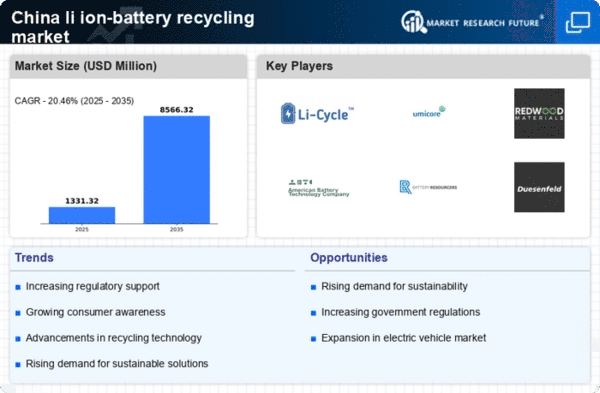
As per Market Research Future analysis, the China Li Ion Battery Recycling Market size was estimated at 1105.2 USD Million in 2024. The Li Ion-battery-recycling market is projected to grow from 1331.32 USD Million in 2025 to 8566.32 USD Million by 2035, exhibiting a compound annual growth rate (CAGR) of 20.4% during the forecast period 2025 - 2035

Key Market Trends & Highlights

The China li ion-battery-recycling market is poised for substantial growth driven by regulatory support and technological advancements.

  • Regulatory support is enhancing the framework for sustainable recycling practices in China.
  • Technological advancements are streamlining recycling processes, making them more efficient and cost-effective.
  • Consumer awareness regarding environmental impacts is increasing, driving demand for responsible recycling solutions.
  • The rising demand for electric vehicles and government initiatives are key drivers propelling market growth.

Market Size & Forecast

2024 Market Size 1105.2 (USD Million)
2035 Market Size 8566.32 (USD Million)
CAGR (2025 - 2035) 20.46%

Major Players

Li-Cycle (CA), Umicore (BE), Redwood Materials (US), American Battery Technology Company (US), Battery Resourcers (US), Duesenfeld (DE), Recupyl (FR), Aqua Metals (US)

Our Impact
Enabled $4.3B Revenue Impact for Fortune 500 and Leading Multinationals
Partnering with 2000+ Global Organizations Each Year
30K+ Citations by Top-Tier Firms in the Industry

China Li Ion Battery Recycling Market Trends

The China Li Ion Battery Recycling Market is experiencing notable growth, driven by increasing environmental concerns and the rising demand for sustainable energy solutions. As the world shifts towards electric vehicles and renewable energy storage, the need for effective recycling methods becomes paramount. In China, government policies are increasingly supportive of recycling initiatives, which encourages investment in advanced technologies. This trend is likely to enhance the efficiency of recycling processes, thereby reducing waste and promoting resource recovery. Furthermore, the market is characterized by a growing awareness among consumers regarding the importance of recycling lithium-ion batteries, which may lead to higher collection rates and improved recycling practices. In addition, The li ion-battery recycling market is experiencing a surge in collaboration between manufacturers and recycling firms. This partnership approach appears to facilitate the development of innovative recycling technologies and processes. As companies strive to meet regulatory requirements and consumer expectations, they are likely to invest in research and development. This could result in more efficient methods for extracting valuable materials from used batteries, thus contributing to a circular economy. Overall, the future of the li ion-battery-recycling market seems promising, with potential for significant advancements in technology and increased participation from various stakeholders.

Regulatory Support

The regulatory environment in China is becoming increasingly favorable for the li ion-battery-recycling market. Government initiatives are promoting recycling practices, which may lead to enhanced compliance among manufacturers and recyclers. This support could drive innovation and investment in recycling technologies.

Technological Advancements

Technological progress is playing a crucial role in the li ion-battery-recycling market. Innovations in recycling processes are likely to improve efficiency and recovery rates of valuable materials. This trend may encourage more companies to adopt advanced recycling methods.

Consumer Awareness

There is a growing awareness among consumers regarding the importance of recycling lithium-ion batteries. This heightened consciousness may lead to increased participation in recycling programs, thereby enhancing collection rates and supporting sustainable practices.

China Li Ion Battery Recycling Market Drivers

Growing Environmental Concerns

Heightened awareness of environmental issues is propelling the li ion-battery-recycling market in China. As the country grapples with pollution and waste management challenges, the need for sustainable practices has become paramount. Improper disposal of lithium-ion batteries poses significant environmental risks, including soil and water contamination. In response, both consumers and businesses are increasingly prioritizing recycling as a responsible choice. Surveys indicate that over 70% of consumers in urban areas are willing to pay a premium for products made from recycled materials. This shift in consumer behavior is likely to drive demand for recycling services and technologies, thereby bolstering the li ion-battery-recycling market. Additionally, public campaigns and educational initiatives are further raising awareness about the importance of battery recycling, creating a more informed consumer base.

Government Initiatives and Policies

The Chinese government has implemented various initiatives to promote the recycling of lithium-ion batteries, which serves as a crucial driver for the li ion-battery-recycling market. Policies such as the Extended Producer Responsibility (EPR) mandate that manufacturers take responsibility for the entire lifecycle of their products, including recycling. In 2023, the government allocated approximately $1 billion to support recycling infrastructure and technology development. These initiatives not only enhance the recycling rate but also encourage investment in the sector. Furthermore, the government's commitment to reducing carbon emissions aligns with the objectives of the li ion-battery-recycling market, as recycling helps minimize the environmental impact of battery production and disposal. This regulatory framework is likely to foster a more sustainable and circular economy in the battery industry.

Rising Demand for Electric Vehicles

The increasing adoption of electric vehicles (EVs) in China is a primary driver for the li ion-battery-recycling market. As the country aims to have 20% of all vehicles be electric by 2025, the demand for lithium-ion batteries is expected to surge. This growth in battery usage leads to a corresponding rise in the need for effective recycling solutions. In 2023, the number of EVs on Chinese roads surpassed 10 million, indicating a robust market for battery recycling. The recycling of these batteries not only helps in recovering valuable materials but also addresses environmental concerns associated with battery disposal. The li ion-battery-recycling market is thus positioned to benefit significantly from this trend, as manufacturers and consumers alike seek sustainable solutions for battery end-of-life management.

Investment in Recycling Infrastructure

Investment in recycling infrastructure is a critical driver for the li ion-battery-recycling market. In recent years, China has seen a surge in funding directed towards the establishment of recycling facilities and processing plants. In 2023, investments in this sector reached approximately $500 million, reflecting a growing recognition of the economic potential of battery recycling. This influx of capital is facilitating the development of state-of-the-art facilities capable of handling large volumes of spent batteries. Moreover, partnerships between private companies and government entities are fostering innovation and efficiency in recycling operations. As infrastructure improves, the li ion-battery-recycling market is likely to expand, providing more opportunities for material recovery and reducing reliance on virgin resources. This trend aligns with China's broader goals of achieving a circular economy and sustainable resource management.

Technological Innovations in Recycling Processes

Advancements in recycling technologies are significantly influencing the li ion-battery-recycling market. Innovations such as hydrometallurgical and pyrometallurgical processes have improved the efficiency of material recovery from spent batteries. In 2023, new technologies enabled recovery rates of over 90% for critical materials like lithium, cobalt, and nickel. These developments not only enhance the economic viability of recycling operations but also reduce the environmental footprint associated with traditional disposal methods. As technology continues to evolve, the li ion-battery-recycling market is expected to see increased participation from both established players and new entrants, driven by the potential for higher profitability and sustainability. The integration of automation and artificial intelligence in recycling facilities further streamlines operations, making the recycling process more efficient and cost-effective.


Market Segment Insights

By Application: Electric Vehicles (Largest) vs. Consumer Electronics (Fastest-Growing)

In the China li ion-battery-recycling market, the application segment is predominantly driven by Electric Vehicles, holding the largest market share. Following closely, Consumer Electronics is witnessing rapid growth, reflecting the increasing demand for sustainable practices in technology. Energy Storage Systems and Power Tools also contribute to the market but at a less significant scale. The growth of this segment is primarily fueled by a surge in Electric Vehicles, driven by government initiatives aimed at promoting greener transportation. Consumer Electronics, as a fastest-growing segment, is propelled by technological advancements and the push for recycling sustainable materials. The transition towards renewable energy sources and advancements in battery technology further catalyze this market.

Electric Vehicles (Dominant) vs. Consumer Electronics (Emerging)

Electric Vehicles stand out as the dominant application in the China li ion-battery-recycling market, largely due to their increasing integration into everyday transportation. With the government's push towards electric mobility, the demand for battery recycling in this sector is paramount in mitigating environmental impacts. In contrast, Consumer Electronics represents an emerging segment characterized by exponential growth fueled by rising electronic waste and consumer awareness about recycling benefits. This sector faces unique challenges such as the rapid turnover of technology, but also presents vast opportunities for growth as manufacturers embrace sustainable practices. Overall, the competitive landscape is shaped by innovation and the need for environmentally friendly solutions.

By Technology: Hydrometallurgical (Largest) vs. Direct Recycling (Fastest-Growing)

In the China li ion-battery-recycling market, the market share distribution indicates that hydrometallurgical processes lead significantly, being favored for their efficiency and environmental benefits. Pyrometallurgical methods capture a substantial share, yet they are witnessing a gradual decline as sustainability concerns rise. Meanwhile, direct recycling is rapidly gaining traction among manufacturers due to its ability to reutilize battery materials without extensive processing. The growth trends in this segment are driven by stringent environmental regulations and a rising demand for sustainable solutions in battery recycling. Technological advancements in direct recycling methods are also accelerating its adoption. As electric vehicle (EV) sales continue to surge, the focus on efficient recycling processes is likely to intensify, promoting investment and innovation in the segment.

Technology: Hydrometallurgical (Dominant) vs. Direct Recycling (Emerging)

Hydrometallurgical recycling methods are currently the dominant approach in the China li ion-battery-recycling market due to their ability to efficiently recover valuable materials like lithium, cobalt, and nickel. This method is favored by large recycling facilities for its lower environmental impact compared to traditional pyrometallurgical processes. On the other hand, direct recycling is emerging as a revolutionary technique that minimizes material loss and is less energy-intensive, making it particularly appealing to manufacturers looking to optimize costs and sustainability. As technology evolves, both segments are expected to play critical roles, with hydrometallurgical methods preserving their status while direct recycling accelerates in adoption, supported by advancements and favorable regulatory frameworks.

By Battery Type: Lithium Nickel Manganese Cobalt Oxide (Largest) vs. Lithium Iron Phosphate (Fastest-Growing)

The market share distribution among the battery types reveals that Lithium Nickel Manganese Cobalt Oxide holds a significant portion of the segment, driven by its widespread application in electric vehicles and portable electronics. In contrast, Lithium Iron Phosphate is gaining traction, owing to its enhanced safety features and cost-effectiveness, positioning it as a strong competitor in the recycling landscape. Growth trends indicate a robust interest in Lithium Iron Phosphate as manufacturers increasingly opt for safer alternatives. The push towards sustainability and the rise in electric vehicle adoption are key drivers, enabling Lithium Nickel Manganese Cobalt Oxide to maintain its dominant position while Lithium Iron Phosphate emerges as a preferred choice among recyclers aiming for eco-friendly solutions.

Lithium Nickel Manganese Cobalt Oxide (Dominant) vs. Lithium Iron Phosphate (Emerging)

Lithium Nickel Manganese Cobalt Oxide serves as the dominant player in the battery type segment, primarily due to its high energy density and versatility across various applications. This type of battery is favored in high-performance environments, making it essential for electric vehicles and large-scale energy storage systems. On the other hand, Lithium Iron Phosphate is characterized by its robust stability and lower environmental impact, making it an emerging choice for many manufacturers. As the demand for safer, more sustainable battery technologies evolves, Lithium Iron Phosphate is positioned to capture a larger market share, particularly in applications that prioritize longevity and safety over energy density.

By End Use: Automotive (Largest) vs. Industrial (Fastest-Growing)

In the China li ion-battery-recycling market, The automotive segment holds a substantial share and is regarded as the largest end-use category due to the increasing number of electric vehicles (EVs) on the road. This segment benefits from significant investments and governmental support aimed at improving the recycling infrastructure, catering to the growing demand for sustainable practices in vehicle manufacturing. On the other hand, the industrial segment is emerging as the fastest-growing area, driven by the rising need for energy storage solutions in various applications. Companies in sectors such as renewable energy are increasingly focusing on recycling used batteries, which enhances energy efficiency and supports corporate sustainability goals. This trend is expected to accelerate as industries seek to reduce their environmental footprint and comply with stringent regulations.

Automotive (Dominant) vs. Industrial (Emerging)

The automotive segment is dominant in the China li ion-battery-recycling market, fueled by the rapid adoption of electric vehicles, which significantly contribute to battery waste. This segment is supported by robust infrastructure and a strong regulatory framework aimed at promoting battery recovery, ensuring a steady flow of recyclable materials. In contrast, the industrial segment is considered emerging as it capitalizes on the growing demand for energy storage solutions used in renewable energy applications, such as solar and wind. As industries increasingly turn towards eco-friendly practices, the need for recycling initiatives is becoming more pronounced. Consequently, companies within the industrial segment are investing in advanced recycling technologies and facilities, positioning themselves favorably for future growth.

Get more detailed insights about China Li Ion Battery Recycling Market

Key Players and Competitive Insights

The competitive dynamics within the li ion-battery-recycling market are characterized by a rapidly evolving landscape, driven by increasing regulatory pressures and a growing emphasis on sustainability. Major players such as Li-Cycle (CA), Umicore (BE), and Redwood Materials (US) are strategically positioning themselves to capitalize on these trends. Li-Cycle (CA) focuses on innovative recycling technologies that enhance recovery rates of critical materials, while Umicore (BE) emphasizes its integrated approach, combining recycling with material production. Redwood Materials (US) is leveraging partnerships with automotive manufacturers to secure a steady supply of used batteries, thereby enhancing its operational focus on circular economy principles. Collectively, these strategies are shaping a competitive environment that prioritizes technological advancement and sustainable practices.
Key business tactics employed by these companies include localizing manufacturing and optimizing supply chains to reduce costs and improve efficiency. The market appears moderately fragmented, with several players vying for market share, yet the influence of key players is substantial. Their ability to innovate and adapt to regulatory changes is likely to dictate the competitive structure moving forward, as companies seek to differentiate themselves through advanced recycling processes and sustainable practices.
In October 2025, Li-Cycle (CA) announced a partnership with a major automotive manufacturer to establish a joint venture focused on battery recycling. This strategic move is significant as it not only secures a consistent feedstock for Li-Cycle's operations but also aligns with the automotive sector's increasing commitment to sustainability. Such collaborations may enhance Li-Cycle's market position and facilitate the scaling of its innovative recycling technologies.
In September 2025, Umicore (BE) unveiled plans to expand its recycling facilities in China, aiming to increase its processing capacity by 50%. This expansion is indicative of Umicore's commitment to meeting the rising demand for recycled materials, particularly in the context of stringent environmental regulations. The strategic importance of this move lies in its potential to solidify Umicore's leadership in the market while addressing the growing need for sustainable sourcing of battery materials.
In August 2025, Redwood Materials (US) secured a $100M investment to enhance its recycling capabilities and expand its operations. This funding is crucial for Redwood as it seeks to scale its operations and improve its technological offerings. The investment underscores the increasing interest in the recycling sector and highlights the potential for innovation-driven growth in the market.
As of November 2025, current trends in the li ion-battery-recycling market are increasingly defined by digitalization, sustainability, and the integration of AI technologies. Strategic alliances among key players are shaping the landscape, fostering collaboration that enhances operational efficiencies and technological advancements. Looking ahead, competitive differentiation is likely to evolve from traditional price-based competition to a focus on innovation, technology, and supply chain reliability. Companies that can effectively leverage these trends will likely emerge as leaders in the market.

Key Companies in the China Li Ion Battery Recycling Market include

Industry Developments

The China Li-Ion Battery Recycling Market has witnessed significant developments recently, primarily driven by government initiatives aimed at promoting sustainable practices and addressing environmental concerns associated with battery waste. For instance, in August 2023, CATL announced its plans to invest heavily in a new recycling facility aimed at enhancing its circular economy practices. In July 2023, Brunp Recycling reported an increase in its processing capacity due to advances in technology that enable more efficient lithium extraction from recycled batteries.

There have also been notable mergers and acquisitions, such as the partnership between GEM and Tianjin Fawde in September 2023, focusing on establishing a comprehensive recycling system to mitigate the growing waste problem. The growth in market valuation for companies such as LiCycle and Aqua Metals reflects a broader industry shift towards sustainability, with LiCycle recently expanding its footprint in China. This trend indicates a robust advancement towards a more circular economy amid rising demand for electric vehicles and battery storage solutions.

Overall, the developments are shaping the future of the Li-Ion battery recycling market in China, paving the way for increased investment and innovation.

Future Outlook

China Li Ion Battery Recycling Market Future Outlook

The li ion-battery-recycling market is poised for growth at 20.46% CAGR from 2025 to 2035, driven by regulatory support, technological advancements, and increasing demand for sustainable practices.

New opportunities lie in:

  • Development of automated recycling facilities to enhance efficiency and reduce costs.
  • Partnerships with EV manufacturers for end-of-life battery collection programs.
  • Investment in R&D for advanced recycling technologies to recover rare materials.

By 2035, the market is expected to achieve substantial growth, positioning itself as a leader in sustainable practices.

Market Segmentation

China Li Ion Battery Recycling Market End Use Outlook

  • Automotive
  • Industrial
  • Residential
  • Commercial

China Li Ion Battery Recycling Market Technology Outlook

  • Hydrometallurgical
  • Pyrometallurgical
  • Direct Recycling

China Li Ion Battery Recycling Market Application Outlook

  • Consumer Electronics
  • Electric Vehicles
  • Energy Storage Systems
  • Power Tools

China Li Ion Battery Recycling Market Battery Type Outlook

  • Lithium Nickel Manganese Cobalt Oxide
  • Lithium Iron Phosphate
  • Lithium Cobalt Oxide
  • Lithium Manganese Oxide

Report Scope

MARKET SIZE 2024 1105.2(USD Million)
MARKET SIZE 2025 1331.32(USD Million)
MARKET SIZE 2035 8566.32(USD Million)
COMPOUND ANNUAL GROWTH RATE (CAGR) 20.46% (2025 - 2035)
REPORT COVERAGE Revenue Forecast, Competitive Landscape, Growth Factors, and Trends
BASE YEAR 2024
Market Forecast Period 2025 - 2035
Historical Data 2019 - 2024
Market Forecast Units USD Million
Key Companies Profiled Li-Cycle (CA), Umicore (BE), Redwood Materials (US), American Battery Technology Company (US), Battery Resourcers (US), Duesenfeld (DE), Recupyl (FR), Aqua Metals (US)
Segments Covered Application, Technology, Battery Type, End Use
Key Market Opportunities Advancements in recycling technologies enhance resource recovery in the li ion-battery-recycling market.
Key Market Dynamics Rising regulatory pressures drive innovation and investment in lithium-ion battery recycling technologies and processes.
Countries Covered China
Leave a Comment

FAQs

What is the expected market size of the China Li-Ion Battery Recycling Market in 2024?

The China Li-Ion Battery Recycling Market is expected to be valued at 547.2 million USD in the year 2024.

What is the projected market size for the China Li-Ion Battery Recycling Market by 2035?

By the year 2035, the market is anticipated to reach a value of 5500.0 million USD.

What is the expected compound annual growth rate (CAGR) for the China Li-Ion Battery Recycling Market from 2025 to 2035?

The market is forecasted to exhibit a CAGR of 23.342% from 2025 to 2035.

Which application segment is leading the China Li-Ion Battery Recycling Market?

The Electric Vehicles segment is expected to dominate the market with a value of 250.0 million USD in 2024, growing to 2500.0 million USD by 2035.

What will be the market value for Consumer Electronics in the China Li-Ion Battery Recycling Market in 2024?

The Consumer Electronics segment is projected to be valued at 150.0 million USD in 2024.

Who are some of the key players in the China Li-Ion Battery Recycling Market?

Major players in the market include Northvolt, CATL, Aqua Metals, and Brunp Recycling among others.

What is the estimated market size for the Energy Storage Systems application in 2035?

The Energy Storage Systems application is expected to reach a value of 1000.0 million USD by 2035.

What challenges are currently faced by the China Li-Ion Battery Recycling Market?

The market faces challenges related to technological advancements and regulatory compliance.

What market size is projected for Power Tools segment in 2035?

The Power Tools segment is expected to be valued at 500.0 million USD in the year 2035.

What are the growth drivers for the China Li-Ion Battery Recycling Market?

The primary growth drivers include the rising demand for electric vehicles and increased focus on sustainable practices.

Download Free Sample

Kindly complete the form below to receive a free sample of this Report

Compare Licence

×
Features License Type
Single User Multiuser License Enterprise User
Price $4,950 $5,950 $7,250
Maximum User Access Limit 1 User Upto 10 Users Unrestricted Access Throughout the Organization
Free Customization
Direct Access to Analyst
Deliverable Format
Platform Access
Discount on Next Purchase 10% 15% 15%
Printable Versions