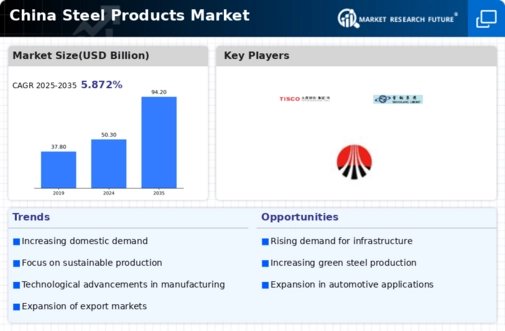
The steel products market in China is characterized by intense competition and rapid evolution, driven by factors such as increasing domestic demand, infrastructure development, and a push towards sustainability. Major players like China Baowu Steel Group (CN), Hebei Iron and Steel Group (CN), and Jiangsu Shagang Group (CN) are at the forefront, each adopting distinct strategies to enhance their market positioning. China Baowu Steel Group (CN) focuses on innovation and digital transformation, aiming to integrate advanced technologies into its production processes. Meanwhile, Hebei Iron and Steel Group (CN) emphasizes regional expansion and strategic partnerships to bolster its supply chain capabilities. Collectively, these strategies contribute to a competitive environment that is both dynamic and multifaceted.
In terms of business tactics, companies are increasingly localizing manufacturing and optimizing supply chains to enhance efficiency and reduce costs. The market structure appears moderately fragmented, with several key players exerting considerable influence. This fragmentation allows for a variety of competitive strategies, as companies seek to differentiate themselves through quality, service, and technological advancements.
In November 2025, Jiangsu Shagang Group (CN) announced a significant investment in a new steel production facility aimed at increasing its output capacity by 20%. This strategic move is likely to enhance its competitive edge by meeting the growing demand for high-quality steel products in both domestic and international markets. The investment underscores the company's commitment to scaling operations and improving production efficiency, which may position it favorably against its competitors.
In October 2025, China Baowu Steel Group (CN) entered into a joint venture with Nippon Steel Corporation (JP) to develop advanced steel materials for the automotive sector. This collaboration is indicative of a broader trend towards innovation and specialization within the industry. By leveraging Nippon Steel's expertise in high-strength steel, China Baowu aims to enhance its product offerings and cater to the evolving needs of the automotive industry, which increasingly prioritizes lightweight and durable materials.
In September 2025, Hebei Iron and Steel Group (CN) launched a sustainability initiative focused on reducing carbon emissions by 30% over the next five years. This initiative aligns with global trends towards environmental responsibility and positions the company as a leader in sustainable steel production. The emphasis on sustainability not only addresses regulatory pressures but also appeals to a growing segment of environmentally conscious consumers and businesses.
As of December 2025, the competitive landscape is increasingly shaped by trends such as digitalization, sustainability, and the integration of artificial intelligence in production processes. Strategic alliances are becoming more prevalent, as companies recognize the value of collaboration in driving innovation and efficiency. Looking ahead, competitive differentiation is likely to evolve from traditional price-based competition to a focus on technological advancements, sustainability initiatives, and supply chain reliability. This shift may redefine the parameters of success in the steel products market, compelling companies to innovate continuously and adapt to changing market dynamics.




















Leave a Comment