×
Request Free Sample ×

Kindly complete the form below to receive a free sample of this Report

* Please use a valid business email

Leading companies partner with us for data-driven Insights

clients tt-cursor
Hero Background

Chromatography Resin Market

ID: MRFR/CnM/5581-CR
110 Pages
Anshula Mandaokar
October 2022

Chromatography Resin Market Research Report Information By Type (Natural Resin, Synthetic Resin, Inorganic Media) Technique (Ion-exchange chromatography, Affinity chromatography, Hydrophobic interaction chromatography, Size exclusion chromatography, Multi-modal chromatography, Others) Forecast 2032

Share:
Download PDF ×

We do not share your information with anyone. However, we may send you emails based on your report interest from time to time. You may contact us at any time to opt-out.

Chromatography Resin Market Infographic
Purchase Options

Chromatography Resin Market Summary

As per MRFR analysis, the Chromatography Resin Market Size was estimated at 15601.81 USD Million in 2024. The Chromatography Resin industry is projected to grow from 16678.65 in 2025 to 32510.24 by 2035, exhibiting a compound annual growth rate (CAGR) of 6.9 during the forecast period 2025 - 2035.

Key Market Trends & Highlights

The Chromatography Resin Market is poised for substantial growth driven by technological advancements and increasing demand for biopharmaceuticals.

  • Sustainable resin development is becoming a focal point as environmental concerns gain traction in the industry.
  • Technological advancements in purification processes are enhancing the efficiency and effectiveness of chromatography applications.
  • The influence of personalized medicine is driving innovation, particularly in the biotechnology segment, which is experiencing rapid growth.
  • Rising demand for biopharmaceuticals and a focus on quality control are key drivers propelling the market forward, especially in North America.

Market Size & Forecast

2024 Market Size 15601.81 (USD Million)
2035 Market Size 32510.24 (USD Million)
CAGR (2025 - 2035) 6.9%

Major Players

GE Healthcare (US), Thermo Fisher Scientific (US), Merck KGaA (DE), Bio-Rad Laboratories (US), Agilent Technologies (US), Pall Corporation (US), Repligen Corporation (US), Sartorius AG (DE)

Chromatography Resin Market Trends

The Chromatography Resin Market is currently experiencing a dynamic evolution, driven by advancements in biopharmaceuticals and the increasing demand for high-purity products. As industries seek to enhance separation processes, the focus on innovative resin technologies is becoming more pronounced. This market appears to be influenced by the growing need for efficient purification methods, particularly in the production of monoclonal antibodies and other biologics. Furthermore, the trend towards sustainable practices is prompting manufacturers to explore eco-friendly resin options, which may reshape the competitive landscape. In addition, the rise of personalized medicine is likely to propel the demand for specialized chromatography resins tailored to specific applications. The integration of automation and digital technologies into chromatography processes is also noteworthy, as it enhances operational efficiency and reduces human error. Overall, the Chromatography Resin Market seems poised for substantial growth, with various factors converging to create a robust environment for innovation and development.

Sustainable Resin Development

The emphasis on sustainability is becoming increasingly relevant in the Chromatography Resin Market. Manufacturers are exploring bio-based and recyclable materials to create resins that minimize environmental impact. This trend reflects a broader commitment to eco-friendly practices across industries, potentially attracting environmentally conscious consumers.

Technological Advancements in Purification

Innovations in resin technology are transforming purification processes within the Chromatography Resin Market. Enhanced performance characteristics, such as improved selectivity and binding capacity, are being developed to meet the evolving needs of biopharmaceutical applications. These advancements may lead to more efficient and cost-effective separation methods.

Personalized Medicine Influence

The growing trend towards personalized medicine is likely to drive demand for specialized chromatography resins. Tailored solutions that cater to specific therapeutic needs are becoming essential in the development of targeted treatments. This shift may encourage manufacturers to invest in research and development to create innovative resin products.

Chromatography Resin Market Drivers

Market Growth Projections

The Global Chromatography Resin Market Industry is poised for substantial growth, with projections indicating a market size of 15.6 USD Billion in 2024 and an anticipated increase to 32.5 USD Billion by 2035. This growth trajectory suggests a compound annual growth rate (CAGR) of 6.9% from 2025 to 2035. The expansion is driven by various factors, including the rising demand for biopharmaceuticals, technological advancements, and increased focus on quality control. As industries continue to innovate and adapt to changing market dynamics, the chromatography resin market is likely to experience robust growth, reflecting its critical role in diverse applications.

Growing Environmental Concerns

Environmental sustainability is becoming an essential consideration in the Global Chromatography Resin Market Industry. As industries face increasing pressure to adopt eco-friendly practices, the demand for sustainable chromatography solutions rises. Manufacturers are developing resins that minimize environmental impact, such as those derived from renewable resources or designed for easier disposal. This shift towards greener alternatives not only aligns with global sustainability goals but also attracts environmentally conscious consumers. As a result, the market is likely to evolve, with a growing segment dedicated to sustainable chromatography resins, reflecting the industry's commitment to addressing environmental challenges.

Increasing Focus on Quality Control

Quality control remains a pivotal driver in the Global Chromatography Resin Market Industry, particularly in sectors such as pharmaceuticals and food safety. Regulatory agencies impose stringent guidelines that necessitate the use of high-quality chromatography resins to ensure product safety and efficacy. The demand for reliable and reproducible results in analytical testing propels the adoption of advanced chromatography techniques. Consequently, manufacturers are investing in high-performance resins that meet regulatory standards. This focus on quality not only enhances consumer trust but also contributes to the overall growth of the market, as companies strive to maintain compliance with evolving regulations.

Rising Demand for Biopharmaceuticals

The Global Chromatography Resin Market Industry experiences a notable surge in demand driven by the biopharmaceutical sector. As the industry expands, the need for effective purification and separation techniques becomes paramount. Chromatography resins play a crucial role in the production of monoclonal antibodies and other biologics. In 2024, the market is projected to reach 15.6 USD Billion, reflecting the increasing reliance on these resins for high-purity applications. This trend is expected to continue, with the market potentially reaching 32.5 USD Billion by 2035, indicating a robust growth trajectory fueled by advancements in biopharmaceutical manufacturing processes.

Technological Advancements in Chromatography

Technological innovations significantly influence the Global Chromatography Resin Market Industry, enhancing the efficiency and effectiveness of chromatography processes. The introduction of novel resin materials and improved separation techniques allows for better resolution and faster analysis times. For instance, advancements in high-performance liquid chromatography (HPLC) and affinity chromatography are reshaping the landscape. These innovations not only improve productivity but also reduce operational costs for laboratories and manufacturing facilities. As a result, the market is likely to witness a compound annual growth rate (CAGR) of 6.9% from 2025 to 2035, reflecting the ongoing integration of cutting-edge technologies in chromatography.

Expansion of Research and Development Activities

The Global Chromatography Resin Market Industry benefits from the expansion of research and development (R&D) activities across various sectors. Increased funding for scientific research, particularly in life sciences and environmental studies, drives the demand for chromatography resins. Academic institutions and research organizations are increasingly utilizing these resins for analytical purposes, leading to a rise in their consumption. This trend is likely to bolster the market, as R&D initiatives continue to explore new applications and methodologies. The growing emphasis on innovation in research is expected to sustain the market's growth trajectory, aligning with the projected figures for the coming years.
Market Segment Insights

By Application: Protein Purification (Largest) vs. Affinity Chromatography (Fastest-Growing)

The chromatography resin market is significantly influenced by various applications, with protein purification leading the segment in market share. It is the cornerstone application, consistently dominating due to its critical role in the biopharmaceutical sector for the purification of therapeutic proteins. Following closely are ion exchange chromatography and size exclusion chromatography, which also contribute to the overall market dynamics, though at smaller scales compared to protein purification.

Protein Purification (Dominant) vs. Affinity Chromatography (Emerging)

The protein purification segment is pivotal within the chromatography resin market, recognized for its extensive use in biopharmaceutical processes, encompassing drug development and manufacturing. It benefits from established methodologies and a robust demand for biologics. In contrast, affinity chromatography is rapidly emerging, characterized by its high specificity and effectiveness in capturing target biomolecules. This method leverages specific interactions between biomolecules, making it increasingly preferred for various applications, including diagnostics and research. Both segments are vital, but while protein purification remains dominant, affinity chromatography is witnessing accelerated adoption driven by technological advancements and growing applications in personalized medicine.

By End Use: Pharmaceuticals (Largest) vs. Biotechnology (Fastest-Growing)

In the Chromatography Resin Market, the 'End Use' segment reveals a robust distribution of market shares, with Pharmaceuticals commanding the largest portion. This sector benefits from the increasing demand for efficient separation processes in drug development and quality control, making it a key player. In contrast, the Biotechnology segment is gaining momentum, propelled by continued advancements in biopharmaceuticals. It is rapidly capturing attention due to its innovative applications in therapeutic development and diagnostics.

Pharmaceuticals: Dominant vs. Biotechnology: Emerging

The Pharmaceuticals segment stands as the dominant force within the Chromatography Resin Market, characterized by established applications in drug formulation and purification processes. Its focus on regulatory compliance and product quality ensures that top-tier resins are utilized to maintain stringent standards. On the other hand, the Biotechnology segment is emerging with significant potential, driven by the increasing investment in biologics and personalized medicine. This sector showcases innovative uses of chromatography resin, enhancing bioprocessing strategies and fostering growth in newly developed therapies. The collaboration between biopharmaceutical companies and resin manufacturers fuels the demand for specialized resins tailored to complex biological processes.

By Type: Natural Resins (Largest) vs. Synthetic Resins (Fastest-Growing)

In the Chromatography Resin Market, the segments are primarily divided into Natural Resins, Synthetic Resins, and Inorganic Resins. Natural Resins hold the largest market share, due to their favorable properties and extensive use in various applications such as protein purification and biopharmaceutical development. Conversely, Synthetic Resins have emerged as a notable force, being widely adopted for their tailored characteristics and performance in high-throughput processing, thus gaining significant ground in recent years. As the demand for biopharmaceuticals continues to rise, the growth of Synthetic Resins is driven by innovations that allow for enhanced separation and purification processes. On the other hand, Natural Resins are propelled by their increasing use in environmentally friendly applications and the growing trend of using sustainably sourced materials. Inorganic Resins, while less dominant, are expected to see gradual growth as specialized applications require their unique capabilities in chromatography.

Natural Resins (Dominant) vs. Synthetic Resins (Emerging)

Natural Resins are recognized for their biocompatibility and effectiveness in a multitude of chromatographic applications, which solidifies their position as a dominant player in the chromatography market. They are often derived from natural sources like plants and animals, making them appealing for industries focused on sustainability and eco-friendliness. This segment finds usage in critical applications such as protein purification and antibody production, highlighting their significance in the biopharmaceutical sector. On the other hand, Synthetic Resins are emerging rapidly due to their customizable properties, allowing for specialized applications across different industries. They offer enhanced efficiency in various chromatographic techniques, making them a preferred choice in high-demand scenarios where performance is crucial. Their development is often fueled by technological advancements that enable finer control over their chemical composition, thus catering to specific market needs.

By Form: Pre-packed Columns (Largest) vs. Bulk Resins (Fastest-Growing)

In the chromatography resin market, the segment distribution reveals that pre-packed columns hold a significant share, benefiting from their ease of use and minimal preparation time. Bulk resins, meanwhile, exhibit a growing presence due to their versatility and cost-effectiveness, particularly in laboratory applications. The resin beads segment, while paramount for certain specialized applications, trails behind in overall market share compared to the dominant pre-packed columns and the rapidly expanding bulk resins.

Pre-packed Columns (Dominant) vs. Bulk Resins (Emerging)

Pre-packed columns are widely regarded as the dominant form in chromatography due to their ability to streamline processes, minimize sample preparation, and enhance reproducibility, making them highly favored in both research and industrial settings. On the other hand, bulk resins are emerging fast in the market, driven by their adaptability for various separation needs and lower purchasing costs, appealing particularly to small and mid-sized laboratories. Resin beads, while crucial for certain niche applications, have seen slower growth compared to these two forms, reflecting a shifting preference in the market towards efficiency and versatility.

By Functionality: Ion Exchange (Largest) vs. Affinity (Fastest-Growing)

In the Chromatography Resin Market, the functionality segment shows a diverse distribution with Ion Exchange resins holding the largest market share due to their widespread application in biopharmaceutical processes. Affinity resins, although comprising a smaller portion, are gaining traction due to their specificity and efficiency, attracting increasing investments and applications. Size Exclusion and Mixed-Mode resins also play crucial roles, especially in purifying larger biomolecules and offering versatile functionalities, respectively, but lag behind the dominant segments in terms of market share.

Ion Exchange (Dominant) vs. Affinity (Emerging)

Ion Exchange resins are the backbone of chromatography, excelling in purifying and separating biomolecules based on their charge. This dominant functionality empowers pharmaceutical companies and research institutions to achieve high-purity end products. On the other hand, Affinity resins, known for their ability to selectively bind specific target molecules, represent an emerging trend in the market. Their efficiency makes them ideal for targeted purification processes, especially in therapeutic protein production. As innovations continue, the demand for Affinity resins is expected to rise sharply, paving the way for new applications in diverse biotechnological fields.

Get more detailed insights about Chromatography Resin Market

Regional Insights

North America : Market Leader in Innovation

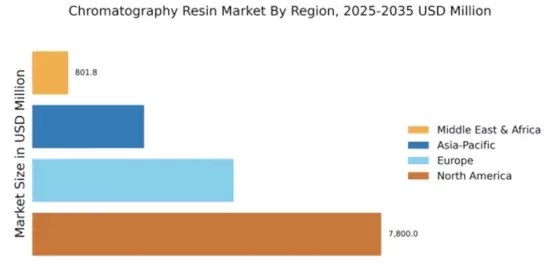
North America continues to lead the chromatography resin market, holding a significant share of 7800.0. The region's growth is driven by increasing demand for biopharmaceuticals and advancements in analytical techniques. Regulatory support from agencies like the FDA further catalyzes market expansion, ensuring high-quality standards and safety in bioprocessing applications. The focus on personalized medicine and biologics is also propelling the need for advanced chromatography solutions. The competitive landscape in North America is robust, featuring key players such as GE Healthcare, Thermo Fisher Scientific, and Bio-Rad Laboratories. These companies are investing heavily in R&D to innovate and enhance product offerings. The presence of established manufacturing facilities and a skilled workforce further strengthens the region's market position. As the demand for high-purity resins grows, North America is poised to maintain its leadership in the chromatography resin sector.

Europe : Emerging Regulatory Frameworks

Europe's chromatography resin market is valued at 4500.0, driven by stringent regulatory frameworks and a growing emphasis on quality assurance in pharmaceuticals. The European Medicines Agency (EMA) plays a crucial role in shaping market dynamics, ensuring compliance with safety and efficacy standards. The increasing focus on biologics and biosimilars is also a significant growth driver, as companies seek advanced solutions for purification and separation processes. Leading countries in this region include Germany, France, and the UK, where major players like Merck KGaA and Sartorius AG are headquartered. The competitive landscape is characterized by innovation and strategic partnerships, as companies aim to enhance their product portfolios. The presence of a well-established pharmaceutical industry further supports the demand for chromatography resins, making Europe a key player in the global market.

Asia-Pacific : Rapidly Growing Market Potential

The Asia-Pacific region, with a market size of 2500.0, is rapidly emerging as a significant player in the chromatography resin market. The growth is fueled by increasing investments in biopharmaceutical manufacturing and a rising demand for advanced analytical techniques. Countries like China and India are witnessing a surge in biotechnology initiatives, supported by government policies aimed at enhancing healthcare infrastructure and research capabilities. This trend is expected to drive the adoption of chromatography resins in various applications. Key players in the region include Agilent Technologies and Pall Corporation, which are expanding their presence through strategic collaborations and local partnerships. The competitive landscape is evolving, with a focus on innovation and cost-effective solutions. As the region continues to develop its biopharmaceutical sector, the demand for high-quality chromatography resins is anticipated to grow significantly, positioning Asia-Pacific as a future leader in the market.

Middle East and Africa : Untapped Market Opportunities

The Middle East and Africa (MEA) region, with a market size of 801.81, presents untapped opportunities in the chromatography resin market. The growth is driven by increasing investments in healthcare and biopharmaceutical sectors, alongside a rising awareness of advanced analytical techniques. Governments are actively promoting biotechnology initiatives, which are expected to enhance the demand for chromatography solutions in drug development and quality control processes. Countries like South Africa and the UAE are leading the way in adopting bioprocessing technologies, with key players beginning to establish a foothold in the region. The competitive landscape is gradually evolving, with local and international companies exploring partnerships to meet the growing demand. As the MEA region continues to develop its biopharmaceutical capabilities, the chromatography resin market is poised for significant growth, driven by innovation and regulatory support.

Key Players and Competitive Insights

The Chromatography Resin Market is currently characterized by a dynamic competitive landscape, driven by increasing demand for biopharmaceuticals and advancements in analytical techniques. Key players such as GE Healthcare (US), Thermo Fisher Scientific (US), and Merck KGaA (DE) are strategically positioned to leverage innovation and expand their market presence. GE Healthcare (US) focuses on enhancing its product portfolio through continuous innovation, while Thermo Fisher Scientific (US) emphasizes strategic partnerships to bolster its technological capabilities. Merck KGaA (DE) appears to be concentrating on regional expansion, particularly in emerging markets, thereby shaping a competitive environment that is increasingly collaborative yet fiercely competitive.

In terms of business tactics, companies are localizing manufacturing to reduce lead times and optimize supply chains, which is crucial in a market that is moderately fragmented. The competitive structure is influenced by the collective actions of these key players, who are not only vying for market share but also striving to enhance operational efficiencies. This collective influence fosters a landscape where innovation and strategic partnerships are paramount, as companies seek to differentiate themselves in a crowded marketplace.

In November 2025, GE Healthcare (US) announced the launch of a new line of chromatography resins designed specifically for the purification of monoclonal antibodies. This strategic move is significant as it aligns with the growing demand for targeted therapies in the biopharmaceutical sector, potentially enhancing GE's competitive edge in a high-growth area. The introduction of these specialized resins may also facilitate faster and more efficient production processes, thereby appealing to a broader customer base.

In October 2025, Thermo Fisher Scientific (US) entered into a partnership with a leading biotechnology firm to co-develop advanced chromatography solutions. This collaboration is indicative of a trend towards innovation through partnerships, allowing Thermo Fisher to leverage external expertise and accelerate the development of cutting-edge technologies. Such strategic alliances are likely to enhance their product offerings and strengthen their market position in the long term.

In September 2025, Merck KGaA (DE) expanded its manufacturing capabilities in Asia by investing €50 million in a new facility dedicated to chromatography resin production. This expansion is crucial as it not only increases production capacity but also positions Merck to better serve the growing demand in the Asia-Pacific region. The investment reflects a strategic focus on regional growth and the importance of localized production in meeting customer needs efficiently.

As of December 2025, the competitive trends in the Chromatography Resin Market are increasingly defined by digitalization, sustainability, and the integration of AI technologies. Companies are forming strategic alliances to enhance their capabilities and address the evolving demands of the market. The shift from price-based competition to a focus on innovation, technology, and supply chain reliability is becoming more pronounced. Looking ahead, competitive differentiation will likely hinge on the ability to innovate and adapt to these trends, positioning companies to thrive in an ever-evolving landscape.

Key Companies in the Chromatography Resin Market market include

Industry Developments

  • Q2 2024: Cytiva opens new chromatography resin manufacturing facility in Uppsala, Sweden Cytiva inaugurated a new state-of-the-art facility in Uppsala to expand its production capacity for chromatography resins, aiming to meet growing global demand from the biopharmaceutical sector.
  • Q2 2024: Bio-Rad Laboratories launches new mixed-mode chromatography resin for bioprocessing Bio-Rad announced the commercial launch of a novel mixed-mode chromatography resin designed to improve purification efficiency for monoclonal antibodies and other biologics.
  • Q3 2024: Thermo Fisher Scientific expands chromatography resin portfolio with new affinity resin Thermo Fisher introduced a new affinity chromatography resin targeting the purification of next-generation biologics, enhancing its offering for pharmaceutical manufacturers.
  • Q3 2024: Purolite announces partnership with major Asian biopharma for custom resin supply Purolite entered a multi-year supply agreement with a leading Asian biopharmaceutical company to provide custom chromatography resins for large-scale therapeutic protein production.
  • Q4 2024: Repligen acquires chromatography resin technology from private biotech firm Repligen completed the acquisition of proprietary chromatography resin technology, strengthening its position in the downstream bioprocessing market.
  • Q1 2025: Merck KGaA opens new chromatography resin R&D center in Darmstadt, Germany Merck inaugurated a dedicated research and development center focused on advancing chromatography resin technologies for pharmaceutical and biotech applications.
  • Q1 2025: Tosoh Corporation launches high-capacity ion exchange resin for vaccine purification Tosoh introduced a new ion exchange chromatography resin specifically engineered for high-throughput vaccine purification processes.
  • Q2 2025: Agilent Technologies announces strategic partnership with European CDMO for resin supply Agilent entered a strategic partnership to supply chromatography resins to a major European contract development and manufacturing organization (CDMO) supporting biologics production.
  • Q2 2025: Bio-Rad Laboratories appoints new VP of Chromatography Business Unit Bio-Rad named a new Vice President to lead its Chromatography Business Unit, signaling a renewed focus on innovation and global expansion in resin technologies.
  • Q3 2025: Thermo Fisher Scientific secures multi-year contract to supply chromatography resins to top-10 pharma company Thermo Fisher signed a multi-year supply agreement with a leading global pharmaceutical company for chromatography resins used in large-scale biologics manufacturing.
  • Q3 2025: Cytiva launches sustainable chromatography resin line with reduced environmental footprint Cytiva introduced a new line of chromatography resins manufactured using sustainable processes and materials, targeting environmentally conscious bioprocessing customers.
  • Q4 2025: Repligen announces $100 million investment in US chromatography resin manufacturing expansion Repligen revealed plans to invest $100 million to expand its US-based chromatography resin manufacturing capacity, aiming to address supply chain resilience and rising demand.


Future Outlook

Chromatography Resin Market Future Outlook

The Chromatography Resin Market is projected to grow at a 6.9% CAGR from 2024 to 2035, driven by increasing demand in biopharmaceuticals, advancements in technology, and rising applications in food safety.

New opportunities lie in:

  • Development of customized resins for specific biopharmaceutical applications.
  • Expansion into emerging markets with tailored marketing strategies.
  • Investment in sustainable resin production technologies to meet regulatory demands.

By 2035, the Chromatography Resin Market is expected to achieve substantial growth, reflecting evolving industry needs.

Market Segmentation

Chromatography Resin Market Form Outlook

  • Pre-packed Columns
  • Bulk Resins
  • Resin Beads

Chromatography Resin Market Type Outlook

  • Natural Resins
  • Synthetic Resins
  • Inorganic Resins

Chromatography Resin Market End Use Outlook

  • Pharmaceuticals
  • Biotechnology
  • Food and Beverage
  • Environmental Testing

Chromatography Resin Market Application Outlook

  • Protein Purification
  • Ion Exchange Chromatography
  • Affinity Chromatography
  • Size Exclusion Chromatography

Chromatography Resin Market Functionality Outlook

  • Ion Exchange
  • Affinity
  • Size Exclusion
  • Mixed-Mode

Report Scope

MARKET SIZE 202415601.81(USD Million)
MARKET SIZE 202516678.65(USD Million)
MARKET SIZE 203532510.24(USD Million)
COMPOUND ANNUAL GROWTH RATE (CAGR)6.9% (2024 - 2035)
REPORT COVERAGERevenue Forecast, Competitive Landscape, Growth Factors, and Trends
BASE YEAR2024
Market Forecast Period2025 - 2035
Historical Data2019 - 2024
Market Forecast UnitsUSD Million
Key Companies ProfiledGE Healthcare (US), Thermo Fisher Scientific (US), Merck KGaA (DE), Bio-Rad Laboratories (US), Agilent Technologies (US), Pall Corporation (US), Repligen Corporation (US), Sartorius AG (DE)
Segments CoveredApplication, End Use, Type, Form, Functionality
Key Market OpportunitiesAdvancements in biopharmaceuticals drive demand for innovative chromatography resins in purification processes.
Key Market DynamicsRising demand for biopharmaceuticals drives innovation and competition in the chromatography resin market.
Countries CoveredNorth America, Europe, APAC, South America, MEA

Market Highlights

Author
Anshula Mandaokar
Team Lead - Research

Anshula Mandaokar holds an academic degree in Chemical Engineering and has been contributing to the field for more than 5 years. She has expertise in Market Research and Business Consulting and serves as a Team Lead for a reputed Market Research firm under the Chemicals and Materials domain spectrum. She has worked on multiple projects, generating explicit results in a quick turnaround time. Her understanding of data interpretation justifies her role as a leader.

Leave a Comment

FAQs

What growth rate global chromatography resin Market would register in the future?

The global chromatography resin market would register a growth of 6.90%.

Which industry will play a crucial role in taking the chromatography resin market ahead?

Pharmaceutical and biotechnology industry, will play a crucial role in taking the Chromatography resin market ahead.

What is the key restraining factor for the global chromatography resin market?

High cost of affinity resins, is the key restraining factor for the global chromatography resin market.

Which region holds the largest share in the global chromatography resin market?

North America holds the largest share in the global chromatography resin market, followed by Europe and the Asia Pacific, respectively.

What are the important market drivers for the increase in the Chromatography Resin Market Revenue across the globe?

The rising demands for chromatography tests, increasing research and development projects in the pharmaceutical sector, and rise in drug approvals are the important market drivers for the increase in the global Chromatography Resin Market Revenue.

Download Free Sample

Kindly complete the form below to receive a free sample of this Report

Compare Licence

×
Features License Type
Single User Multiuser License Enterprise User
Price $4,950 $5,950 $7,250
Maximum User Access Limit 1 User Upto 10 Users Unrestricted Access Throughout the Organization
Free Customization
Direct Access to Analyst
Deliverable Format
Platform Access
Discount on Next Purchase 10% 15% 15%
Printable Versions