Download Free Sample
Kindly complete the form below to receive a free sample of this Report
Circulating Tumor DNA (ctDNA) Market Research Report By Application (Early Cancer Detection, Therapeutic Monitoring, Disease Surveillance, Recurrence Monitoring), By Technology (Next Generation Sequencing, PCR-Based Techniques, Digital PCR, Microarray-Based Techniques), By End Use (Hospitals, Clinical Laboratories, Research Institutions, Diagnostic Centers), By Product Type (Reagents, Kits, Instruments) and By Regional (North America, Europe, South America, Asia-Pacific, Middle East and Africa) - Growth & Industry Forecast 2025 To 2035
As per Market Research Future analysis, the Circulating Tumor DNA (ctDNA) Market Size was estimated at 6.866 USD Billion in 2024. The ctDNA industry is projected to grow from 7.88 USD Billion in 2025 to 31.28 USD Billion by 2035, exhibiting a compound annual growth rate (CAGR) of 14.78% during the forecast period 2025 - 2035
The Circulating Tumor DNA (ctDNA) market is poised for substantial growth driven by technological advancements and increasing demand for non-invasive testing.
| 2024 Market Size | 6.866 (USD Billion) |
| 2035 Market Size | 31.28 (USD Billion) |
| CAGR (2025 - 2035) | 14.78% |
The Circulating Tumor DNA (ctDNA) Market is currently experiencing a transformative phase, driven by advancements in genomic technologies and an increasing emphasis on personalized medicine. This market encompasses a range of applications, including early cancer detection, monitoring treatment responses, and assessing minimal residual disease. The growing prevalence of cancer globally has heightened the demand for non-invasive diagnostic tools, which ctDNA testing provides. As healthcare systems evolve, the integration of ctDNA analysis into routine clinical practice appears to be gaining traction, potentially leading to improved patient outcomes and more tailored therapeutic strategies. Moreover, the regulatory landscape surrounding ctDNA testing is evolving, with various health authorities recognizing the potential of these tests in clinical settings. This recognition may facilitate the development and approval of new ctDNA-based assays, further expanding the market. Additionally, collaborations between biotechnology firms and academic institutions are likely to foster innovation, enhancing the capabilities of ctDNA technologies. As the market matures, it seems poised for sustained growth, driven by ongoing research and the increasing adoption of precision medicine approaches in oncology.
Recent innovations in sequencing technologies and bioinformatics are enhancing the sensitivity and specificity of ctDNA assays. These advancements enable earlier detection of tumors and more accurate monitoring of treatment responses, which could lead to better patient management.
There is a growing preference for non-invasive diagnostic methods among both healthcare providers and patients. ctDNA testing offers a less invasive alternative to traditional biopsy procedures, making it an attractive option for cancer diagnosis and monitoring.
The evolving regulatory framework surrounding ctDNA testing is likely to promote the development of standardized protocols. This support may enhance the credibility of ctDNA assays, encouraging their adoption in clinical practice and improving patient care.
The rising incidence of cancer worldwide is a primary driver for the Circulating Tumor DNA (ctDNA) Market. As cancer cases continue to escalate, the demand for effective diagnostic and monitoring tools becomes more pronounced. According to recent statistics, cancer is projected to affect millions annually, necessitating innovative solutions for early detection and treatment monitoring. ctDNA testing offers a non-invasive method to identify tumor presence and genetic mutations, which is crucial for personalized medicine. This trend is likely to propel the ctDNA market, as healthcare providers seek advanced technologies to improve patient outcomes and reduce treatment costs. Furthermore, the increasing awareness of cancer screening and the importance of early diagnosis are expected to further stimulate market growth.
The growing awareness and education surrounding cancer and its diagnostics are crucial drivers for the Circulating Tumor DNA (ctDNA) Market. As patients become more informed about their health and the importance of early detection, the demand for advanced diagnostic tools like ctDNA testing is expected to rise. Educational campaigns by healthcare organizations and advocacy groups are playing a vital role in disseminating information about the benefits of ctDNA testing, including its non-invasive nature and ability to provide actionable insights. This heightened awareness is likely to lead to increased adoption of ctDNA tests in clinical settings, thereby expanding the market. Furthermore, as healthcare providers emphasize the importance of personalized treatment plans, the role of ctDNA in guiding these decisions is becoming increasingly recognized.
Technological advancements in genomic sequencing and analysis are significantly influencing the Circulating Tumor DNA (ctDNA) Market. Innovations such as next-generation sequencing (NGS) have enhanced the sensitivity and specificity of ctDNA tests, allowing for the detection of minimal residual disease and early relapse. The market for genomic technologies is anticipated to grow substantially, with estimates suggesting a compound annual growth rate of over 10% in the coming years. These advancements not only improve diagnostic accuracy but also facilitate the development of targeted therapies, thereby expanding the application of ctDNA in oncology. As a result, the integration of cutting-edge genomic technologies into clinical practice is likely to drive the demand for ctDNA testing, positioning it as a cornerstone in cancer management.
The surge in investment for cancer research is a notable driver for the Circulating Tumor DNA (ctDNA) Market. Governments, private organizations, and philanthropic entities are allocating substantial funds to advance cancer research initiatives. This influx of capital is directed towards developing innovative diagnostic tools, including ctDNA assays, which are essential for understanding tumor biology and improving patient care. Recent reports indicate that funding for cancer research has reached unprecedented levels, with billions of dollars being invested annually. This financial support not only accelerates the development of ctDNA technologies but also fosters collaborations between academia and industry, enhancing the overall landscape of cancer diagnostics. As research progresses, the ctDNA market is likely to benefit from new discoveries and applications.
The shift towards personalized medicine is a significant driver for the Circulating Tumor DNA (ctDNA) Market. Personalized medicine aims to tailor treatment strategies based on individual patient profiles, including genetic makeup and tumor characteristics. ctDNA testing plays a pivotal role in this approach by providing real-time insights into tumor dynamics and treatment response. The market for personalized medicine is expected to witness robust growth, with projections indicating a valuation exceeding several billion dollars in the next few years. This trend is fueled by the increasing recognition of the limitations of traditional one-size-fits-all therapies. Consequently, the demand for ctDNA testing as a tool for guiding personalized treatment decisions is likely to expand, further solidifying its importance in oncology.
In the Circulating Tumor DNA (ctDNA) market, the application segment exhibits a diverse distribution of values, with Early Cancer Detection leading as the largest segment. This segment's prominence stems from the increasing emphasis on preventative healthcare and the demand for early diagnosis to enhance patient outcomes. Following closely is Therapeutic Monitoring, which is rapidly gaining traction due to advancements in personalized medicine and the need for ongoing assessment during treatment courses. Disease Surveillance and Recurrence Monitoring are also critical applications, but they currently hold smaller shares of the market. The growth dynamics within the ctDNA application segment are driven by technological advancements, particularly in next-generation sequencing and the rising prevalence of cancer globally. Increasing investments in research and development are fostering new innovations in ctDNA testing, making it more accessible and reliable. Furthermore, the surge in awareness about precision medicine is propelling the growth of Therapeutic Monitoring as healthcare providers actively seek optimal therapeutic strategies tailored to individual patient profiles. This environment promotes a favorable outlook for ctDNA applications as they evolve to meet changing clinical needs.
Early Cancer Detection (Dominant) vs. Recurrence Monitoring (Emerging)
Within the ctDNA application segment, Early Cancer Detection stands out as the dominant force, positioning itself as a critical tool in proactive healthcare. This application enables the identification of cancer at its nascent stages, significantly improving patient prognosis through timely interventions. Conversely, Recurrence Monitoring is steadily emerging as a vital segment, driven by a growing recognition of the importance of post-treatment surveillance. As patients increasingly seek assurance post-recovery, Recurrence Monitoring technologies are evolving to provide timely insights that effectively inform ongoing treatment decisions. Both segments contribute uniquely to the market, with Early Cancer Detection focusing on preventive measures and Recurrence Monitoring emphasizing ongoing patient management and follow-up.
The circulating tumor DNA (ctDNA) market exhibits a dynamic distribution of technologies. Next Generation Sequencing (NGS) currently dominates the technology segment, accounting for a significant share as it offers comprehensive genomic insights. In contrast, PCR-based techniques, while smaller in share, are the fastest-growing segment due to their rapid advancements and clinical applications, highlighting the shift towards more precise diagnostic methods in oncology.
Technology: NGS (Dominant) vs. Digital PCR (Emerging)
Next Generation Sequencing (NGS) remains the dominant technology in the ctDNA market, leveraging its ability to analyze vast amounts of genetic information quickly and with high accuracy. Its widespread adoption in clinical and research settings underpins its leading position. Meanwhile, Digital PCR is emerging as a promising technology, notable for its enhanced sensitivity and specificity in measuring ctDNA levels. The attribute of Digital PCR to provide precise quantification of low-abundance mutations positions it well for future expansion, particularly in personalized medicine applications, where accuracy is paramount.
Within the Circulating Tumor DNA (ctDNA) market, hospitals hold the largest share among end-users, driven primarily by their comprehensive capabilities in cancer management and treatment. As diagnostic demands increase, hospitals are adopting ctDNA testing for its efficiency in detecting and monitoring cancer, making it an essential tool for oncologists. Clinical laboratories, on the other hand, are rapidly emerging as a critical segment, benefitting from advances in technology and a growing preference for non-invasive testing methods. Their ability to provide timely and accurate results enhances their role in the ctDNA landscape.
Hospitals (Dominant) vs. Clinical Laboratories (Emerging)
Hospitals, as dominant players in the ctDNA market, have established robust infrastructure and specialized teams that facilitate advanced cancer diagnostics and personalized treatment plans. Their extensive resources enable them to integrate ctDNA analyses into routine care, enhancing patient outcomes. Conversely, clinical laboratories are evolving as an emerging segment, characterized by agility and innovation. They focus on developing cutting-edge testing methodologies and expanding service offerings, driving demand for ctDNA analyses. Their partnership with healthcare providers positions them to contribute significantly to early cancer detection and monitoring, appealing to a growing market that increasingly values precision medicine.
The product type segment within the Circulating Tumor DNA (ctDNA) market showcases a diverse landscape, where reagents hold the largest market share. This is attributed to their essential role in ctDNA analysis, aiding in the detection and monitoring of various cancers. Kits, although smaller in market share relative to reagents, are catching up rapidly. Kits combine multiple reagents and components necessary for ctDNA testing, making them highly appealing due to their convenience and comprehensive nature.
Reagents (Dominant) vs. Kits (Emerging)
Reagents are the dominant product type in the ctDNA market as they serve fundamental functions in the extraction and analysis of ctDNA from blood samples. Their established presence is bolstered by continual advancements in reagent formulations that enhance sensitivity and specificity, meeting the growing demand from both research and clinical settings. On the other hand, kits represent an emerging segment, offering comprehensive solutions that met the needs of laboratory workflows. Their popularity is largely driven by the increasing need for user-friendly and all-in-one products that simplify the testing process, catering to a growing end-user preference for efficiency and ease-of-use.
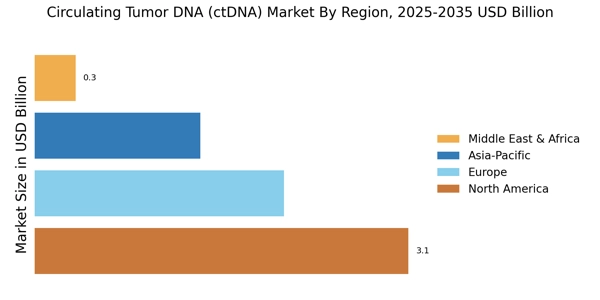
North America is the largest market for circulating tumor DNA (ctDNA), accounting for approximately 45% of the global market share. The region benefits from advanced healthcare infrastructure, significant investment in research and development, and a growing prevalence of cancer. Regulatory support from agencies like the FDA has catalyzed the adoption of ctDNA technologies, enhancing early detection and personalized treatment options. The United States is the primary driver of this market, with key players such as Illumina, Guardant Health, and Exact Sciences leading the charge. The competitive landscape is characterized by rapid technological advancements and collaborations among biotech firms and research institutions. Canada also plays a significant role, contributing to the market with its supportive regulatory environment and increasing focus on precision medicine.
Europe is witnessing significant growth in the ctDNA market, holding approximately 30% of the global share. The region's growth is driven by increasing cancer incidence, advancements in genomic technologies, and supportive regulatory frameworks. The European Medicines Agency (EMA) has been proactive in establishing guidelines that facilitate the integration of ctDNA testing into clinical practice, thereby enhancing patient outcomes. Leading countries in this market include Germany, the UK, and France, where a robust healthcare system and high investment in cancer research are evident. Key players like Roche and Qiagen are at the forefront, driving innovation and expanding their product offerings. The competitive landscape is marked by collaborations between pharmaceutical companies and diagnostic firms, aiming to enhance the accuracy and efficiency of ctDNA testing.
Asia-Pacific is rapidly emerging as a significant player in the ctDNA market, accounting for about 20% of the global share. The region's growth is fueled by increasing cancer prevalence, rising healthcare expenditure, and advancements in molecular diagnostics. Countries like China and India are witnessing a surge in demand for ctDNA testing, driven by a growing awareness of personalized medicine and early cancer detection. China is leading the market, supported by government initiatives aimed at enhancing cancer care and research. The competitive landscape features both local and international players, including Sysmex and Natera, who are expanding their presence through strategic partnerships and innovations. The region's diverse healthcare landscape presents both challenges and opportunities for market players, as they navigate regulatory environments and varying levels of healthcare access.
The Middle East and Africa (MEA) region is currently the smallest market for ctDNA, holding approximately 5% of the global share. However, it presents significant growth potential due to increasing cancer rates and a rising focus on advanced diagnostic solutions. Governments in the region are beginning to recognize the importance of early cancer detection, leading to initiatives aimed at improving healthcare infrastructure and access to innovative technologies. Countries like South Africa and the UAE are emerging as key players in the ctDNA market, with investments in healthcare technology and research. The competitive landscape is still developing, with opportunities for both local and international companies to establish a foothold. As awareness of ctDNA testing grows, the region is likely to see increased collaboration between healthcare providers and diagnostic companies, paving the way for future growth.
The Circulating Tumor DNA (ctDNA) Market is currently characterized by a dynamic competitive landscape, driven by advancements in precision medicine and the increasing demand for non-invasive cancer diagnostics. Key players such as Illumina (US), Guardant Health (US), and Roche (CH) are at the forefront, leveraging their technological capabilities and extensive research to enhance their market positions. Illumina (US) focuses on innovation in sequencing technologies, while Guardant Health (US) emphasizes its proprietary liquid biopsy tests. Roche (CH), with its strong pharmaceutical background, integrates ctDNA testing into its oncology portfolio, thereby enhancing its therapeutic offerings. Collectively, these strategies foster a competitive environment that prioritizes technological advancement and comprehensive patient care.In terms of business tactics, companies are increasingly localizing manufacturing and optimizing supply chains to enhance efficiency and reduce costs. The ctDNA market appears moderately fragmented, with several players vying for market share. However, the influence of major companies is substantial, as they set industry standards and drive innovation. This competitive structure suggests that while there is room for smaller entities, the dominance of established players shapes market dynamics significantly.
In August Illumina (US) announced a strategic partnership with a leading healthcare provider to expand its ctDNA testing capabilities across multiple regions. This collaboration is expected to enhance patient access to advanced genomic testing, thereby solidifying Illumina's position in the market. The strategic importance of this partnership lies in its potential to increase market penetration and foster innovation in personalized medicine.
In September Guardant Health (US) launched a new ctDNA assay aimed at early cancer detection, which is a significant advancement in their product line. This move not only reinforces Guardant's commitment to innovation but also positions the company as a leader in the early detection space, potentially transforming patient outcomes. The introduction of this assay could lead to increased adoption of liquid biopsies in clinical settings, further solidifying Guardant's market presence.
In July Roche (CH) expanded its ctDNA testing portfolio by acquiring a biotech firm specializing in next-generation sequencing technologies. This acquisition is strategically important as it enhances Roche's capabilities in precision oncology, allowing for more comprehensive testing solutions. By integrating these advanced technologies, Roche aims to strengthen its competitive edge and offer more robust diagnostic options to healthcare providers.
As of October the ctDNA market is witnessing trends such as digitalization, sustainability, and the integration of artificial intelligence in diagnostic processes. Strategic alliances among key players are increasingly shaping the competitive landscape, fostering innovation and enhancing service delivery. Looking ahead, it is likely that competitive differentiation will evolve, with a shift from price-based competition to a focus on technological innovation, reliability in supply chains, and the development of comprehensive, patient-centered solutions.

The Global Circulating Tumor DNA (ctDNA) Market has witnessed significant developments recently. Thermo Fisher Scientific has expanded its portfolio in liquid biopsy technologies, enhancing capabilities for detecting ctDNA. Adaptive Biotechnologies is making strides with its immune profiling and ctDNA tracking platform, showcasing innovations for cancer monitoring. Foundation Medicine has been pivotal in advancing genomic profiling tests that incorporate ctDNA analysis.
Additionally, GRAIL has made headlines for its multi-cancer early-detection blood tests, consistently pushing boundaries in this sector. On the mergers and acquisitions front, several of the companies are actively pursuing strategic collaborations to enhance their market positioning. Roche has been expanding its reach through partnerships to advance personalized medicine techniques utilizing ctDNA analysis.
Furthermore, Illumina's efforts in integrating genotyping technologies indicate a broader trend toward advanced diagnostic solutions. The market has seen robust growth in valuation, largely driven by heightened demand for precision oncology and advancements in assay technologies, which are creating an upward trajectory for companies like Guardant Health and Natera. As these firms continue to innovate and partner, the ctDNA market is poised for sustained expansion and transformative impacts on cancer diagnostics and treatment monitoring.
The Circulating Tumor DNA (ctDNA) Market is projected to grow at a 14.78% CAGR from 2025 to 2035, driven by advancements in precision medicine, increasing cancer prevalence, and technological innovations.
New opportunities lie in:
By 2035, the ctDNA market is expected to be a pivotal component of oncology diagnostics.
| MARKET SIZE 2024 | 6.866(USD Billion) |
| MARKET SIZE 2025 | 7.88(USD Billion) |
| MARKET SIZE 2035 | 31.28(USD Billion) |
| COMPOUND ANNUAL GROWTH RATE (CAGR) | 14.78% (2025 - 2035) |
| REPORT COVERAGE | Revenue Forecast, Competitive Landscape, Growth Factors, and Trends |
| BASE YEAR | 2024 |
| Market Forecast Period | 2025 - 2035 |
| Historical Data | 2019 - 2024 |
| Market Forecast Units | USD Billion |
| Key Companies Profiled | Illumina (US), Guardant Health (US), Roche (CH), Biocept (US), Freenome (US), Exact Sciences (US), Natera (US), Sysmex (JP), Qiagen (NL) |
| Segments Covered | Application, Technology, End Use, Product Type, Regional |
| Key Market Opportunities | Advancements in liquid biopsy technologies enhance early cancer detection in the Circulating Tumor DNA (ctDNA) Market. |
| Key Market Dynamics | Rising demand for non-invasive cancer diagnostics drives innovation and competition in the Circulating Tumor DNA market. |
| Countries Covered | North America, Europe, APAC, South America, MEA |
The Circulating Tumor DNA (ctDNA) Market is projected to reach a valuation of 31.28 USD Billion by 2035.
In 2024, the overall market valuation of the Circulating Tumor DNA (ctDNA) Market was 6.866 USD Billion.
The expected CAGR for the Circulating Tumor DNA (ctDNA) Market during the forecast period 2025 - 2035 is 14.78%.
The Therapeutic Monitoring application segment is projected to reach 9.0 USD Billion by 2035.
Key technologies driving growth include Next Generation Sequencing, projected to reach 11.5 USD Billion by 2035.
The Hospitals end-use segment is expected to dominate, with a projected valuation of 12.36 USD Billion by 2035.
Reagents and Kits are included, both projected to reach 9.25 USD Billion by 2035, indicating strong growth.
Key players include Illumina, Guardant Health, Roche, and Natera, among others.



Kindly complete the form below to receive a free sample of this Report

“This is really good guys. Excellent work on a tight deadline. I will continue to use you going forward and recommend you to others. Nice job”


“Thanks. It’s been a pleasure working with you, please use me as reference with any other Intel employees.”


“Thanks for sending the report it gives us a good global view of the Betaïne market.”


“Thank you, this will be very helpful for OQS.”


“We found the report very insightful! we found your research firm very helpful. I'm sending this email to secure our future business.”


“I am very pleased with how market segments have been defined in a relevant way for my purposes (such as "Portable Freezers & refrigerators" and "last-mile"). In general the report is well structured. Thanks very much for your efforts.”


“I have been reading the first document or the study, ,the Global HVAC and FP market report 2021 till 2026. Must say, good info! I have not gone in depth at all parts, but got a good indication of the data inside!”


“We got the report in time, we really thank you for your support in this process. I also thank to all of your team as they did a great job.”


“The Automotive 48V ECU Components Procurement Intelligence Study” was a complex project, but the Market Research Future (MRFR) team handled it with quality, agility, and customer-centricity. They delivered all requested data on time and within the agreed scope. The team, including Shubhendra Anand and Rahul Gotadki, was always readily available to clarify questions and swiftly implement necessary adjustments, driving the project to a successful conclusion within a very demanding timeframe.
I would also like to specifically commend Akshay Agarwal for his responsiveness and support at every stage—from our initial inquiry on May 6th through to final delivery on June 18th. His dedication made the entire process seamless.”



