×
Request Free Sample ×

Kindly complete the form below to receive a free sample of this Report

* Please use a valid business email

Leading companies partner with us for data-driven Insights

clients tt-cursor
Hero Background

Clinical Laboratory Test Market

ID: MRFR/LS/1118-CR
88 Pages
Rahul Gotadki
February 2021

Clinical Laboratory Test Market Research Report: Size, Share, Trend Analysis By Typess of Laboratories (Rigid and Flexible), By Typess of Tests (Complete Blood Count (CBC), Basic Metabolic Panel (BMP), HbA1c Tests, HGB/HCT Tests, Comprehensive Metabolic Panel Tests, BUN Creatinine Tests, Renal Panel Tests, Electrolytes Testing, and Liver Panel Tests & Lipid Panel Tests), By Applications (Parasitology, Virology, Hematology, Toxicology, Immunology/Serology, and Histopathology and Urinalysis), And By Region (North America, Europe, Asia-Pacific, And Rest Of The World) - Growth Outlook & Industry Forecast 2025 To 2035

Share:
Download PDF ×

We do not share your information with anyone. However, we may send you emails based on your report interest from time to time. You may contact us at any time to opt-out.

Clinical Laboratory Test Market Infographic
Purchase Options

Clinical Laboratory Test Market Summary

As per Market Research Future analysis, the Clinical Laboratory Test Market was estimated at 123.27 USD Billion in 2024. The Clinical Laboratory Test industry is projected to grow from 134.14 USD Billion in 2025 to 312.37 USD Billion by 2035, exhibiting a compound annual growth rate (CAGR) of 8.8%2% during the forecast period 2025 - 2035.

Key Market Trends & Highlights

The Clinical Laboratory Test Market is experiencing a dynamic evolution driven by technological advancements and changing healthcare paradigms.

  • Technological advancements are reshaping the landscape of clinical laboratory testing, enhancing accuracy and efficiency.
  • North America remains the largest market, while the Asia-Pacific region is emerging as the fastest-growing area for clinical laboratory tests.
  • The Complete Blood Count (CBC) segment holds the largest market share, whereas HbA1c tests are witnessing rapid growth due to increased diabetes prevalence.
  • Key market drivers include the rising prevalence of chronic diseases and a growing aging population, which are fueling demand for laboratory testing.

Market Size & Forecast

2024 Market Size 123.27 (USD Billion)
2035 Market Size 312.37 (USD Billion)
CAGR (2025 - 2035) 8.82%

Major Players

Abbott Laboratories (US), Roche Diagnostics (CH), Siemens Healthineers (DE), Thermo Fisher Scientific (US), Danaher Corporation (US), Becton Dickinson and Company (US), bioMerieux (FR), PerkinElmer (US), Ortho Clinical Diagnostics (US)

Our Impact
Enabled $4.3B Revenue Impact for Fortune 500 and Leading Multinationals
Partnering with 2000+ Global Organizations Each Year
30K+ Citations by Top-Tier Firms in the Industry

Clinical Laboratory Test Market Trends

The Clinical Laboratory Test Market is currently experiencing a dynamic evolution, driven by advancements in technology and an increasing emphasis on personalized medicine. The integration of artificial intelligence and automation into laboratory processes appears to enhance efficiency and accuracy, thereby improving patient outcomes. Furthermore, the growing demand for rapid diagnostic tests is reshaping the landscape, as healthcare providers seek to deliver timely results. This shift not only streamlines workflows but also addresses the rising expectations of patients and clinicians alike. In addition, the Clinical Laboratory Test Market is witnessing a notable trend towards the adoption of point-of-care testing. This approach allows for immediate results, facilitating quicker clinical decisions. As healthcare systems strive to enhance accessibility and convenience, the proliferation of portable diagnostic devices seems to be a key factor. Overall, the market is poised for continued growth, influenced by technological innovations and evolving healthcare needs, which may lead to a more patient-centric approach in laboratory testing.

Technological Advancements

The Clinical Laboratory Test Market is increasingly influenced by technological innovations, particularly in automation and artificial intelligence. These advancements streamline laboratory operations, enhance accuracy, and reduce turnaround times, thereby improving overall efficiency.

Shift Towards Point-of-Care Testing

There is a growing trend towards point-of-care testing within the Clinical Laboratory Test Market. This approach allows for immediate diagnostic results, enabling healthcare providers to make timely decisions and improving patient care.

Emphasis on Personalized Medicine

The focus on personalized medicine is reshaping the Clinical Laboratory Test Market. Tailoring tests to individual patient needs enhances treatment efficacy and fosters a more targeted approach to healthcare.

Clinical Laboratory Test Market Drivers

Growing Aging Population

The demographic shift towards an aging population is another significant factor influencing the Clinical Laboratory Test Market. As individuals age, they typically experience a higher incidence of health issues, necessitating more frequent laboratory testing. Projections indicate that by 2030, the number of people aged 65 and older will reach approximately 1.4 billion, which could lead to an increased demand for diagnostic services. This demographic trend suggests that clinical laboratories will play a crucial role in managing the health of older adults, thereby driving growth in the Clinical Laboratory Test Market. The need for routine screenings and monitoring of age-related conditions is likely to further bolster this market.

Rising Prevalence of Chronic Diseases

The increasing prevalence of chronic diseases such as diabetes, cardiovascular disorders, and cancer appears to be a primary driver for the Clinical Laboratory Test Market. As these conditions require regular monitoring and management, the demand for laboratory tests is likely to rise. According to recent statistics, chronic diseases account for approximately 70% of all deaths, underscoring the necessity for effective diagnostic tools. This trend suggests that healthcare providers are increasingly relying on clinical laboratory tests to guide treatment decisions and improve patient outcomes. Consequently, the Clinical Laboratory Test Market is expected to experience substantial growth as healthcare systems adapt to the rising burden of chronic diseases.

Increased Focus on Preventive Healthcare

There is a growing emphasis on preventive healthcare, which is significantly impacting the Clinical Laboratory Test Market. As healthcare systems shift from reactive to proactive approaches, the demand for routine laboratory tests is expected to rise. Preventive screenings and early detection of diseases can lead to better health outcomes and reduced healthcare costs. Reports indicate that investments in preventive care can save healthcare systems billions annually. This trend suggests that clinical laboratories will increasingly be utilized for preventive measures, thereby driving growth in the Clinical Laboratory Test Market. The integration of laboratory tests into routine health assessments is likely to become more commonplace.

Technological Innovations in Diagnostics

Technological advancements in diagnostic tools and methodologies are transforming the Clinical Laboratory Test Market. Innovations such as next-generation sequencing, automated analyzers, and point-of-care testing devices are enhancing the accuracy and efficiency of laboratory tests. These technologies not only improve diagnostic capabilities but also reduce turnaround times, which is critical in clinical settings. The market for laboratory automation is projected to grow significantly, with estimates suggesting a compound annual growth rate of over 6% in the coming years. This trend indicates that as technology continues to evolve, the Clinical Laboratory Test Market will likely expand, driven by the demand for more sophisticated and rapid testing solutions.

Regulatory Support for Laboratory Testing

Regulatory frameworks supporting laboratory testing are also contributing to the growth of the Clinical Laboratory Test Market. Governments and health organizations are recognizing the importance of laboratory diagnostics in disease management and public health. Initiatives aimed at improving laboratory standards and accessibility are being implemented, which may enhance the reliability of test results. Furthermore, regulatory bodies are increasingly approving new tests and technologies, facilitating market entry for innovative solutions. This supportive environment suggests that the Clinical Laboratory Test Market will continue to thrive as regulatory measures promote the adoption of advanced diagnostic tools and methodologies.

Market Segment Insights

By Type of Laboratories: Rigid (Largest) vs. Flexible (Fastest-Growing)

The Clinical Laboratory Test Market is characterized by a diverse range of laboratory types, with rigid laboratories holding a substantial share due to their established infrastructure and long-standing presence in the market. Rigid laboratories are typically associated with traditional testing methodologies and have benefited from a reputation for reliability and accuracy. Conversely, flexible laboratories are quickly gaining traction, leveraging modern technologies and methodologies to provide more adaptable and innovative testing solutions, carving out a growing segment in the market.

Laboratories: Rigid (Dominant) vs. Flexible (Emerging)

Rigid laboratories dominate the Clinical Laboratory Test Market due to their stability, advanced equipment, and the extensive experience of their workforce. They are known for providing comprehensive testing services, often focused on standardized processes that ensure consistency and quality. On the other hand, flexible laboratories, which emphasize adaptability and innovation, are emerging as a vital part of the market landscape. They leverage cutting-edge technologies like automation and point-of-care diagnostic testing, allowing them to respond swiftly to changing demands and healthcare needs. This flexibility not only appeals to a broader range of clients but also positions them to capitalize on new opportunities and trends in the clinical testing arena.

By Type of Tests: Complete Blood Count (CBC) (Largest) vs. HbA1c Tests (Fastest-Growing)

In the Clinical Laboratory Test Market, the Complete Blood Count (CBC) holds the largest market share, widely used for routine health evaluations and disease diagnosis. Following closely are HbA1c Tests, which are critical for diabetes management, emerging as the fastest-growing segment due to increasing diabetes prevalence globally. Other tests like Basic Metabolic Panels and Liver Panel Tests also contribute significantly but do not match the CBC’s dominance or HbA1c's growth trajectory.

Complete Blood Count (CBC): Dominant vs. HbA1c Tests: Emerging

The Complete Blood Count (CBC) is a fundamental test in the clinical laboratory space, frequently utilized for initial health assessments, offering insights into various health conditions by evaluating different blood components. In contrast, HbA1c Tests are gaining traction, driven by the rise in diabetes incidence and the need for long-term glucose monitoring. These tests reflect a shift towards preventive healthcare, with HbA1c Tests being preferred by clinicians for their efficiency in monitoring metabolic changes over time, establishing them as a pivotal player in the emerging health landscape.

By Application: Immunology/Serology (Largest) vs. Toxicology (Fastest-Growing)

In the Clinical Laboratory Test Market, the application segment shows a varied distribution among several critical areas. Immunology/serology holds the largest market share due to the increasing prevalence of autoimmune diseases and the growing demand for specialized diagnostics. Other segments such as hematology and virology also contribute significantly but trail behind in terms of overall share. Toxicology, though smaller in comparison, is gaining traction as more laboratories focus on substance abuse testing and environmental monitoring.

Toxicology: Emerging vs. Immunology/Serology: Dominant

Immunology/serology remains the dominant segment in the Clinical Laboratory Test Market, characterized by a wide range of tests available for various autoimmune diseases, allergies, and infectious diseases. It benefits from continuous advancements in testing technologies, which enhance accuracy and efficiency. On the other hand, Toxicology is emerging rapidly, driven by heightened awareness regarding substance abuse and regulatory requirements. This segment emphasizes the need for accurate toxicological analyses and is expected to achieve considerable growth as laboratories diversify their testing capabilities to meet the rising demand.

Get more detailed insights about Clinical Laboratory Test Market

Regional Insights

North America : Market Leader in Innovation

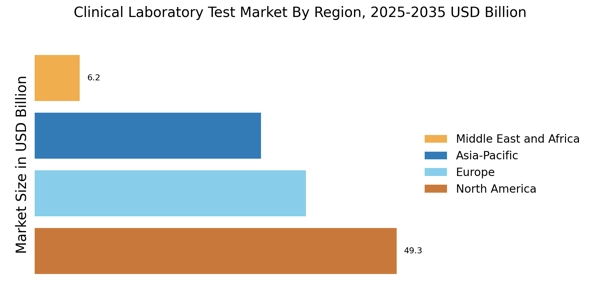
North America is the largest market for clinical laboratory tests, holding approximately 40% of the global market share. The region's growth is driven by advanced healthcare infrastructure, increasing prevalence of chronic diseases, and a strong emphasis on research and development. Regulatory support from agencies like the FDA further catalyzes innovation and adoption of new testing technologies. The United States is the primary contributor, with significant investments from key players such as Abbott Laboratories and Thermo Fisher Scientific. Canada also plays a vital role, focusing on enhancing laboratory capabilities. The competitive landscape is characterized by a mix of established companies and emerging startups, fostering a dynamic environment for clinical testing advancements.

Europe : Regulatory Framework Enhancements

Europe is the second-largest market for clinical laboratory tests, accounting for around 30% of the global market share. The region benefits from stringent regulatory frameworks that ensure high-quality testing standards. The European Union's In Vitro Diagnostic Regulation (IVDR) is a significant catalyst, promoting innovation while ensuring patient safety and efficacy in testing. Leading countries include Germany, France, and the UK, where major players like Roche Diagnostics and Siemens Healthineers are headquartered. The competitive landscape is robust, with a mix of multinational corporations and local firms. The focus on personalized medicine and advanced diagnostics is driving growth, supported by government initiatives to enhance healthcare delivery.

Asia-Pacific : Emerging Market Potential

Asia-Pacific is an emerging powerhouse in the clinical laboratory test market, holding approximately 25% of the global market share. The region's growth is fueled by increasing healthcare expenditure, rising awareness of preventive healthcare, and a growing population. Countries like China and India are witnessing rapid advancements in healthcare infrastructure, which are pivotal for market expansion. China is the largest market in the region, driven by significant investments in healthcare technology and a rising demand for diagnostic services. India follows closely, with a burgeoning private healthcare sector. The competitive landscape features both global players and local companies, creating a diverse market environment that fosters innovation and accessibility in clinical testing.

Middle East and Africa : Untapped Market Opportunities

The Middle East and Africa region is characterized by untapped market potential in the clinical laboratory test sector, holding about 5% of the global market share. Growth is driven by increasing investments in healthcare infrastructure, government initiatives to improve healthcare access, and rising awareness of disease prevention. Countries like the UAE and South Africa are leading the way in enhancing laboratory capabilities and services. The competitive landscape is evolving, with both international and local players entering the market. Key players are focusing on partnerships and collaborations to expand their reach. The region's unique challenges, such as varying regulatory environments, present opportunities for innovation and tailored solutions in clinical testing.

Clinical Laboratory Test Market Regional Image

Key Players and Competitive Insights

The Clinical Laboratory Test Market is characterized by a dynamic competitive landscape, driven by technological advancements, increasing demand for diagnostic testing, and a growing emphasis on personalized medicine. Major players such as Abbott Laboratories (US), Roche Diagnostics (CH), and Siemens Healthineers (DE) are at the forefront, each adopting distinct strategies to enhance their market positioning. Abbott Laboratories (US) focuses on innovation in point-of-care testing, while Roche Diagnostics (CH) emphasizes its extensive portfolio in molecular diagnostics. Siemens Healthineers (DE) is investing heavily in digital transformation, integrating AI and data analytics into its testing solutions. Collectively, these strategies not only enhance operational efficiency but also foster a competitive environment that prioritizes rapid technological advancements and improved patient outcomes.
Key business tactics within the Clinical Laboratory Test Market include localizing manufacturing and optimizing supply chains to enhance responsiveness to regional demands. The market structure appears moderately fragmented, with a mix of large multinational corporations and smaller specialized firms. The collective influence of key players shapes the competitive dynamics, as they leverage their resources to innovate and expand their market reach, thereby intensifying competition.
In August 2025, Roche Diagnostics (CH) announced the launch of its new digital pathology platform, which integrates AI capabilities to streamline the diagnostic process. This strategic move is significant as it positions Roche at the cutting edge of digital health solutions, potentially improving diagnostic accuracy and efficiency. The integration of AI into pathology could redefine workflows in laboratories, making Roche a formidable competitor in the market.
In September 2025, Siemens Healthineers (DE) unveiled a partnership with a leading telehealth provider to enhance remote diagnostic capabilities. This collaboration is crucial as it reflects a growing trend towards telemedicine, allowing for more accessible and timely laboratory testing. By aligning with telehealth services, Siemens Healthineers is likely to expand its customer base and improve patient engagement, thereby solidifying its market presence.
In July 2025, Abbott Laboratories (US) expanded its manufacturing capabilities in Asia to meet the rising demand for rapid testing solutions. This expansion is strategically important as it not only increases production capacity but also reduces lead times for customers in the region. By localizing manufacturing, Abbott can respond more swiftly to market needs, enhancing its competitive edge in a rapidly evolving landscape.
As of October 2025, current competitive trends in the Clinical Laboratory Test Market are heavily influenced by digitalization, sustainability initiatives, and the integration of artificial intelligence. Strategic alliances are increasingly shaping the landscape, enabling companies to pool resources and expertise to drive innovation. Looking ahead, competitive differentiation is likely to evolve from traditional price-based competition towards a focus on technological innovation, reliability in supply chains, and the ability to deliver personalized healthcare solutions.

Key Companies in the Clinical Laboratory Test Market include

Industry Developments

April 2022: Quest Diagnostics, situated in Secaucus, has announced several organizational changes and senior leadership appointments to better support the company's two-point business strategy of accelerating growth and driving operational excellence.

April 2022: Abbott has updated the digital health app with its chronic pain neurostimulation devices, making it easier for clinicians to monitor how well patients respond to treatment. The Neurosphere myPath app measures and reports patient-perceived pain alleviation and general well-being while utilizing Abbott's Proclaim device range for spinal cord stimulation (SCS) or dorsal root ganglion (DRG) therapy.

July 2022: EDAN Instruments Inc launched a next-generation ABG solution designed to reduce the burden in a patient care setting.

Future Outlook

Clinical Laboratory Test Market Future Outlook

The Clinical Laboratory Test Market is projected to grow at an 8.82% CAGR from 2025 to 2035, driven by technological advancements, increasing chronic diseases, and rising healthcare expenditure.

New opportunities lie in:

  • Expansion of telehealth services for remote diagnostics
  • Development of personalized medicine testing kits
  • Investment in AI-driven laboratory automation solutions

By 2035, the market is expected to be robust, driven by innovation and increased demand.

Market Segmentation

Clinical Laboratory Test Market Application Outlook

  • Parasitology
  • Virology
  • Hematology
  • Toxicology
  • Immunology/Serology
  • Histopathology and Urinalysis

Clinical Laboratory Test Market Type of Tests Outlook

  • Complete Blood Count (CBC)
  • Basic Metabolic Panel (BMP)
  • HbA1c Tests
  • HGB/HCT Tests
  • Comprehensive Metabolic Panel Tests
  • BUN Creatinine Tests
  • Renal Panel Tests
  • Electrolytes Testing
  • Liver Panel Tests & Lipid Panel Tests

Clinical Laboratory Test Market Type of Laboratories Outlook

  • Rigid
  • Flexible

Report Scope

MARKET SIZE 2024 123.27(USD Billion)
MARKET SIZE 2025 134.14(USD Billion)
MARKET SIZE 2035 312.37(USD Billion)
COMPOUND ANNUAL GROWTH RATE (CAGR) 8.82% (2025 - 2035)
REPORT COVERAGE Revenue Forecast, Competitive Landscape, Growth Factors, and Trends
BASE YEAR 2024
Market Forecast Period 2025 - 2035
Historical Data 2019 - 2024
Market Forecast Units USD Billion
Key Companies Profiled Abbott Laboratories (US), Roche Diagnostics (CH), Siemens Healthineers (DE), Thermo Fisher Scientific (US), Danaher Corporation (US), Becton Dickinson and Company (US), bioMerieux (FR), PerkinElmer (US), Ortho Clinical Diagnostics (US)
Segments Covered Typess of Laboratories, Typess of Tests, Applications, Region
Key Market Opportunities Integration of artificial intelligence in diagnostic processes enhances efficiency in the Clinical Laboratory Test Market.
Key Market Dynamics Technological advancements and regulatory changes drive innovation and competition in the Clinical Laboratory Test Market.
Countries Covered North America, Europe, APAC, South America, MEA

Market Highlights

Author
Rahul Gotadki
Assistant Manager

He holds an experience of about 7+ years in Market Research and Business Consulting, working under the spectrum of Life Sciences and Healthcare domains. Rahul conceptualizes and implements a scalable business strategy and provides strategic leadership to the clients. His expertise lies in market estimation, competitive intelligence, pipeline analysis, customer assessment, etc. In addition to the above, his other responsibility includes strategic tracking of high growth markets & advising clients on the potential areas of focus they could direct their business initiatives

Leave a Comment

FAQs

What is the current valuation of the Clinical Laboratory Test Market in 2025?

The Clinical Laboratory Test Market is valued at approximately 123.27 USD Billion in 2024.

What is the projected market size for the Clinical Laboratory Test Market by 2035?

The market is projected to reach approximately 312.37 USD Billion by 2035.

What is the expected CAGR for the Clinical Laboratory Test Market during the forecast period 2025 - 2035?

The expected CAGR for the Clinical Laboratory Test Market during the forecast period 2025 - 2035 is 8.82%.

Which companies are considered key players in the Clinical Laboratory Test Market?

Key players in the market include Abbott Laboratories, Roche Diagnostics, Siemens Healthineers, and Thermo Fisher Scientific.

What are the major segments of the Clinical Laboratory Test Market?

The major segments include Type of Laboratories, Type of Tests, and Application.

How does the valuation of rigid and flexible laboratories compare in the market?

In 2024, rigid laboratories were valued at 49.31 USD Billion, while flexible laboratories were valued at 73.96 USD Billion.

Research Approach

Research Methodology on Clinical Laboratory Tests Market

Introduction

The global Clinical Laboratory Tests Market (marketed as CLTM) is considered to be a fast-growing market due to its various features that enhance the quality of healthcare. CLTM provides various clinical services in the medical sector for assisting medical practitioners in managing and diagnosing diseases. These clinical laboratory tests are related to the screening, analysis, diagnostics and monitoring of various physical, chemical and biological characteristics and components to detect and prevent diseases (Rittenhouse, 2012).

Research Objectives

The main objectives of this research are to determine the size of the global Clinical Laboratory Tests Market and to understand certain drivers, restraints, trends and opportunities which are affecting the market growth. In addition, to analyze the current market trends in the CLTM and suggest the prospective trends in the next seven years.

Research Questions

This research aims to answer some of the following questions

  • What is the size of the global Clinical Laboratory Tests Market?
  • What are the key growth drivers for CLTM?
  • What are the major trends shaping the CLTM?
  • What are the major restraining factors for CLTM?
  • What are the most attractive investment avenues in CLTM?

Research Methodology

The research methodology used for this study is a combination of both primary and secondary research methodologies. The primary research methodology comprises interviews with relevant stakeholders who could provide first-hand information on the expansive CLTM. The key stakeholders interviewed for this research are medical practitioners, health experts, medical equipment manufacturers, medical equipment dealers and distributors, medical research laboratories, and other healthcare professionals. The interviews are conducted through online survey methods.

The secondary research methodology includes a thorough literature review of existing studies and industry-related documents such as company reports, annual reports, and market reports which have already been published. Furthermore, reliable web-based sources such as the Global Burden of Disease Study (GBD) and the Centers for Disease Control and Prevention (CDC) were consulted in order to collect relevant data pertaining to the CLTM. The research also looked into different reports of industry associations and trade bodies.

Analysis Methodology

The analysis methodology used for this research includes both qualitative and quantitative research methods. This helps in explaining the current trends, conditions, and growth of the CLTM in detail. For quantitative analysis, descriptive as well as inferential methods were used. The inferential methods include market segmentation, demographic analysis, and cross-tabulation. The market segmentation is comprised of dividing the CLTM into different segments based on the various components such as screenings, tests, diagnostics, and other services.

To determine the overall market growth rate and to analyze the current trends in the CLTM, regression analysis was used. The results from this analysis are then compared with the industry average of the CLTM to determine the future trends in the market.

Data Collection and Measurement

The data collection process is initiated by making contact with key stakeholders in the industry which include manufacturers, researchers, medical professionals, and dealers. The primary data is collected through online surveys and interviews with the relevant stakeholders. The response to these surveys and interviews is collected, coded and analyzed to yield useful information.

In order to establish accurate and reliable data, the secondary sources of data collected included published reports and news, industry databases, statistical reports of the industry and government websites. Various qualitative and quantitative techniques were used to gather and analyze the data.

Data Analysis and Interpretation

The collected data is used to answer the research questions. Descriptive statistics are used to analyze the collected data which included frequencies, means, percentages, cross-tabulations and charts. In addition to this, the data analysis process includes regression analysis to help in predicting the size and scope of the global CLTM.

The collected data is also used to calculate the global market size, market growth and market share of the CLTM. The information is then used to analyze the growth trends and dynamic market scenarios.

Ethical Considerations

The ethical considerations taken into account while conducting this research includes obtaining informed consent from the participants. Furthermore, the participants were provided with the required information about the research objectives and were asked to sign a consent form acknowledging that they were voluntarily taking part in the research. Apart from this, the confidentiality and anonymity of the participants were also maintained.

Conclusion

The primary objective of this research is to analyze the size and scope of the global CLTM and to understand the driving factors and restraining factors of its growth. The research methodology used for this study includes a combination of both primary and secondary research methods. The analysis methodology employed for this study includes qualitative and quantitative research methods. Based on the data collected and analyzed, various trends have been identified in the CLTM that have an impact on its growth. The results of this research are put forward to help stakeholders in understanding the dynamic nature of the CLTM, and its forecast for 2023 to 2032and make sound decisions.

Download Free Sample

Kindly complete the form below to receive a free sample of this Report

Compare Licence

×
Features License Type
Single User Multiuser License Enterprise User
Price $4,950 $5,950 $7,250
Maximum User Access Limit 1 User Upto 10 Users Unrestricted Access Throughout the Organization
Free Customization
Direct Access to Analyst
Deliverable Format
Platform Access
Discount on Next Purchase 10% 15% 15%
Printable Versions