Download Free Sample
Kindly complete the form below to receive a free sample of this Report
Clinical Oncology NG Market Research Report: Size, Share, Trend Analysis By Treatment Type (Chemotherapy, Radiation Therapy, Immunotherapy, Targeted Therapy), By Cancer Type (Breast Cancer, Lung Cancer, Colorectal Cancer, Prostate Cancer, Others), By End Users (Hospitals, Cancer Research Institutes, Specialty Clinics, Homecare Settings), By Drug Type (Small Molecules, Biologics, Combination Therapies, Supportive Care Drugs) and By Regional (North America, Europe, South America, Asia Pacific, Middle East and Africa) - Growth Outlook & Industry Forecast 2025 To 2035
As per Market Research Future analysis, the Clinical Oncology NG Market Size was estimated at 77.52 USD Billion in 2024. The Clinical Oncology NG industry is projected to grow from 81.19 USD Billion in 2025 to 129.02 USD Billion by 2035, exhibiting a compound annual growth rate (CAGR) of 4.74% during the forecast period 2025 - 2035
The Clinical Oncology NG Market is experiencing transformative growth driven by technological advancements and a shift towards personalized care.
| 2024 Market Size | 77.52 (USD Billion) |
| 2035 Market Size | 129.02 (USD Billion) |
| CAGR (2025 - 2035) | 4.74% |
The Clinical Oncology NG Market is currently experiencing a transformative phase characterized by rapid advancements in technology and a growing emphasis on personalized medicine. This evolution is driven by the increasing prevalence of cancer globally, which necessitates innovative treatment modalities and diagnostic tools. The integration of artificial intelligence and machine learning into oncology practices appears to enhance the precision of diagnoses and treatment plans, thereby improving patient outcomes. Furthermore, the collaboration between pharmaceutical companies and biotechnology firms is fostering the development of novel therapies, which may lead to more effective management of various cancer types. In addition to technological advancements, the Clinical Oncology NG Market is witnessing a shift towards value-based care. Healthcare providers are increasingly focusing on delivering high-quality care that emphasizes patient satisfaction and outcomes rather than merely the volume of services provided. This trend suggests a potential reallocation of resources towards preventive measures and early detection strategies, which could ultimately reduce the burden of cancer on healthcare systems. As the market continues to evolve, stakeholders must remain vigilant in adapting to these changes to ensure they meet the needs of patients and healthcare providers alike.
The Clinical Oncology NG Market is increasingly leaning towards personalized medicine, which tailors treatment based on individual patient characteristics. This approach enhances the effectiveness of therapies and minimizes adverse effects, thereby improving overall patient care.
The incorporation of advanced technologies, such as artificial intelligence and machine learning, is transforming the Clinical Oncology NG Market. These innovations facilitate more accurate diagnostics and treatment planning, potentially leading to better patient outcomes.
There is a growing emphasis on value-based care within the Clinical Oncology NG Market. This trend prioritizes patient outcomes and satisfaction over the volume of services, encouraging healthcare providers to invest in preventive measures and early detection.
Technological advancements in biotechnology are reshaping the Clinical Oncology NG Market. Innovations such as CRISPR gene editing, next-generation sequencing, and monoclonal antibodies are revolutionizing cancer treatment paradigms. The biotechnology sector is expected to witness substantial growth, with projections indicating a compound annual growth rate of over 10% in the coming years. These advancements facilitate the development of personalized therapies that target specific genetic mutations, enhancing treatment efficacy and minimizing side effects. Furthermore, the integration of artificial intelligence in drug discovery processes is streamlining the identification of potential therapeutic candidates, thereby accelerating the timeline for bringing new oncology drugs to market. As these technologies continue to evolve, they are likely to play a pivotal role in shaping the future landscape of the Clinical Oncology NG Market.
The rising incidence of cancer worldwide is a primary driver for the Clinical Oncology NG Market. According to recent statistics, cancer cases are projected to increase significantly, with estimates suggesting that by 2040, the number of new cancer cases could reach 30 million annually. This alarming trend necessitates the development of innovative treatment options and diagnostic tools, thereby propelling the Clinical Oncology NG Market forward. As healthcare systems grapple with the growing burden of cancer, investments in research and development are likely to surge, fostering advancements in targeted therapies and immunotherapies. The increasing prevalence of risk factors such as obesity, smoking, and an aging population further exacerbates this situation, indicating a sustained demand for oncology solutions.
The shift towards precision medicine is transforming the Clinical Oncology NG Market. This approach tailors treatment strategies based on individual patient characteristics, including genetic makeup and tumor biology. The precision medicine market is anticipated to grow significantly, with projections indicating a value exceeding 100 billion dollars by 2026. This growth is driven by advancements in genomic profiling and biomarker identification, which enable oncologists to select the most effective therapies for their patients. Additionally, the increasing availability of targeted therapies and immunotherapies aligns with the principles of precision medicine, offering more effective treatment options with fewer side effects. As healthcare providers continue to adopt this patient-centric approach, the Clinical Oncology NG Market is likely to experience substantial growth and innovation.
Regulatory support and funding initiatives are crucial drivers for the Clinical Oncology NG Market. Governments and regulatory bodies are increasingly recognizing the need for innovative cancer therapies and are implementing policies to expedite the approval process for new treatments. For instance, the introduction of breakthrough therapy designations and accelerated approval pathways has significantly reduced the time required for new oncology drugs to reach the market. Furthermore, public and private funding for cancer research is on the rise, with billions of dollars allocated annually to support clinical trials and research initiatives. This financial backing not only fosters innovation but also encourages collaboration between academia and industry, ultimately enhancing the development of novel oncology solutions. As these supportive measures continue to evolve, they are likely to have a profound impact on the Clinical Oncology NG Market.
The increasing emphasis on early detection and screening of cancer is a significant driver for the Clinical Oncology NG Market. Early diagnosis has been shown to improve survival rates, leading to a heightened focus on screening programs and diagnostic tools. The market for cancer screening is projected to grow substantially, with estimates suggesting a value of over 10 billion dollars by 2027. This growth is fueled by rising awareness among the public and healthcare professionals regarding the benefits of early intervention. Additionally, advancements in imaging technologies and biomarker research are enhancing the accuracy and efficiency of cancer detection methods. As healthcare systems prioritize preventive measures, the demand for innovative screening solutions is likely to escalate, further propelling the Clinical Oncology NG Market.
In the Clinical Oncology NG Market, Chemotherapy is currently the largest treatment type, holding a significant portion of the market share due to its long-standing use and established efficacy across a variety of cancer types. Following chemotherapy, Radiation Therapy also accounts for a considerable share, largely serving as a complementary treatment option for localized cancers. Meanwhile, Immunotherapy and Targeted Therapy are rapidly capturing attention with a smaller but increasingly impactful share, reflecting a shift towards more personalized medicine in oncology treatment.
Chemotherapy (Dominant) vs. Immunotherapy (Emerging)
Chemotherapy remains the dominant treatment type within the Clinical Oncology NG Market, characterized by its use of cytotoxic agents that target rapidly dividing cells. While effective for many cancers, the side effects often push patients towards alternatives. On the other hand, Immunotherapy is emerging rapidly, designed to harness the body's immune system to fight cancer more effectively and with fewer side effects. This innovative approach is gaining traction due to advances in research and technology, aimed at improving patient outcomes, and it is increasingly seen as not just an alternative, but a necessary complement to traditional therapies.
In the Clinical Oncology NG Market, Breast Cancer currently holds the largest market share, driven by extensive research initiatives and the availability of innovative therapies. This segment benefits from heightened awareness and screening practices which result in early diagnosis and increased treatment uptake. Lung Cancer, though trailing in share, is marked as the fastest-growing segment, reflecting an urgent need for novel treatment options as recognition of high prevalence rates escalates, alongside a focus on personalized medicine approaches that specifically target genetic mutations.
Breast Cancer (Dominant) vs. Lung Cancer (Emerging)
Breast Cancer remains the dominant force in the Clinical Oncology NG Market, bolstered by advanced diagnostic technologies and a broad array of targeted therapies which enhance patient outcomes. It captures considerable attention from both pharmaceutical companies and researchers aiming to explore innovative treatment pathways. Conversely, the Lung Cancer segment is emerging rapidly, showcasing potential as personalized therapies cater to the unique genetic profiles of patients. This segment's growth is propelled by increased initiatives for early detection and improved treatment options, highlighting an important shift towards more effective management strategies in combating malignancies.
In the Clinical Oncology NG Market, hospitals hold a significant share, being the primary end users of oncology treatments and therapies. They encompass the largest segment, leveraging comprehensive infrastructure and resources to support cancer care. In contrast, cancer research institutes, while smaller in overall market share, are rapidly gaining traction. Their focus on innovative clinical trials and breakthrough therapies positions them as crucial players in the evolving landscape of oncology treatment.
Hospitals (Dominant) vs. Cancer Research Institutes (Emerging)
Hospitals dominate the Clinical Oncology NG Market due to their extensive capabilities, which include advanced diagnostic technologies, multidisciplinary teams, and comprehensive treatment options. They are equipped to handle a large volume of patients and to implement new therapies as they become available. In comparison, cancer research institutes serve as the emerging segment, emphasizing research and development. They play a pivotal role in shaping future treatments by conducting clinical trials and developing novel therapies, thus appealing to the growing demand for personalized medicine and targeted treatments. This dynamic creates a complementary relationship, with hospitals relying on research institutes for innovations, while research institutes benefit from hospitals' practical application and validation of new treatment modalities.
In the Clinical Oncology NG Market, the distribution of drug types reveals a competitive landscape with biologics holding the largest share due to their targeted therapeutic benefits and impressive clinical efficacy. Small molecules also contribute significantly, favored for their cost-effectiveness and established use. Supporting Care Drugs play a crucial role in helping patients manage treatment-related side effects, while combination therapies are gaining traction as they enhance treatment outcomes through synergistic effects. Current growth trends show a marked increase in the adoption of combination therapies, driven by their ability to overcome resistance mechanisms in tumors. Innovations in biologics are also propelling their market share as more stakeholders recognize their value in precision oncology. The supportive care drugs segment continues to expand alongside these therapeutic advancements, fostering a holistic approach to cancer treatment.
Biologics (Dominant) vs. Combination Therapies (Emerging)
Biologics have established themselves as a dominant force in the Clinical Oncology NG Market, offering highly targeted treatments that significantly improve patient outcomes. This includes monoclonal antibodies and other protein-based therapies that specifically bind to cancer cells, minimizing damage to healthy tissue. In contrast, combination therapies are emerging as a highly promising approach, leveraging multiple mechanisms of action to combat resistance and enhance efficacy. These therapies often merge the power of biologics with small molecules, creating a synergistic effect that leads to improved response rates. This growing popularity can be attributed to ongoing research efforts and clinical trials confirming the added benefits of using combinations over single-agent therapies.
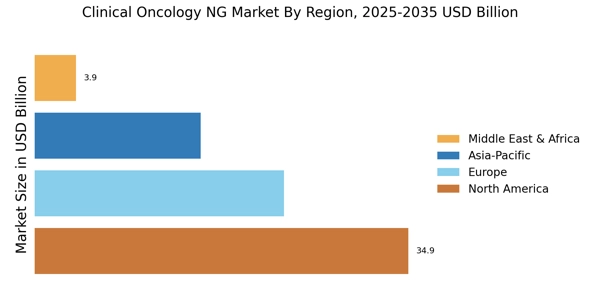
North America is the largest market for Clinical Oncology NG Market, holding approximately 45% of the global market share. The region benefits from advanced healthcare infrastructure, significant R&D investments, and a high prevalence of cancer, driving demand for innovative therapies. Regulatory support from agencies like the FDA further catalyzes market growth, ensuring rapid approval of new treatments and technologies. The United States is the primary player in this market, with key companies such as Merck & Co., Bristol-Myers Squibb, and Pfizer leading the charge. The competitive landscape is characterized by continuous innovation and strategic partnerships among major pharmaceutical firms. Canada also contributes to the market, focusing on personalized medicine and targeted therapies, enhancing the overall regional growth.
Europe is the second-largest market for Clinical Oncology NG Market, accounting for approximately 30% of the global market share. The region is witnessing growth driven by collaborative research initiatives and a strong regulatory framework that supports the development of new oncology therapies. The European Medicines Agency (EMA) plays a crucial role in facilitating timely access to innovative treatments, which is essential for addressing the rising cancer incidence across member states. Leading countries in this market include Germany, France, and the UK, where significant investments in healthcare and research are evident. Major players like Roche and AstraZeneca are actively involved in clinical trials and partnerships, enhancing their market presence. The competitive landscape is marked by a focus on personalized medicine and immunotherapy, with ongoing efforts to streamline regulatory processes for faster drug approvals.
Asia-Pacific is an emerging powerhouse in the Clinical Oncology NG Market, holding about 20% of the global market share. The region's growth is fueled by increasing cancer prevalence, rising healthcare expenditure, and a growing focus on research and development. Countries like China and India are investing heavily in healthcare infrastructure and biotechnology, which are critical for advancing oncology treatments and improving patient outcomes. China is the largest market in the region, with a rapidly expanding pharmaceutical sector and a strong presence of local and international players. India follows closely, with a burgeoning market for generic oncology drugs. The competitive landscape is characterized by collaborations between domestic firms and global giants, enhancing innovation and access to cutting-edge therapies. The region is also witnessing a rise in clinical trials, further driving market growth.
The Middle East and Africa represent a resource-rich frontier for the Clinical Oncology NG Market, holding approximately 5% of the global market share. The region is experiencing growth driven by increasing awareness of cancer, improving healthcare infrastructure, and government initiatives aimed at enhancing cancer care. Countries like South Africa and the UAE are leading efforts to establish comprehensive cancer treatment programs, which are essential for addressing the rising cancer burden. South Africa is the largest market in the region, with a growing number of oncology centers and a focus on improving access to treatment. The competitive landscape is evolving, with both local and international players entering the market to meet the increasing demand for oncology therapies. Collaborative efforts between governments and private sectors are crucial for advancing research and improving patient outcomes in this region.
The Clinical Oncology NG Market has become increasingly competitive in recent years, with numerous companies vying for leadership and market share amidst a landscape marked by rapid advancements in research, technology, and treatment methodologies. This market encompasses a wide array of oncology therapies, from traditional chemotherapy and radiation treatments to innovative approaches such as targeted therapies and immunotherapy. As the prevalence of cancer continues to rise across the globe, the demand for effective oncology solutions has amplified, prompting industry players to enhance their product portfolios and focus on the development of novel therapies.Competitive insights reveal that companies are not only investing heavily in R&D but are also forming strategic partnerships and collaborations to bolster their positions in the market. The competitive dynamics involve a mix of established pharmaceutical giants and emerging biotech firms, each leveraging unique strengths to differentiate themselves and address the evolving needs of healthcare providers and patients alike. Celgene has established itself as a powerful player within the Clinical Oncology NG Market through its strong portfolio of innovative oncology products and a commitment to advancing cancer treatment.The company is particularly recognized for its research-driven approach, focusing on developing therapies that target the underlying mechanisms of cancer cell proliferation and survival.Celgene's strengths lie in its extensive clinical trial experience and a robust pipeline of investigational products aimed at treating various forms of cancer, including hematologic malignancies and solid tumors. Its ability to navigate complex regulatory environments and successfully bring therapies to market has further fortified its presence in the oncology sector. Additionally, Celgene's emphasis on collaboration with academic institutions and research organizations bolsters its innovation efforts, ensuring that the company remains at the cutting edge of oncology research and development.Merck has carved out a significant position in the Clinical Oncology NG Market by leveraging its expertise in immuno-oncology, particularly with its leading product that utilizes the body’s immune system to combat cancer cells.The company's strengths include a strong commitment to scientific excellence and a holistic approach to cancer research that encompasses both monotherapies and combination treatments. Merck's investment in clinical trials and real-world evidence generation has enabled it to substantiate the efficacy and safety of its oncology products, enhancing clinician confidence and patient access.Furthermore, Merck's global footprint and well-established distribution channels provide it with a competitive advantage, ensuring that its groundbreaking therapies are accessible to patients across diverse geographical regions. The company’s focus on patient-centric strategies and robust engagement with healthcare professionals positions it favorably in the competitive landscape, enabling it to meet the unique needs of oncology patients in an evolving treatment environment.

Recent developments in the Clinical Oncology NG Market have been influenced by significant advancements and strategic initiatives from leading companies. Celgene and Bristol Myers Squibb continue to enhance their portfolios, focusing on innovative therapies that address unmet patient needs. Merck is expanding its pipeline with a strong emphasis on immunotherapy, while Roche is driving progress in precision medicine for cancer treatment. Novartis and Sanofi are witnessing growth through collaborations aimed at discovering new treatment modalities. Teva Pharmaceutical Industries and Eli Lilly are making strides in improving access to oncology medications.
In terms of mergers and acquisitions, Regeneron Pharmaceuticals is actively pursuing partnerships to bolster its research capabilities, while Gilead Sciences and AbbVie are exploring strategic acquisitions to diversify their oncology offerings. AstraZeneca and Johnson & Johnson have also been involved in various alliances to strengthen their clinical trial capabilities. The market valuation for these companies continues to grow, reflecting their commitment to innovation and expansion in the oncology sector, ultimately impacting treatment options available for patients globally. The ongoing evolution within this market is set to enhance the competitive landscape and increase the availability of advanced therapies in clinical oncology.
The Clinical Oncology NG Market is projected to grow at a 4.74% CAGR from 2025 to 2035, driven by advancements in precision medicine, increasing cancer prevalence, and enhanced diagnostic technologies.
New opportunities lie in:
By 2035, the Clinical Oncology NG Market is expected to be robust, reflecting substantial growth and innovation.
| MARKET SIZE 2024 | 77.52(USD Billion) |
| MARKET SIZE 2025 | 81.19(USD Billion) |
| MARKET SIZE 2035 | 129.02(USD Billion) |
| COMPOUND ANNUAL GROWTH RATE (CAGR) | 4.74% (2025 - 2035) |
| REPORT COVERAGE | Revenue Forecast, Competitive Landscape, Growth Factors, and Trends |
| BASE YEAR | 2024 |
| Market Forecast Period | 2025 - 2035 |
| Historical Data | 2019 - 2024 |
| Market Forecast Units | USD Billion |
| Key Companies Profiled | Roche (CH), Merck & Co. (US), Bristol-Myers Squibb (US), Novartis (CH), Pfizer (US), AstraZeneca (GB), Amgen (US), Gilead Sciences (US), Eli Lilly and Company (US) |
| Segments Covered | Treatment Type, Cancer Type, End Users, Drug Type, Regional |
| Key Market Opportunities | Integration of artificial intelligence in personalized treatment plans for enhanced patient outcomes in Clinical Oncology NG Market. |
| Key Market Dynamics | Rising demand for personalized medicine drives innovation and competition in the Clinical Oncology Next Generation Market. |
| Countries Covered | North America, Europe, APAC, South America, MEA |
The Clinical Oncology NG Market was valued at 77.52 USD Billion in 2024.
The market is projected to reach 129.02 USD Billion by 2035.
The expected CAGR for the Clinical Oncology NG Market from 2025 to 2035 is 4.74%.
Chemotherapy, Radiation Therapy, Immunotherapy, and Targeted Therapy are the primary treatment types, with Chemotherapy valued between 30.0 and 50.0 USD Billion.
Lung Cancer and Breast Cancer are leading types, with Lung Cancer valued between 20.0 and 30.0 USD Billion.
Key players include Roche, Merck & Co., Bristol-Myers Squibb, Novartis, and Pfizer.
Hospitals are valued between 30.0 and 50.0 USD Billion as end users in the market.
Small Molecules and Biologics are significant contributors, with Small Molecules valued between 30.0 and 50.0 USD Billion.
Cancer Research Institutes are valued between 20.0 and 35.0 USD Billion in the Clinical Oncology NG Market.
The market is likely to experience steady growth, driven by advancements in treatment types and increasing cancer prevalence.



Kindly complete the form below to receive a free sample of this Report

“This is really good guys. Excellent work on a tight deadline. I will continue to use you going forward and recommend you to others. Nice job”


“Thanks. It’s been a pleasure working with you, please use me as reference with any other Intel employees.”


“Thanks for sending the report it gives us a good global view of the Betaïne market.”


“Thank you, this will be very helpful for OQS.”


“We found the report very insightful! we found your research firm very helpful. I'm sending this email to secure our future business.”


“I am very pleased with how market segments have been defined in a relevant way for my purposes (such as "Portable Freezers & refrigerators" and "last-mile"). In general the report is well structured. Thanks very much for your efforts.”


“I have been reading the first document or the study, ,the Global HVAC and FP market report 2021 till 2026. Must say, good info! I have not gone in depth at all parts, but got a good indication of the data inside!”


“We got the report in time, we really thank you for your support in this process. I also thank to all of your team as they did a great job.”


“The Automotive 48V ECU Components Procurement Intelligence Study” was a complex project, but the Market Research Future (MRFR) team handled it with quality, agility, and customer-centricity. They delivered all requested data on time and within the agreed scope. The team, including Shubhendra Anand and Rahul Gotadki, was always readily available to clarify questions and swiftly implement necessary adjustments, driving the project to a successful conclusion within a very demanding timeframe.
I would also like to specifically commend Akshay Agarwal for his responsiveness and support at every stage—from our initial inquiry on May 6th through to final delivery on June 18th. His dedication made the entire process seamless.”



