Closed System Drug Transfer Device Market (2025 - 2035)

ID: MRFR/HC/6264-CR
146 Pages
Vikita Thakur
Last Updated: July 16, 2026
Closed System Drug Transfer Device Market Research Report By Type (Membrane-to-Membrane Systems, Needleless Systems), By Component (Vial Access Devices, Syringe Safety Devices, Accessories, Bag/Line Access Devices), By Closing Mechanism (Push to Turn System, Color-to-Color Alignment System, Luer Lock Systems, Click to Lock Systems), By Technology (Compartmentalize Devices, Diaphragm-Based Devices, Air Filtration Devices), By End Users (Hospitals & Clinics, Specialty Centers, Others) and By Regional (North America, Europe, South America, Asia Pacific, Middle East and Africa) - Industry Forecast to 2035.
Closed System Drug Transfer Device Market
Market Size
Forecast Period2025-2035
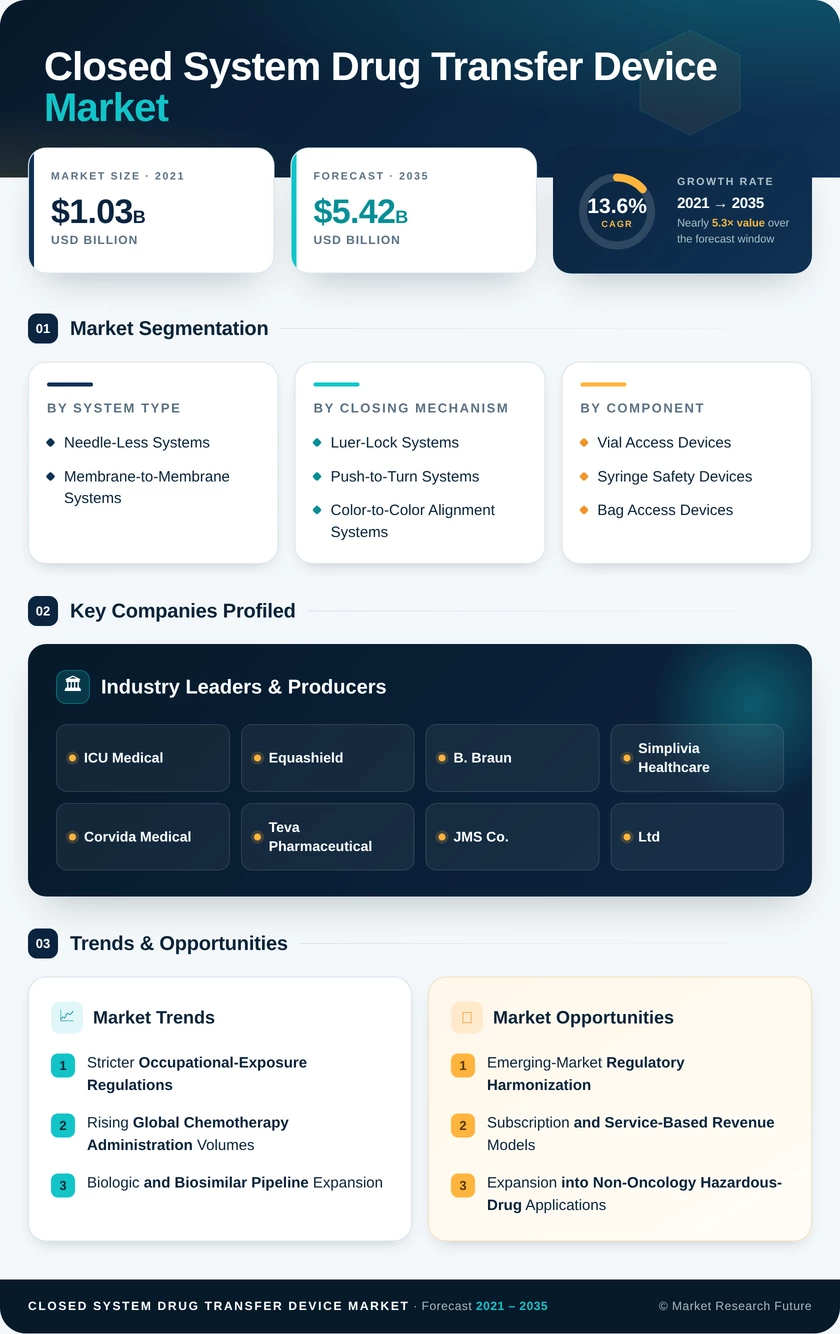
CAGR (2025-2035)13.6%
2025 Market SizeUSD 1.52 Billion
2035 Market SizeUSD 5.42 Billion
Key Players
ICU Medical
Equashield
B. Braun
Simplivia Healthcare
Corvida Medical
Teva Pharmaceutical
Opportunities
  • Emerging-Market Regulatory Harmonization
  • Subscription and Service-Based Revenue Models
  • Expansion into Non-Oncology Hazardous-Drug Applications
  1. 1 Market Overview |
    1. 1.1 Study Assumptions & Market Definition |
    2. 1.2 Scope of the Study |
    3. 1.3 Research Methodology
  2. 2 Market Summary & Key Takeaways
  3. 3 Market Dynamics |
    1. 3.1 Market Drivers Analysis | |
      1. 3.1.1 Stricter Occupational-Exposure Regulations | |
      2. 3.1.2 Rising Global Chemotherapy Administration Volumes | |
      3. 3.1.3 Biologic and Biosimilar Pipeline Expansion | |
      4. 3.1.4 Robotic Compounding System Integration | |
      5. 3.1.5 Hospital Accreditation and Quality-Score Linkage | |
      6. 3.1.6 National Cancer-Control Plan Rollouts in Emerging Economies | |
      7. 3.1.7 Insurance and GPO Reimbursement Pathway Creation |
    2. 3.2 Market Restraints Analysis | |
      1. 3.2.1 High Per-Unit Cost and Budget Constraints | |
      2. 3.2.2 Training Burden and Workflow Disruption | |
      3. 3.2.3 Proprietary Connector Lock-In | |
      4. 3.2.4 Limited Clinical Evidence in Non-Oncology Settings | |
      5. 3.2.5 Waste-Stream Management Complexities |
    3. 3.3 Market Opportunity Analysis | |
      1. 3.3.1 Emerging-Market Regulatory Harmonization | |
      2. 3.3.2 Subscription and Service-Based Revenue Models | |
      3. 3.3.3 Expansion into Non-Oncology Hazardous-Drug Applications | |
      4. 3.3.4 Digital Twin and Data Monetization Platforms | |
      5. 3.3.5 Contract Pharmacy and Centralized Compounding Growth |
    4. 3.4 Industry Value Chain Analysis |
    5. 3.5 Porter's Five Forces Analysis
  4. 4 Global Closed System Drug Transfer Device Market Size & Forecast (2021–2035) |
    1. 4.1 Historical Market Size (2021–2025) |
    2. 4.2 Current & Forecast Market Size (2026–2035) |
    3. 4.3 Market Size by Revenue (USD Billion) |
    4. 4.4 Year-over-Year Growth Analysis
  5. 5 Segmentation Analysis |
    1. 5.1 By System Type | |
      1. 5.1.1 Needle-Less Systems | |
      2. 5.1.2 Membrane-to-Membrane Systems |
    2. 5.2 By Closing Mechanism | |
      1. 5.2.1 Luer-Lock Systems | |
      2. 5.2.2 Push-to-Turn Systems | |
      3. 5.2.3 Color-to-Color Alignment Systems |
    3. 5.3 By Component | |
      1. 5.3.1 Vial Access Devices | |
      2. 5.3.2 Syringe Safety Devices | |
      3. 5.3.3 Bag Access Devices |
    4. 5.4 By Technology | |
      1. 5.4.1 Diaphragm-Based Devices | |
      2. 5.4.2 Compartmentalized Devices |
    5. 5.5 By End User | |
      1. 5.5.1 Hospitals | |
      2. 5.5.2 Oncology Centers | |
      3. 5.5.3 Others (Retail Pharmacy, Home Infusion)
  6. 6 Regional Analysis |
    1. 6.1 North America | |
      1. 6.1.1 United States | |
      2. 6.1.2 Canada | |
      3. 6.1.3 Mexico |
    2. 6.2 Europe | |
      1. 6.2.1 Germany | |
      2. 6.2.2 United Kingdom | |
      3. 6.2.3 France | |
      4. 6.2.4 Italy | |
      5. 6.2.5 Spain | |
      6. 6.2.6 Nordic Countries | |
      7. 6.2.7 Russia | |
      8. 6.2.8 Rest of Europe |
    3. 6.3 Asia-Pacific | |
      1. 6.3.1 China | |
      2. 6.3.2 India | |
      3. 6.3.3 Japan | |
      4. 6.3.4 South Korea | |
      5. 6.3.5 ASEAN | |
      6. 6.3.6 Rest of Asia-Pacific |
    4. 6.4 South America | |
      1. 6.4.1 Brazil | |
      2. 6.4.2 Argentina | |
      3. 6.4.3 Rest of South America |
    5. 6.5 Middle East & Africa | |
      1. 6.5.1 Saudi Arabia | |
      2. 6.5.2 UAE | |
      3. 6.5.3 South Africa | |
      4. 6.5.4 Egypt | |
      5. 6.5.5 Rest of MEA
  7. 7 Competitive Landscape |
    1. 7.1 Market Share Analysis (2025) |
    2. 7.2 Competitive Benchmarking Matrix |
    3. 7.3 Company Profiles | |
      1. 7.3.1 Becton, Dickinson and Company (BD) | |
      2. 7.3.2 ICU Medical | |
      3. 7.3.3 Equashield | |
      4. 7.3.4 B. Braun | |
      5. 7.3.5 Simplivia Healthcare | |
      6. 7.3.6 Corvida Medical | |
      7. 7.3.7 Teva Pharmaceutical | |
      8. 7.3.8 JMS Co., Ltd | |
      9. 7.3.9 Yukon Medical | |
      10. 7.3.10 Caragen Ltd
  8. 8 Future Outlook & Strategic Recommendations (2026–2035) |
    1. 8.1 AI-Enabled Pharmacy Automation |
    2. 8.2 Sustainability and Circular-Economy Pressures |
    3. 8.3 Personalized Medicine and Small-Batch Compounding |
    4. 8.4 Global Regulatory Convergence
  9. 9 Recent Developments & News
  10. 10 Frequently Asked Questions (FAQs)
  11. 11 Report Scope & Methodology |
    1. 11.1 Study Period & Base Year |
    2. 11.2 Data Sources & Citations |
    3. 11.3 Abbreviations
  12. 12 LIST OF TABLES |
  13. TABLE 1 Global Closed System Drug Transfer Device Market Size & Forecast, by Revenue (USD Billion), 2021–2035 |
  14. TABLE 2 Global Closed System Drug Transfer Device Market — Year-over-Year Growth Analysis, 2021–2035 |
  15. TABLE 3 Global Closed System Drug Transfer Device Market — Driver Impact Analysis |
  16. TABLE 4 Global Closed System Drug Transfer Device Market — Restraints Impact Analysis |
  17. TABLE 5 Global Closed System Drug Transfer Device Market Size, by System Type, 2021–2035 (USD Billion) |
  18. TABLE 6 Global Closed System Drug Transfer Device Market Size, by Closing Mechanism, 2021–2035 (USD Billion) |
  19. TABLE 7 Global Closed System Drug Transfer Device Market Size, by Component, 2021–2035 (USD Billion) |
  20. TABLE 8 Global Closed System Drug Transfer Device Market Size, by Technology, 2021–2035 (USD Billion) |
  21. TABLE 9 Global Closed System Drug Transfer Device Market Size, by End User, 2021–2035 (USD Billion) |
  22. TABLE 10 Global Closed System Drug Transfer Device Market Size, by Region, 2021–2035 (USD Billion) |
  23. TABLE 11 North America Closed System Drug Transfer Device Market Size, by Country, 2021–2035 (USD Billion) |
  24. TABLE 12 Europe Closed System Drug Transfer Device Market Size, by Country, 2021–2035 (USD Billion) |
  25. TABLE 13 Asia-Pacific Closed System Drug Transfer Device Market Size, by Country, 2021–2035 (USD Billion) |
  26. TABLE 14 South America Closed System Drug Transfer Device Market Size, by Country, 2021–2035 (USD Billion) |
  27. TABLE 15 Middle East & Africa Closed System Drug Transfer Device Market Size, by Country, 2021–2035 (USD Billion) |
  28. TABLE 16 Competitive Benchmarking Matrix — Global Closed System Drug Transfer Device Market, 2025 |
  29. TABLE 17 Company Profiles — Key Players, Global Closed System Drug Transfer Device Market |
  30. TABLE 18 Recent Developments & Strategic Announcements, 2023–2025 |
  31. TABLE 19 Report Scope & Methodology Summary |
  32. TABLE 20 Detailed Sources and Citations |
  33. TABLE 21 North America Closed System Drug Transfer Device Market Size, by System Type, 2021–2035 (USD Billion) |
  34. TABLE 22 North America Closed System Drug Transfer Device Market Size, by Closing Mechanism, 2021–2035 (USD Billion) |
  35. TABLE 23 North America Closed System Drug Transfer Device Market Size, by Component, 2021–2035 (USD Billion) |
  36. TABLE 24 North America Closed System Drug Transfer Device Market Size, by Technology, 2021–2035 (USD Billion) |
  37. TABLE 25 North America Closed System Drug Transfer Device Market Size, by End User, 2021–2035 (USD Billion) |
  38. TABLE 26 Europe Closed System Drug Transfer Device Market Size, by System Type, 2021–2035 (USD Billion) |
  39. TABLE 27 Europe Closed System Drug Transfer Device Market Size, by Closing Mechanism, 2021–2035 (USD Billion) |
  40. TABLE 28 Europe Closed System Drug Transfer Device Market Size, by Component, 2021–2035 (USD Billion) |
  41. TABLE 29 Europe Closed System Drug Transfer Device Market Size, by Technology, 2021–2035 (USD Billion) |
  42. TABLE 30 Europe Closed System Drug Transfer Device Market Size, by End User, 2021–2035 (USD Billion) |
  43. TABLE 31 Asia-Pacific Closed System Drug Transfer Device Market Size, by System Type, 2021–2035 (USD Billion) |
  44. TABLE 32 Asia-Pacific Closed System Drug Transfer Device Market Size, by Closing Mechanism, 2021–2035 (USD Billion) |
  45. TABLE 33 Asia-Pacific Closed System Drug Transfer Device Market Size, by Component, 2021–2035 (USD Billion) |
  46. TABLE 34 Asia-Pacific Closed System Drug Transfer Device Market Size, by Technology, 2021–2035 (USD Billion) |
  47. TABLE 35 Asia-Pacific Closed System Drug Transfer Device Market Size, by End User, 2021–2035 (USD Billion) |
  48. TABLE 36 South America Closed System Drug Transfer Device Market Size, by System Type, 2021–2035 (USD Billion) |
  49. TABLE 37 South America Closed System Drug Transfer Device Market Size, by Closing Mechanism, 2021–2035 (USD Billion) |
  50. TABLE 38 South America Closed System Drug Transfer Device Market Size, by Component, 2021–2035 (USD Billion) |
  51. TABLE 39 South America Closed System Drug Transfer Device Market Size, by Technology, 2021–2035 (USD Billion) |
  52. TABLE 40 South America Closed System Drug Transfer Device Market Size, by End User, 2021–2035 (USD Billion) |
  53. TABLE 41 Middle East & Africa Closed System Drug Transfer Device Market Size, by System Type, 2021–2035 (USD Billion) |
  54. TABLE 42 Middle East & Africa Closed System Drug Transfer Device Market Size, by Closing Mechanism, 2021–2035 (USD Billion) |
  55. TABLE 43 Middle East & Africa Closed System Drug Transfer Device Market Size, by Component, 2021–2035 (USD Billion) |
  56. TABLE 44 Middle East & Africa Closed System Drug Transfer Device Market Size, by Technology, 2021–2035 (USD Billion) |
  57. TABLE 45 Middle East & Africa Closed System Drug Transfer Device Market Size, by End User, 2021–2035 (USD Billion)
  58. 13 LIST OF FIGURES |
  59. FIGURE 1 Global Closed System Drug Transfer Device Market Dynamics — Drivers, Restraints, Opportunities |
  60. FIGURE 2 Industry Value Chain Analysis — Closed System Drug Transfer Device Market |
  61. FIGURE 3 Porter's Five Forces Analysis — Closed System Drug Transfer Device Market |
  62. FIGURE 4 Global Closed System Drug Transfer Device Market Size Trend (USD Billion), 2021–2035 |
  63. FIGURE 5 Global Closed System Drug Transfer Device Market Share, by System Type, 2025 |
  64. FIGURE 6 Global Closed System Drug Transfer Device Market Share, by Closing Mechanism, 2025 |
  65. FIGURE 7 Global Closed System Drug Transfer Device Market Share, by Component, 2025 |
  66. FIGURE 8 Global Closed System Drug Transfer Device Market Share, by Technology, 2025 |
  67. FIGURE 9 Global Closed System Drug Transfer Device Market Share, by End User, 2025 |
  68. FIGURE 10 Global Closed System Drug Transfer Device Market Share, by Region, 2025 |
  69. FIGURE 11 North America Closed System Drug Transfer Device Market Size (USD Billion), 2021–2035 |
  70. FIGURE 12 Europe Closed System Drug Transfer Device Market Size (USD Billion), 2021–2035 |
  71. FIGURE 13 Asia-Pacific Closed System Drug Transfer Device Market Size (USD Billion), 2021–2035 |
  72. FIGURE 14 South America Closed System Drug Transfer Device Market Size (USD Billion), 2021–2035 |
  73. FIGURE 15 Middle East & Africa Closed System Drug Transfer Device Market Size (USD Billion), 2021–2035 |
  74. FIGURE 16 Competitive Landscape — Market Share Analysis, 2025

Segmentation Quick Reference

DimensionSub-SegmentsDominant SegmentFastest Growing Segment
System TypeNeedle-Less Systems; Membrane-to-Membrane SystemsNeedle-Less SystemsMembrane-to-Membrane Systems
Closing MechanismLuer-Lock Systems; Push-to-Turn Systems; Color-to-Color Alignment SystemsLuer-Lock SystemsPush-to-Turn Systems
ComponentVial Access Devices; Syringe Safety Devices; Bag Access DevicesVial Access DevicesSyringe Safety Devices
TechnologyDiaphragm-Based Devices; Compartmentalized DevicesDiaphragm-Based DevicesCompartmentalized Devices
End UserHospitals; Oncology Centers; OthersHospitalsOncology Centers


Market Segmentation Overview

By System Type

Sub-SegmentKey Trend
Needle-Less SystemsPreferred by hospitals seeking combined sharps-safety and vapor-containment compliance in a single device platform
Membrane-to-Membrane SystemsGaining adoption in centralized compounding facilities processing more than 200 daily preparations


Needle-less systems continue to set the design standard across the global market, while membrane-to-membrane alternatives are carving a niche in high-volume, automation-ready pharmacy environments.

By Closing Mechanism

Sub-SegmentKey Trend
Luer-Lock SystemsUniversal compatibility with existing syringe infrastructure drives sustained procurement preference.
Push-to-Turn SystemsErgonomic activation reduces technician fatigue and supports single-hand operation during extended shifts.
Color-to-Color Alignment SystemsVisual error-reduction cues improve safety culture and reduce mismatch incidents.


Luer-Lock remains the default specification in hospital tenders, but push-to-turn mechanisms are attracting attention from facilities focused on workflow ergonomics and error prevention.

By Component

Sub-SegmentKey Trend
Vial Access DevicesConsumable-driven demand tied directly to chemotherapy preparation volumes
Syringe Safety DevicesGrowth linked to expanding needlestick-prevention mandates worldwide
Bag Access DevicesRising IV-bag preparation volumes in outpatient infusion settings boost demand.


Vial access devices remain indispensable as the first touchpoint in every closed transfer workflow, ensuring consistent consumable revenue for manufacturers.

By Technology

Sub-SegmentKey Trend
Diaphragm-Based DevicesIndustry-standard containment validated by NIOSH and ASTM testing protocols
Compartmentalized DevicesMulti-drug handling capability suits complex multi-agent oncology regimens


Diaphragm-based designs hold the performance benchmark, while compartmentalized architectures address the growing complexity of precision oncology compounding.

By End User

Sub-SegmentKey Trend
HospitalsLargest procurement channel driven by regulatory mandates and accreditation requirements
Oncology CentersRapid expansion of stand-alone cancer treatment facilities in suburban and semi-urban markets
Others (Retail Pharmacy, Home Infusion)Emerging channel as home-based chemotherapy and biologic infusion services expand


Hospitals anchor the demand base, but oncology centers and home-infusion providers represent the growth frontier for the next decade.


Download PDF ×

We do not share your information with anyone. However, we may send you emails based on your report interest from time to time. You may contact us at any time to opt-out.