Download Free Sample
Kindly complete the form below to receive a free sample of this Report
Cloud-Based Security System MRO Services Market Research Report: Size, Share & Trend Analysis By End Use Outlook (Government, Healthcare, Retail, Financial Services, Manufacturing) By Technology Outlook (Artificial Intelligence, Machine Learning, Blockchain, Internet of Things) By Application Outlook (Surveillance, Access Control, Intrusion Detection, Data Protection, Network Security) By Service Type Outlook (Managed Services, Professional Services, Support Services) By Deployment Type Outlook (Public Cloud, Private Cloud, Hybrid Cloud) – Growth Outlook & Industry Forecast To 2035
As per MRFR analysis, the Cloud-Based Security System MRO Services Market was estimated at 10.5 USD Billion in 2024. The Cloud-Based Security System MRO Services industry is projected to grow from 11.24 USD Billion in 2025 to 22.3 USD Billion by 2035, exhibiting a compound annual growth rate (CAGR) of 7.09% during the forecast period 2025 - 2035.
The Cloud-Based Security System MRO Services Market is experiencing robust growth driven by technological advancements and increasing security demands.
| 2024 Market Size | 10.5 (USD Billion) |
| 2035 Market Size | 22.3 (USD Billion) |
| CAGR (2025 - 2035) | 7.09% |
Microsoft (US), Amazon (US), IBM (US), Cisco (US), Palo Alto Networks (US), Fortinet (US), Check Point Software (IL), McAfee (US), Trend Micro (JP), CrowdStrike (US)
Our Impact
Enabled $4.3B Revenue Impact for Fortune 500 and Leading Multinationals
Partnering with 2000+ Global Organizations Each Year
30K+ Citations by Top-Tier Firms in the Industry
The Cloud-Based Security System MRO Services Market is currently experiencing a transformative phase, driven by the increasing demand for efficient maintenance, repair, and operations solutions. Organizations are increasingly recognizing the value of cloud-based systems, which offer enhanced flexibility, scalability, and cost-effectiveness. This shift towards cloud solutions appears to be influenced by the need for real-time data access and improved collaboration among teams. As businesses continue to prioritize cybersecurity, the integration of advanced technologies into MRO services is becoming more prevalent, suggesting a potential for growth in this sector. Moreover, the Cloud-Based Security System MRO Services Market seems to be evolving in response to the rising complexity of security threats. Companies are investing in innovative solutions that not only address current vulnerabilities but also anticipate future challenges. This proactive approach indicates a shift in mindset, where organizations are not merely reacting to incidents but are instead focusing on building resilient systems. The emphasis on compliance with regulatory standards further underscores the importance of robust security measures in MRO services, highlighting a trend towards comprehensive risk management strategies that align with organizational goals.
The Cloud-Based Security System MRO Services Market is witnessing a growing trend towards the integration of artificial intelligence and automation technologies. These advancements are enhancing operational efficiency and enabling predictive maintenance, which can significantly reduce downtime and costs.
As regulatory requirements become more stringent, organizations are placing greater emphasis on compliance within the Cloud-Based Security System MRO Services Market. This trend reflects a broader commitment to safeguarding sensitive data and ensuring that security protocols meet industry standards.
The demand for remote monitoring solutions is on the rise within the Cloud-Based Security System MRO Services Market. This trend is driven by the need for real-time oversight and management of security systems, allowing organizations to respond swiftly to potential threats.
The integration of Internet of Things (IoT) devices significantly influences the Cloud-Based Security System MRO Services Market. As IoT adoption accelerates across various sectors, the need for comprehensive security solutions becomes increasingly critical. The interconnected nature of IoT devices creates potential vulnerabilities, making them attractive targets for cybercriminals. Reports indicate that the number of connected IoT devices is expected to exceed 30 billion by 2025, underscoring the urgency for effective security measures. Cloud-based security systems offer the necessary infrastructure to monitor and manage these devices efficiently. By leveraging cloud technology, organizations can implement real-time monitoring and threat detection, thereby enhancing their overall security posture. This integration of IoT devices into the security framework is likely to drive the growth of the Cloud-Based Security System MRO Services Market, as businesses prioritize the protection of their interconnected environments.
Cost efficiency and scalability are essential factors driving the Cloud-Based Security System MRO Services Market. Organizations are increasingly seeking solutions that not only enhance security but also optimize operational costs. Cloud-based security systems offer a pay-as-you-go model, allowing businesses to scale their security measures according to their needs without incurring significant upfront investments. This flexibility is particularly appealing to small and medium-sized enterprises (SMEs) that may lack the resources for extensive on-premises security infrastructure. Additionally, cloud solutions reduce the burden of maintenance and updates, as service providers manage these aspects. As organizations recognize the financial benefits of adopting cloud-based security systems, the demand for such solutions is expected to rise, further propelling the growth of the Cloud-Based Security System MRO Services Market.
Regulatory compliance and data protection are pivotal drivers in the Cloud-Based Security System MRO Services Market. With the introduction of stringent data protection regulations, such as the General Data Protection Regulation (GDPR) and the California Consumer Privacy Act (CCPA), organizations are compelled to adopt robust security measures. Non-compliance can result in severe penalties, prompting businesses to invest in cloud-based security solutions that ensure adherence to these regulations. The market for compliance-related security services is projected to grow significantly, as organizations seek to mitigate risks associated with data breaches. Furthermore, cloud-based systems provide the necessary tools for data encryption, access control, and audit trails, facilitating compliance efforts. As regulatory frameworks continue to evolve, the demand for cloud-based security solutions that address these challenges is likely to bolster the Cloud-Based Security System MRO Services Market.
The Cloud-Based Security System MRO Services Market experiences a notable surge in demand for enhanced security solutions. As organizations increasingly recognize the importance of safeguarding sensitive data, the need for robust security measures becomes paramount. This trend is driven by the proliferation of cyber threats, which have escalated in complexity and frequency. According to recent data, The Cloud-Based Security System MRO Services is projected to reach USD 345 billion by 2026, indicating a strong inclination towards investing in advanced security systems. Consequently, businesses are turning to cloud-based solutions that offer scalability and flexibility, allowing them to adapt to evolving security challenges. This rising demand for enhanced security solutions is likely to propel the growth of the Cloud-Based Security System MRO Services Market, as organizations seek to fortify their defenses against potential breaches.
An increased focus on business continuity planning is emerging as a critical driver in the Cloud-Based Security System MRO Services Market. Organizations are recognizing the necessity of maintaining operations during unforeseen disruptions, such as natural disasters or cyber incidents. Cloud-based security systems play a vital role in ensuring business continuity by providing reliable backup and recovery solutions. According to industry reports, businesses that invest in comprehensive continuity plans are 50% more likely to recover from disruptions effectively. This emphasis on resilience is prompting organizations to adopt cloud-based security solutions that facilitate rapid recovery and minimize downtime. As the importance of business continuity planning continues to gain traction, the Cloud-Based Security System MRO Services Market is likely to experience sustained growth, driven by the demand for solutions that support operational resilience.
The Cloud-Based Security System MRO Services Market exhibits a diverse application landscape, with Surveillance leading as the largest segment by market share. This segment significantly outpaces others due to its essential role in ensuring safety and security in various environments. Following behind, Access Control, Data Protection, Network Security, and Intrusion Detection hold substantial shares, yet they are gradually expanding their foothold in the market.
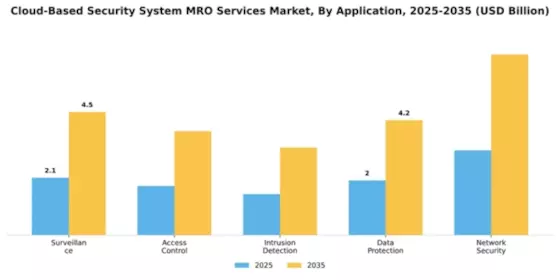
Surveillance (Dominant) vs. Intrusion Detection (Emerging)
Surveillance solutions dominate the Cloud-Based Security System MRO Services Market, providing comprehensive monitoring capabilities that are essential for a wide range of industries, from retail to critical infrastructure. Their extensive adoption is driven by the increasing need for enhanced safety measures and regulatory compliance. Conversely, the Intrusion Detection segment is emerging as a critical area of focus, driven by the rising threat landscape in terms of cyber and physical threats. While still developing, Intrusion Detection is becoming pivotal as organizations prioritize proactive measures against security breaches, thus increasing demand for advanced detection services.
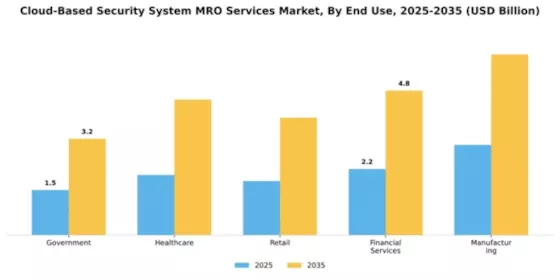
In the Cloud-Based Security System MRO Services Market, the distribution of market share among end-use segments reveals Healthcare as the largest contributor. This sector benefits from significant investments towards strengthening cybersecurity measures due to the sensitive nature of patient data and compliance with strict regulations. Conversely, the Financial Services sector is emerging as the fastest-growing segment, characterized by a substantial rise in cyber threats and the increasing transition towards digital banking services, driving the demand for robust cloud security solutions.
Healthcare: Largest vs. Financial Services: Fastest-Growing
The Healthcare segment stands out in the Cloud-Based Security System MRO Services Market as a dominant force, driven by the urgent need for dependable security systems to protect confidential patient information. The focus on regulatory compliance and patient privacy has propelled healthcare organizations to invest heavily in advanced cloud-based security solutions. In contrast, the Financial Services segment, classified as the fastest-growing area, is constantly adapting to the rapid evolution of digital transactions and emerging cyber threats. Financial institutions are compelled to adopt innovative security measures to safeguard sensitive financial data, making this segment a critical area of growth and development in the MRO services landscape.
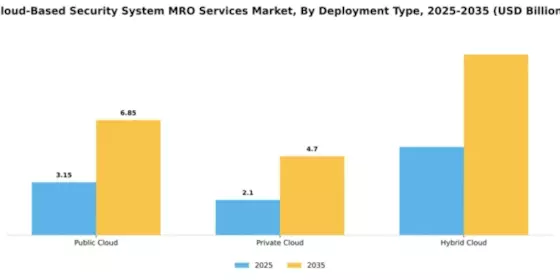
The deployment type in the Cloud-Based Security System MRO Services Market is primarily dominated by the Public Cloud, which benefits from extensive scalability and cost-efficiency that particularly attracts small to medium-sized enterprises. This segment has captured a significant portion of the market due to its flexibility and ease of access for various organizations, facilitating a broader adoption of cloud security technologies. On the other hand, the Hybrid Cloud is emerging as a vital player, blending on-premises and online resources, and tailored for organizations requiring both control and flexibility in their security frameworks. As the demand for more secure and adaptable deployment types increases, the Hybrid Cloud is showing the fastest growth within the market. Adopting a hybrid model allows companies to manage sensitive data more securely while leveraging the massively scalable benefits of public cloud systems. The rise in remote work and digital transformations among enterprises is acting as a catalyst for this growth, as organizations seek hybrid solutions that seamlessly integrate their existing infrastructure with cloud-based security services.
Public Cloud (Dominant) vs. Hybrid Cloud (Emerging)
The Public Cloud represents the dominant segment of the Cloud-Based Security System MRO Services Market, providing businesses with scalable, on-demand resources to meet fluctuating security needs. Organizations are drawn to its lower initial costs, rapid deployment capabilities, and the broad array of tools available, making it an attractive option for a variety of security applications. Public Cloud services typically offer high availability and centralized management, which simplifies maintenance and updates. Conversely, the Hybrid Cloud is recognized as an emerging segment that is rapidly gaining traction. This approach allows for customizable solutions that combine the strengths of both public and private environments, catering to businesses that have complex requirements—including compliance and data sovereignty concerns. By utilizing hybrid solutions, companies can maintain critical security functions while capitalizing on the cost-efficiencies of the Public Cloud, thus positioning themselves strategically for future growth.
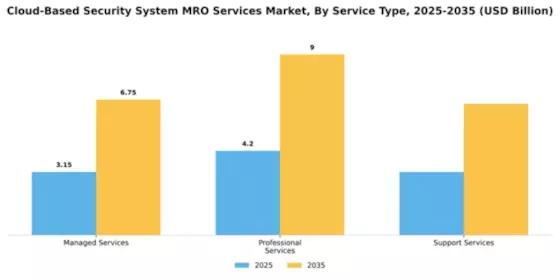
In the Cloud-Based Security System MRO Services Market, Managed Services account for the largest share, positioning themselves as the backbone of security infrastructure for organizations leveraging cloud technologies. This segment is being embraced for its ability to deliver ongoing support, mitigate risks, and enhance compliance. On the other hand, Professional Services are gaining traction, highlighting the increasing demand for specialized expertise and tailored solutions. This shift signifies a more nuanced approach to cloud security management, focusing on specific client needs and strategic implementations.
Managed Services: Dominant vs. Professional Services: Emerging
Managed Services are recognized as the dominant force within the Cloud-Based Security System MRO Services Market; they provide a comprehensive framework for organizations to maintain their security posture effectively. Organizations prefer these services due to their holistic approach, which includes continuous monitoring, threat detection, and incident response, allowing businesses to focus on core operations while outsourcing security management. In contrast, Professional Services are emerging rapidly, driven by the need for customized solutions and advanced consulting interventions. As businesses increasingly recognize the complexity of cloud environments, the demand for Professional Services is expanding, enabling firms to leverage expert insights and tailor their security measures to meet regulatory compliance and specific risk profiles.
The Cloud-Based Security System MRO Services Market is witnessing substantial segmentation by technology, with Artificial Intelligence (AI) holding the largest market share. AI plays a crucial role in enhancing security measures, offering predictive analytics, and automating threat detection, which solidifies its dominance in the market. On the other hand, Machine Learning (ML) is rapidly gaining traction, driven by its capability to analyze vast amounts of data for real-time decision-making and adaptive security solutions. This dynamic is reshaping the competitive landscape as organizations increasingly recognize the value of these technologies in mitigating risks and optimizing resource management.
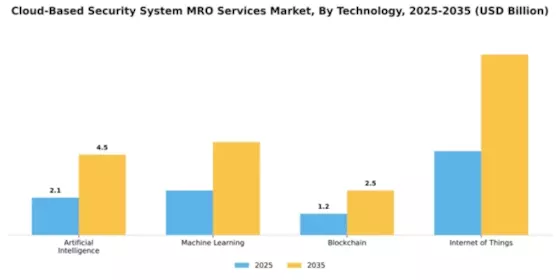
Technology: AI (Dominant) vs. ML (Emerging)
Artificial Intelligence (AI) is recognized as the dominant force within the Cloud-Based Security System MRO Services Market. Its ability to integrate automated processes with security protocols leads to enhanced threat detection and response effectiveness, making it a vital technology for enterprises. In contrast, Machine Learning (ML) represents the emerging innovation driving transformation within cloud security. ML's capacity to learn from data patterns and improve over time offers organizations sophisticated tools for addressing evolving cyber threats. While AI provides a foundational infrastructure for security applications, the agile and adaptive nature of ML positions it as a burgeoning force, enabling businesses to stay ahead of increasingly complex digital threats.
Get more detailed insights about Cloud-Based Security System MRO Services Market Request Free Sample
North America continues to lead the Cloud-Based Security System MRO Services market, holding a significant share of 5.25 billion in 2024. The region's growth is driven by increasing cyber threats, regulatory compliance requirements, and a shift towards digital transformation. Companies are investing heavily in cloud security solutions to protect sensitive data and maintain customer trust. The demand for advanced security measures is further fueled by the rise of remote work and cloud adoption. The competitive landscape in North America is robust, featuring key players such as Microsoft, Amazon, and IBM. These companies are at the forefront of innovation, offering comprehensive security solutions tailored to various industries. The presence of established tech giants and a strong startup ecosystem fosters a dynamic environment for growth. As organizations prioritize cybersecurity, the market is expected to expand, driven by continuous advancements in technology and increasing awareness of security risks.
Europe's Cloud-Based Security System MRO Services market is valued at 2.8 billion, reflecting a growing recognition of the importance of cybersecurity. The region is experiencing increased demand for cloud security services due to stringent regulations like GDPR, which mandate robust data protection measures. Additionally, the rise in cyberattacks has prompted organizations to invest in comprehensive security solutions, driving market growth. The focus on digital transformation across various sectors further accelerates this trend. Leading countries in Europe, such as Germany, the UK, and France, are witnessing significant investments in cloud security. The competitive landscape includes major players like Cisco and Palo Alto Networks, who are innovating to meet the evolving needs of businesses. The presence of regulatory bodies ensures that companies adhere to high standards of security, fostering a secure environment for cloud services. As the market matures, collaboration between tech firms and regulatory agencies will be crucial for sustained growth.
The Asia-Pacific region, valued at 2.0 billion, is rapidly emerging as a significant player in the Cloud-Based Security System MRO Services market. The growth is driven by increasing internet penetration, a surge in cyber threats, and the adoption of cloud technologies across various sectors. Governments are also implementing regulations to enhance cybersecurity frameworks, which is further propelling market demand. The region's diverse economies are investing in advanced security solutions to safeguard critical infrastructure and data. Countries like China, India, and Japan are leading the charge in adopting cloud security services. The competitive landscape features key players such as Trend Micro and Fortinet, who are expanding their offerings to cater to local needs. As organizations prioritize cybersecurity, the market is expected to grow significantly, supported by government initiatives and a rising awareness of security risks among businesses and consumers alike.
The Middle East and Africa region, with a market size of 0.45 billion, is witnessing a gradual increase in demand for Cloud-Based Security System MRO Services. The growth is driven by rising cyber threats and the need for compliance with international security standards. Governments are beginning to recognize the importance of cybersecurity, leading to increased investments in security infrastructure. The region's diverse economic landscape presents both challenges and opportunities for market expansion. Countries like the UAE and South Africa are at the forefront of adopting cloud security solutions. The competitive landscape is evolving, with both local and international players entering the market. As awareness of cybersecurity risks grows, organizations are increasingly prioritizing investments in security services. The potential for growth in this region is significant, as businesses seek to enhance their security posture in an increasingly digital world.
The Cloud-Based Security System MRO Services Market is currently characterized by a dynamic competitive landscape, driven by the increasing demand for robust security solutions amid rising cyber threats. Major players such as Microsoft (US), Amazon (US), and Palo Alto Networks (US) are strategically positioning themselves through innovation and partnerships. Microsoft (US) emphasizes its cloud capabilities, integrating advanced security features into its Azure platform, while Amazon (US) focuses on enhancing its AWS security offerings through continuous updates and customer-centric solutions. Palo Alto Networks (US) is leveraging its expertise in AI-driven security to differentiate its services, indicating a trend towards more intelligent and adaptive security measures.The market structure appears moderately fragmented, with a mix of established players and emerging startups. Key business tactics include localizing services to meet regional compliance requirements and optimizing supply chains to enhance service delivery. This collective influence of major players fosters a competitive environment where agility and responsiveness to market needs are paramount.In November Microsoft (US) announced a significant partnership with a leading telecommunications provider to enhance its cloud security offerings, aiming to deliver integrated solutions that address both security and connectivity challenges. This strategic move is likely to bolster Microsoft's market position by expanding its reach and enhancing its service portfolio, thereby appealing to a broader customer base.In October Amazon (US) launched a new suite of security tools within its AWS platform, designed to provide real-time threat detection and response capabilities. This initiative underscores Amazon's commitment to maintaining its competitive edge by continuously evolving its service offerings to meet the growing demands for security in cloud environments. The introduction of these tools may significantly enhance customer trust and retention.In September Palo Alto Networks (US) unveiled a new AI-driven security framework aimed at automating threat detection and response processes. This development not only reflects the company's focus on innovation but also positions it as a leader in the integration of AI within security services. The strategic importance of this move lies in its potential to reduce response times and improve overall security efficacy for clients.As of December the competitive trends in the Cloud-Based Security System MRO Services Market are increasingly defined by digitalization, sustainability, and the integration of AI technologies. Strategic alliances are becoming more prevalent, as companies recognize the value of collaboration in enhancing service offerings and expanding market reach. Looking ahead, competitive differentiation is likely to evolve from traditional price-based competition towards a focus on innovation, technological advancements, and supply chain reliability, suggesting a shift in how companies will vie for market share.





The Cloud-Based Security System MRO Services Market is projected to grow at a 7.09% CAGR from 2025 to 2035, driven by increasing cybersecurity threats and demand for operational efficiency.
New opportunities lie in:
By 2035, the market is expected to solidify its position as a leader in security solutions.
| MARKET SIZE 2024 | 10.5(USD Billion) |
| MARKET SIZE 2025 | 11.24(USD Billion) |
| MARKET SIZE 2035 | 22.3(USD Billion) |
| COMPOUND ANNUAL GROWTH RATE (CAGR) | 7.09% (2025 - 2035) |
| REPORT COVERAGE | Revenue Forecast, Competitive Landscape, Growth Factors, and Trends |
| BASE YEAR | 2024 |
| Market Forecast Period | 2025 - 2035 |
| Historical Data | 2019 - 2024 |
| Market Forecast Units | USD Billion |
| Key Companies Profiled | Microsoft (US), Amazon (US), IBM (US), Cisco (US), Palo Alto Networks (US), Fortinet (US), Check Point Software (IL), McAfee (US), Trend Micro (JP), CrowdStrike (US) |
| Segments Covered | Application, End Use, Deployment Type, Service Type, Technology |
| Key Market Opportunities | Integration of artificial intelligence enhances efficiency in Cloud-Based Security System MRO Services Market. |
| Key Market Dynamics | Rising demand for integrated solutions drives competition and innovation in Cloud-Based Security System Maintenance, Repair, and Overhaul Services. |
| Countries Covered | North America, Europe, APAC, South America, MEA |
The projected market valuation for the Cloud-Based Security System MRO Services Market is 22.3 USD Billion by 2035.
The overall market valuation was 10.5 USD Billion in 2024.
The expected CAGR for the Cloud-Based Security System MRO Services Market during the forecast period 2025 - 2035 is 7.09%.
Key players in the market include Microsoft, Amazon, IBM, Cisco, Palo Alto Networks, Fortinet, Check Point Software, McAfee, Trend Micro, and CrowdStrike.
The Surveillance segment is projected to reach 4.5 USD Billion by 2035.
The Data Protection segment's valuation increases from 2.0 USD Billion in 2024 to 4.2 USD Billion by 2035.
The Hybrid Cloud deployment type is expected to generate revenues of 10.75 USD Billion by 2035.
The Financial Services end-use segment is projected to grow to 4.8 USD Billion by 2035.
The Internet of Things technology segment is expected to achieve the highest revenue of 10.1 USD Billion by 2035.
Professional Services are projected to generate revenues of 9.0 USD Billion by 2035.



Kindly complete the form below to receive a free sample of this Report

“This is really good guys. Excellent work on a tight deadline. I will continue to use you going forward and recommend you to others. Nice job”


“Thanks. It’s been a pleasure working with you, please use me as reference with any other Intel employees.”


“Thanks for sending the report it gives us a good global view of the Betaïne market.”


“Thank you, this will be very helpful for OQS.”


“We found the report very insightful! we found your research firm very helpful. I'm sending this email to secure our future business.”


“I am very pleased with how market segments have been defined in a relevant way for my purposes (such as "Portable Freezers & refrigerators" and "last-mile"). In general the report is well structured. Thanks very much for your efforts.”


“I have been reading the first document or the study, ,the Global HVAC and FP market report 2021 till 2026. Must say, good info! I have not gone in depth at all parts, but got a good indication of the data inside!”


“We got the report in time, we really thank you for your support in this process. I also thank to all of your team as they did a great job.”


“The Automotive 48V ECU Components Procurement Intelligence Study” was a complex project, but the Market Research Future (MRFR) team handled it with quality, agility, and customer-centricity. They delivered all requested data on time and within the agreed scope. The team, including Shubhendra Anand and Rahul Gotadki, was always readily available to clarify questions and swiftly implement necessary adjustments, driving the project to a successful conclusion within a very demanding timeframe.
I would also like to specifically commend Akshay Agarwal for his responsiveness and support at every stage—from our initial inquiry on May 6th through to final delivery on June 18th. His dedication made the entire process seamless.”



