Download Free Sample
Kindly complete the form below to receive a free sample of this Report
CNC Machine Tools MRO Services Market Research Report By Technology (Conventional Machining, Computer Numerical Control, Hybrid Machining, Additive Manufacturing), By Application (Preventive Maintenance, Corrective Maintenance, Predictive Maintenance, Overhaul Services), By Service Type (Repair Services, Replacement Services, Calibration Services, Installation Services), By Customer Type (Original Equipment Manufacturers, Independent Service Providers, In-House Maintenance Teams), By End Use Industry (Aerospace, Automotive, Manufacturing, Electronics) And By Region (North America, Europe, Asia-Pacific, And Rest Of The World) – Market Forecast Till 2035.
As per MRFR analysis, the CNC Machine Tools MRO Services Market was estimated at 20.5 USD Billion in 2024. The CNC Machine Tools MRO Services industry is projected to grow from 21.22 USD Billion in 2025 to 30.0 USD Billion by 2035, exhibiting a compound annual growth rate (CAGR) of 3.52% during the forecast period 2025 - 2035.
The CNC Machine Tools MRO Services Market is poised for substantial growth driven by technological advancements and evolving customer needs.
| 2024 Market Size | 20.5 (USD Billion) |
| 2035 Market Size | 30.0 (USD Billion) |
| CAGR (2025 - 2035) | 3.52% |
Siemens (DE), Fanuc (JP), Mitsubishi Electric (JP), Haas Automation (US), DMG Mori (DE), Okuma (JP), Yamazaki Mazak (JP), KUKA (DE), FANUC America (US)
Our Impact
Enabled $4.3B Revenue Impact for Fortune 500 and Leading Multinationals
Partnering with 2000+ Global Organizations Each Year
30K+ Citations by Top-Tier Firms in the Industry
The CNC Machine Tools MRO Services Market is currently experiencing a dynamic evolution, driven by the increasing demand for precision engineering and the need for efficient maintenance solutions. As industries continue to embrace automation and advanced manufacturing techniques, the reliance on CNC machine tools has intensified. This trend suggests that companies are prioritizing the upkeep of their machinery to ensure optimal performance and minimize downtime. Furthermore, the integration of smart technologies into maintenance practices appears to be reshaping the landscape, enabling predictive maintenance and real-time monitoring of equipment health. In addition, the growing emphasis on sustainability and resource efficiency is influencing the CNC Machine Tools MRO Services Market. Organizations are increasingly seeking eco-friendly solutions that not only enhance operational efficiency but also reduce environmental impact. This shift indicates a broader trend towards responsible manufacturing practices, where companies are motivated to adopt MRO services that align with their sustainability goals. As the market continues to evolve, it is likely that innovation and adaptability will play crucial roles in shaping the future of CNC machine tools maintenance and repair services.
The incorporation of smart technologies into CNC machine tools MRO services is becoming more prevalent. This trend indicates a shift towards predictive maintenance, where data analytics and IoT devices monitor equipment performance in real-time. Such advancements may lead to reduced downtime and enhanced operational efficiency.
There is a growing emphasis on sustainable practices within the CNC Machine Tools MRO Services Market. Companies are increasingly seeking eco-friendly maintenance solutions that not only improve efficiency but also minimize environmental impact. This trend suggests a broader commitment to responsible manufacturing.
The demand for tailored MRO services is on the rise, as businesses recognize the need for solutions that cater to their specific operational requirements. This trend indicates a shift towards more personalized service offerings, allowing companies to optimize their maintenance strategies.
The growing adoption of automation in manufacturing processes is a key driver for the CNC Machine Tools MRO Services Market. As industries increasingly integrate automated systems to enhance production capabilities, the reliance on CNC machines becomes more pronounced. This shift necessitates a robust MRO framework to ensure that these automated systems operate seamlessly. The automation market is projected to witness a CAGR of approximately 10% over the next few years, indicating a substantial increase in the number of CNC machines requiring maintenance and repair services. Consequently, the CNC Machine Tools MRO Services Market is poised to expand as manufacturers seek to maintain their automated systems effectively.
The CNC Machine Tools MRO Services Market experiences a notable surge in demand for precision engineering across various sectors, including aerospace, automotive, and medical devices. As industries increasingly rely on high-precision components, the need for effective maintenance, repair, and operations (MRO) services becomes paramount. This trend is driven by the necessity to minimize production downtime and enhance operational efficiency. According to recent data, the precision engineering sector is projected to grow at a compound annual growth rate (CAGR) of approximately 6% over the next five years. Consequently, the CNC Machine Tools MRO Services Market is likely to benefit from this growth, as manufacturers seek reliable MRO solutions to maintain their advanced machinery.
The CNC Machine Tools MRO Services Market is significantly impacted by the increasing focus on operational efficiency among manufacturers. Companies are striving to enhance productivity while minimizing costs, leading to a greater emphasis on effective maintenance strategies. This trend is evident as organizations adopt lean manufacturing principles, which prioritize the reduction of waste and the optimization of processes. As a result, the demand for MRO services that can ensure the reliability and longevity of CNC machines is on the rise. Recent studies suggest that organizations implementing comprehensive MRO strategies can achieve up to a 20% reduction in operational costs, thereby underscoring the importance of the CNC Machine Tools MRO Services Market in achieving these efficiency goals.
Regulatory compliance and safety standards play a crucial role in shaping the CNC Machine Tools MRO Services Market. As industries face increasing scrutiny regarding workplace safety and environmental regulations, the demand for MRO services that ensure compliance with these standards is likely to rise. Companies are compelled to maintain their CNC machines in accordance with stringent regulations to avoid penalties and ensure safe operations. This trend is particularly evident in sectors such as aerospace and automotive, where compliance is non-negotiable. The market for MRO services that address these regulatory requirements is expected to grow, reflecting the critical importance of the CNC Machine Tools MRO Services Market in supporting safe and compliant manufacturing practices.
Technological advancements in CNC machinery significantly influence the CNC Machine Tools MRO Services Market. The introduction of sophisticated CNC machines equipped with IoT capabilities and AI-driven analytics enhances operational efficiency and predictive maintenance. These innovations allow for real-time monitoring of machine performance, thereby reducing the likelihood of unexpected breakdowns. As a result, the demand for specialized MRO services that can support these advanced technologies is expected to rise. Industry reports indicate that the market for smart CNC machines is anticipated to expand at a CAGR of around 8% in the coming years, further propelling the CNC Machine Tools MRO Services Market as manufacturers seek to optimize their investments.
In the CNC Machine Tools MRO Services Market, Preventive Maintenance holds a significant market share, due to its widespread adoption among manufacturers looking to minimize unexpected equipment failures. This segment is favored for its proactive approach, ensuring that machine tools are serviced regularly to maintain optimal performance. Corrective Maintenance, while necessary, is less frequent and thus represents a smaller portion of the overall market. Overhaul Services, though essential for older machinery, also holds a limited share compared to both Preventive and Predictive segments.
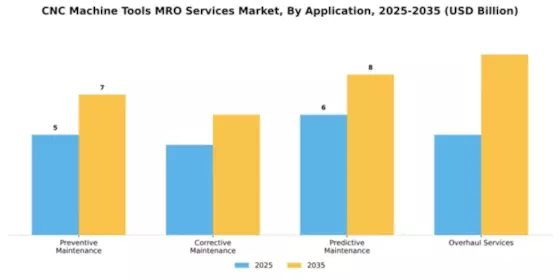
Maintenance Strategies: Preventive (Dominant) vs. Predictive (Emerging)
Preventive Maintenance is recognized as the dominant strategy within the CNC Machine Tools MRO Services Market, characterized by scheduled inspections, adjustments, and replacements to avert potential failures. This method is favored for its ability to extend machinery life and enhance operational efficiency. In contrast, Predictive Maintenance is emerging rapidly, leveraging advanced technologies like IoT and AI to monitor equipment conditions in real time, enabling timely interventions. Its application is increasing among innovative manufacturers, seeking to optimize maintenance processes and reduce downtime. While Preventive Maintenance remains essential, Predictive Maintenance appeals to tech-driven enterprises prioritizing data-driven decision-making.
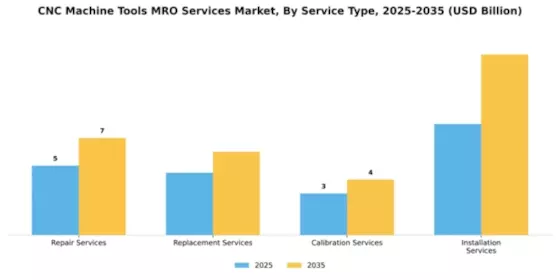
In the CNC Machine Tools MRO Services Market, Repair Services hold the largest share as they are critical for maintaining equipment efficiency and longevity. This segment has traditionally dominated the market due to the high frequency of maintenance required by CNC machines, enabling operators to reduce downtime and extend the lifespan of their machine tools. Replacement and Installation Services follow closely, with a significant portion of market activity driven by technological advancements and the need for modern capabilities in manufacturing environments. Calibrations Services are emerging as the fastest-growing segment, fueled by increasing awareness about precision and accuracy in machining processes. As industries focus on enhancing productivity and quality control, the demand for calibration has surged. Additionally, regulatory requirements and manufacturing standards are propelling the growth of this service type, making it essential for businesses aiming to stay competitive in a rapidly evolving market.
Repair Services (Dominant) vs. Calibration Services (Emerging)
Repair Services in the CNC Machine Tools MRO Services Market are characterized by their critical function in maintaining operational efficiency and reducing machine downtime. This segment is well-established, with a vast network of service providers and a customer base that relies on timely repairs to minimize disruptions in production. In contrast, Calibration Services are rapidly gaining traction due to their essential role in ensuring the precision and accuracy of CNC operations. As manufacturers face increasing competition and quality demands, the emerging focus on calibration highlights a shift towards more sophisticated service offerings. This growing emphasis on precision not only enhances product quality but also drives the need for regular calibration services, positioning it as a vital segment in the MRO landscape.
In the CNC Machine Tools MRO Services Market, the distribution of market share by end use industry reveals a robust demand from the Aerospace sector, which holds the largest share. The advanced complexity and precision required in aerospace manufacturing drive a steady need for CNC machine tools and their maintenance. In contrast, the Automotive industry follows closely, leveraging CNC machine tools to enhance productivity and precision in manufacturing. Both industries significantly influence the overall market dynamics, with specific needs shaping the MRO services landscape.
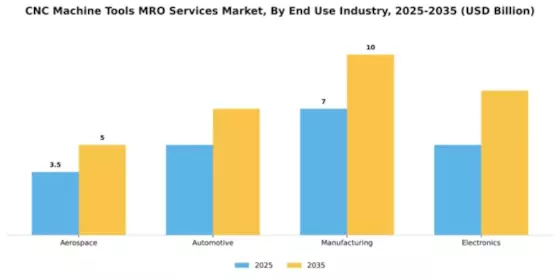
Aerospace (Dominant) vs. Automotive (Emerging)
The Aerospace sector stands out as a dominant force within the CNC Machine Tools MRO Services Market, given its stringent regulatory requirements and commitment to quality. Aerospace companies prioritize maintenance services that ensure operational excellence and compliance with safety standards, leading to heightened demand for specialized CNC tools. Conversely, the Automotive industry, labeled as emerging, is experiencing rapid growth due to innovations in electric vehicles and automation. This segment is increasingly integrating advanced CNC solutions to streamline production processes, reflecting a pivot toward efficiency and smart manufacturing practices.
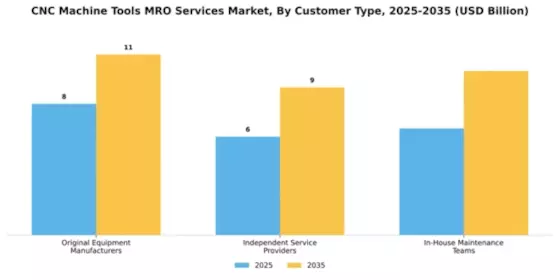
In the CNC Machine Tools MRO Services Market, the customer type segment is primarily dominated by Original Equipment Manufacturers (OEMs), who represent the largest market share. These manufacturers rely heavily on MRO services to maintain their machinery and ensure peak operational efficiency. This reliance has solidified their position as key players in the market, as OEMs necessitate reliable maintenance and repair service providers to support their manufacturing capabilities. On the other hand, Independent Service Providers have emerged as a rapidly growing segment within the CNC MRO landscape. As manufacturers seek flexibility and potentially lower costs, they are increasingly turning to these independent entities for their maintenance needs. This trend suggests a shift in customer preferences towards more diverse service options, with independent firms capitalizing on the demand for specialized and efficient MRO solutions.
Customer Type: OEMs (Dominant) vs. Independent Service Providers (Emerging)
The Original Equipment Manufacturers (OEMs) segment remains dominant in the CNC Machine Tools MRO Services Market due to their critical role in ensuring machine longevity and reliability. These OEMs often offer tailored maintenance packages and repair services that cater to the specific needs of their machinery users. In contrast, Independent Service Providers, while currently emerging, are increasingly recognized for their adaptability and specialized skill sets. They attract a growing share of the market by providing more cost-effective and flexible services, appealing to manufacturers looking for alternatives to OEM offerings. The competition between these two customer types highlights a dynamic market where value, efficiency, and service quality are paramount.
In the CNC Machine Tools MRO Services Market, the Computer Numerical Control (CNC) segment holds the largest market share due to its precision, flexibility, and efficiency in production processes. CNC machines automate machining tasks, reducing human error and increasing throughput. This segment is well-established and widely adopted across various industries, making it a dominant force in the market. On the other hand, Additive Manufacturing is emerging as the fastest-growing segment, driven by rapid advancements in 3D printing technologies and materials. This approach allows for the production of complex geometries and custom parts, catering to specific production needs. The increasing demand for rapid prototyping and manufacturing flexibility is further fueling the growth of this segment, indicating a transformative shift within the CNC machine tools market.
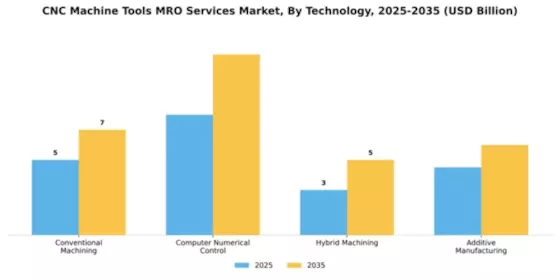
Technology: CNC (Dominant) vs. Additive Manufacturing (Emerging)
The Computer Numerical Control (CNC) segment maintains its dominance by offering unparalleled precision and efficiency, making it the backbone of modern manufacturing processes. Industries such as aerospace, automotive, and medical devices heavily rely on CNC technology for complex parts that require tight tolerances. Its ability to perform numerous operations—from milling to drilling—without manual intervention enhances productivity. In contrast, Additive Manufacturing is gaining traction as an emerging technology, known for its capability to produce intricate designs that traditional methods cannot achieve. Supported by advancements in 3D printing technologies, this segment is particularly appealing for prototyping and small-batch production, where speed and customization are critical. As industries increasingly seek to innovate and reduce waste, Additive Manufacturing's unique advantages present it as a valuable complement to traditional CNC machining.
Get more detailed insights about CNC Machine Tools MRO Services Market Request Free Sample
North America is poised to maintain its leadership in the CNC Machine Tools MRO Services market, holding a significant market share of 10.5 in 2024. The region's growth is driven by advanced manufacturing technologies, increased automation, and a strong focus on operational efficiency. Regulatory support for innovation and sustainability further catalyzes demand, as industries seek to enhance productivity while adhering to environmental standards. The competitive landscape is robust, with key players like Siemens, Haas Automation, and FANUC America leading the charge. The U.S. stands out as a major contributor, supported by a well-established infrastructure and a skilled workforce. The presence of these industry giants fosters a dynamic environment for MRO services, ensuring that North America remains at the forefront of CNC technology advancements.
Europe's CNC Machine Tools MRO Services market is projected to grow, with a market size of 5.5 in 2024. The region benefits from a strong manufacturing base, particularly in Germany and Italy, where innovation and quality are paramount. Regulatory frameworks promoting energy efficiency and sustainability are driving demand for advanced MRO services, as companies aim to reduce operational costs and environmental impact. Germany leads the market, supported by key players like DMG Mori and Siemens, who are investing heavily in R&D. The competitive landscape is characterized by a mix of established firms and emerging startups, fostering innovation. The European market is also witnessing increased collaboration between manufacturers and service providers, enhancing service delivery and customer satisfaction.
The Asia-Pacific region is experiencing significant growth in the CNC Machine Tools MRO Services market, with a size of 4.5 in 2024. This growth is fueled by rising industrialization, particularly in countries like China and Japan, where demand for precision engineering is surging. Government initiatives aimed at boosting manufacturing capabilities and technological advancements are also key drivers of market expansion. China is a major player in this landscape, with companies like Fanuc and Mitsubishi Electric leading the charge. The competitive environment is intensifying as local firms emerge, offering innovative solutions tailored to regional needs. The presence of established The CNC Machine Tools MRO Services, fostering competition and driving service quality improvements.
The Middle East and Africa region, while currently smaller in the CNC Machine Tools MRO Services market with a size of 0.5 in 2024, presents significant growth opportunities. The region is witnessing increased investments in manufacturing and infrastructure, driven by economic diversification efforts in countries like the UAE and South Africa. Regulatory support for industrial development is also enhancing the demand for MRO services. South Africa is emerging as a key player, with local firms beginning to adopt advanced CNC technologies. The competitive landscape is still developing, with opportunities for international players to enter the market. As the region continues to industrialize, the demand for efficient and reliable MRO services is expected to rise, paving the way for future growth.
The CNC Machine Tools MRO Services Market is characterized by a dynamic competitive landscape, driven by technological advancements and increasing demand for precision manufacturing. Key players such as Siemens (DE), Fanuc (JP), and DMG Mori (DE) are strategically positioned to leverage innovation and digital transformation to enhance their service offerings. Siemens (DE) focuses on integrating IoT solutions into its MRO services, thereby improving operational efficiency and predictive maintenance capabilities. Meanwhile, Fanuc (JP) emphasizes automation and robotics, which are pivotal in streamlining MRO processes and reducing downtime for clients. DMG Mori (DE) adopts a dual strategy of expanding its global footprint while investing in advanced manufacturing technologies, which collectively shapes a competitive environment that is increasingly reliant on technological prowess and service differentiation.The market structure appears moderately fragmented, with a mix of established players and emerging companies vying for market share. Key business tactics include localizing manufacturing to reduce lead times and optimizing supply chains to enhance service delivery. This competitive structure allows for a diverse range of offerings, where companies can tailor their MRO services to meet specific regional demands, thus fostering a more responsive market.In November Siemens (DE) announced the launch of its new digital platform aimed at enhancing predictive maintenance capabilities for CNC machine tools. This strategic move is significant as it positions Siemens at the forefront of digital transformation in the MRO sector, potentially leading to reduced operational costs for clients and improved machine uptime. The integration of advanced analytics into their service offerings may also provide a competitive edge in a market increasingly focused on data-driven decision-making.In October Fanuc (JP) unveiled a new line of AI-driven CNC machines designed to optimize machining processes and reduce energy consumption. This initiative underscores Fanuc's commitment to sustainability and innovation, aligning with global trends towards environmentally friendly manufacturing practices. The introduction of AI capabilities not only enhances operational efficiency but also positions Fanuc as a leader in the integration of smart technologies within the MRO landscape.In September DMG Mori (DE) expanded its partnership with a leading software provider to enhance its digital service offerings. This collaboration aims to integrate advanced software solutions into DMG Mori's MRO services, facilitating real-time monitoring and analytics for clients. Such strategic alliances are crucial in a market where technological integration is paramount, allowing DMG Mori to offer comprehensive solutions that address the evolving needs of manufacturers.As of December current trends in the CNC Machine Tools MRO Services Market indicate a strong shift towards digitalization, sustainability, and AI integration. Strategic alliances are increasingly shaping the competitive landscape, enabling companies to pool resources and expertise to deliver innovative solutions. The evolution of competitive differentiation appears to be moving away from price-based competition towards a focus on technological innovation, reliability, and supply chain efficiency. This shift suggests that companies that prioritize these aspects may be better positioned to thrive in the future.



The CNC Machine Tools MRO Services Market is projected to grow at a 3.52% CAGR from 2025 to 2035, driven by technological advancements and increasing automation.
New opportunities lie in:
By 2035, the market is expected to achieve robust growth, reflecting evolving industry demands.
| MARKET SIZE 2024 | 20.5(USD Billion) |
| MARKET SIZE 2025 | 21.22(USD Billion) |
| MARKET SIZE 2035 | 30.0(USD Billion) |
| COMPOUND ANNUAL GROWTH RATE (CAGR) | 3.52% (2025 - 2035) |
| REPORT COVERAGE | Revenue Forecast, Competitive Landscape, Growth Factors, and Trends |
| BASE YEAR | 2024 |
| Market Forecast Period | 2025 - 2035 |
| Historical Data | 2019 - 2024 |
| Market Forecast Units | USD Billion |
| Key Companies Profiled | Siemens (DE), Fanuc (JP), Mitsubishi Electric (JP), Haas Automation (US), DMG Mori (DE), Okuma (JP), Yamazaki Mazak (JP), KUKA (DE), FANUC America (US) |
| Segments Covered | Application, Service Type, End Use Industry, Customer Type, Technology |
| Key Market Opportunities | Integration of advanced predictive maintenance technologies enhances efficiency in the CNC Machine Tools MRO Services Market. |
| Key Market Dynamics | Rising demand for advanced CNC Machine Tools MRO Services driven by technological advancements and evolving consumer expectations. |
| Countries Covered | North America, Europe, APAC, South America, MEA |
As of 2024, the market valuation stood at 20.5 USD Billion.
The market is expected to reach a valuation of 30.0 USD Billion by 2035.
The market is anticipated to grow at a CAGR of 3.52% from 2025 to 2035.
The market segments by application include Preventive Maintenance, Corrective Maintenance, Predictive Maintenance, and Overhaul Services.
The projected values for Predictive Maintenance range from 6.0 to 8.0 USD Billion.
Key players include Siemens, Fanuc, Mitsubishi Electric, Haas Automation, and DMG Mori.
The service type segment includes Repair Services, Replacement Services, Calibration Services, and Installation Services.
The projected market value for Installation Services ranges from 8.0 to 13.0 USD Billion.
The end-use industries include Aerospace, Automotive, Manufacturing, and Electronics.
The Automotive sector is projected to contribute between 5.0 and 7.0 USD Billion to the market.



Kindly complete the form below to receive a free sample of this Report

“This is really good guys. Excellent work on a tight deadline. I will continue to use you going forward and recommend you to others. Nice job”


“Thanks. It’s been a pleasure working with you, please use me as reference with any other Intel employees.”


“Thanks for sending the report it gives us a good global view of the Betaïne market.”


“Thank you, this will be very helpful for OQS.”


“We found the report very insightful! we found your research firm very helpful. I'm sending this email to secure our future business.”


“I am very pleased with how market segments have been defined in a relevant way for my purposes (such as "Portable Freezers & refrigerators" and "last-mile"). In general the report is well structured. Thanks very much for your efforts.”


“I have been reading the first document or the study, ,the Global HVAC and FP market report 2021 till 2026. Must say, good info! I have not gone in depth at all parts, but got a good indication of the data inside!”


“We got the report in time, we really thank you for your support in this process. I also thank to all of your team as they did a great job.”


“The Automotive 48V ECU Components Procurement Intelligence Study” was a complex project, but the Market Research Future (MRFR) team handled it with quality, agility, and customer-centricity. They delivered all requested data on time and within the agreed scope. The team, including Shubhendra Anand and Rahul Gotadki, was always readily available to clarify questions and swiftly implement necessary adjustments, driving the project to a successful conclusion within a very demanding timeframe.
I would also like to specifically commend Akshay Agarwal for his responsiveness and support at every stage—from our initial inquiry on May 6th through to final delivery on June 18th. His dedication made the entire process seamless.”



