×
Request Free Sample ×

Kindly complete the form below to receive a free sample of this Report

* Please use a valid business email

Leading companies partner with us for data-driven Insights

clients tt-cursor
Hero Background

Coated Fabrics Market

ID: MRFR/CnM/4676-HCR
100 Pages
Priya Nagrale
October 2025

Coated Fabrics Market Research Report Information By Type (Polymer Coated, Rubber Coated, Fabric Backed), By Application (Transportation, Protective Clothing, Industrial, Furniture And Others) And By Region (North America, Europe, Asia-Pacific, And Rest Of The World) –Market Forecast Till 2035

Share:
Download PDF ×

We do not share your information with anyone. However, we may send you emails based on your report interest from time to time. You may contact us at any time to opt-out.

Coated Fabrics Market Infographic
Purchase Options

Coated Fabrics Market Summary

As per MRFR analysis, the Coated Fabrics Market Size was estimated at 36.09 USD Billion in 2024. The coated fabrics industry is projected to grow from 37.63 USD Billion in 2025 to 57.12 USD Billion by 2035, exhibiting a compound annual growth rate (CAGR) of 4.26 during the forecast period 2025 - 2035.

Key Market Trends & Highlights

The Coated Fabrics Market is experiencing a dynamic shift towards sustainability and technological innovation.

  • North America remains the largest market for coated fabrics, driven by robust demand across various industries.
  • The Asia-Pacific region is emerging as the fastest-growing market, fueled by increasing industrialization and urbanization.
  • The automotive segment continues to dominate, while the aerospace segment is witnessing rapid growth due to advancements in material technology.
  • Key market drivers include rising demand in the automotive sector and sustainability trends that influence material choices.

Market Size & Forecast

2024 Market Size 36.09 (USD Billion)
2035 Market Size 57.12 (USD Billion)
CAGR (2025 - 2035) 4.26%

Major Players

Dunlop (GB), Continental (DE), Saint-Gobain (FR), Sioen Industries (BE), Trelleborg (SE), Serge Ferrari (FR), Miller Weldmaster (US), Herculite Products (US), Avery Dennison (US), Cooley Group (US)

Coated Fabrics Market Trends

The Coated Fabrics Market is currently experiencing a dynamic evolution, driven by various factors that influence its growth trajectory. The increasing demand for durable and versatile materials across multiple industries, including automotive, aerospace, and healthcare, appears to be a primary catalyst. Innovations in coating technologies, such as the development of eco-friendly and high-performance coatings, suggest a shift towards sustainability and enhanced functionality. Furthermore, the rising awareness of safety and protection standards in industrial applications indicates a growing preference for coated fabrics that offer superior resistance to environmental factors and wear and tear. In addition, the Coated Fabrics Market seems to be adapting to changing consumer preferences, with a noticeable trend towards customization and personalization. Manufacturers are likely to invest in research and development to create tailored solutions that meet specific client needs. This adaptability, combined with the ongoing advancements in manufacturing processes, may lead to increased efficiency and reduced production costs. Overall, the Coated Fabrics Market is poised for continued growth, reflecting broader trends in technology and consumer behavior that prioritize quality, sustainability, and innovation.

Sustainability Initiatives

The Coated Fabrics Market is witnessing a notable shift towards sustainable practices. Manufacturers are increasingly focusing on eco-friendly materials and processes, driven by consumer demand for environmentally responsible products. This trend indicates a broader commitment to reducing the ecological footprint of coated fabrics, which may enhance brand loyalty and market competitiveness.

Technological Advancements

Innovations in coating technologies are reshaping the Coated Fabrics Market. The introduction of advanced materials and techniques enhances the performance characteristics of coated fabrics, such as durability and resistance to various environmental factors. This trend suggests that ongoing research and development will play a crucial role in meeting evolving industry standards.

Customization and Personalization

There is a growing trend towards customization within the Coated Fabrics Market. Clients increasingly seek tailored solutions that cater to specific applications and preferences. This shift indicates that manufacturers may need to adopt more flexible production methods to accommodate diverse customer requirements, potentially leading to enhanced customer satisfaction.

Coated Fabrics Market Drivers

Market Growth Projections

The Global Coated Fabrics Market Industry is poised for substantial growth, with projections indicating a market value of 36.1 USD Billion in 2024 and an anticipated increase to 57.1 USD Billion by 2035. This growth trajectory suggests a CAGR of 4.26% from 2025 to 2035, reflecting the industry's resilience and adaptability to changing consumer demands. Various sectors, including automotive, protective clothing, and furniture, are expected to contribute to this growth, highlighting the diverse applications of coated fabrics. The evolving landscape of coated fabrics signifies a promising future for the industry.

Growth in Protective Clothing

The Global Coated Fabrics Market Industry is significantly influenced by the expanding use of coated fabrics in protective clothing. Industries such as construction, healthcare, and manufacturing increasingly require garments that offer protection against hazardous conditions. Coated fabrics provide essential features such as waterproofing, flame resistance, and chemical protection, making them ideal for safety apparel. The rising awareness of occupational safety standards and regulations further propels this trend. As a result, the demand for coated fabrics in protective clothing is expected to bolster market growth, aligning with the overall trajectory of the industry.

Emerging Markets and Urbanization

Emerging markets and urbanization are pivotal drivers of the Global Coated Fabrics Market Industry. As urban populations grow, there is an increasing need for infrastructure development, which in turn drives demand for coated fabrics in construction and transportation applications. Countries in Asia-Pacific and Latin America are witnessing rapid urbanization, leading to heightened investments in public infrastructure and housing. This trend is likely to create new opportunities for coated fabrics, as they are essential in various applications, including tents, tarpaulins, and awnings. The market's expansion in these regions may significantly influence global growth patterns.

Rising Demand in Automotive Sector

The Global Coated Fabrics Market Industry experiences a notable surge in demand from the automotive sector, driven by the need for durable and lightweight materials. Coated fabrics are increasingly utilized in vehicle interiors, including seats, headliners, and dashboards, due to their resistance to wear and tear. In 2024, the market is projected to reach 36.1 USD Billion, reflecting the automotive industry's shift towards enhanced aesthetics and functionality. As manufacturers prioritize quality and performance, the adoption of advanced coated fabrics is likely to grow, contributing to a projected CAGR of 4.26% from 2025 to 2035.

Technological Advancements in Coating Processes

Technological advancements in coating processes are reshaping the Global Coated Fabrics Market Industry. Innovations such as nanotechnology and eco-friendly coatings enhance the performance and sustainability of coated fabrics. These advancements not only improve the durability and functionality of the fabrics but also cater to the growing consumer demand for environmentally responsible products. As manufacturers adopt these cutting-edge technologies, the market is likely to witness an increase in product offerings that meet diverse consumer needs. This trend may contribute to the anticipated growth of the market, with projections indicating a rise to 57.1 USD Billion by 2035.

Increasing Applications in Furniture and Upholstery

The Global Coated Fabrics Market Industry is experiencing growth due to the increasing applications of coated fabrics in furniture and upholstery. The demand for stylish, durable, and easy-to-clean materials in residential and commercial furniture is driving manufacturers to incorporate coated fabrics into their designs. These fabrics offer resistance to stains, fading, and wear, making them suitable for high-traffic areas. As consumers prioritize aesthetics and functionality in their living spaces, the market for coated fabrics in furniture is expected to expand, reflecting broader trends in home decor and design.

Market Segment Insights

By Application: Automotive (Largest) vs. Aerospace (Fastest-Growing)

The Coated Fabrics Market showcases a diverse application landscape, with the automotive sector leading in market share due to the increasing demand for protective and aesthetic coating finishes. This segment encompasses a wide variety of products such as seat covers, upholstery, and protective covers, essential for enhancing durability and appearance. Following closely is the aerospace segment, which, although smaller in share, exhibits rapid growth due to rising investments in lightweight materials and advanced coatings that enhance aircraft performance and longevity.

Automotive (Dominant) vs. Aerospace (Emerging)

The automotive application of coated fabrics is characterized by its extensive usage across different vehicle types, focusing on durability, style, and safety. Manufacturers are increasingly adopting advanced coated fabrics not only for seat upholstery but also for dashboards and interior trims to improve aesthetics and functionality. Meanwhile, the aerospace sector represents an emerging opportunity as it leverages specialized coated fabrics for applications like insulation, interiors, and lightweight structures, crucial for fuel efficiency and performance. The dual focus on innovation and efficiency drives their respective growth trajectories in today's competitive market.

By End Use: Protective Clothing (Largest) vs. Tarpaulins (Fastest-Growing)

In the Coated Fabrics Market, protective clothing holds the largest share, driven by rising safety regulations across multiple industries. Following closely, upholstery and tents share significant portions of the market as well, thanks to ongoing developments in interior design and outdoor recreational activities. Tarpaulins, even with a smaller market share, are rapidly gaining attention due to their utility in transportation and weather protection, showcasing the emerging demand for durable and multifunctional materials. As industries evolve, the growth trends within this segment reveal a robust trajectory for protective clothing driven by technological advancements in materials. Tarpaulins are witnessing an upward trend as the construction and agricultural sectors increasingly adopt coated fabrics for enhanced durability. Meanwhile, upholstery is evolving as consumer preference shifts toward high-performance fabrics that offer aesthetic and functional benefits. This growth is propelled by innovations in textile technologies, which cater to changing consumer demands for sustainable and versatile materials.

Protective Clothing: Dominant vs. Tarpaulins: Emerging

Protective clothing has established itself as a dominant player in the Coated Fabrics Market, characterized by its use in various industries such as construction, healthcare, and manufacturing where safety is paramount. This segment is marked by the use of high-performance coated fabrics that ensure protection against environmental hazards. In contrast, tarpaulins represent an emerging segment, increasingly utilized in sectors like agriculture and logistics for their robust and weather-resistant properties. While protective clothing emphasizes safety compliance, tarpaulins are celebrated for their multipurpose applications, appealing to industries that require reliable shielding against the elements. As consumer awareness increases, both segments are poised for growth, driven by innovation and changing application needs.

By Material Type: Polyurethane (Largest) vs. Polyvinyl Chloride (Fastest-Growing)

The Coated Fabrics Market is characterized by diverse material types, with Polyurethane commanding the largest share. This is primarily due to its versatility and durability, making it an ideal choice for a wide range of applications, including automotive and upholstery. Polyvinyl Chloride has emerged as the fastest-growing segment, fueled by its cost-effectiveness and increasing usage in various industries, enhancing the market dynamics and attracting significant market interest. As manufacturers focus on enhancing the properties of coated fabrics, the demand for high-performance materials continues to rise. Polyurethane's dominant position is supported by its superior performance characteristics, while Polyvinyl Chloride is experiencing rapid adoption in new applications, driven by innovation and changing consumer preferences towards more sustainable materials. The growth in both segments highlights the trend towards specialized applications and the need for materials that meet evolving industry standards.

Polyurethane (Dominant) vs. Polyvinyl Chloride (Emerging)

Polyurethane remains the dominant player in the Coated Fabrics Market, prized for its exceptional durability, flexibility, and resistance to wear and tear. This material is extensively used in applications that require high performance, including automotive interiors and protective clothing. In contrast, Polyvinyl Chloride is recognized as an emerging material within this sector. It offers a balanced combination of affordability and versatility, making it increasingly popular for various applications such as tarpaulins and upholstery. While Polyurethane is often preferred for premium products, the affordability and adaptability of Polyvinyl Chloride make it a compelling alternative, particularly in price-sensitive markets. As manufacturers innovate and develop new products, both materials are likely to play pivotal roles in shaping the future landscape of the coated fabrics market.

By Coating Type: Waterproof Coating (Largest) vs. Flame Retardant Coating (Fastest-Growing)

In the Coated Fabrics Market, Waterproof Coating represents the largest share among various segment values, as it caters to a wide range of applications in industries such as automotive, fashion, and outdoor gear. Its substantial demand stems from consumers’ growing preference for durable and weather-resistant materials, which drives significant investments in manufacturing technologies to enhance product efficiency and longevity. On the other hand, the Flame Retardant Coating segment is emerging as the fastest-growing value in the market, heightened by stringent safety regulations across sectors like construction and aviation. The increasing focus on fire safety and performance is propelling innovations in flame retardant formulations, thus attracting a rising customer base and expanding market reach.

Waterproof Coating (Dominant) vs. Flame Retardant Coating (Emerging)

Waterproof Coating stands as a dominant force in the Coated Fabrics Market, due to its versatility and extensive application across numerous industries. The ability to repel water without compromising fabric breathability makes it ideal for producing outdoor apparel, upholstery, and industrial textiles. Conversely, Flame Retardant Coating, though currently a smaller segment, is witnessing rapid growth driven by increasing regulatory measures around fire safety. This coating is particularly significant in sectors that prioritize worker and consumer safety, such as aerospace and healthcare. Both segments are experiencing constant innovation, with advancements intended to enhance performance and application versatility in their respective domains.

Get more detailed insights about Coated Fabrics Market

Regional Insights

North America : Market Leader in Coated Fabrics

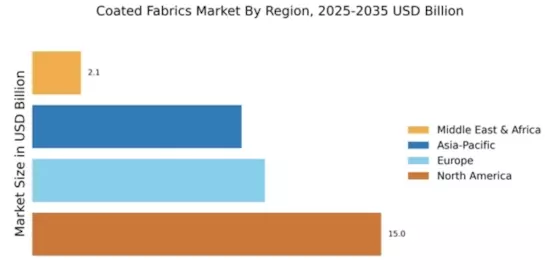
North America is poised to maintain its leadership in the coated fabrics market, holding a significant market share of 15.0 in 2024. The region's growth is driven by increasing demand in automotive, aerospace, and industrial applications, alongside stringent regulations promoting high-quality materials. The presence of advanced manufacturing technologies and a robust supply chain further catalyze market expansion. The United States stands as the largest market, with key players like Dunlop, Continental, and Avery Dennison leading the charge. The competitive landscape is characterized by innovation and strategic partnerships, enhancing product offerings. As companies invest in R&D, the market is expected to witness the introduction of advanced coated fabrics, catering to diverse applications and driving further growth.

Europe : Emerging Market with Growth Potential

Europe's coated fabrics market is on a growth trajectory, with a market size of 10.0 in 2024. The region benefits from a strong focus on sustainability and eco-friendly materials, driven by regulatory frameworks aimed at reducing environmental impact. The demand for coated fabrics in sectors like construction and automotive is also rising, supported by innovations in material technology and design. Leading countries such as Germany, France, and the UK are at the forefront of this market, with companies like Saint-Gobain and Sioen Industries playing pivotal roles. The competitive landscape is marked by a mix of established players and emerging startups, fostering innovation. As the market evolves, collaboration between manufacturers and regulatory bodies will be crucial for compliance and growth.

Asia-Pacific : Rapid Growth in Emerging Markets

The Asia-Pacific region is witnessing rapid growth in the coated fabrics market, with a market size of 9.0 in 2024. This growth is fueled by increasing industrialization, urbanization, and rising disposable incomes, leading to higher demand in sectors such as automotive and consumer goods. Additionally, favorable government policies and investments in infrastructure are acting as catalysts for market expansion. Countries like China, India, and Japan are leading the charge, with a competitive landscape featuring both local and international players. Companies such as Trelleborg and Herculite Products are establishing a strong presence, focusing on innovation and quality. As the market matures, the emphasis on sustainable practices and advanced manufacturing techniques will shape its future trajectory.

Middle East and Africa : Emerging Market with Unique Challenges

The Middle East and Africa region is gradually emerging in the coated fabrics market, with a market size of 2.09 in 2024. The growth is primarily driven by increasing demand in the construction and automotive sectors, alongside a growing awareness of the benefits of coated fabrics. However, challenges such as economic fluctuations and regulatory hurdles may impact market dynamics. Countries like South Africa and the UAE are key players in this market, with a mix of local and international companies striving to capture market share. The competitive landscape is evolving, with firms focusing on innovation and sustainability to meet the unique needs of the region. As investments in infrastructure and industrialization continue, the coated fabrics market is expected to gain momentum.

Key Players and Competitive Insights

The Coated Fabrics Market is currently characterized by a dynamic competitive landscape, driven by innovation, sustainability, and strategic partnerships. Key players such as Dunlop (GB), Continental (DE), and Sioen Industries (BE) are actively shaping the market through their distinct operational focuses. Dunlop (GB) emphasizes product innovation, particularly in developing high-performance coated fabrics for automotive applications, while Continental (DE) is leveraging its technological expertise to enhance the durability and functionality of its offerings. Sioen Industries (BE) appears to be concentrating on sustainability, integrating eco-friendly materials into its production processes, which aligns with the growing demand for environmentally responsible products. Collectively, these strategies contribute to a competitive environment that is increasingly focused on differentiation through quality and sustainability rather than merely competing on price.

In terms of business tactics, companies are localizing manufacturing to reduce lead times and optimize supply chains, which is particularly crucial in a market that is moderately fragmented. This localization strategy not only enhances responsiveness to regional demands but also mitigates risks associated with global supply chain disruptions. The competitive structure of the market indicates that while a few players dominate, there remains ample opportunity for smaller firms to carve out niches, particularly in specialized applications of coated fabrics.

In November 2025, Sioen Industries (BE) announced a strategic partnership with a leading textile recycling firm to develop a new line of coated fabrics made from recycled materials. This initiative not only underscores Sioen's commitment to sustainability but also positions the company as a pioneer in the circular economy within the coated fabrics sector. The collaboration is expected to enhance Sioen's product portfolio and appeal to environmentally conscious consumers, thereby potentially increasing market share.

In October 2025, Continental (DE) unveiled a new range of coated fabrics designed specifically for the aerospace industry, featuring advanced lightweight materials that improve fuel efficiency. This strategic move reflects Continental's focus on innovation and its intent to penetrate high-value markets. By addressing the specific needs of the aerospace sector, Continental is likely to strengthen its competitive position and attract new clients seeking cutting-edge solutions.

In September 2025, Dunlop (GB) expanded its manufacturing capabilities by investing in a state-of-the-art facility in Eastern Europe, aimed at increasing production capacity for its automotive coated fabrics. This expansion not only enhances Dunlop's operational efficiency but also allows for quicker response times to market demands in the region. Such investments are indicative of a broader trend where companies are prioritizing operational scalability to meet growing consumer expectations.

As of December 2025, the Coated Fabrics Market is witnessing trends that emphasize digitalization, sustainability, and the integration of AI technologies. Strategic alliances are increasingly shaping the competitive landscape, enabling companies to pool resources and expertise to innovate more effectively. The shift from price-based competition to a focus on technological advancement and supply chain reliability is becoming evident. Companies that can leverage these trends to differentiate their offerings are likely to thrive in this evolving market.

Key Companies in the Coated Fabrics Market market include

Industry Developments

In April 2021 TechStyles, a division of the AFF group based in South Carolina, introduced new products to address various industry challenges such as longer lead times, rising costs, product availability, inconsistent quality, and higher minimums. The company intends to completely transform the coated fabrics industry.

In March 2021 AFF TechStyles, based in Spartanburg, developed. TechArt is a digitally printed, coated fabric that has joined TechStyle's textile products that feature either pre-developed designs or custom images.

In July 2020 Proquinal Costa Rica, a Spradling Group company, announced a USD 20 million reinvestment in its coated fabric manufacturing plant in Costa Rica. The reinvestment will allow the plant to implement a new process, increasing its export capacity.

Future Outlook

Coated Fabrics Market Future Outlook

The Coated Fabrics Market is projected to grow at a 4.26% CAGR from 2024 to 2035, driven by increasing demand in automotive, healthcare, and protective clothing sectors.

New opportunities lie in:

  • Expansion into sustainable coated fabric technologies
  • Development of smart textiles with integrated sensors
  • Partnerships with automotive manufacturers for specialized applications

By 2035, the Coated Fabrics Market is expected to achieve robust growth and diversification.

Market Segmentation

Coated Fabrics Market End Use Outlook

  • Protective Clothing
  • Upholstery
  • Tarpaulins
  • Tents
  • Inflatable Structures

Coated Fabrics Market Application Outlook

  • Automotive
  • Aerospace
  • Industrial
  • Medical
  • Consumer Goods

Coated Fabrics Market Coating Type Outlook

  • Waterproof Coating
  • Flame Retardant Coating
  • Anti-Static Coating
  • UV Resistant Coating
  • Chemical Resistant Coating

Coated Fabrics Market Material Type Outlook

  • Polyurethane
  • Polyvinyl Chloride
  • Silicone
  • Rubber
  • Polyester

Report Scope

MARKET SIZE 202436.09(USD Billion)
MARKET SIZE 202537.63(USD Billion)
MARKET SIZE 203557.12(USD Billion)
COMPOUND ANNUAL GROWTH RATE (CAGR)4.26% (2024 - 2035)
REPORT COVERAGERevenue Forecast, Competitive Landscape, Growth Factors, and Trends
BASE YEAR2024
Market Forecast Period2025 - 2035
Historical Data2019 - 2024
Market Forecast UnitsUSD Billion
Key Companies ProfiledDunlop (GB), Continental (DE), Saint-Gobain (FR), Sioen Industries (BE), Trelleborg (SE), Serge Ferrari (FR), Miller Weldmaster (US), Herculite Products (US), Avery Dennison (US), Cooley Group (US)
Segments CoveredApplication, End Use, Material Type, Coating Type
Key Market OpportunitiesGrowing demand for sustainable and multifunctional coated fabrics in various industries presents significant market opportunities.
Key Market DynamicsRising demand for sustainable materials drives innovation and competition in the coated fabrics market.
Countries CoveredNorth America, Europe, APAC, South America, MEA

Market Highlights

Author
Priya Nagrale
Senior Research Analyst

With an experience of over five years in market research industry (Chemicals & Materials domain), I gather and analyze market data from diverse sources to produce results, which are then presented back to a client. Also, provide recommendations based on the findings. As a Senior Research Analyst, I perform quality checks (QC) for market estimations, QC for reports, and handle queries and work extensively on client customizations. Also, handle the responsibilities of client proposals, report planning, report finalization, and execution

Leave a Comment

FAQs

How much is the Coated Fabrics market?

The Coated Fabrics Market size was valued at USD 36.09 Billion in 2024.

What is the growth rate of the Coated Fabrics market?

Coated Fabrics Market is expected to grow with a CAGR of 4.26% in the period 2025-2035

Which region held the largest market share in the Coated Fabrics market?

Asia Pacific had the largest share of the global market

Who are the key players in the Coated Fabrics market?

The key players in the market are Saint-Gobain (France), Sioen Industries NV (Belgium)., Mauritzon Inc (U.S.) ContiTech AG (Germany), Isotex S.p.A. (Italy).

Which type led the Coated Fabrics market?

The polymer Coated Fabrics category dominated the market in 2024.

Which application had the largest market share in the Coated Fabrics market?

The transportation sector had the largest share of the global market.

Download Free Sample

Kindly complete the form below to receive a free sample of this Report

Compare Licence

×
Features License Type
Single User Multiuser License Enterprise User
Price $4,950 $5,950 $7,250
Maximum User Access Limit 1 User Upto 10 Users Unrestricted Access Throughout the Organization
Free Customization
Direct Access to Analyst
Deliverable Format
Platform Access
Discount on Next Purchase 10% 15% 15%
Printable Versions