Request Free Sample ×

Kindly complete the form below to receive a free sample of this Report

* Please use a valid business email

Leading companies partner with us for data-driven Insights

clients tt-cursor
Hero Background

Cocoa Beans Market

ID: MRFR/FnB/20216-HCR
128 Pages
Sakshi Gupta
Last Updated: May 28, 2026
Cocoa Beans Market Size, Share, Industry Trend & Analysis Research Report Information By Product Type (Conventional Cocoa Beans, Organic Cocoa Beans, Fine/Flavor Cocoa Beans), By Application (Chocolate Confectionery, Cocoa Butter & Powder (Food), Cosmetics & Pharmaceuticals), By Region (North America, Europe, Asia-Pacific, South America, Middle East & Africa) – Forecast Till 2035
Download PDF ×

We do not share your information with anyone. However, we may send you emails based on your report interest from time to time. You may contact us at any time to opt-out.


Cocoa Beans Market Summary

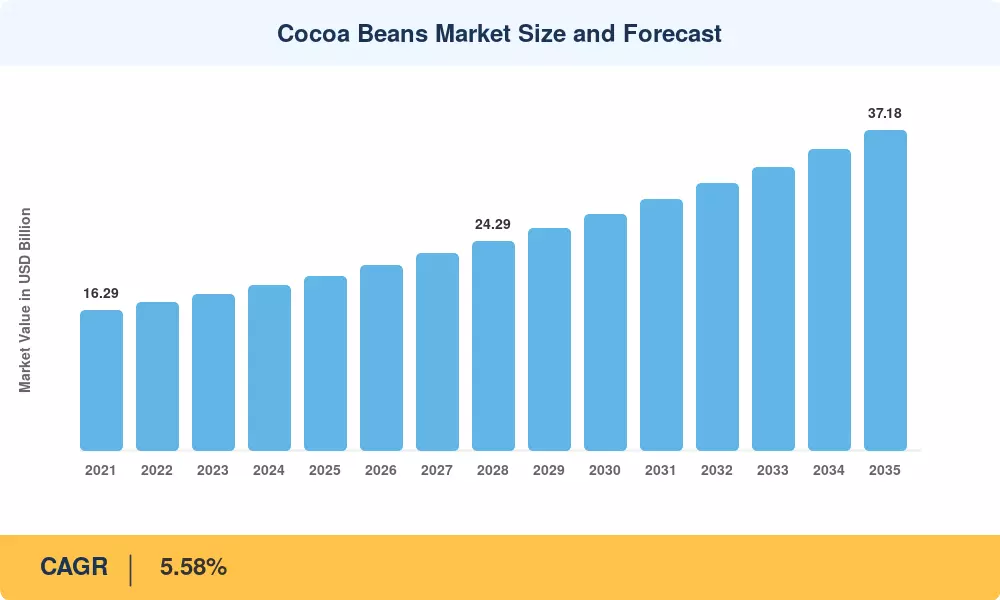
The global Cocoa Beans Market reached an estimated USD 20.24 billion in 2025 and is projected to expand from USD 21.38 billion in 2026 to USD 37.18 billion by 2035, registering a CAGR of 5.58% across the forecast window. Two catalysts are accelerating this trajectory: the European Union Deforestation Regulation (EUDR), which compels importers to prove zero-deforestation sourcing by late 2025, and a USD 1.3 billion coordinated investment program by West Africa cocoa production boards aimed at rehabilitating aging tree stock across Côte d'Ivoire and Ghana [2][3]. Together, these forces are reshaping cocoa supply chain sustainability practices and pulling capital into origin-country processing infrastructure.

There is a change in technology taking place across the cocoa value chain. Age-old sun-drying and manual fermentation procedures long established in West Africa’s cocoa-producing regions are being replaced by solar-powered fermentation chambers, satellite-monitored crop health platforms and blockchain-backed traceability ledgers. Cargill alone pledged more than USD 130 million from 2024-2025 to install 500 solar fermentation units in Indonesia, reducing post-harvest losses by about 15% and increasing the uniformity of cocoa bean origin flavor at the farm gate [4]. Consumer demand for ethically sourced products continues to grow, with an estimated 22% of the global traded volume already certified under fair trade cocoa programs (16% in 2021) [5].


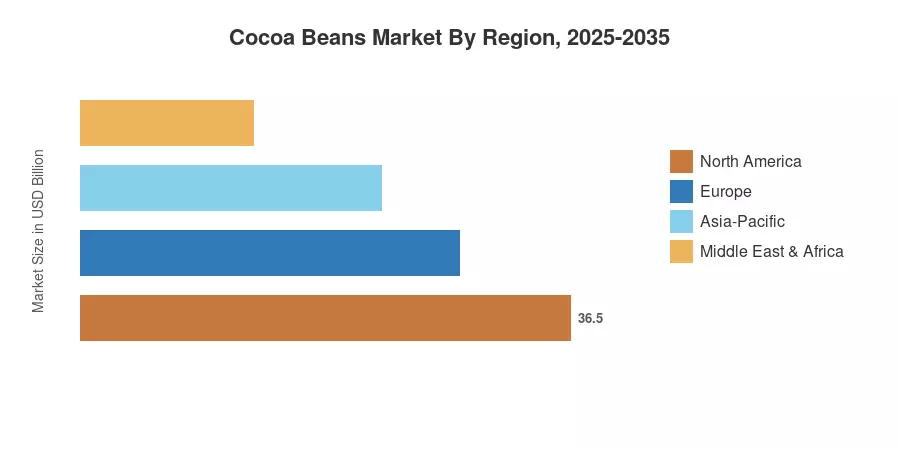
The European Cocoa Beans Market accounts for around 35% of the world’s Cocoa Beans Market value, with the Netherlands and Germany as major grinding hubs and a legacy of quality chocolate production. Asia-Pacific is the fastest growing area and is expected to develop at a CAGR of 5.30% through 2035, as consumption of confectionary products is seeing a significant surge in China, India and ASEAN countries. The second largest region is North America with a share of about 24%. The region is driven by artisan chocolate innovation and commodity hedging of cocoa bean prices by industrial customers The next decade will pay off for enterprises that combine sustainability in the cocoa supply chain, with processing at origin and digital traceability.


Key Report Takeaways

• By Product Type

  • Conventional cocoa beans account for roughly 72% of the Cocoa Beans Market by value in 2025, reflecting bulk confectionery and industrial demand
  • Organic and specialty-grade beans are projected to grow at a 7.10% CAGR through 2035, outpacing the overall market as fair trade cocoa certification expands retail shelf space

• By Application

  • Chocolate confectionery remains the dominant application, valued at approximately USD 12.8 billion in 2025, driven by premiumization and single-origin branding
  • Cocoa butter and powder for cosmetics and pharmaceuticals are expanding at a 6.25% CAGR, fueled by clean-label ingredient trends

• By Region

  • Europe held a 35% share of the Cocoa Beans Market in 2025, supported by EUDR compliance investment and deep grinding infrastructure
  • Asia-Pacific is set to expand at a 5.30% CAGR to 2035 as cocoa bean origin flavor awareness grows among Asian consumers
  • The Cocoa Beans Market in North America is valued at approximately USD 4.86 billion, underpinned by craft chocolate and institutional procurement


Cocoa Beans Market Size and Forecast (2021–2035)

MRFR's estimates combine bottom-up trade flow data (ICCO, FAO), import/export customs records, processor capacity filings, and proprietary demand modeling. Historical values (2021–2024) are triangulated against published grinding statistics, while forecast projections apply a calibrated compound growth rate adjusted for supply disruptions and regulatory phase-in timelines.
Cocoa Beans Market Size and Forecast
Our Impact
Enabled $4.3B Revenue Impact for Fortune 500 and Leading Multinationals
Partnering with 2000+ Global Organizations Each Year
30K+ Citations by Top-Tier Firms in the Industry
 

Driver Impact Analysis

Driver ~% Impact on CAGR Geographic Relevance Impact Timeline
EUDR compliance & deforestation-free sourcing mandates 18–22% Europe, Global Short-term (≤2 yr)
Rising Asian confectionery consumption 15–19% Asia-Pacific Medium-term (2–4 yr)
West Africa cocoa production rehabilitation programs 12–16% Africa, Global supply Long-term (≥4 yr)
Fair trade cocoa certification & premium pricing 10–14% North America, Europe Medium-term (2–4 yr)
Origin grinding expansion (Indonesia, Ecuador) 8–12% Asia-Pacific, South America Medium-term (2–4 yr)
Blockchain & satellite traceability adoption 6–10% Global Long-term (≥4 yr)
Cocoa bean price commodity hedging & financialization 5–8% Global Short-term (≤2 yr)


EU Deforestation Regulation and Compliance Investment

The EUDR requires all entities importing cocoa derivatives into the EU to provide strict, geo-referenced plot coordinates proving beans originate from non-deforested land (cleared post-December 2020). According to trade group assessments, the most significant upward pressure on supply costs stems from mandatory physical segregation, requiring compliant beans to be completely separated at every point of storage and transportation. This structural constraint disproportionately penalizes mid-tier traders who face a competitive disadvantage against vertically integrated multinational conglomerates equipped with internal satellite arrays and proprietary farm mapping networks.


Asian Confectionery Demand Expansion

Asia-Pacific continues to be a major structural tailwind for global cocoa consumption. Consumption behavior is altering across major hubs such as China and India, with increasing middle-class disposable incomes, urbanization and increasing premiumization of confectionary items. Importantly, key mature buying markets like as Japan are driving a major structural shift towards premiumization, with consumers showing an increased readiness to pay for nuanced, single-origin flavor profiles from boutique sources such as Ecuador, Madagascar and Vietnam.


West Africa Production Rehabilitation

Ghana and Côte d'Ivoire together supply roughly 60% of global cocoa beans, but aging tree stock (average age exceeds 25 years) and swollen shoot virus have depressed yields. The Cocoa Board of Ghana's USD 600 million rehabilitation program aims to replant 300,000 hectares by 2030, while Côte d'Ivoire's Conseil du Café-Cacao is distributing 40 million high-yield seedlings [3][7]. These programs, if executed, will stabilize West Africa cocoa production and moderate the cocoa bean price commodity volatility that has characterized 2023–2025.

Fair Trade and Certification Premium Dynamics

The landscape for certified and ethically verified cocoa is moving away from optional premium niches toward standardized baseline procurement. The volume of certified cocoa has been driven aggressively by mandatory corporate environmental commitments rather than linear year-on-year market growth. Major multi-national confectionery brands have heavily integrated certified volumes to protect supply chain security ahead of stringent compliance deadlines. Crucially, Mondelēz International achieved its milestone of sourcing approximately 100% of its global chocolate business cocoa volume through its proprietary Cocoa Life sustainability program, partnering with over 257,000 registered smallholder farmers across eight origin countries to guarantee traceability. Similarly, Nestlé continues to heavily funnel its procurement budgets exclusively toward verified and fully traceable cooperatives to meet its structured ESG compliance mandates, solidifying certification as a permanent prerequisite for global supply chain viability.


Restraints Impact Analysis

Restraint ~% Drag on CAGR Geographic Relevance Impact Timeline
Climate-driven supply volatility (El Niño, drought) –12 to –16% West Africa, Global Short-term (≤2 yr)
Cocoa bean price commodity inflation squeezing processors –10 to –14% Global Short-term (≤2 yr)
Compliance cost burden on small-scale exporters –6 to –9% Africa Medium-term (2–4 yr)
Synthetic cocoa flavor substitution risk –4 to –7% Japan, North America Long-term (≥4 yr)
Fragmented smallholder land tenure limiting investment –3 to –6% West Africa Long-term (≥4 yr)


Climate-Driven Supply Disruptions

The 2023–2024 El Niño cycle slashed Côte d'Ivoire's main-crop output by an estimated 20%, pushing cocoa futures above USD 10,000 per metric ton for the first time [7]. West Africa cocoa production remains acutely sensitive to rainfall timing and temperature extremes. Climate models project a 10–15% reduction in suitable cocoa-growing area in Ghana by 2050 unless shade-tree agroforestry is widely adopted [14]. These supply shocks amplify cocoa bean price commodity swings and discourage long-term capacity planning by grinders.

Processor Margin Compression

The gap between the skyrocketing raw commodity prices and the pass-through to consumer prices at retail counters has hit confectionery producers hard in the pocket. To shield unit economics from rising inputs, corporations are employing a variety of product-engineering solutions. This involves moving to shrinkflation, adding non-seasonal non-cocoa choices, or replacing premium inputs with other vegetable fats (such as Cocoa Butter Equivalents) up to the maximum acceptable thresholds permitted by localized food identity requirements.


Synthetic Flavor Molecule Development

Japanese biotech firms and several North American startups are engineering synthetic cocoa flavor compounds that replicate cocoa bean origin flavor profiles without raw bean inputs [13]. While commercial volumes remain negligible today, successful scale-up could erode 2–4% of industrial demand by the early 2030s, posing a long-term structural risk to the Cocoa Beans Market's growth ceiling.


Cocoa Beans Market Opportunities

Origin Grinding and Value-Added Processing

Governments across key producing nations in Southeast Asia and Latin America continue to expand localized tax incentives and structural grants to attract corporate grinding facilities. Shifting primary processing activities closer to domestic cultivation hubs helps regional economies mitigate steep maritime freight overheads, minimize currency exchange risks, and capture a larger percentage of the value-added downstream supply loop. This strategic shift is heavily characterized by major regional players like Guan Chong Bhd expanding localized operations to diversify bean sourcing networks outside of volatile West African corridors.


Digital Traceability and Carbon-Credit Monetization

Global cocoa processors, led by major operations at Barry Callebaut and Cargill, have deployed advanced geolocation polygon farm mapping and satellite-verified tracking networks. These digital systems are designed to establish compliance pipelines for international trading standards, ensuring that raw cocoa supplies are certified as deforestation-free. As carbon accounting metrics standardize, these multi-tenant mapping frameworks are increasingly being evaluated by corporate compliance offices to measure and reduce Scope 3 Forest, Land, and Agriculture (FLAG) supply chain emissions.


Premiumization and Single-Origin Craft Chocolate

The global craft and artisanal chocolate market is experiencing structural expansion as consumer preferences shift toward high-value, transparent supply chains. While mainstream confectionery remains tied to bulk commodity pricing, the specialized bean-to-bar and artisan chocolate segment reached a global valuation of approximately USD 14.6 billion and is projected to expand at an 8.8% CAGR over the next decade. By leveraging direct-trade procurement models, craft chocolate makers bypass traditional multinational intermediaries. This direct pipeline allows organized farmer cooperatives in premium origin countries—such as Peru, Madagascar, and Tanzania—to isolate their unique flavor profiles and secure favorable, structured premiums over the fluctuating International Cocoa Organization (ICCO) bulk terminal market prices.


Cocoa Butter Diversification into Cosmetics and Nutraceuticals

Cocoa butter's natural emollient properties and dense antioxidant content have solidified its position as a highly sought-after ingredient within clean-beauty skincare and premium personal care formulations. Rather than existing as an isolated multi-billion dollar standalone cosmetic segment, this demand is driving the broader global cocoa butter market toward a USD 4.28 billion valuation, expanding at a stable 5.4% CAGR. The commercial pressure on natural fats is further evidenced by the parallel Cocoa Butter Equivalent (CBE) market—which processes alternative sustainable fats like shea and palm—projected to reach USD 2.0 billion by 2030. Manufacturers that secure ethical and fair-trade certifications for these non-food cosmetic applications can insulate themselves from food-retail price sensitivities, capturing reliable margins from wellness-conscious consumers.


Climate-Smart Farming and Agroforestry Expansion

Agroforestry systems that intercrop cocoa with shade trees improve resilience to drought, sequester carbon, and raise yields by 15–25% over monoculture [14]. The World Bank's USD 300 million Climate-Smart Cocoa Program targets 500,000 smallholders across Ghana and Côte d'Ivoire, creating scalable templates for other West Africa cocoa production regions


Cocoa Beans Market Future Outlook

Digital Supply Chains and AI-Driven Crop Management

Satellite imagery, drone-based canopy analysis, and machine-learning yield prediction tools are actively restructuring West African cocoa production management. The scaling of these digital tools introduces major structural cost efficiencies by enabling precise, data-driven fertilizer application, early localized disease detection (such as black pod rot), and localized weather-resilience mapping. Crucially, these precision agriculture platforms generate the verified, polygon-mapped geo-location data mandatory for European Union Deforestation Regulation (EUDR) compliance. By embedding end-to-end traceability into daily farm management, producer nations are successfully transforming regulatory compliance burdens into direct, long-term farm-level productivity gains.


Premiumization and the Single-Origin Economy

Evolving consumer willingness to pay for provenance and traceable agricultural storytelling is systematically restructuring value distribution within the global cocoa beans market. Driven by high-value dark chocolate, organic varieties, and artisanal bean-to-bar segments, the market is moving toward a multi-billion-dollar expansion over the next decade. Cocoa bean origin flavor differentiation—anchored in regional terroir, precise fermentation methods, and distinct genetic profiles—is allowing organized producer cooperatives to separate themselves from volatile commodity terminal market indices. This premium economy builds an insulated marketplace where price structures directly reward sensory quality and supply chain transparency over raw export volumes.


ESG Integration and Deforestation-Free Supply

Corporate ESG and supply chain disclosure mandates are rapidly expanding beyond the boundaries of European legislation. While the federal US SEC climate rule has faced domestic legal delays, state-level mandates—led by California's landmark Climate Corporate Data Accountability Act (SB 253)—are reshaping North American procurement. Under SB 253, major corporations operating in California must disclose verified Scope 1 and Scope 2 greenhouse gas inventories starting in August 2026, with comprehensive Scope 3 supply chain reporting phased in by 2027. Concurrently, global regulatory environments—including emerging supply chain due diligence frameworks in Japan—are forcing non-EU buyers to aggressively adopt strict agroforestry, carbon accounting, and ethical fair-trade certification structures to preserve baseline market access.


Supply Diversification Beyond West Africa

While Côte d'Ivoire and Ghana will remain dominant, deliberate diversification toward Indonesia, Ecuador, Vietnam, and Papua New Guinea is reshaping global production geography. Vietnam's cocoa output has grown at a 14% CAGR since 2020, backed by government incentives and Japanese development agency support [10]. This diversification mitigates concentration risk and introduces new cocoa bean origin flavor profiles to global markets, broadening the Cocoa Beans Market's supply base.


Cocoa Beans Market Segmentation

By Product Type

Segment Key Metric Primary Demand Driver
Conventional Cocoa Beans ~72% market share (2025) Bulk confectionery, industrial grinding
Organic Cocoa Beans 7.10% CAGR (2026–2035) Fair trade cocoa certification, clean-label demand
Fine/Flavor Cocoa Beans USD 2.84 Billion (2025) Single-origin craft chocolate, premiumization


Conventional beans dominate the Cocoa Beans Market by volume and value, serving industrial chocolate manufacturers and cocoa butter/powder processors. West Africa cocoa production supplies the vast majority of conventional-grade beans, with Forastero varieties accounting for over 80% of global output. Cocoa supply chain sustainability pressures are gradually shifting conventional sourcing toward certified supply, but cost sensitivity among mass-market manufacturers limits the pace of transition.

The fine/flavor segment, anchored by Criollo and Trinitario varieties from Ecuador, Peru, Madagascar, and Venezuela, commands a significant per-kilogram premium. Craft chocolatiers prize cocoa bean origin flavor complexity—floral notes from Madagascar, nutty profiles from Ecuador—driving direct-trade procurement models that bypass commodity exchanges. Organic beans represent the fastest-growing category, as fair trade cocoa certification and organic double-certification unlock retail placement in premium European and North American channels.

By Application

Segment Key Metric Primary Demand Driver
Chocolate Confectionery USD 12.80 Billion (2025) Consumer premiumization, gifting culture
Cocoa Butter & Powder (Food) ~28% market share (2025) Baking, beverages, dairy blending
Cosmetics & Pharmaceuticals 6.25% CAGR (2026–2035) Clean-beauty, nutraceutical formulations


Chocolate confectionery absorbs the largest share of the Cocoa Beans Market, spanning everything from mass-market bars to artisanal truffles. The segment's growth is tightly linked to cocoa bean origin flavor storytelling, with brands investing heavily in packaging narratives that trace beans from specific cooperatives. Cocoa butter and powder for food applications form a stable base-demand layer, serving bakeries, beverage companies, and dairy processors globally. The cosmetics and pharmaceutical application is a high-growth niche where cocoa butter's moisturizing properties and flavonoid antioxidant content command premium pricing, especially under fair trade cocoa certification branding.

By Region

Regional segmentation mirrors the analysis in Section 7. Europe leads by value, Asia-Pacific leads by growth rate, and Africa's role as the primary supply origin distinguishes the Cocoa Beans Market from most agricultural commodity markets. Cross-reference for detailed country-level metrics.


Regional Market Share Analysis

Region Key Metric Primary Investment Themes
North America ~24% market share (2025) Craft chocolate, cocoa bean price commodity hedging
Europe USD 7.08 Billion (2025) EUDR compliance, cocoa supply chain sustainability
Asia-Pacific 5.30% CAGR (2026–2035) Confectionery demand, origin grinding
South America ~8% market share (2025) Single-origin premiumization, fair trade cocoa certification
Middle East & Africa USD 3.24 Billion (2025) West Africa cocoa production rehabilitation, export infrastructure
Total USD 20.24 Billion (2025)

The Cocoa Beans Market exhibits distinct regional dynamics shaped by consumption patterns, regulatory regimes, and proximity to origin-country supply chains. Europe's entrenched grinding and manufacturing base secures its leadership, while Asia-Pacific's consumption growth is the decade's defining trend.


North America

Country Key Metric Key Driver
US ~78% of regional value Craft chocolate and institutional procurement
Canada 4.85% CAGR (2026–2035) Fair trade cocoa certification retail demand
Mexico ~6% of regional share Domestic cacao heritage and artisanal processing


The United States dominates North American demand, with Hershey, Mars, and Mondelēz collectively grinding over 400,000 metric tons annually. Canadian consumers increasingly favor fair trade cocoa certification labels, pushing certified imports up 18% year-on-year in 2024. Mexico's artisanal cacao tradition is experiencing a revival, with government-backed denomination-of-origin programs supporting Tabasco and Chiapas producers and enriching cocoa bean origin flavor diversity in the regional Cocoa Beans Market [16].

Europe

Country Key Metric Key Driver
Germany ~22% of European value Industrial grinding hubs
UK 5.15% CAGR (2026–2035) Premium retail and ethical sourcing
France USD 1.12 Billion (2025) Luxury chocolate heritage
Italy ~8% of the European share Confectionery and gelato manufacturing
Spain 4.90% CAGR Growing domestic consumption
Nordic Countries ~5% of the European share High per-capita chocolate consumption
Russia USD 0.38 Billion (2025) Import substitution efforts
Rest of Europe 4.70% CAGR Eastern European demand expansion


Europe's Cocoa Beans Market leadership rests on the Netherlands' port infrastructure, Germany's grinding capacity, and France's luxury chocolate sector. EUDR compliance is the continent's dominant investment theme, with Dutch and Belgian processors committing over EUR 500 million collectively to supply-chain digitization. The UK's fair trade cocoa certification penetration exceeds 40% of retail chocolate by volume, the highest globally, reinforcing cocoa supply chain sustainability standards across the region [2][5].

Asia-Pacific

Country Key Metric Key Driver
China ~32% of regional value Confectionery market expansion
India 6.10% CAGR (2026–2035) Urbanization and rising chocolate consumption
Japan USD 1.48 Billion (2025) Single-origin and craft bean-to-bar
South Korea ~9% of regional share K-confectionery export growth
ASEAN 5.80% CAGR Indonesia grinding; regional consumption rises
Rest of Asia-Pacific ~7% of regional share Emerging markets


Asia-Pacific's Cocoa Beans Market growth is propelled by China's rapidly expanding chocolate confectionery retail sector and India's urbanizing middle class. Japan's sophisticated palate for cocoa bean origin flavor makes it the region's highest per-capita spender on premium cocoa products. Indonesia occupies a dual role as both a major producer and a growing origin grinder, with government-subsidized processing zones in Sulawesi attracting foreign investment [10]. South Korea's confectionery exports—particularly K-beauty-inspired chocolate gifting sets—are an emerging Cocoa Beans Market growth vector.

South America

Country Key Metric Key Driver
Brazil ~52% of regional value Domestic consumption and fine-flavor production
Argentina 4.60% CAGR (2026–2035) Artisanal chocolate manufacturing
Rest of South America USD 0.54 Billion (2025) Ecuador and Peru single-origin exports


Ecuador is the world's leading producer of fine-flavor cocoa (classified as Arriba Nacional), commanding premium prices in European and Japanese markets. Brazil's domestic Cocoa Beans Market benefits from a strong internal confectionery sector and Bahia-region production recovery following years of witches' broom disease management. Fair trade cocoa certification adoption among Peruvian cooperatives grew 25% between 2022 and 2025, supporting cocoa supply chain sustainability across the sub-region [11].

Middle East & Africa

Country Key Metric Key Driver
Saudi Arabia 5.40% CAGR (2026–2035) Luxury confectionery imports
UAE ~12% of regional share Re-export hub and premium retail
South Africa USD 0.28 Billion (2025) Regional processing gateway
Egypt 4.80% CAGR Growing middle-class consumption
Rest of MEA ~68% of regional value West Africa cocoa production dominance


This region is defined by a fundamental duality: West Africa cocoa production constitutes the bulk of the global supply, yet most beans are exported raw, with less than 25% processed domestically. Côte d'Ivoire and Ghana are aggressively pursuing origin-grinding capacity to retain more value, and Barry Callebaut's USD 130 million investment in Ivorian processing facilities signals multinational confidence in this shift [4]. Gulf states, meanwhile, represent high-growth consumption pockets where premium Cocoa Beans Market positioning and cocoa bean origin flavor storytelling resonate with affluent consumers.


Cocoa Beans Market By Region, 2025-2035
Regional Market Share
 

Competitive Benchmarking

The Cocoa Beans Market exhibits moderate concentration, with the top five players collectively controlling an estimated 38–44% of global traded value. The Herfindahl-Hirschman Index (HHI) sits in the low-to-moderate range (~800–1,100), reflecting meaningful competition among integrated traders, regional grinders, and emerging craft-channel disruptors. Vertical integration—from farm-level sourcing through grinding to semi-finished product sales—is the primary competitive differentiator, and companies with robust cocoa supply chain sustainability credentials are gaining procurement preference from major FMCG brands.

Company Est. Revenue Share Range Key Offerings for Cocoa Beans Market Strategic Positioning
Barry Callebaut AG ~11–14% Cocoa mass, butter, powder; blockchain traceability Largest grinder; vertical integration leader
Cargill Incorporated ~9–12% Cocoa sourcing, grinding, sustainable supply programs Global trader; solar fermentation pioneer
Olam Group (ofi) ~8–11% Origin processing, deforestation-free supply chains Africa-centric; EUDR-ready infrastructure
Blommer Chocolate Co. ~4–6% North American grinding and distribution Regional scale; cocoa bean price commodity management
Touton S.A. ~3–5% West African origin sourcing and trading Niche trader; Francophone Africa specialization
Ecom Agroindustrial Corp. ~3–5% Global cocoa trading, farmer extension services Sustainability-certified supply; Latin America strength
Sucden (Sucres et Denrées) ~2–4% Cocoa bean trading and logistics European trading house; origin diversification
Puratos Group ~2–3% Cocoa-based bakery ingredients and couverture B2B ingredient innovation; fair trade cocoa certification focus
Niche Craft Chocolatiers (aggregated) ~3–5% Single-origin bean-to-bar; direct-trade cooperatives Cocoa bean origin flavor differentiation
SunOpta Inc. ~1–2% Organic and specialty cocoa ingredient sourcing Organic supply-chain specialization


Recent News & Developments


  • European Commission (December 2024): Began phased enforcement of the EUDR, requiring geo-referenced deforestation-free proof for all cocoa imports—reshaping compliance investment across the Cocoa Beans Market [2].


  • ICCO (April 2024): Reported global cocoa production fell 14% in the 2023/24 season due to El Niño, driving cocoa bean price commodity futures to record highs above USD 10,000/MT [7].


Cocoa Beans Market Report Scope

Parameter Details
Market Scope Global Cocoa Beans Market — production, consumption, trade, pricing, and competitive analysis
Study Period 2021–2035
Historical Period 2021–2024
Base Year 2025
Forecast Period 2026–2035
CAGR (2026–2035) 5.58%
Market Size (2025) USD 20.24 Billion
Market Size (2035) USD 37.18 Billion
Fastest Growing Region Asia-Pacific
Fastest Growing Segment Organic Cocoa Beans (by product type); Cosmetics & Pharmaceuticals (by application)
Companies Profiled 10 (including Barry Callebaut, Cargill, Olam/ofi, Blommer, Touton, Ecom, Sucden, Puratos, SunOpta, and aggregated craft chocolatiers)
Valuation Currency USD Billion


FAQs

How does the EUDR affect small-scale cocoa exporters differently from multinationals?

Small exporters in Cameroon and Nigeria face 3–5% compliance surcharges for geo-mapping and traceability systems they lack in-house. Multinationals absorb these costs across larger volumes, creating acquisition pressure on under-capitalized traders [2].

What distinguishes Forastero, Criollo, and Trinitario cocoa varieties for buyers?

Forastero offers high yield and disease resistance for bulk applications. Criollo delivers complex cocoa bean origin flavor with low bitterness but fragile agronomy. Trinitario hybrids balance flavor and resilience for premium-grade sourcing [11].

How are carbon credits being integrated into cocoa farming economics?

Agroforestry-based cocoa farms can generate 2–4 verified carbon credits per hectare annually under REDD+ protocols, adding USD 10–20 per hectare in supplementary income for smallholders [12].

What role does origin grinding play in reshaping the Cocoa Beans Market value chain?

Processing beans at origin reduces freight costs 12–15% and retains value in producer countries. Indonesia and Ecuador are leading this shift with government-subsidized grinding zones [10].

How vulnerable is the Cocoa Beans Market to synthetic cocoa flavor substitution?

Commercial synthetic volumes remain negligible in 2025. Even optimistic projections suggest only 2–4% industrial demand displacement by the early 2030s, limited to compound coatings and flavoring [13].

What procurement strategies help chocolate manufacturers hedge cocoa bean price commodity risk?

Manufacturers increasingly combine futures-exchange hedging with long-term direct-trade contracts from certified cooperatives, locking in both price stability and cocoa supply chain sustainability compliance [6][8].

How does fair trade cocoa certification impact retail pricing and consumer behavior?

Certified products carry an 8–12% retail premium in Europe and North America. Consumer surveys show 62% of millennials prefer certified labels, driving supermarket shelf-space allocation toward certified brands [5][8].


Author
Author
Author Profile
Sakshi Gupta LinkedIn
Team Lead - Research
Currently a Team Lead in consumer goods, FMCG, and F&B, she translates rigorous research into decisive strategy. She develops GTM roadmaps, pricing architectures, and competitive benchmarks for companies across Europe, the US, and APAC. She synthesize insights, align cross-functional teams, and drive execution from brief to measurable outcomes. She leads end-to-end engagements with crisp analysis, compelling storytelling, and a strong command of Power BI, Tableau, SQL, and advanced research platforms.
Download Free Sample

Kindly complete the form below to receive a free sample of this Report
















