Request Free Sample ×

Kindly complete the form below to receive a free sample of this Report

* Please use a valid business email

Leading companies partner with us for data-driven Insights

clients tt-cursor
Hero Background

Cocoa Beans Market

ID: MRFR/FnB/20216-HCR
128 Pages
Sakshi Gupta
Last Updated: May 28, 2026
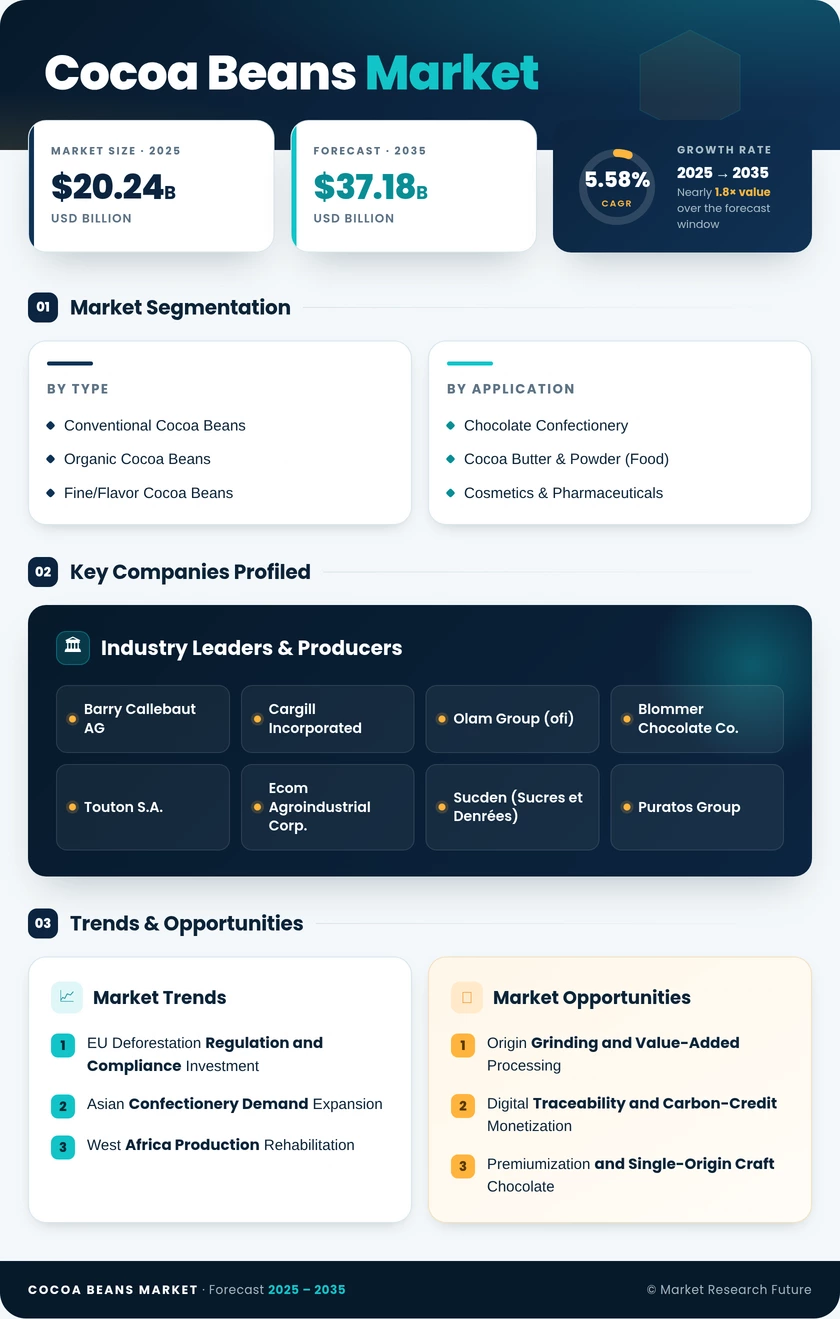
Cocoa Beans Market Size, Share, Industry Trend & Analysis Research Report Information By Product Type (Conventional Cocoa Beans, Organic Cocoa Beans, Fine/Flavor Cocoa Beans), By Application (Chocolate Confectionery, Cocoa Butter & Powder (Food), Cosmetics & Pharmaceuticals), By Region (North America, Europe, Asia-Pacific, South America, Middle East & Africa) – Forecast Till 2035
Download PDF ×

We do not share your information with anyone. However, we may send you emails based on your report interest from time to time. You may contact us at any time to opt-out.

  1. 1 Market Overview |
    1. 1.1 Study Assumptions & Market Definition |
    2. 1.2 Scope of the Study |
    3. 1.3 Research Methodology
  2. 2 Market Summary & Key Takeaways
  3. 3 Market Dynamics |
    1. 3.1 Market Drivers Analysis | |
      1. 3.1.1 EUDR Compliance & Deforestation-Free Sourcing Mandates | |
      2. 3.1.2 Rising Asian Confectionery Consumption | |
      3. 3.1.3 West Africa Cocoa Production Rehabilitation Programs | |
      4. 3.1.4 Fair Trade Cocoa Certification & Premium Pricing | |
      5. 3.1.5 Origin Grinding Expansion (Indonesia, Ecuador) | |
      6. 3.1.6 Blockchain & Satellite Traceability Adoption | |
      7. 3.1.7 Cocoa Bean Price Commodity Hedging & Financialization |
    2. 3.2 Market Restraints Analysis | |
      1. 3.2.1 Climate-Driven Supply Volatility (El Niño, Drought) | |
      2. 3.2.2 Cocoa Bean Price Commodity Inflation Squeezing Processors | |
      3. 3.2.3 Compliance Cost Burden on Small-Scale Exporters | |
      4. 3.2.4 Synthetic Cocoa Flavor Substitution Risk | |
      5. 3.2.5 Fragmented Smallholder Land Tenure Limiting Investment |
    3. 3.3 Market Opportunity Analysis | |
      1. 3.3.1 Origin Grinding and Value-Added Processing | |
      2. 3.3.2 Digital Traceability and Carbon-Credit Monetization | |
      3. 3.3.3 Premiumization and Single-Origin Craft Chocolate | |
      4. 3.3.4 Cocoa Butter Diversification into Cosmetics & Nutraceuticals | |
      5. 3.3.5 Climate-Smart Farming and Agroforestry Expansion |
    4. 3.4 Industry Value Chain Analysis |
    5. 3.5 Porter's Five Forces Analysis
  4. 4 Global Cocoa Beans Market Size & Forecast (2021–2035) |
    1. 4.1 Historical Market Size (2021–2025) |
    2. 4.2 Current & Forecast Market Size (2026–2035) |
    3. 4.3 Market Size by Revenue (USD Billion) |
    4. 4.4 Year-over-Year Growth Analysis
  5. 5 Segmentation Analysis |
    1. 5.1 By Product Type | |
      1. 5.1.1 Conventional Cocoa Beans | |
      2. 5.1.2 Organic Cocoa Beans | |
      3. 5.1.3 Fine/Flavor Cocoa Beans |
    2. 5.2 By Application | |
      1. 5.2.1 Chocolate Confectionery | |
      2. 5.2.2 Cocoa Butter & Powder (Food) | |
      3. 5.2.3 Cosmetics & Pharmaceuticals
  6. 6 Regional Analysis |
    1. 6.1 North America | |
      1. 6.1.1 United States | |
      2. 6.1.2 Canada | |
      3. 6.1.3 Mexico |
    2. 6.2 Europe | |
      1. 6.2.1 Germany | |
      2. 6.2.2 United Kingdom | |
      3. 6.2.3 France | |
      4. 6.2.4 Italy | |
      5. 6.2.5 Spain | |
      6. 6.2.6 Nordic Countries | |
      7. 6.2.7 Russia | |
      8. 6.2.8 Rest of Europe |
    3. 6.3 Asia-Pacific | |
      1. 6.3.1 China | |
      2. 6.3.2 India | |
      3. 6.3.3 Japan | |
      4. 6.3.4 South Korea | |
      5. 6.3.5 ASEAN | |
      6. 6.3.6 Rest of Asia-Pacific |
    4. 6.4 South America | |
      1. 6.4.1 Brazil | |
      2. 6.4.2 Argentina | |
      3. 6.4.3 Rest of South America |
    5. 6.5 Middle East & Africa | |
      1. 6.5.1 Saudi Arabia | |
      2. 6.5.2 UAE | |
      3. 6.5.3 South Africa | |
      4. 6.5.4 Egypt | |
      5. 6.5.5 Rest of MEA
  7. 7 Competitive Landscape |
    1. 7.1 Market Share Analysis (2025) |
    2. 7.2 Competitive Benchmarking Matrix |
    3. 7.3 Company Profiles | |
      1. 7.3.1 Barry Callebaut AG | |
      2. 7.3.2 Cargill Incorporated | |
      3. 7.3.3 Olam Group (ofi) | |
      4. 7.3.4 Blommer Chocolate Co. | |
      5. 7.3.5 Touton S.A. | |
      6. 7.3.6 Ecom Agroindustrial Corp. | |
      7. 7.3.7 Sucden (Sucres et Denrées) | |
      8. 7.3.8 Puratos Group | |
      9. 7.3.9 Niche Craft Chocolatiers (Aggregated) | |
      10. 7.3.10 SunOpta Inc.
  8. 8 Future Outlook & Strategic Recommendations (2026–2035) |
    1. 8.1 Digital Supply Chains and AI-Driven Crop Management |
    2. 8.2 Premiumization and the Single-Origin Economy |
    3. 8.3 ESG Integration and Deforestation-Free Supply |
    4. 8.4 Supply Diversification Beyond West Africa
  9. 9 Recent Developments & News
  10. 10 Frequently Asked Questions (FAQs)
  11. 11 Report Scope & Methodology |
    1. 11.1 Study Period & Base Year |
    2. 11.2 Data Sources & Citations |
    3. 11.3 Abbreviations
  12. 1 LIST OF TABLES
  13. 2 LIST OF FIGURES

Segmentation Quick Reference

DimensionSub-SegmentsDominant SegmentFastest Growing Segment
By Product TypeConventional Cocoa Beans, Organic Cocoa Beans, Fine/Flavor Cocoa BeansConventional Cocoa BeansOrganic Cocoa Beans
By ApplicationChocolate Confectionery, Cocoa Butter & Powder (Food), Cosmetics & PharmaceuticalsChocolate ConfectioneryCosmetics & Pharmaceuticals
By RegionNorth America, Europe, Asia-Pacific, South America, Middle East & AfricaEuropeAsia-Pacific


Market Segmentation Overview

By Product Type

Sub-SegmentKey Trend
Conventional Cocoa BeansBulk-grade Forastero varieties dominate the global supply; EUDR compliance pressures are driving traceability upgrades across conventional supply chains
Organic Cocoa BeansDouble-certified (organic + fair trade) beans command premium shelf placement; growth outpaces conventional at 7.10% CAGR
Fine/Flavor Cocoa BeansSingle-origin and estate-grade beans from Ecuador, Peru, and Madagascar fuel the craft chocolate premiumization wave


Product type segmentation reflects the Cocoa Beans Market's dual structure: a high-volume conventional base serving industrial processors and a rapidly expanding premium tier where organic and fine/flavor beans capture disproportionate value through provenance storytelling and certification premiums.

By Application

Sub-SegmentKey Trend
Chocolate ConfectioneryLargest application by value; premiumization and Asian consumption growth are primary tailwinds
Cocoa Butter & Powder (Food)Stable demand from bakery, beverage, and dairy sectors; price sensitivity limits premium positioning
Cosmetics & PharmaceuticalsFastest-growing application; clean-beauty and nutraceutical formulations drive above-market expansion


Application segmentation highlights the broadening end-use base for cocoa derivatives. While chocolate confectionery remains the Cocoa Beans Market's anchor demand segment, non-food applications—particularly cosmetics leveraging cocoa butter's emollient properties—are expanding the addressable market and attracting cross-industry investment.