Request Free Sample ×

Kindly complete the form below to receive a free sample of this Report

* Please use a valid business email

Leading companies partner with us for data-driven Insights

clients tt-cursor
Hero Background

Coffee Pods and Capsules Market

ID: MRFR/CG/5418-CR
100 Pages
Pradeep Nandi
Last Updated: June 01, 2026
Coffee Pods and Capsules Market Size, Share, Industry Trend & Analysis Research Report Information By Product Type (Capsules, Pods), Category (Conventional, Organic), By Packaging Material (Plastic, Aluminum, Compostable/Biodegradable), By Distribution Channel (Off-Trade, On-Trade), By Geography (North America, Europe, Asia-Pacific, South America, Middle East & Africa) – Forecast Till 2035
Download PDF ×

We do not share your information with anyone. However, we may send you emails based on your report interest from time to time. You may contact us at any time to opt-out.

  1. 1 Market Overview |
    1. 1.1 Study Assumptions & Market Definition |
    2. 1.2 Scope of the Study |
    3. 1.3 Research Methodology
  2. 2 Market Summary & Key Takeaways
  3. 3 Market Dynamics |
    1. 3.1 Market Drivers Analysis | |
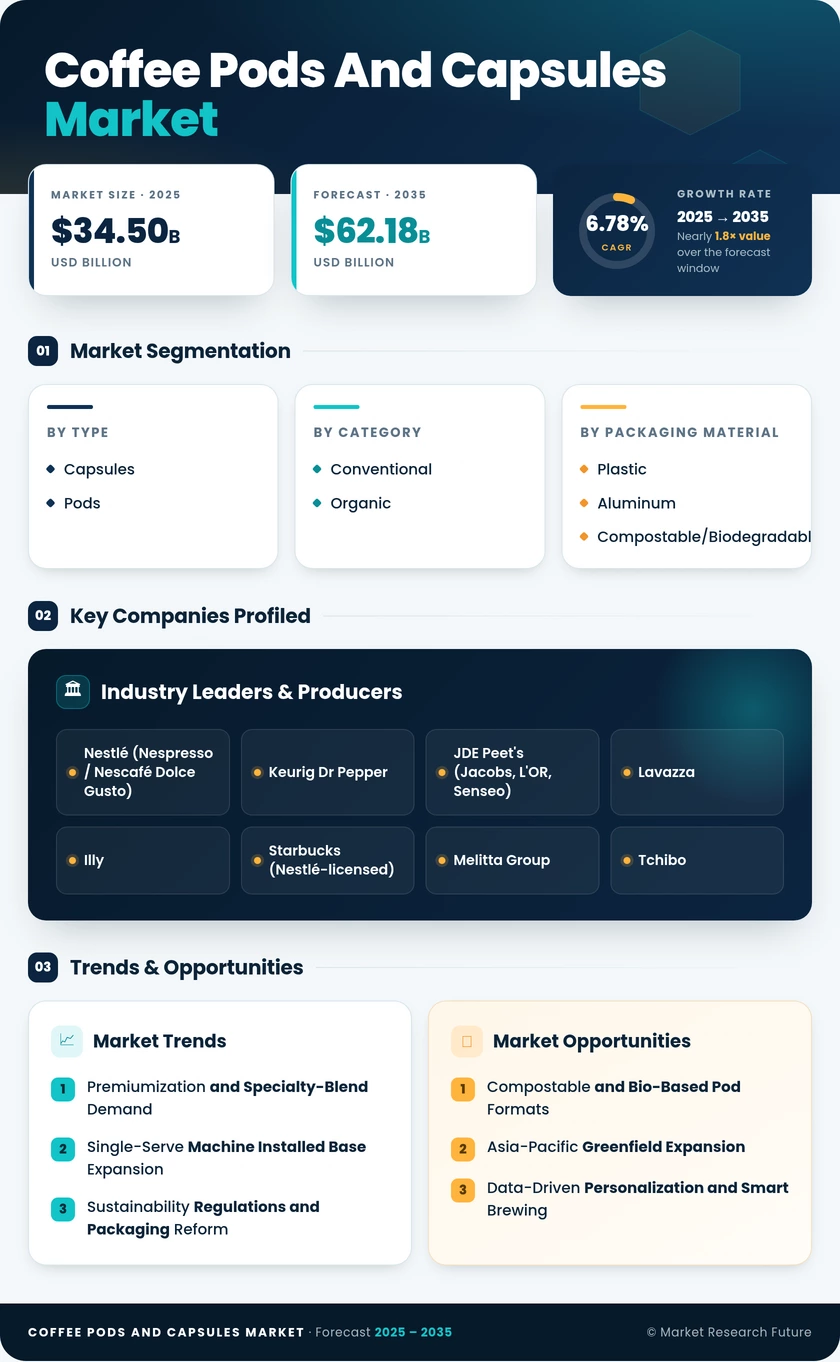
      1. 3.1.1 Premiumization and Specialty-Blend Demand | |
      2. 3.1.2 Single-Serve Machine Installed Base Expansion | |
      3. 3.1.3 Sustainability Regulations and Packaging Reform | |
      4. 3.1.4 Coffee Capsule Subscription and DTC Channel Growth | |
      5. 3.1.5 Private-Label and Retailer-Brand Capsule Proliferation | |
      6. 3.1.6 Rising Middle-Class Coffee Culture in Emerging Economies | |
      7. 3.1.7 Aluminum and Compostable Format Innovation |
    2. 3.2 Market Restraints Analysis | |
      1. 3.2.1 Environmental Backlash Against Plastic Pods | |
      2. 3.2.2 Price Sensitivity in Emerging Economies | |
      3. 3.2.3 Raw Material (Coffee, Aluminum) Price Volatility | |
      4. 3.2.4 Patent and IP Restrictions on Closed Systems | |
      5. 3.2.5 Competition from Ready-to-Drink and Instant Coffee |
    3. 3.3 Market Opportunity Analysis | |
      1. 3.3.1 Compostable and Bio-Based Pod Formats | |
      2. 3.3.2 Asia-Pacific Greenfield Expansion | |
      3. 3.3.3 Data-Driven Personalization and Smart Brewing | |
      4. 3.3.4 Private-Label and Retailer-Owned Capsule Brands | |
      5. 3.3.5 Specialty and Functional Coffee Capsules |
    4. 3.4 Industry Value Chain Analysis |
    5. 3.5 Porter's Five Forces Analysis
  4. 4 Global Coffee Pods and Capsules Market Size & Forecast (2021–2035) |
    1. 4.1 Historical Market Size (2021–2025) |
    2. 4.2 Current & Forecast Market Size (2026–2035) |
    3. 4.3 Market Size by Revenue (USD Billion) |
    4. 4.4 Year-over-Year Growth Analysis
  5. 5 Segmentation Analysis |
    1. 5.1 By Product Type | |
      1. 5.1.1 Capsules | |
      2. 5.1.2 Pods |
    2. 5.2 By Category | |
      1. 5.2.1 Conventional | |
      2. 5.2.2 Organic |
    3. 5.3 By Packaging Material | |
      1. 5.3.1 Plastic | |
      2. 5.3.2 Aluminum | |
      3. 5.3.3 Compostable/Biodegradable |
    4. 5.4 By Distribution Channel | |
      1. 5.4.1 Off-Trade | |
      2. 5.4.2 On-Trade
  6. 6 Regional Analysis |
    1. 6.1 North America | |
      1. 6.1.1 United States | |
      2. 6.1.2 Canada | |
      3. 6.1.3 Mexico |
    2. 6.2 Europe | |
      1. 6.2.1 Germany | |
      2. 6.2.2 United Kingdom | |
      3. 6.2.3 France | |
      4. 6.2.4 Italy | |
      5. 6.2.5 Spain | |
      6. 6.2.6 Nordic Countries | |
      7. 6.2.7 Russia | |
      8. 6.2.8 Rest of Europe |
    3. 6.3 Asia-Pacific | |
      1. 6.3.1 China | |
      2. 6.3.2 India | |
      3. 6.3.3 Japan | |
      4. 6.3.4 South Korea | |
      5. 6.3.5 ASEAN | |
      6. 6.3.6 Rest of Asia-Pacific |
    4. 6.4 South America | |
      1. 6.4.1 Brazil | |
      2. 6.4.2 Argentina | |
      3. 6.4.3 Rest of South America |
    5. 6.5 Middle East & Africa | |
      1. 6.5.1 Saudi Arabia | |
      2. 6.5.2 UAE | |
      3. 6.5.3 South Africa | |
      4. 6.5.4 Egypt | |
      5. 6.5.5 Rest of MEA
  7. 7 Competitive Landscape |
    1. 7.1 Market Share Analysis (2025) |
    2. 7.2 Competitive Benchmarking Matrix |
    3. 7.3 Company Profiles | |
      1. 7.3.1 Nestlé (Nespresso / Nescafé Dolce Gusto) | |
      2. 7.3.2 Keurig Dr Pepper | |
      3. 7.3.3 JDE Peet's | |
      4. 7.3.4 Lavazza | |
      5. 7.3.5 Illy | |
      6. 7.3.6 Starbucks (Nestlé-licensed) | |
      7. 7.3.7 Melitta Group | |
      8. 7.3.8 Tchibo | |
      9. 7.3.9 3Corações | |
      10. 7.3.10 Caffitaly System
  8. 8 Future Outlook & Strategic Recommendations (2026–2035) |
    1. 8.1 Smart Brewing and Connected Home Espresso Pod Systems |
    2. 8.2 Circular Economy and Zero-Waste Packaging |
    3. 8.3 Premiumization Supercycle and Origin Transparency |
    4. 8.4 Channel Evolution: Subscription, Vending, and Micro-Retail
  9. 9 Recent Developments & News
  10. 10 Frequently Asked Questions (FAQs)
  11. 11 Report Scope & Methodology |
    1. 11.1 Study Period & Base Year |
    2. 11.2 Data Sources & Citations |
    3. 11.3 Abbreviations
  12. 1 LIST OF TABLES
  13. 2 LIST OF FIGURES

Segmentation Quick Reference

DimensionSub-SegmentsDominant SegmentFastest Growing Segment
Product TypeCapsules, PodsCapsules (55.2% share, 2025)Pods (7.12% CAGR)
CategoryConventional, OrganicConventional (USD 30.08B, 2025)Organic (7.84% CAGR)
Packaging MaterialPlastic, Aluminum, Compostable/BiodegradablePlastic (57.2% share, 2025)Aluminum (7.32% CAGR)
Distribution ChannelOff-Trade, On-TradeOff-Trade (66.1% share, 2025)On-Trade (7.10% CAGR)
GeographyNorth America, Europe, Asia-Pacific, South America, Middle East & AfricaEurope (38.4% share, 2025)Asia-Pacific (7.58% CAGR)


Market Segmentation Overview

By Product Type

Sub-SegmentKey Trend
CapsulesClosed-system machine ecosystem lock-in continues to drive repeat purchase; aluminum capsule adoption rising with sustainability mandates
PodsOpen-standard ESE format gaining traction; compostable pod innovation accelerating among specialty roasters


The product type split reflects an ongoing tension between proprietary system convenience and open-format flexibility. Capsules benefit from deeper brand integration and superior extraction technology, while pods attract cost-conscious and environmentally motivated consumers seeking compostable alternatives.

By Category

Sub-SegmentKey Trend
ConventionalMainstream blends dominate retail shelves; private-label expansion compressing brand premiums
OrganicUSDA and EU organic certifications driving shelf premiums of 25–40%; specialty DTC brands leading adoption


Conventional coffee remains the volume anchor, but organic capsules and pods are capturing a disproportionate share of new product launches as retailers allocate shelf space to health-oriented SKUs.

By Packaging Material

Sub-SegmentKey Trend
PlasticCost-efficient but facing regulatory phase-out pressure in EU and select North American jurisdictions
AluminumRecyclability advantage and superior oxygen-barrier performance fueling rapid adoption
Compostable/BiodegradableEU PPWR mandates and consumer eco-preferences driving investment; cost parity expected by 2033–2034


Packaging material is the most dynamic segmentation dimension, with regulatory action and consumer sentiment accelerating the transition away from conventional plastics toward aluminum and compostable formats.

By Distribution Channel

Sub-SegmentKey Trend
Off-TradeSupermarkets, e-commerce, and subscription DTC channels dominate consumer access points
On-TradeHotels, restaurants, cafés, and offices adopting capsule systems for consistency and labor savings


Off-trade channels remain dominant, but on-trade growth reflects a structural shift as hospitality and workplace operators adopt capsule-based systems to standardize beverage quality and reduce barista dependency.