Collagen Dressings Market (2026 - 2035)

Collagen Dressings Market Research Report By Application (Surgical Wounds, Chronic Wounds, Burns, Trauma Injuries), By Product Type (Collagen Alginate Dressings, Collagen Hydrogel Dressings, Collagen Foams, Collagen Sheets), By End Use (Hospitals, Clinics, Home Healthcare, Ambulatory Surgical Centers), By Formulation (Topical, Injectable, Implantable) and By Regional (North America, Europe, South America, Asia Pacific, Middle East and Africa) - Growth & Industry Forecast 2025 To 2035

Forecast Period
2026-2035
CAGR
5.25%
2025 Market Size
USD 1.34 Billion
2035 Market Size
USD 2.23 Billion
Healthcare ● Updated August 24, 2026 Report ID: MRFR/HC/7725-HCR | Pages: 100 | Author: Rahul Gotadki, Vikita Thakur

Collagen Dressings Market Summary

The Collagen Dressings Market was valued at USD 1.34 Billion in 2025 and is projected to move from USD 1.41 Billion in 2026 to USD 2.23 Billion by 2035, expanding at a CAGR of 5.25% across the forecast window. Two catalysts anchor that trajectory. First, the U.S. Centers for Medicare & Medicaid Services finalized a Local Coverage Determination framework in 2025 that tightens documentation for skin substitutes while preserving reimbursement pathways for evidence-backed collagen matrices [7]. Second, the International Diabetes Federation counts 589 million adults living with diabetes in 2024, a caseload that converts directly into diabetic foot ulcer demand for the Collagen Dressings Market [3].

Clinicians are steadily retiring passive gauze-and-hydrocolloid protocols in favour of bioactive matrices that sequester matrix metalloproteinases and scaffold fibroblast migration. The National Institutes of Health committed roughly USD 96 million across regenerative wound-repair grants in fiscal 2024, and recombinant type I and III collagen platforms now attract a meaningful share of that funding [12]. This shift redefines the Collagen Dressings Market as a materials-science category rather than a commodity consumables line.

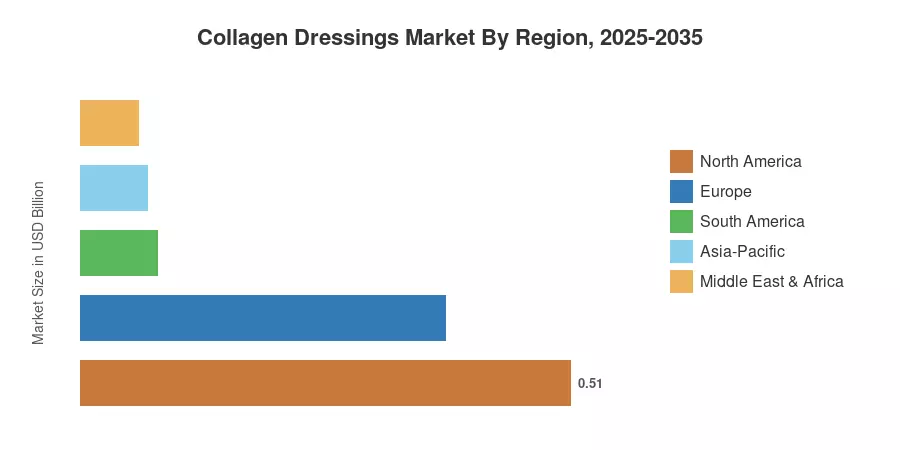
North America holds 38.2% of 2025 revenue, supported by dense outpatient wound-centre infrastructure. Asia-Pacific advances fastest at a 5.48% CAGR through 2035, while Europe — the second-largest region — draws momentum from national pressure-injury prevention mandates. Whoever pairs clinical dossiers with resilient sourcing will define the next decade.


Key Report Takeaways

The bullets below summarise where value concentrates inside the Collagen Dressings Market.

• By Source

  • Bovine collagen accounted for 38.4% of 2025 revenue, reflecting entrenched supply infrastructure and cost advantage
  • Equine collagen is forecast to compound at 6.00% CAGR through 2035 as immunogenicity concerns push formulators toward alternative species

• By Form

  • Gel formats generated 29.7% of 2025 revenue, favoured for irregular tunnelling wounds
  • Sheet formats are set to grow at 6.12% CAGR, the fastest of any form factor

• By Application

  • Acute wounds captured 56.6% of 2025 revenue across surgical, trauma and burn settings


• By End User

  • Ambulatory surgical centres are projected to expand at 6.08% CAGR as procedures migrate out of inpatient theatres

• By Region

  • North America led the Collagen Dressings Market with 38.2% revenue share in 2025
  • Asia-Pacific posts the highest regional CAGR at 5.48% through 2035


Market Size and Forecast (2021–2035)

Estimates blend bottom-up procedure-volume modelling with top-down revenue triangulation across public filings, hospital group purchasing disclosures, customs data on collagen raw material flows, and primary interviews with wound-care directors and distributors. Historical years reconcile against audited segment reporting; forecast years apply epidemiological caseload projections to a price-mix model. The Collagen Dressings Market series below is expressed in constant 2025 U.S. dollars.
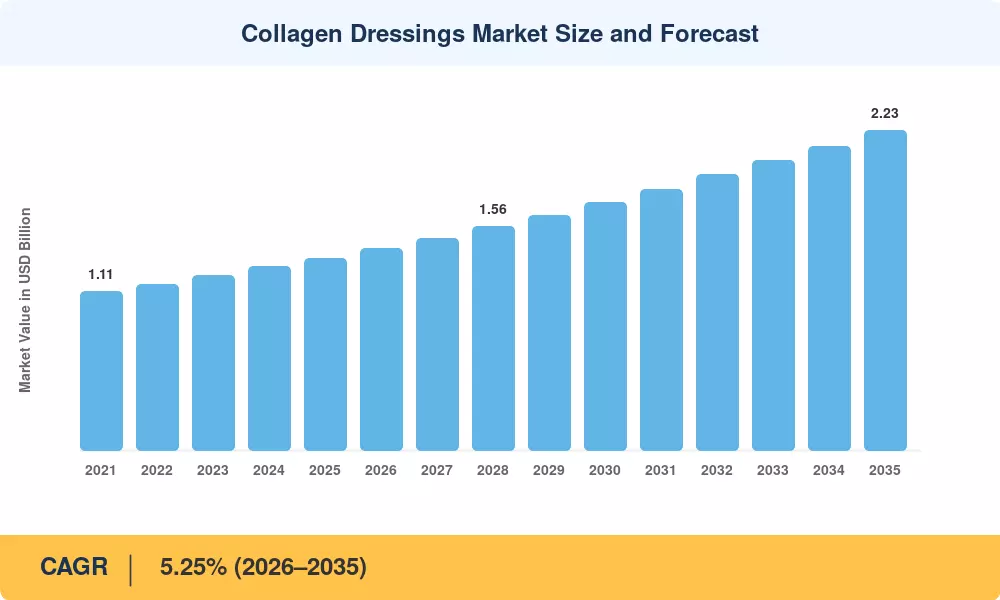
Collagen Dressings Market Size and Forecast
Our Impact
Enabled $4.3B Revenue Impact for Fortune 500 and Leading Multinationals
Partnering with 2000+ Global Organizations Each Year
30K+ Citations by Top-Tier Firms in the Industry

Driver Impact Analysis

Driver ~% Impact on CAGR Geographic Relevance Impact Timeline
Rising diabetic foot ulcer and pressure injury caseload +1.15 pp Global Long-term (≥4 yr)
Recovery and growth in surgical and trauma volumes +0.85 pp North America, Europe Short-term (≤2 yr)
Reimbursement expansion for advanced wound care +0.72 pp US, Japan Medium-term (2–4 yr)
Migration of wound care to outpatient settings +0.61 pp North America, Europe Medium-term (2–4 yr)
Recombinant and plant-derived collagen commercialisation +0.54 pp Global Long-term (≥4 yr)
Population ageing and home-care penetration +0.48 pp Japan, Europe, China Long-term (≥4 yr)
Antimicrobial and composite dressing innovation +0.39 pp Global Short-term (≤2 yr)


Reimbursement Clarity Unlocks Order Flow

In the US, adoption is gated by coverage policy rather than clinical zeal. More than 200 products were grouped into tiered evidence categories under the 2025 CMS skin-substitute framework [7]. Collagen matrices are subject to prior authorization restrictions but still have Part B coverage in doctors' offices. Manufacturers who supported randomized controlled trials, such as Organogenesis and Integra, benefited, as their order books grew throughout the second half of the year.


Outpatient Migration Reshapes the Channel

Approximately 68% of chronic wound encounters are now handled by hospital outpatient departments and doctors' offices, up from 54% ten years ago, according to data [9]. Clinical champions are given disproportionate weight in smaller purchasing committees that make formulary decisions as a result of this change. Compared to vendors designed for centralized hospital tenders, those with clinician education programs and single-use, ready-to-apply presentations convert more quickly in our setting.


Alternative Sourcing De-Risks the Supply Base

Recombinant human collagen production capacity roughly tripled between 2022 and 2025 as fermentation yields improved and unit costs fell below USD 900 per gram for research grade [12]. Plant-expressed collagen from tobacco and barley platforms has cleared early biocompatibility hurdles in the European Union. These routes sidestep transmissible spongiform encephalopathy screening entirely, shortening regulatory files and appealing to markets where bovine-derived materials face religious or cultural resistance.


Restraints Impact Analysis

Restraint weightings follow the same directional convention as Section 4 — analyst-scored drags on headline growth rather than additive subtractions from the reported CAGR. Regional exposure varies considerably, and a restraint that binds hard in one geography may be immaterial in another. The Collagen Dressings Market is most exposed to regulatory and pricing frictions in its two largest revenue pools.

Restraint ~% Impact on CAGR Geographic Relevance Impact Timeline
FDA wound-dressing reclassification uncertainty −0.62 pp United States Medium-term (2–4 yr)
Tender-driven price erosion −0.51 pp Europe, Asia-Pacific Short-term (≤2 yr)
Animal-source supply chain and TSE compliance cost −0.44 pp Global Medium-term (2–4 yr)
Thin head-to-head comparative evidence −0.36 pp Global Long-term (≥4 yr)
Low awareness and access in emerging economies −0.29 pp South America, MEA Long-term (≥4 yr)


5.1 Reclassification Hangs Over U.S. Planning

For items that have shipped for years without them, the FDA's proposed order to reclassify some unclassified wound dressings from Class I into Class II with specific restrictions would necessitate 510(k) filings [6]. Increased compliance expenses per SKU are estimated by industry comment letters to be between USD 180,000 and USD 400,000. Smaller specialists with narrow, wide catalogs are most vulnerable, and some have already indicated that their portfolios should be trimmed.


Tenders Compress Margin Faster Than Volume Grows

Multi-year wound-care frameworks are being awarded by national procurement authorities in the UK, Italy, and South Korea using weighted price-quality criteria, with price accounting for 45% to 60% of the score [10]. Despite an increase in unit quantities, the average realized prices for standard collagen sheets in those tenders decreased by almost 7% between 2023 and 2025. In response, vendors combine training with outcome-tracking services, which safeguards the partnership but seldom makes up for lost profit.


Evidence Gaps Slow Formulary Conversion

A 2024 Cochrane review of collagen-based dressings for diabetic foot ulcers judged the certainty of evidence low to very low across most comparisons, citing small sample sizes and inconsistent endpoint definitions [8]. Hospital value-analysis committees read those conclusions literally. Until adequately powered comparative trials land, premium positioning rests on mechanism rather than outcome data, which caps price ceilings in cost-conscious systems.


Collagen Dressings Market Opportunities

Sensor-Integrated Smart Dressings

Embedded pH, temperature, and moisture sensors turn a passive matrix into a monitoring endpoint, and early European pilots report infection detection two to three days ahead of visual inspection [18]. Reimbursement for remote physiologic monitoring already exists in the United States, so the billing scaffolding is in place. Vendors in the Collagen Dressings Market that pair a matrix with a validated alert algorithm can defend premium pricing that a dressing alone cannot.

Emerging-Market Access Expansion

India's Ayushman Bharat scheme covers roughly 580 million beneficiaries, and its 2025 procedure package revisions added advanced wound-care line items for the first time [17]. Brazil's Sistema Único de Saúde is piloting similar coverage in five states. Localised manufacturing partnerships that hit sub-USD 15 per-unit price points can open volumes that mature markets simply cannot supply.

Data Monetisation Through Wound Registries

Healing-trajectory data collected across thousands of applications has standalone commercial value to payers negotiating outcome-based contracts and to regulators assessing real-world performance. Convatec and Smith+Nephew have both built digital wound-imaging platforms that generate exactly this asset. Subscription analytics layered onto consumables converts a one-time sale into recurring revenue and shifts the Collagen Dressings Market toward a hybrid device-plus-service model.

Veterinary and Adjacent Applications

Companion-animal surgical spend in the United States exceeded USD 12 billion in 2024, and equine and bovine collagen matrices transfer into that setting with minimal reformulation [19]. Regulatory friction is far lower than on the human side. For manufacturers with excess capacity, veterinary channels absorb marginal output at acceptable margins.

Combination Products with Growth Factors

Pairing a collagen scaffold with platelet-derived growth factor or antimicrobial silver creates a differentiated regulatory filing and a defensible claim set. The European Union Medical Device Regulation treats such combinations as higher-risk, which raises the barrier — and therefore protects whoever clears it first [11].


Collagen Dressings Market Future Outlook

Digital Wound Assessment Becomes Standard of Care

Smartphone-based wound imaging with automated area measurement has already been deployed across more than 400 UK community nursing teams, cutting documentation time by roughly 40% [18]. As these tools normalise, product selection will increasingly be driven by measured healing velocity rather than clinician preference. Manufacturers in the Collagen Dressings Market who can demonstrate faster closure in registry data will win formulary positions that marketing spend cannot buy.

Biomanufacturing Reshapes the Cost Curve

Fermentation-derived collagen escapes the abattoir supply chain entirely, and precision-fermentation capacity for structural proteins is scaling on the back of food-industry investment. Analysts expect recombinant input costs to fall 30% to 45% by 2032 as reactor utilisation improves [12]. That trajectory reopens price points in emerging markets currently served only by gauze.

Value-Based Contracting Arrives in Wound Care

Payers are piloting arrangements that tie payment to documented closure at 12 weeks. Two U.S. commercial insurers ran such pilots in 2025 covering roughly 14,000 diabetic foot ulcer episodes [7]. Vendors comfortable with outcome risk will consolidate share; those selling on features will find themselves negotiating with procurement rather than clinicians.

Sustainability Reporting Reaches Consumables

The EU Corporate Sustainability Reporting Directive now captures medical device manufacturers above defined thresholds, forcing disclosure of animal-sourcing practices and packaging waste [11]. Single-use wound care is a visible target. Suppliers to the Collagen Dressings Market who move early on recyclable packaging and traceable sourcing will avoid the retrofit costs their competitors absorb later.


Collagen Dressings Market Segmentation

Segmentation in the Collagen Dressings Market follows source species, physical form, wound type, and care setting — four axes that rarely move in the same direction.

By Source

Segment Metric Primary Demand Driver
Bovine 38.4% revenue share (2025) Lowest input cost and broadest regulatory precedent
Porcine USD 0.34 Billion (2025) Superior structural similarity to human dermis
Equine 6.00% CAGR (2026–2035) Lower immunogenic profile and zoonotic risk
Ovine, Marine and Other Sources 13.9% revenue share (2025) Cultural acceptability and marine peptide bioactivity


Bovine material still underwrites the Collagen Dressings Market because hide-derived type I collagen is abundant, well characterised and cheap. Equine collagen is the interesting mover. European manufacturers have pushed it hard on the grounds that equine tissue carries negligible TSE risk, and the resulting regulatory files clear faster. Porcine holds a defensible middle position on clinical performance but faces dietary and religious constraints across the Gulf and parts of Asia.

By Form

Segment Metric Primary Demand Driver
Gel 29.7% revenue share (2025) Conformability in tunnelling and undermined wounds
Powder USD 0.28 Billion (2025) Ease of application in irregular cavity wounds
Sheet 6.12% CAGR (2026–2035) Handling convenience and predictable dosing
Pads, Particles and Other Forms 22.4% revenue share (2025) Combination antimicrobial and absorbent constructs


Form factor within the Collagen Dressings Market is decided at the bedside, not the boardroom. Gels dominate because wounds are rarely flat. Sheets grow fastest because ambulatory settings need products a rotating staff can apply correctly without specialist training — a practical constraint that outweighs marginal clinical differences.

By Application

Segment Metric Primary Demand Driver
Acute Wounds 56.6% revenue share (2025) Surgical, trauma and burn volumes
Chronic Wounds 6.05% CAGR (2026–2035) Diabetic foot ulcers, venous leg ulcers, pressure injuries


Acute applications generate the majority of current revenue in the Collagen Dressings Market simply because surgical volume is enormous and predictable. Chronic wounds grow faster and matter more to long-run economics: a single non-healing ulcer can consume 30 to 60 dressing changes, turning one patient into a multi-year annuity. That asymmetry explains why nearly every clinical trial programme now targets the chronic indication.

By End User

Segment Metric Primary Demand Driver
Hospitals and Clinics 54.8% revenue share (2025) Inpatient surgical and burn-unit consumption
Ambulatory Surgical Centers 6.08% CAGR (2026–2035) Procedure migration and same-day discharge protocols
Home Care Settings and Others USD 0.24 Billion (2025) Ageing-in-place policy and community nursing capacity


Hospitals remain the volume anchor of the Collagen Dressings Market, but the growth is leaving the building. Ambulatory surgical centres now perform a rising share of procedures that once required admission, and their purchasing behaviour differs sharply — smaller order sizes, faster decisions, less tolerance for complex application protocols. Home care is the wildcard, constrained less by product than by trained nursing capacity.


Regional Market Share Analysis

Region Metric (2025 unless noted) Primary Investment Themes
North America 38.2% revenue share Outpatient wound centres, evidence generation, prior-authorisation navigation
Europe USD 0.38 Billion MDR compliance, pressure-injury prevention mandates, tender consolidation
Asia-Pacific 5.48% CAGR (2026–2035) Local manufacturing, diabetes programmes, hospital capacity build-out
South America 6.3% revenue share Public-system coverage pilots, distributor consolidation
Middle East & Africa USD 0.06 Billion Tertiary hospital investment, burn-care specialisation
Total USD 1.34 Billion

Revenue concentration in the Collagen Dressings Market tracks health-system maturity and reimbursement depth rather than raw population.


North America

Country Metric Key Driver
US 84.5% of regional revenue Dense outpatient wound-centre network and Part B coverage
Canada USD 0.06 Billion Provincial home-care wound programmes
Mexico 5.9% CAGR (2026–2035) IMSS procurement modernisation


Regional leadership in the Collagen Dressings Market rests on infrastructure that took two decades to build: roughly 1,100 dedicated outpatient wound centres in the United States alone, staffed by certified wound specialists who control product selection [9]. The 2025 CMS framework introduced friction but also legitimised the category by defining what qualifies. Canada's provincial home-care programmes, particularly Ontario's, have quietly become a reliable secondary channel.

Europe

Country Metric Key Driver
Germany 23.8% of regional revenue Statutory insurance coverage for advanced dressings
UK USD 0.06 Billion NHS Supply Chain framework awards
France 15.1% of regional revenue LPPR reimbursement listing
Italy 5.02% CAGR (2026–2035) Regional pressure-injury prevention programmes
Spain 8.2% of regional revenue Ageing coastal population and long-term care demand
Nordic Countries USD 0.03 Billion Municipal home-nursing protocols
Russia 4.11% CAGR (2026–2035) Domestic substitution policy
Rest of Europe 11.4% of regional revenue Central European hospital modernisation


Europe's defining variable is the Medical Device Regulation, which forced recertification of legacy dressings and removed an estimated 8% of listed wound-care SKUs from the market between 2021 and 2024 [11]. Survivors gained share by default. Germany's G-BA and France's LPPR listings function as de facto continental references, so a favourable decision in either market accelerates adoption well beyond national borders.

Asia-Pacific

Country Metric Key Driver
China 31.2% of regional revenue Provincial volume-based procurement and tier-2 hospital build-out
India 6.9% CAGR (2026–2035) Diabetic foot ulcer prevalence and public scheme coverage
Japan USD 0.07 Billion Super-aged demographics and pressure-ulcer reimbursement
South Korea 9.4% of regional revenue Ambulatory surgical centre density
ASEAN 6.2% CAGR (2026–2035) Medical tourism and private hospital expansion
Rest of Asia-Pacific USD 0.03 Billion Australian aged-care wound protocols


Growth in the Collagen Dressings Market across Asia-Pacific is a diabetes story before it is a technology story. China's adult diabetes population exceeds 148 million, and India's approaches 90 million, together representing roughly 40% of the global caseload [3]. Japan supplies the counterweight — a mature, high-value market where the Chuikyo reimbursement schedule explicitly prices pressure-ulcer management, sustaining premium formats that price-driven neighbours cannot yet absorb.

South America

Country Metric Key Driver
Brazil 52.6% of regional revenue SUS coverage pilots and private hospital networks
Argentina 5.7% CAGR (2026–2035) Provincial health-system procurement recovery
Rest of South America USD 0.02 Billion Chilean and Colombian private-sector demand


Brazil anchors the region through ANVISA's relatively predictable registration pathway and a private hospital sector that absorbs premium imports without waiting for public tenders [16]. Currency volatility remains the principal commercial hazard; distributors increasingly negotiate local-currency pricing bands with quarterly reset clauses. Argentina's recovery is real but fragile, and most multinationals still serve it through third-party importers rather than direct subsidiaries.

Middle East & Africa

Country Metric Key Driver
Saudi Arabia 26.4% of regional revenue Vision 2030 hospital construction programme
UAE 5.9% CAGR (2026–2035) Medical tourism and mandatory health insurance
South Africa USD 0.01 Billion Private hospital group standardisation
Egypt 12.8% of regional revenue Universal Health Insurance rollout
Rest of MEA 4.8% CAGR (2026–2035) Gulf state tertiary care investment


Saudi Arabia's health-sector transformation programme has commissioned more than 20 new hospitals since 2021, each specifying advanced wound-care formularies from day one [20]. Diabetes prevalence in the Gulf Cooperation Council states sits among the world's highest at roughly 17% of adults, which compresses the usual lag between infrastructure and demand. Africa outside South Africa and Egypt remains donor-funded and episodic.


Collagen Dressings Market By Region, 2025-2035

Competitive Benchmarking

Concentration in the Collagen Dressings Market is low. An estimated Herfindahl-Hirschman Index of roughly 520 places the category well below the 1,500 threshold that signals moderate concentration, and the top five suppliers together hold approximately 38% to 44% of global revenue. Fragmentation persists because clinical switching costs are modest and regional specialists defend home tenders effectively. Consolidation pressure is building, though — MDR compliance and the pending U.S. reclassification both reward scale.

Company Est. Revenue Share Range Key Offerings for Collagen Dressings Market Strategic Positioning
Integra LifeSciences ~9–12% Bilayer and particulate collagen matrices, regenerative templates Evidence leader with deep RCT portfolio in complex wounds
Smith+Nephew ~8–11% Collagen-ORC matrices, digital wound imaging platform Global scale plus integrated data services
Solventum (3M Health Care) ~7–10% Collagen and composite advanced dressings Broad hospital formulary presence and NPWT adjacency
Convatec Group ~6–9% Collagen-alginate composites, infection-management range Community and home-care channel strength
Coloplast ~4–6% Collagen wound fillers and chronic wound portfolio Nordic engineering base, strong European tender record
Organogenesis Holdings ~4–6% Collagen matrices and advanced wound-care biologics U.S. outpatient specialist with reimbursement expertise
Medline Industries ~3–5% Private-label and branded collagen dressings Distribution reach and GPO contracting depth
Essity (BSN Medical) ~3–5% Collagen and protease-modulating dressings European clinical education and nursing partnerships
MiMedx Group ~2–4% Placental and collagen-based tissue allografts Niche premium regenerative positioning
Advanced Medical Solutions ~2–3% Collagen and surgical wound-closure products OEM and contract manufacturing specialist
DermaRite Industries ~2–3% Collagen sheets, gels and powders Value-tier supplier to long-term care
Human BioSciences ~1–3% Purified collagen wound-care range Vertically integrated collagen processing


Recent News & Developments

  • Integra LifeSciences (March 2024): Received FDA clearance for an expanded indication covering partial-thickness burns, widening addressable procedure volume in acute care [21].
  • Smith+Nephew (September 2024): Launched an AI-assisted wound measurement application bundled with its advanced dressing portfolio, positioning consumables inside a data workflow [22].
  • U.S. FDA (October 2024): Published its proposed order to reclassify certain unclassified wound dressings into Class II with special controls, opening a comment period that drew over 90 industry submissions [6].
  • Convatec (February 2025): Completed the acquisition of a regional advanced wound-care distributor in Southeast Asia, adding direct coverage across four ASEAN markets [23].
  • CMS (April 2025): Finalised revised Local Coverage Determinations for skin substitutes, establishing tiered evidence requirements that took effect for claims from the following quarter [7].
  • Organogenesis (June 2025): Reported 12-week closure data from a 260-patient diabetic foot ulcer trial, strengthening its position under the new coverage tiers [24].
  • Coloplast (August 2025): Announced a EUR 45 million capacity expansion at its European wound-care facility, targeting supply resilience for tender commitments [25].
  • Essity (November 2025): Entered a research collaboration on plant-expressed collagen with a European biotechnology firm, aiming to remove animal-sourcing dependencies from part of its range [26].


Collagen Dressings Market Report Scope

Parameter Detail
Market Scope Global collagen-based advanced wound dressings across all sources, forms, applications and care settings
Study Period 2021–2035 (Historical 2021–2024; Base Year 2025; Forecast 2026–2035)
CAGR 5.25% (2026–2035)
Market Size Checkpoints USD 1.34 Billion (2025); USD 1.41 Billion (2026); USD 2.23 Billion (2035)
Fastest Growing Segments Equine (source); Sheet (form); Chronic Wounds (application); Ambulatory Surgical Centers (end user); Asia-Pacific (region)
Companies Profiled 12 global and regional suppliers spanning multinational device groups, regenerative-medicine specialists, and value-tier manufacturers
Valuation Currency USD Billion, constant 2025 dollars

FAQs

What should procurement teams evaluate first when tendering for the Collagen Dressings Market?
Prioritise total episode cost over unit price — nursing time per change and average changes to closure usually swamp the sticker difference. Request application-time data alongside pricing [9].
How do collagen dressings compare with amniotic membrane products clinically?
Amniotic products carry higher acquisition cost and stronger growth-factor claims, while collagen offers better cost-per-episode economics in moderately exuding wounds. Most protocols reserve amniotic tissue for wounds that stall after four weeks [8].
What integration challenges arise when adopting the Collagen Dressings Market's newer smart formats?
Sensor-enabled dressings need EHR interfaces and staff trained to interpret alerts, which many community teams lack. Budget six to nine months for workflow validation before scaling [18].
Which regulatory nuance most affects new entrants in the United States?
Predicate device selection determines submission burden. Choosing a recently cleared collagen matrix as predicate typically shortens review versus citing older unclassified dressings [6].
Is vertical integration into raw material processing worthwhile for suppliers in the Collagen Dressings Market?
Only above roughly USD 80 million in annual dressing revenue, where purification capacity utilisation justifies capital. Below that, contract processing preserves flexibility across source species [13].
What signals suggest a supplier is at risk of losing formulary position?
Absence of comparative clinical data, single-source animal supply, and no MDR recertification for European SKUs. Any two of these together usually precede a tender loss [11].
Where do investors find the least crowded exposure in this category?
Contract manufacturing and purification specialists supply multiple branded players without carrying reimbursement risk. Veterinary collagen wound healing products offer a second underpenetrated adjacency [19].    
Author
Author
Author Profile
Rahul Gotadki LinkedIn
Research Manager
He holds an experience of about 9+ years in Market Research and Business Consulting, working under the spectrum of Life Sciences and Healthcare domains. Rahul conceptualizes and implements a scalable business strategy and provides strategic leadership to the clients. His expertise lies in market estimation, competitive intelligence, pipeline analysis, customer assessment, etc.
Co-Author
Co-Author Profile
Vikita Thakur LinkedIn
Senior Research Analyst
She holds an experience of about 5+ years in market research and business consulting projects for sectors such as life sciences, medical devices, and healthcare IT. She possesses a robust background in data analysis, market estimation, competitive intelligence, pipeline analysis market trend identification, and consumer behavior insights. Her expertise lies in technical Sales support, client interaction and project management, designing and implementing market research studies, conducting competitive analysis, and synthesizing complex data into actionable recommendations that drive business growth.
Share::
Request Free Sample
Download Free Sample

Kindly complete the form below to receive a free sample of this Report

* Please use a valid business email

Share::
Request Free Sample
Download PDF ×

We do not share your information with anyone. However, we may send you emails based on your report interest from time to time. You may contact us at any time to opt-out.
















