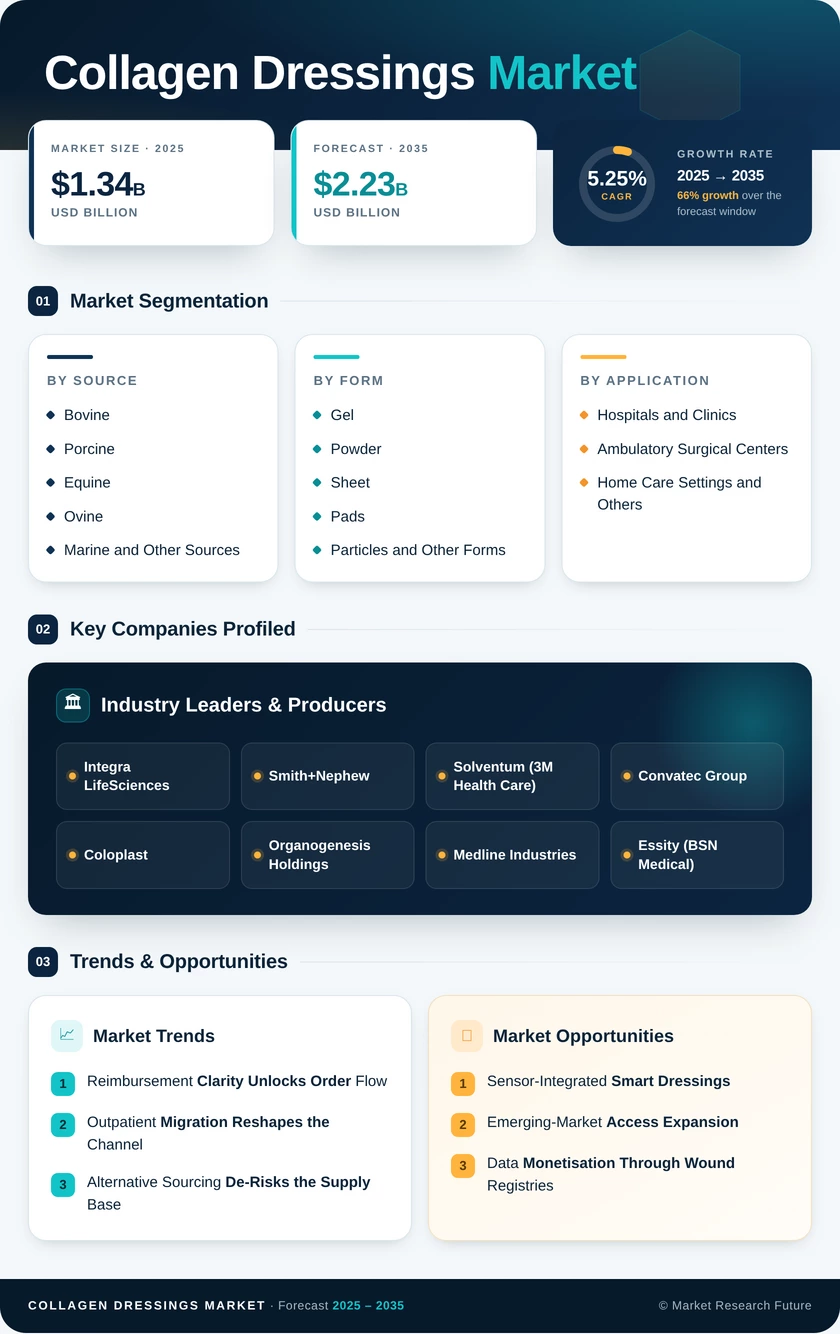
Segmentation Quick Reference
| Dimension | Sub-Segments | Dominant Segment | Fastest Growing Segment |
| By Source | Bovine; Porcine; Equine; Ovine, Marine and Other Sources | Bovine | Equine |
| By Form | Gel; Powder; Sheet; Pads, Particles and Other Forms | Gel | Sheet |
| By Application | Acute Wounds; Chronic Wounds | Acute Wounds | Chronic Wounds |
| By End User | Hospitals and Clinics; Ambulatory Surgical Centers; Home Care Settings and Others | Hospitals and Clinics | Ambulatory Surgical Centers |
| By Geography | North America; Europe; Asia-Pacific; South America; Middle East & Africa | North America | Asia-Pacific |
Market Segmentation Overview
By Source
| Sub-Segment | Key Trend |
| Bovine | Cost leadership sustained, but TSE documentation burden rising in Europe |
| Porcine | Structural similarity drives surgical preference where cultural constraints allow |
| Equine | Fastest expansion as manufacturers market negligible zoonotic risk |
| Ovine, Marine and Other Sources | Marine peptides gain traction in cosmetic-adjacent and halal-sensitive markets |
Species choice is increasingly a regulatory and cultural decision rather than a purely technical one. Manufacturers maintaining two or more source lines carry higher inventory costs but win tenders that single-source competitors cannot enter.
By Form
| Sub-Segment | Key Trend |
| Gel | Preferred for tunnelling and undermined wounds requiring full contact |
| Powder | Retains niche strength in deep cavity and irregular defects |
| Sheet | Growth leader on handling simplicity and predictable dosing |
| Pads, Particles and Other Forms | Antimicrobial and absorbent composites broaden the construct set |
Form innovation now happens at the composite level, combining collagen with alginate, silver or oxidised regenerated cellulose. These hybrids blur traditional category lines and complicate like-for-like tender comparison.
By Application
| Sub-Segment | Key Trend |
| Acute Wounds | Surgical and burn volumes deliver stable, forecastable baseline demand |
| Chronic Wounds | Diabetic foot and venous ulcers drive the highest incremental spend per patient |
Chronic indications attract disproportionate R&D because episode length multiplies product consumption. Trial design has shifted toward 12-week closure endpoints that payers explicitly recognise.
By End User
| Sub-Segment | Key Trend |
| Hospitals and Clinics | Volume anchor, but growth is flattening as procedures shift outward |
| Ambulatory Surgical Centers | Fastest-growing channel, favouring simple application protocols |
| Home Care Settings and Others | Expansion gated by trained community nursing capacity, not product supply |
Channel economics diverge sharply. Hospital contracts reward breadth and price; ambulatory and home settings reward ease of use and packaging designed for single application.